
Here’s a fact that surprises many people: Japan has some of the strictest teen labor laws in the developed world — yet 16-year-olds can absolutely work there.
The key is knowing exactly what the rules are, because the legal framework is more nuanced than a simple yes or no.
Whether you’re a teenager living in Japan, a foreign student, or a parent trying to understand the system, this guide breaks down everything you need to know about getting a job in Japan at 16.
We’ll cover the Labor Standards Act, what jobs are available, what’s off-limits, working hours, pay rates, and the important differences between Japanese nationals and foreign residents.
What Does Japanese Law Say About the Minimum Working Age?
Japan’s employment rules for minors are governed by the Labor Standards Act (労働基準法), and the minimum working age is set at 15 years old — with an important catch.
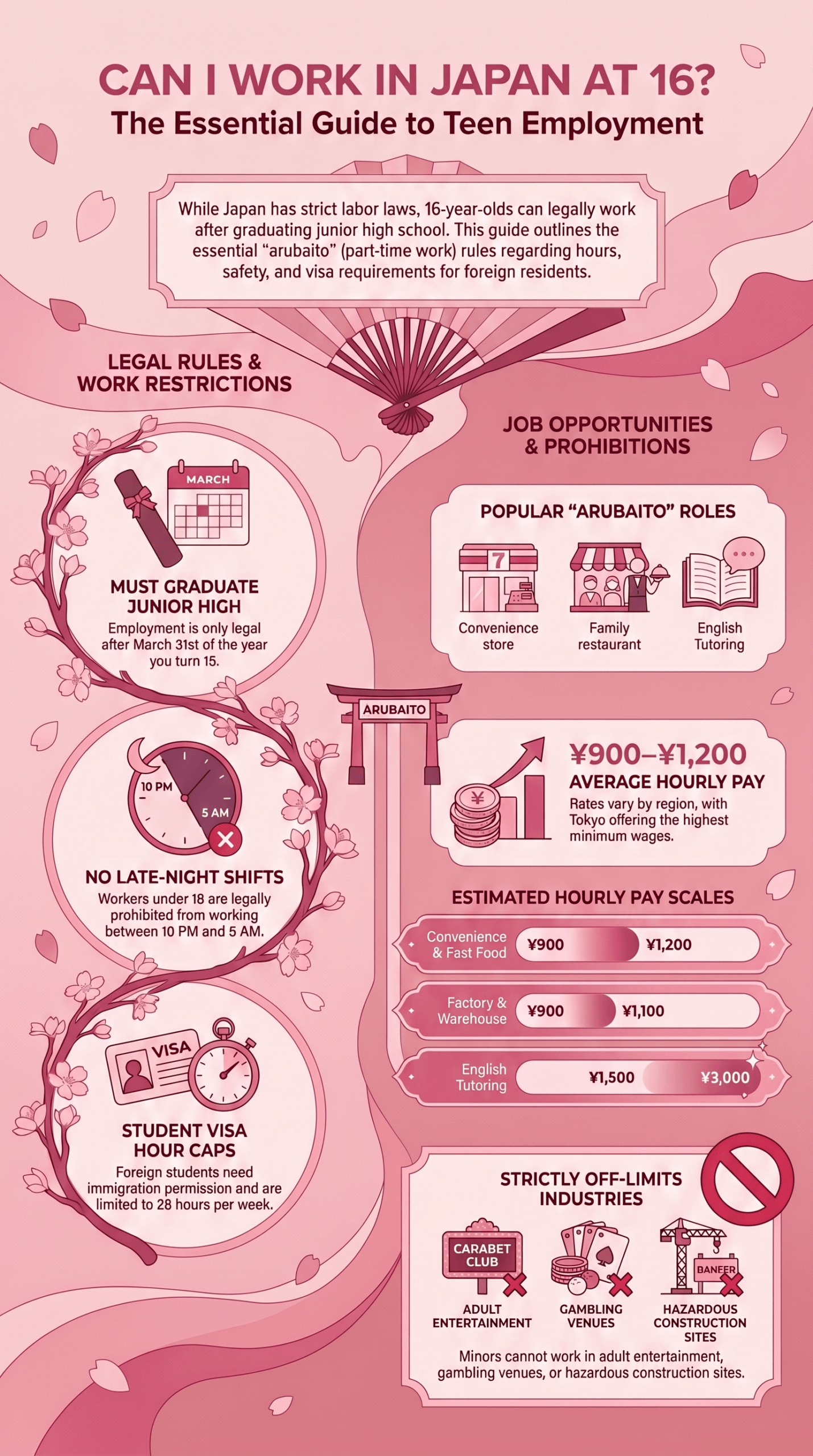
Specifically, the law states that an employer may not hire a child until March 31 of the fiscal year in which they turn 15. In Japan’s school system, junior high school graduation happens at the end of March.
This means that in practice, even a 15-year-old who is still in junior high school cannot legally be hired for a part-time job. The law effectively blocks employment for all junior high students, regardless of their exact birth date.
Once a student graduates junior high and enters high school — typically at age 15 or 16 — the situation changes significantly. Part-time work, known in Japanese as arubaito (アルバイト) or simply baito, becomes legally permissible.
So for a 16-year-old in Japan, the answer is clear: yes, you can legally get a job. A 16-year-old is almost certainly in high school, well past the March 31 threshold, and fully eligible to work under the Labor Standards Act — subject to specific restrictions designed to protect young workers.
Also Read: How Can You Get A Job In Japan? & How Can You Work In Japan?
Key Work Restrictions for 16-Year-Olds in Japan
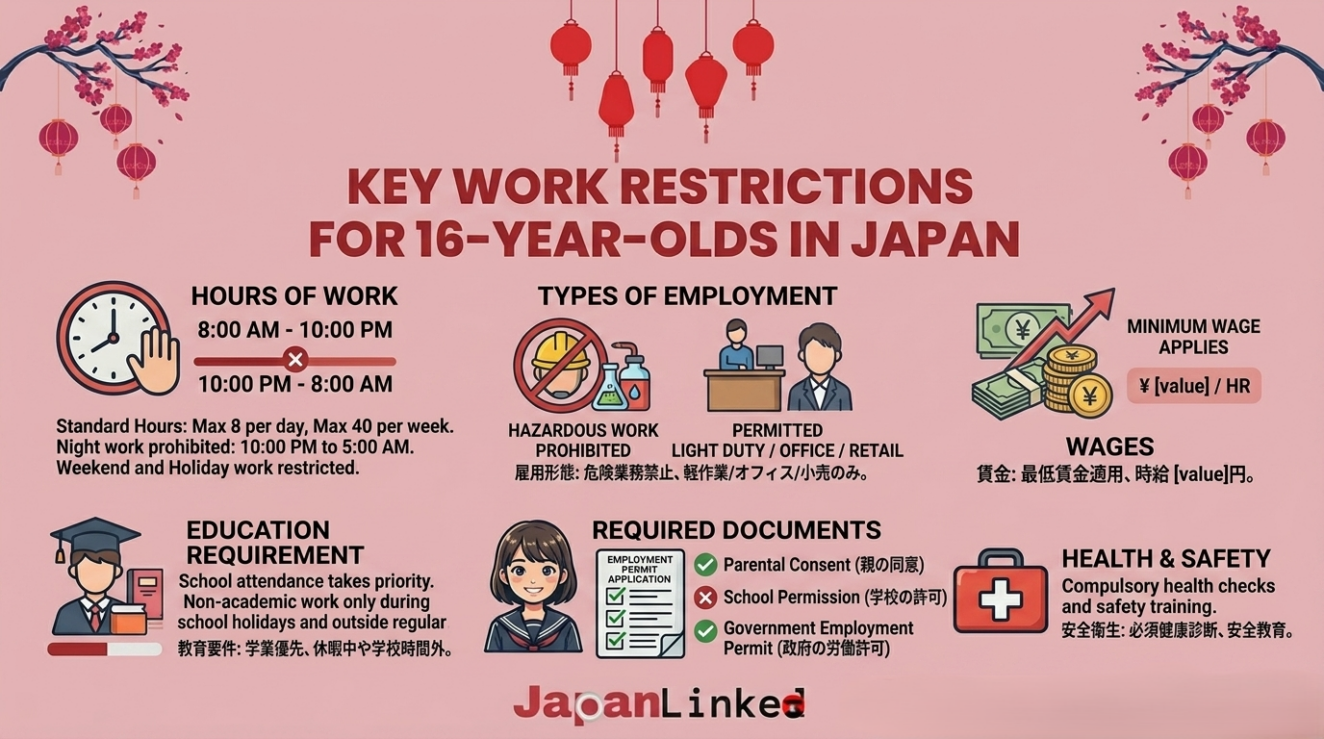
Just because you can work at 16 doesn’t mean there are no rules. Japan’s Labor Standards Act includes a carefully structured set of protections for workers under 18. Here’s what every 16-year-old (and their parents) needs to know.
No Late-Night Work
Young people under 18 are not allowed to work between 22:00 (10 PM) and 05:00 (5 AM). This is a hard legal restriction — employers who schedule minors for late-night shifts are violating the law.
For most part-time jobs like convenience stores and restaurants, this means 16-year-olds can work evening shifts but must clock out before 10 PM.
No Hazardous or Dangerous Work
The Labor Standards Act strictly prohibits the employment of workers under 18 in dangerous conditions. Off-limits work includes:
- Heavy machinery operation
- Chemical handling and industrial manufacturing
- Mining and construction
- Any form of adult entertainment (clubs, hostess bars, pachinko parlors)
- Work that poses a serious physical risk
This prohibition isn’t just guidance — it’s enforceable law, and employers who put minors in these situations face legal penalties.
Working Hours
For high school students who are Japanese nationals or dependent visa holders, working hours are governed by the standard Labor Standards Act rules: up to 8 hours per day and 40 hours per week.
Many high schools also set their own internal policies requiring students to get parental consent and notify the school before taking a part-time job.
Parental Consent
While not always mandated under national law, most Japanese high schools require students to obtain parental consent and submit a notification to the school before starting arubaito.
This is partly cultural and partly an institutional rule — schools in Japan take an active interest in students’ lives outside the classroom.
Working Rules for Foreign 16-Year-Olds in Japan
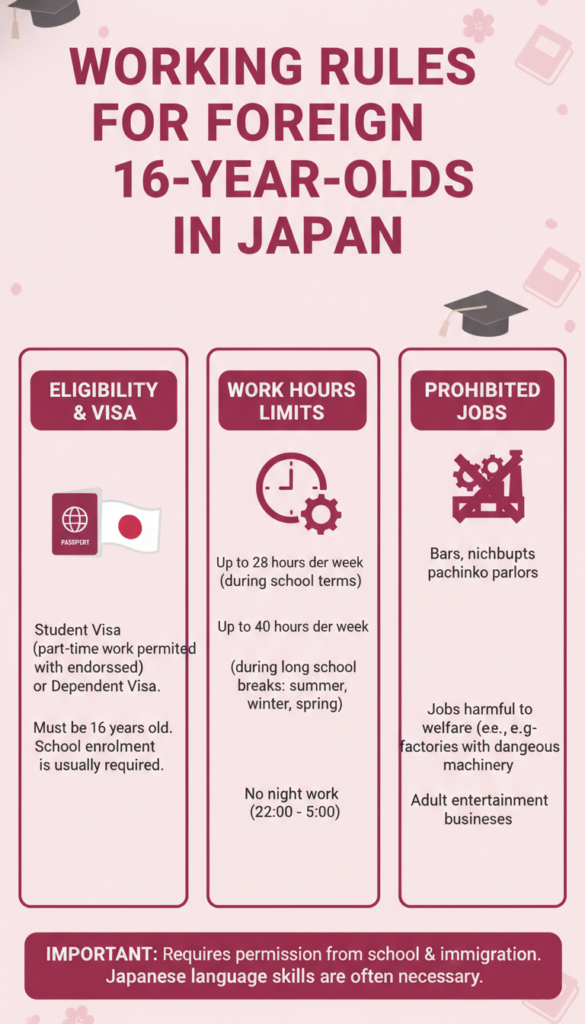
If you’re a foreign teenager living in Japan, there’s an additional layer to the rules: your visa status matters enormously.
On a Dependent Visa (Parent’s Work or Spouse Visa)
If you’re in Japan on a dependent visa attached to a parent’s work or spouse visa, you are not subject to separate work restrictions based on your student status.
The standard Labor Standards Act age requirements apply — meaning a 16-year-old on a dependent visa can generally work part-time, subject to the same restrictions as Japanese students.
On a Student Visa
If you hold your own student visa, things are more regulated. You must apply for “Permission to Engage in Activity Other Than That Permitted Under Status of Residence” (資格外活動許可 / shikakugai-katsudokyoka) from the nearest Regional Immigration Services Bureau before starting any paid work.
Without this permission, working is illegal and can jeopardize your visa status — or even result in deportation.
Once you have permission, foreign student visa holders are typically limited to:
- 28 hours per week during school terms
- Up to 8 hours per day and 40 hours per week during official long school holidays
This rule applies regardless of age — whether you’re 16, 18, or 22. If you’re in Japan on a student visa, the 28-hour cap is your reality during term time.
What Jobs Can 16-Year-Olds Do in Japan?
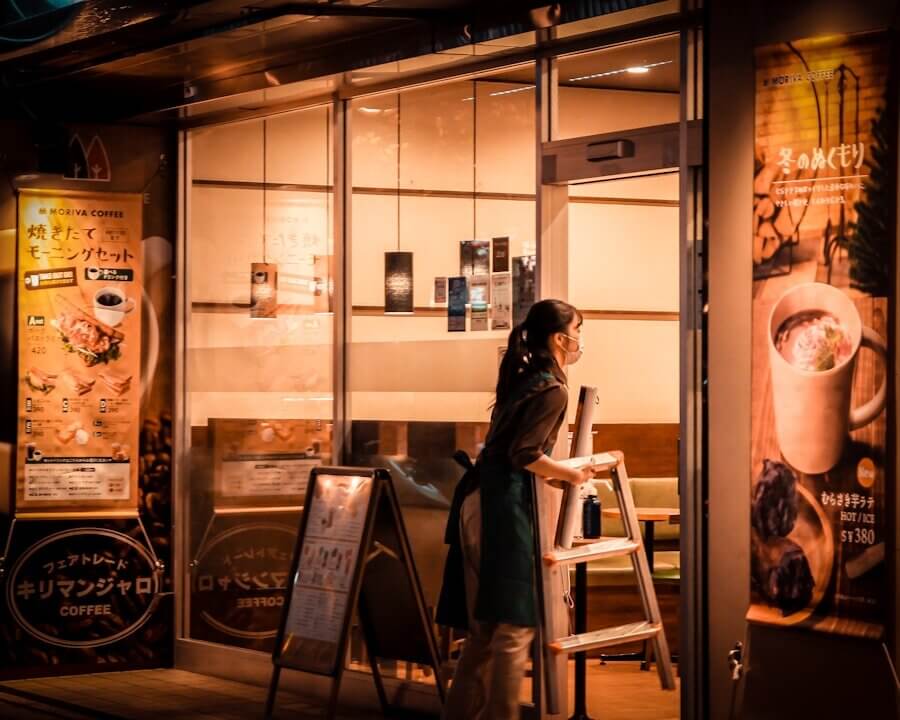
The good news? There are plenty of accessible jobs for 16-year-olds in Japan. The service sector is the most common entry point, and Japan’s labor shortage — driven by its aging population — means employers are genuinely looking for part-time help.
Convenience Stores (Konbini)
Working at a konbini like 7-Eleven, Lawson, or FamilyMart is probably the most classic arubaito for teens in Japan. These jobs involve operating the cash register, stocking shelves, preparing food, and assisting customers.
Pay typically ranges from ¥900 to ¥1,050 per hour depending on the region, with higher rates in metropolitan areas like Tokyo.
Japanese language skills are important here — you’ll be interacting with customers constantly and handling transactions. If your Japanese is solid, konbini work is one of the easiest entry-level jobs to find.
Family Restaurants and Fast Food
Japan has a huge family restaurant (ファミレス) culture, with chains like Gusto, Denny’s Japan, and Royal Host always looking for floor and kitchen staff. Fast food chains — McDonald’s, MOS Burger, and KFC — are also popular employers of high school students.
Kitchen positions require less Japanese than front-of-house roles, making them more accessible to foreign students still building their language skills. Pay is similar to konbini work, roughly ¥900 to ¥1,200 per hour.
Retail and Shopping Centers
Department stores, clothing shops, and specialty retail stores often hire high school students for weekends and holiday periods.
While some positions require a high level of Japanese for customer service, others like stocking and inventory are more straightforward.
Tutoring and English Teaching
For foreign students with strong English skills, teaching English to children or younger students is one of the best-paying arubaito options.
English conversation schools (eikaiwas) and private tutoring can pay ¥1,500 to ¥3,000 per hour — significantly more than service sector work. It’s flexible, lower-stress, and builds a genuine skill.
Delivery Services
With the rise of Uber Eats and Demae-can, food delivery has become a popular and flexible option. You set your own hours, which suits students with unpredictable school schedules.
Keep in mind that some delivery platforms may have their own minimum age requirements of 18, so always check before applying.
Factory and Warehouse Work
Light factory or warehouse work — packaging, sorting, assembly — is available and often requires minimal Japanese. These jobs are more physically demanding but pay steadily and don’t require much customer interaction.
What Jobs Are Strictly Off-Limits?
Some industries are legally prohibited for anyone under 18, and others are specifically banned for those on student visas. Know what to avoid:
- Adult entertainment businesses: Host/hostess clubs, cabaret clubs, certain bars, and similar establishments are strictly off-limits for minors under 18 — this is enshrined in law, not just policy.
- Pachinko parlors: These gambling-adjacent amusement venues prohibit entry to anyone under 18.
- Nightclubs and late-night bars: Between the no-night-work rule and the nature of these businesses, they are not viable for 16-year-olds.
- Hazardous industries: Construction, chemical handling, mining, and heavy machinery are legally prohibited for workers under 18.
For foreign students on student visas, violating these restrictions isn’t just an employment issue — it can trigger visa cancellation or deportation. Every year, international students are forced to leave Japan because of work-related visa violations.
How Much Can a 16-Year-Old Earn in Japan?
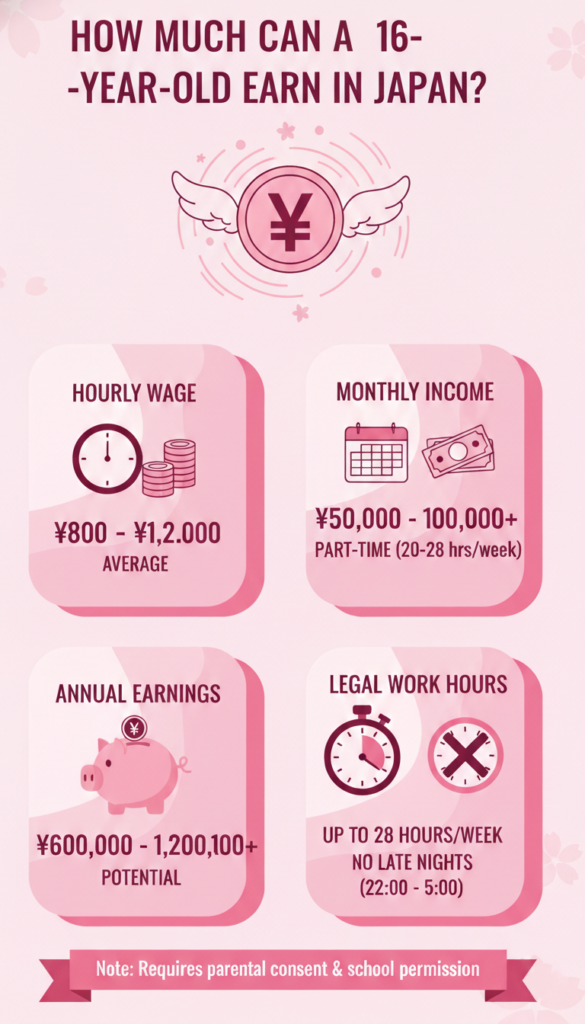
Pay for part-time work in Japan is determined by prefectural minimum wages, which vary across the country. In Tokyo, the minimum wage was raised to ¥1,163 per hour in 2024, while rural prefectures may be closer to ¥850–¥900 per hour.
To put this in perspective:
- A student working 20 hours per week at ¥1,000/hr earns around ¥80,000 per month (roughly $530 USD).
- Japan’s official survey of privately financed international students found that the average monthly earnings from part-time work is approximately ¥81,000 — enough to cover day-to-day expenses but not full tuition and rent.
This is worth being realistic about: arubaito income can meaningfully supplement living costs, but it won’t cover everything.
Japan’s cost of living in cities like Tokyo is high, and over-reliance on part-time work often leads students to neglect their studies — a common reason why foreign students fail to extend their visas.
Cultural Context: How Japan Views Teen Employment
Japan’s approach to teen work is culturally distinct from many Western countries. In the United States or UK, teenagers holding after-school jobs is considered a normal part of growing up — a rite of passage for financial independence.
In Japan, this mindset is largely reserved for high school and university students, not middle schoolers.
For high school students, arubaito is widely accepted and common — but Japanese schools maintain significant oversight.
Many schools require formal approval, set rules about how many hours students can work per week, and some even prohibit working during exam periods. The cultural expectation is that academic performance remains the priority.
For foreign teens, integrating into the Japanese part-time work culture is also a genuinely valuable experience.
Learning to navigate Japanese work customs — punctuality, attention to customer service (omotenashi), teamwork culture — builds both language ability and cultural fluency in a way that no classroom can replicate.
How to Actually Find a Job in Japan at 16
Ready to start looking? Here’s a practical roadmap:
- Check your visa status first: If you’re on a student visa, apply for work permission from the immigration bureau before doing anything else.
- Get parental consent: If your school requires it (most do), sort this out before applying anywhere.
- Prepare a resume (履歴書): Japanese job applications use a standard résumé format called a rirekisho, which can be bought at convenience stores or 100-yen shops. Fill it out carefully — many employers still prefer handwritten applications.
- Check job boards: Sites like GaijinPot, Baitoru, and Townwork list student-friendly part-time jobs. For English-friendly positions, GaijinPot Jobs is particularly useful.
- Walk-in applications: For convenience stores, restaurants, and retail stores, you can often pick up a job posting flyer or ask at the counter. Many small businesses in Japan still hire through in-person inquiries rather than online portals.
- Leverage your school: Many schools and universities maintain relationships with local employers and can refer students to trusted arubaito opportunities.
Conclusion
Yes, 16-year-olds can absolutely get a job in Japan — and for most teens in Japan, whether Japanese or foreign, arubaito is a totally normal and achievable part of high school life.
The legal framework under Japan’s Labor Standards Act protects young workers with sensible restrictions: no late-night work, no dangerous industries, and proper hour caps to keep studies front and center.
The path is a little more complex for foreign students on student visas, who need immigration permission before working and must stay within the 28-hour weekly cap.
But with the right preparation, a part-time job in Japan is well within reach at 16 — and it’s one of the best ways to build language skills, earn money, and experience Japanese working culture firsthand.
