
Two weeks in Japan sounds like a lot – until you land in Tokyo and realize you could spend the entire fortnight in a single neighborhood and still miss half of it.
Here’s the honest truth: 14 days in Japan is genuinely enough to see the country’s greatest hits and feel like you actually experienced something.
Not rushed, not surface-level, but properly immersed. The trick is choosing a route that flows naturally, building in breathing room, and resisting the urge to cram in one more city “just because.”
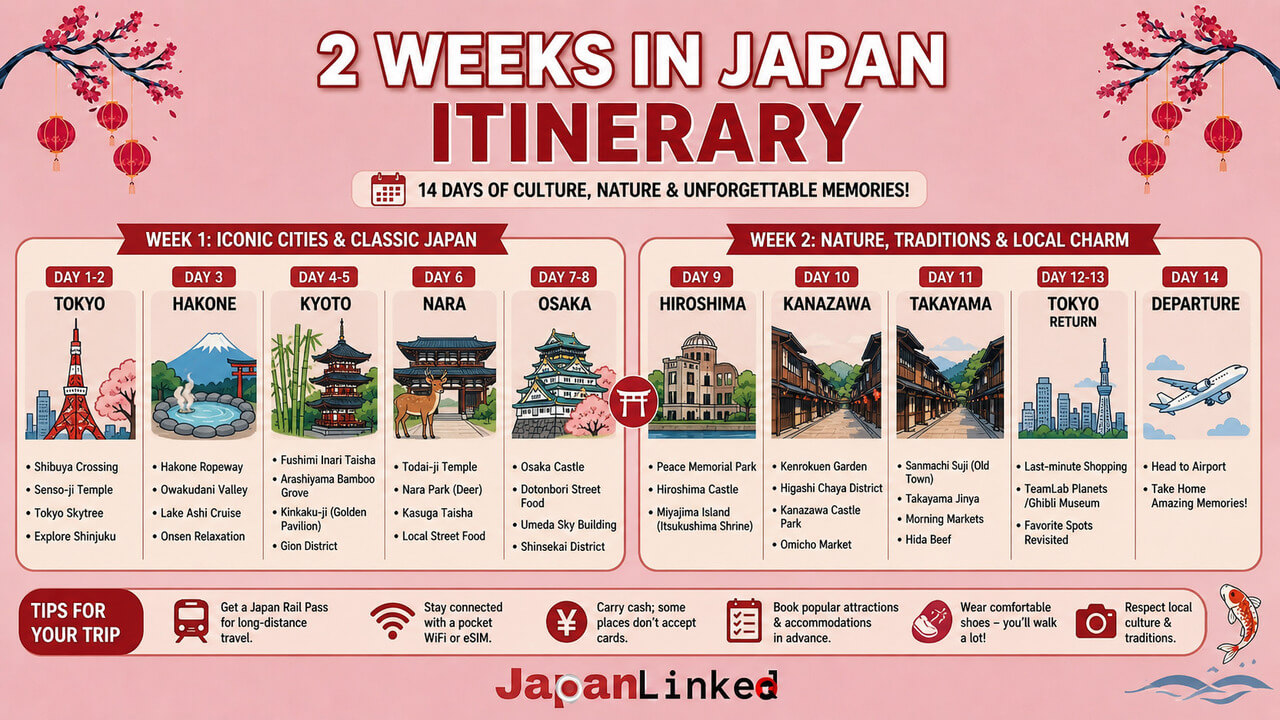
This 2-week Japan itinerary is designed for first-time visitors who want the classics done right – with a couple of smart additions that separate a memorable trip from a generic one.
It follows a west-to-east route from Tokyo through the cultural heartland to Osaka, eliminating backtracking and making the most of Japan’s extraordinary rail system.
By the end of 14 days, you’ll have seen Tokyo’s electric chaos, soaked in an onsen at the foot of Mount Fuji, walked through a thousand red torii gates at dawn, stayed in a 1,200-year-old Buddhist mountain village, and eaten your way across the country’s food capital.
Let’s get into it.
Planning Your 2-Week Japan Trip: The Basics
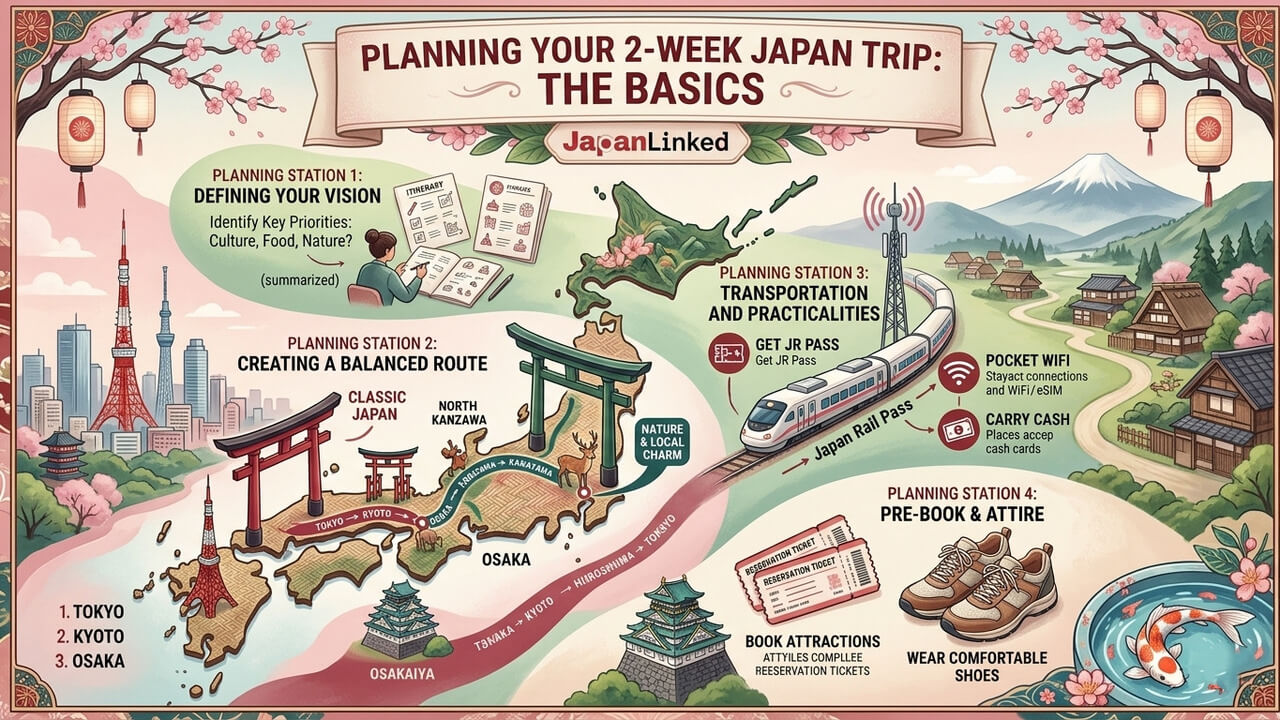
Before diving into the day-by-day breakdown, a few logistics worth knowing upfront.
The JR Pass Question
It’s the most debated topic in Japan travel, and the answer is genuinely nuanced. The 14-day Japan Rail Pass currently costs ¥80,000 (~$530 USD).
For this specific itinerary – Tokyo, Hakone/Fuji area, Kyoto, Hiroshima/Miyajima, and Osaka – buying individual Shinkansen tickets often works out cheaper than the pass.
The math gets more interesting when you add day trips. A side trip from Kyoto to Himeji Castle costs ¥5,940 round trip. Hiroshima from Osaka is another ¥11,000 round trip.
Stack enough of those and the pass starts to make sense – especially since it also removes the friction of buying tickets at every station.
Bottom line: Calculate your specific route using the Japan Guide Rail Pass Calculator before purchasing. And if you do buy one, don’t activate it on Day 1 if you’re spending the first days in Tokyo – you’ll mostly be using the subway there, which the JR Pass doesn’t cover. Activate right before your first Shinkansen journey.
Getting Around Cities: IC Cards
Get a Suica or Pasmo card as soon as you arrive. These rechargeable transit cards work on subways, buses, JR local trains, and even at convenience stores across the country. Load ¥5,000–10,000 and top up as needed – they make city transit effortless.
Money
Japan is still largely a cash society. Withdraw yen from 7-Eleven or Japan Post ATMs (they reliably work with foreign cards).
For context, a mid-range daily budget runs roughly ¥20,000–35,000 (~$130–230 USD) covering accommodation, food, transport within cities, and admission fees. The weak yen makes Japan significantly more affordable than it’s been in years.
The 2-Week Japan Itinerary: Day-by-Day
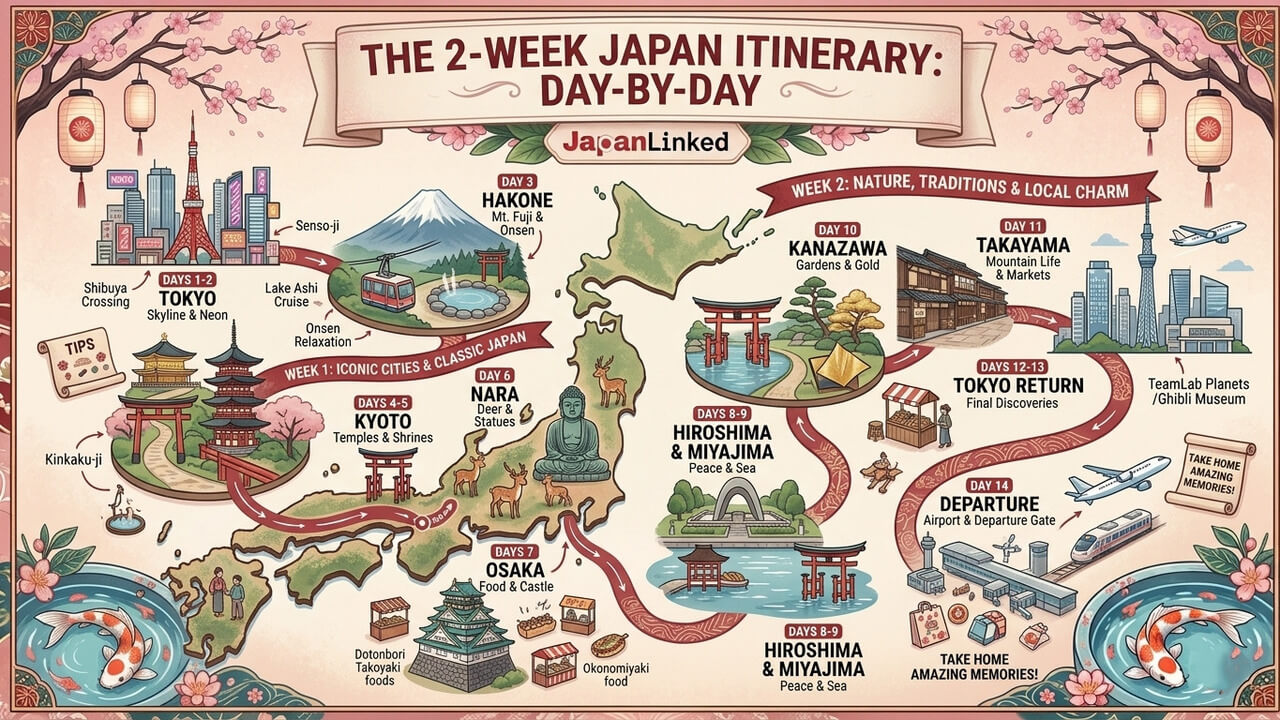
Days 1–4: Tokyo (4 nights)
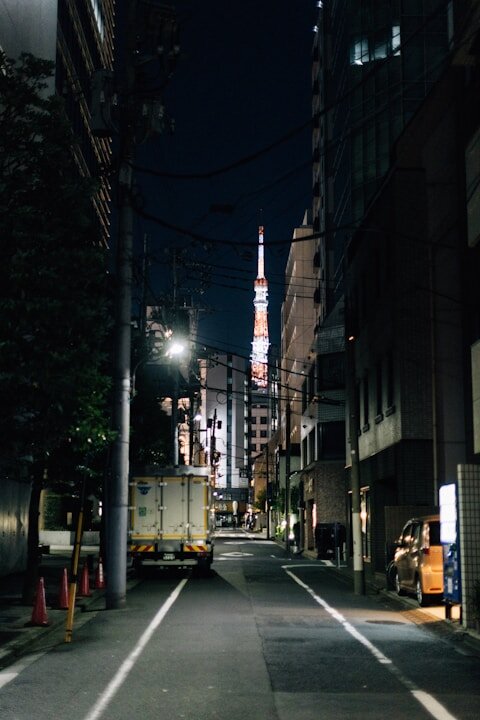
Where to base: Shinjuku or Asakusa for easy access to both old and new Tokyo.
Tokyo is the world’s most populated city and somehow also one of its most navigable. Four days gives you enough time to move through its wildly different neighborhoods without feeling like you’re sprinting.
Day 1–2: Classic Tokyo
- Morning, Tsukiji Outer Market — Most of Tokyo is asleep until 8 AM. The old outer market opens from 5–6 AM and it’s the perfect cure for jet lag: fresh sushi for breakfast, vendors shouting, steam rising from grills. Walk it slowly
- Asakusa and Senso-ji Temple — Tokyo’s oldest temple. Arrive before 8 AM to have the famous Kaminarimon gate almost to yourself. The Nakamise Dori shopping street fills up by mid-morning, so browse early
- Akihabara — Cross the river in the afternoon. Even if electronics aren’t your thing, the layered, neon-drenched energy is unlike anywhere on earth
- Shibuya Crossing at night — Go before 9 AM or after 10 PM for photos without fighting through 500 tourists
Day 3: Neighborhoods and Views
- Shimokitazawa for vintage boutiques and independent cafés – this is the neighborhood local Tokyo loves most, a deliberate replacement for the now-crowded Harajuku
- Shibuya Sky observation deck — book 2–3 weeks in advance on Klook; time slots around sunset sell out months ahead
- Shinjuku for dinner — Omoide Yokocho (Memory Lane) is a tight alley of yakitori stalls and salarymen that feels completely unchanged from decades ago
Day 4: Day Trip to Kamakura or Nikko
- Kamakura (1 hour south of Tokyo) — seaside town with the famous Great Buddha statue, bamboo paths, and hillside shrines. Excellent for a half-day wander
- Nikko (2 hours north) — Japan’s most ornate shrine complex, surrounded by mountain forest. Go if you want something dramatic and slightly off the usual tourist circuit
Pre-book before you go: teamLab Planets (digital art museum in Toyosu), Ghibli Museum in Mitaka (tickets released on the 10th of each month for the following month — set a reminder and be fast), and Tokyo DisneySea if relevant. These sell out weeks or months ahead.
Days 5–6: Hakone & Mount Fuji (2 nights)
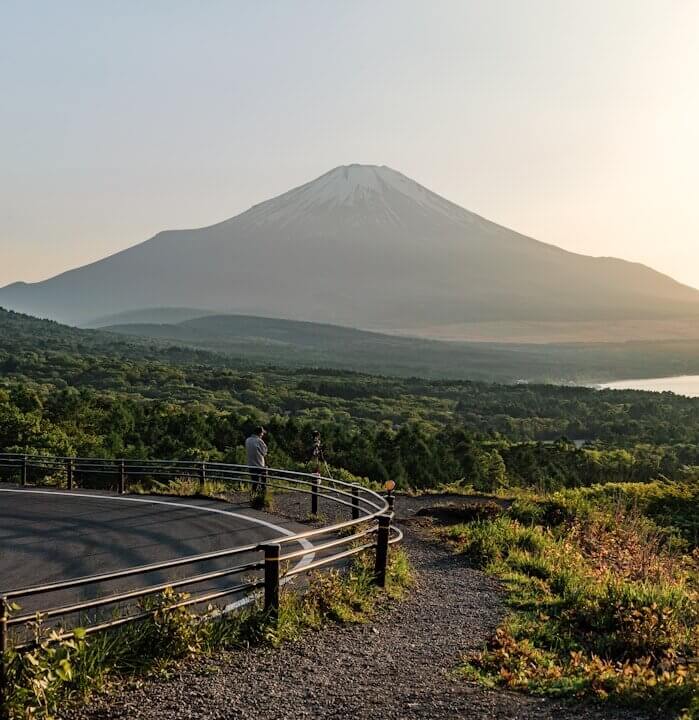
How to get there: Romancecar express from Shinjuku, about 85 minutes. Or Shinkansen to Odawara, then local train.
Hakone is the natural decompression valve between Tokyo’s intensity and Kyoto’s culture. It’s a mountain resort area built around volcanic hot springs, Lake Ashi, and arguably Japan’s best accessible views of Mount Fuji.
The famous Hakone Round Course strings together a chain of transport types — mountain railway, cable car, ropeway over active volcanic vents, boat cruise across Lake Ashi, bus back to base — into one of the most scenically satisfying days in the country.
- Hakone Open-Air Museum — a hilltop sculpture park with a permanent Picasso collection and incredible mountain views. Allow at least 2 hours
- Onsen — book a ryokan with an outdoor hot spring bath for at least one night. This is the ideal introduction to the ritual if you haven’t experienced it before
- Lake Kawaguchiko (optional) — if you want the classic postcard of Mount Fuji reflected in still water, add a night at Kawaguchiko. Cloud cover is the enemy; check forecasts and stay flexible
Practical tip: Get the Hakone Freepass (¥5,000–6,000 depending on your origin), which covers all transport on the round course plus some attractions. It pays for itself in half a day.
Days 7–9: Kyoto (3 nights)
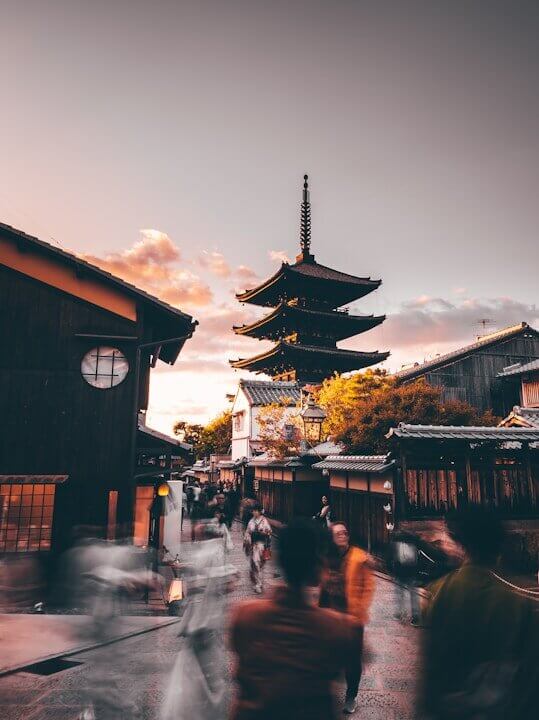
How to get there: Shinkansen from Odawara or Mishima to Kyoto, about 2.5–3 hours.
If you had to choose a single city to represent Japan — the temples, the bamboo, the tea ceremonies, the geisha — it would be Kyoto. Three nights here is the baseline; four would be better, but three is enough to hit the essential experiences without feeling rushed.
Day 7: Eastern Kyoto
- Fushimi Inari Shrine — the famous tunnel of 10,000 red torii gates. This is non-negotiable. Leave your accommodation by 6:30 AM. At that hour, you’ll share the lower gates with maybe a handful of people instead of thousands
- Kiyomizudera Temple — built into a forested hillside with a wooden stage that juts out over the valley. Late afternoon light here is beautiful
- Higashiyama District — wander the preserved stone-paved lanes connecting these temples. This is exactly the Japan you imagined
Day 8: Arashiyama + Philosopher’s Path
- Arashiyama Bamboo Grove — again, the only way to experience this is at dawn (before 7 AM). It’s the most-photographed spot in Kyoto for a reason, but by 9 AM it’s gridlocked with selfie sticks
- Tenryu-ji Temple Garden — a masterpiece of Zen garden design with a pond perfectly framed by borrowed scenery from the surrounding mountains
- Philosopher’s Path (Tetsugaku-no-Michi) — a 2 km canal walk lined with cherry trees (spectacularly beautiful in spring) connecting several small temples. An excellent afternoon slow walk
Day 9: Nijo Castle, Gion, and Day Trip Options
- Nijo Castle — the former Kyoto residence of the Tokugawa shoguns, famous for its “nightingale floors” engineered to squeak underfoot as a security measure against intruders. Genuinely one of the most interesting castle interiors in Japan
- Gion District at dusk — Kyoto’s geisha neighborhood. Walk the Hanamikoji-dori street between 5–8 PM; this is when you’re most likely to spot a maiko or geisha moving between appointments
- Day trip option: Nara — just 45 minutes by express train and one of Japan’s most essential experiences. Hundreds of freely roaming deer, the towering Todai-ji Temple (housing Japan’s largest bronze Buddha), and a genuinely relaxed pace
Don’t miss: A traditional matcha tea ceremony. Many are bookable online for ¥1,500–3,500 and take about an hour. The ones in Higashiyama are especially atmospheric.
Day 10: Koyasan – The Hidden Gem of This Itinerary
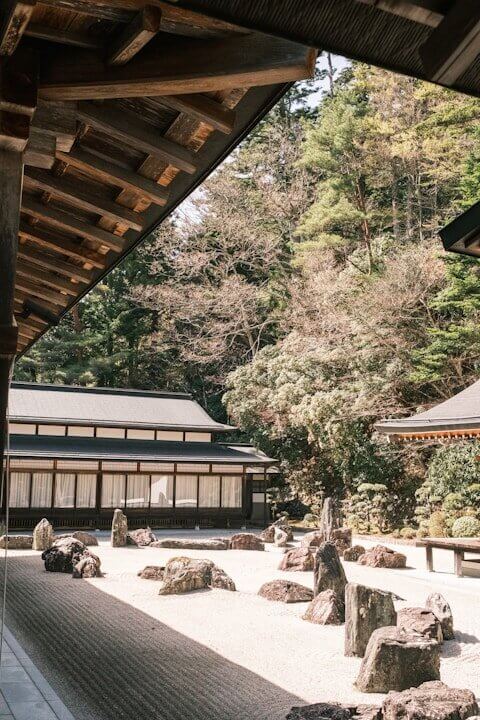
How to get there: JR from Kyoto to Osaka, then Nankai Koya Line to Gokurakubashi, then cable car up the mountain. About 3–3.5 hours total. (Note: Koyasan requires a separate World Heritage Ticket — the JR Pass is not valid on the Nankai Line.)
Most 2-week Japan itineraries skip Koyasan. That is a mistake.
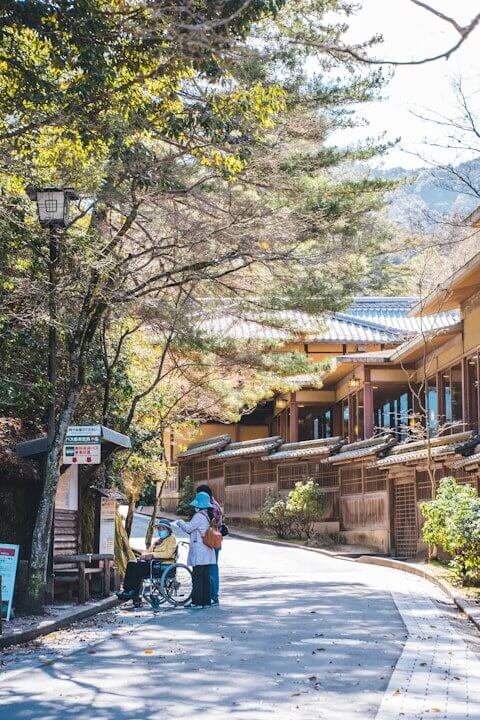
Mount Koya is a sacred mountain town that has been the headquarters of Shingon Buddhism for over 1,200 years, founded by the monk Kobo Daishi in 816 CE.
About 50 temples and monasteries line a forested plateau 800 metres above sea level. The town has fewer than 4,000 permanent residents.
The contrast with Tokyo is staggering. The reason to come here isn’t just sightseeing – it’s shukubo: temple lodging.
You sleep in a tatami room, wear a yukata, eat elaborate shojin ryori (Buddhist vegetarian cuisine served course by course), and wake at 6 AM for morning prayer with monks chanting in the main hall.
Ekoin Temple offers this experience from around ¥12,000 per person including dinner and breakfast, and adds a guided nighttime tour of Okunoin Cemetery – 200,000 tombstones lining a 2 km path through ancient cedar forest, lit by lanterns. It’s genuinely one of the most affecting experiences available in Japan.
- Okunoin Cemetery — the most sacred site on Koyasan and one of the most atmospheric places in the country
- Kongobuji Temple — the head temple of Shingon Buddhism with Japan’s largest rock garden
- Danjo Garan — a complex of vermillion temples and pagodas that have stood since the 9th century
Even if you only stay one night, Koyasan repays every effort it takes to get there.
Days 11–12: Osaka (2 nights, with day trips)
How to get there: Nankai Line back to Osaka, about 1.5 hours from Koyasan.
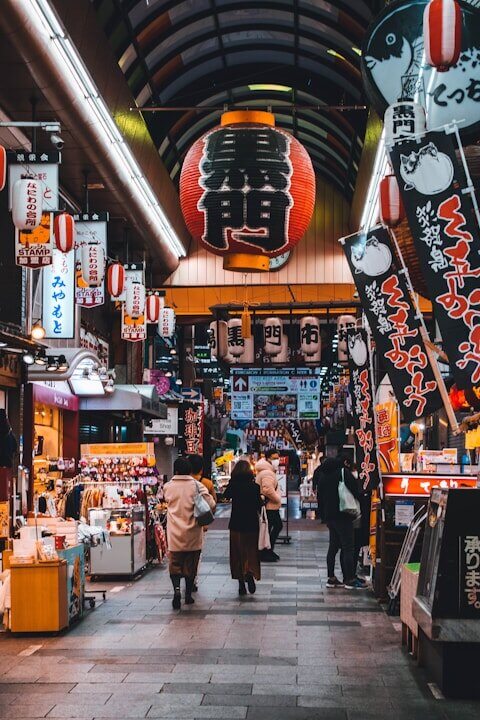
Osaka has one defining quality that separates it from everywhere else in Japan: it is unabashedly, joyfully obsessed with food.
The city even has a concept for it – kuidaore – which loosely translates to “eat until you drop.” Two nights here gives you the time to actually do that.
- Dotonbori — the neon-blazing entertainment district along the canal. Eat takoyaki (octopus balls), kushikatsu (deep-fried skewers you dip once only — double-dipping is a firm local rule), and fresh crab. This is dinner as theatre
- Kuromon Ichiba Market — Osaka’s two-century-old covered food market. Arrive hungry in the morning; vendors serve everything from fresh oysters to wagyu slices directly to you at the stall
- Shinsekai — old Osaka, retro and entirely unluxurious, with retro restaurants and sento (public bathhouses) that feel like a time capsule from 1960
- Day trip: Himeji Castle — only 30 minutes by Shinkansen. This is Japan’s finest surviving castle, a white-plastered UNESCO World Heritage masterpiece nicknamed “The White Heron” that towers above the city. Take the cable car up to Mount Shosha afterwards for a forested hilltop temple complex used as a filming location for The Last Samurai
Also worth considering from Osaka: Kobe (30 minutes, for wagyu beef and a charming harbor district) and Nara (40 minutes, if you skipped the day trip from Kyoto).
Days 13–14: Hiroshima & Miyajima (2 nights)
How to get there: Shinkansen from Osaka to Hiroshima, about 1.5 hours.
End your 2-week Japan itinerary here, and end it with weight.
Hiroshima was destroyed by the first atomic bomb in history on August 6, 1945.
What has been built in the decades since – the city, the Peace Memorial, the deliberate choice to preserve the ruins of the A-Bomb Dome directly beside a thriving modern city – is one of the most profound things you can witness as a traveler.
Day 13: Hiroshima
- Peace Memorial Park — go in the morning before the tour groups arrive. Budget at least 2 hours for the museum; it is deeply moving and not to be rushed
- Genbaku Dome (A-Bomb Dome) — the single building left standing near the hypocenter, preserved exactly as it stood after the blast. The contrast with the modern city around it is startling
- Okonomimura — a five-story building in central Hiroshima entirely dedicated to Hiroshima-style okonomiyaki. This version of the savory pancake layers noodles, cabbage, and pork in distinct levels — completely different from the Osaka style and, to many people, better
Day 14: Miyajima Island
- Take the JR Ferry (covered by the JR Pass) across to Miyajima Island – one of Japan’s three views of classical beauty
- The floating torii gate of Itsukushima Shrine: at high tide, the great vermillion gate stands in the sea. At low tide, you can walk right up to it. Check tide charts before you go; both are worth seeing for different reasons
- Hike Mount Misen (or take the ropeway) for panoramic views across the Seto Inland Sea — one of the most quietly beautiful landscapes in Japan
- The deer on Miyajima, while fewer and shyer than in Nara, roam freely around the shrines and streets
Most people visit Miyajima as a day trip from Hiroshima. If your flight allows, an overnight on the island transforms the experience — the shrine at dawn with no day-trippers is worth the extra night.
Practical Tips for Getting the Most Out of 2 Weeks in Japan
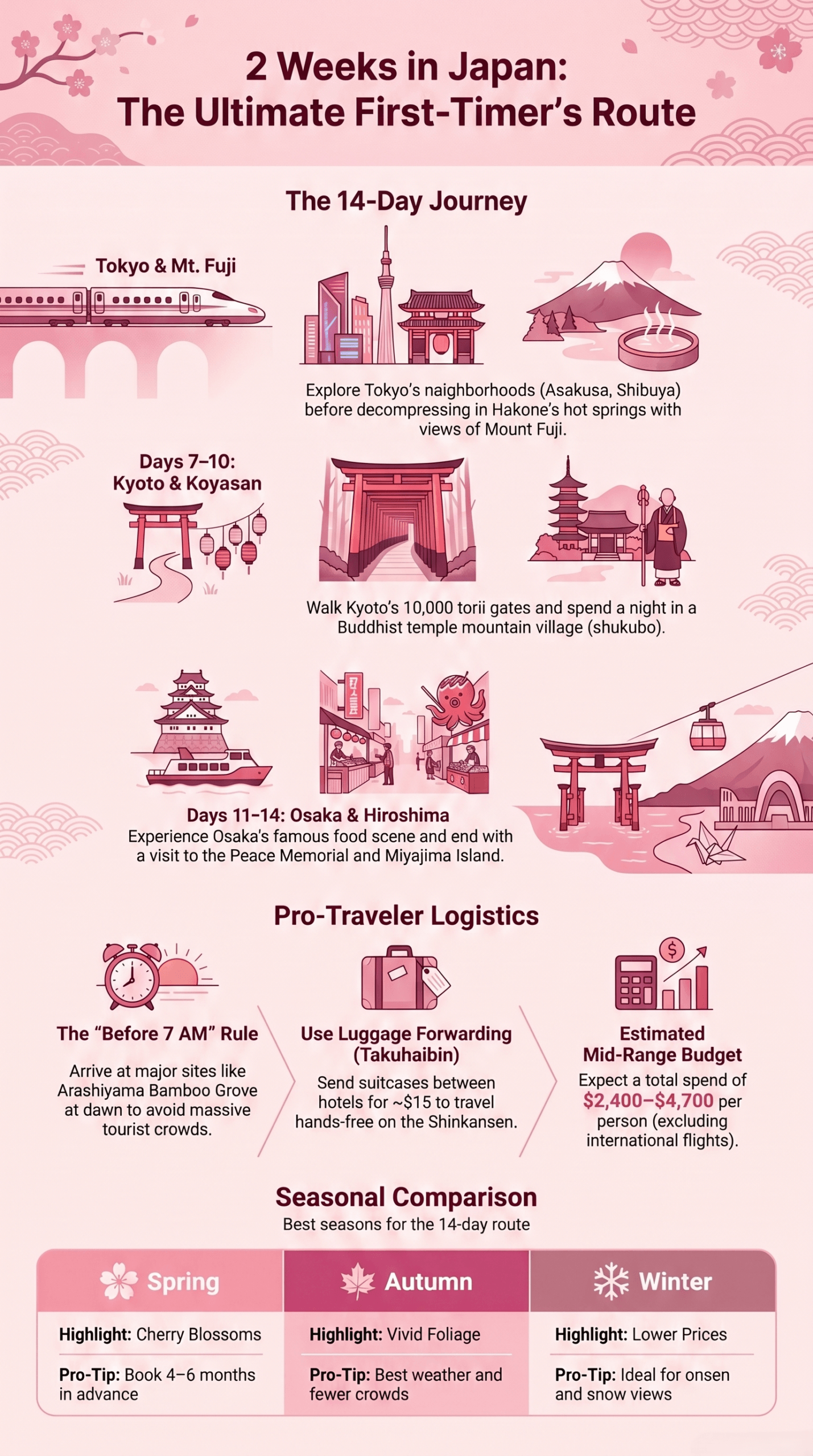
Use luggage forwarding (takuhaibin). For around ¥2,000 per bag, you can send your suitcase ahead to your next hotel and travel entirely hands-free on the Shinkansen. This is one of Japan’s best-kept secrets and one of its most civilized services.
Get up early, consistently. Japan’s most iconic spots — Fushimi Inari, Arashiyama Bamboo Grove, Senso-ji, the floating torii at Miyajima — are transformed by arriving before 7 AM. The difference between 6:30 and 9:00 AM at Fushimi Inari is the difference between a spiritual experience and a gridlock of selfie sticks.
Convenience stores are legitimate restaurants. 7-Eleven, FamilyMart, and Lawson serve genuinely good food — fresh onigiri, hot dishes, desserts — for ¥400–900 per meal. Budget travelers can eat multiple meals a day here without any sense of deprivation.
Book advance tickets now, not later. Some Japan experiences require booking months ahead: teamLab Planets, Ghibli Museum, popular kaiseki restaurants in Kyoto, and ryokans during cherry blossom season (late March–early April). Don’t leave these as “we’ll figure it out when we get there” items.
Download offline maps. Google Maps works brilliantly in Japan and supports offline mode. Download the map for each city you’ll visit before you go. Japanese addresses work differently from Western ones (they’re organized by block, not street), and even locals use navigation apps constantly.
Best Time for a 2-Week Japan Trip
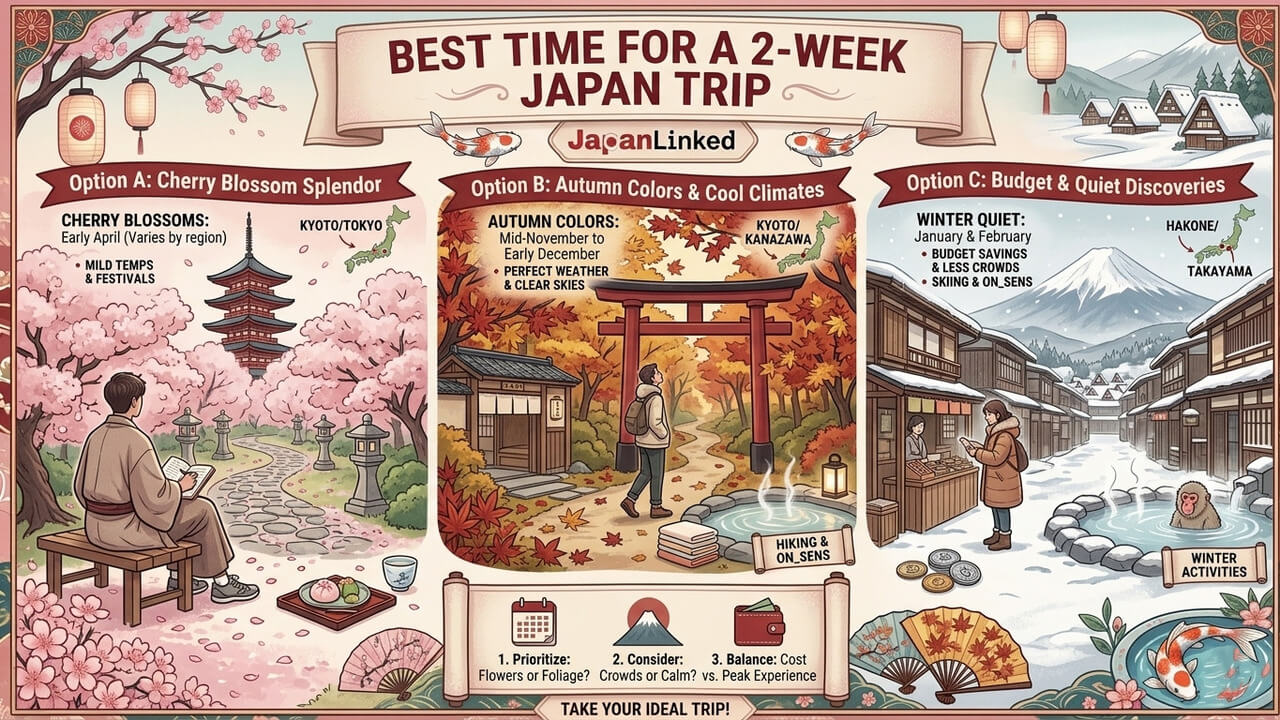
| Season | Highlights | Watch Out For |
|---|---|---|
| Spring (Mar–May) | Cherry blossoms, perfect weather | Extremely crowded; book 4–6 months ahead |
| Autumn (Oct–Nov) | Vivid foliage, comfortable temperatures | Popular but less intense than spring |
| Winter (Dec–Feb) | Far fewer tourists, lower prices, mountain snow | Cold; some days best spent indoors |
| Summer (Jun–Aug) | Festivals, fireworks, full access | Hot and humid; rainy season in June |
Autumn is the sweet spot for first-time visitors who want gorgeous scenery without the cherry blossom crush.
October through mid-November delivers crisp weather, blazing red and gold foliage across temple gardens, and noticeably more breathing room at popular sites.
If cherry blossoms are the whole point, go in late March or early April – just book everything as early as possible.
Sample Budget for 2 Weeks in Japan
| Category | Budget (USD) |
|---|---|
| International flights (round-trip) | $600–1,400 |
| Accommodation (14 nights, mid-range) | $900–1,700 |
| Transport (Shinkansen + local) | $350–600 |
| Food (14 days, mid-range) | $400–700 |
| Activities and entrance fees | $150–300 |
| Total mid-range estimate | $2,400–4,700 |
Budget travelers staying in hostels and capsule hotels can bring this closer to $1,800. Splurging on ryokans and kaiseki dinners will push it higher — and will be among the best money you’ve ever spent on a trip.
Conclusion
Two weeks in Japan is not a compromise. It’s a proper journey through one of the most rewarding countries on earth – enough time to let Tokyo’s layers reveal themselves.
You can understand why everyone who visits Kyoto starts planning their return before they’ve even left. Standing quietly in front of the A-Bomb Dome in Hiroshima, you can feel the weight of the world.
The itinerary above is designed to give you the iconic experiences that earned Japan its reputation, plus one or two decisions — Koyasan, Shimokitazawa, an overnight on Miyajima — that transform a good trip into an unforgettable one.
Start planning early, book the things that sell out, wake up before the crowds, and eat absolutely everything. Japan will exceed your expectations and then raise them.
