
Three weeks in Japan. It’s the magic number. Enough time to wander through Tokyo’s electric neighborhoods, sleep in a centuries-old ryokan, stand at the edge of Mount Fuji, and still have days left over to wander down a quiet Kyoto alleyway with no plan at all.
If you’re planning 3 weeks in Japan, you’ve made the right call. Japan is endlessly layered – every city hides something the last one doesn’t, every region has its own food, its own pace, its own version of beautiful.
A 21-day Japan itinerary gives you the space to actually feel a place rather than just photograph it and move on.
This guide breaks down an optimised, realistic route that balances Japan’s iconic highlights with moments of genuine discovery – without burning yourself out in the process.
Why Three Weeks Is the Perfect Length for Japan
Two weeks in Japan is doable. One week is a sprint. But 21 days in Japan is the sweet spot for slowing down, making unexpected detours, and actually absorbing what you’re seeing.
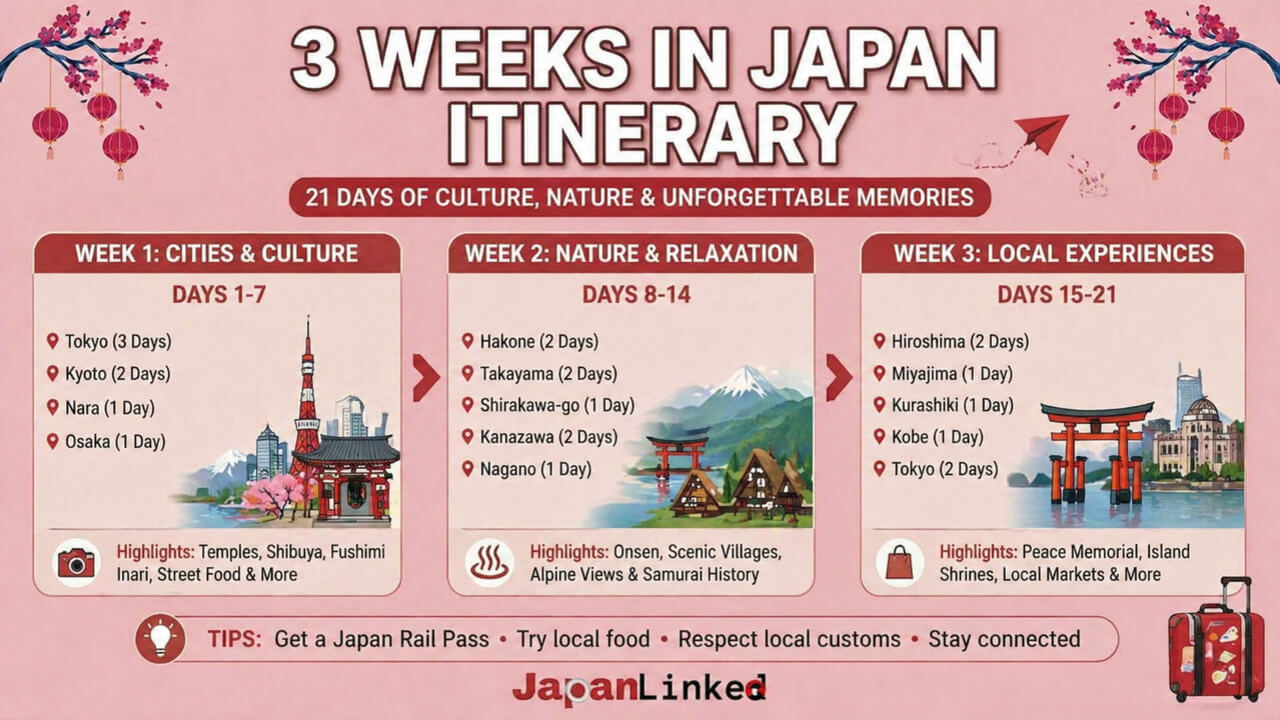
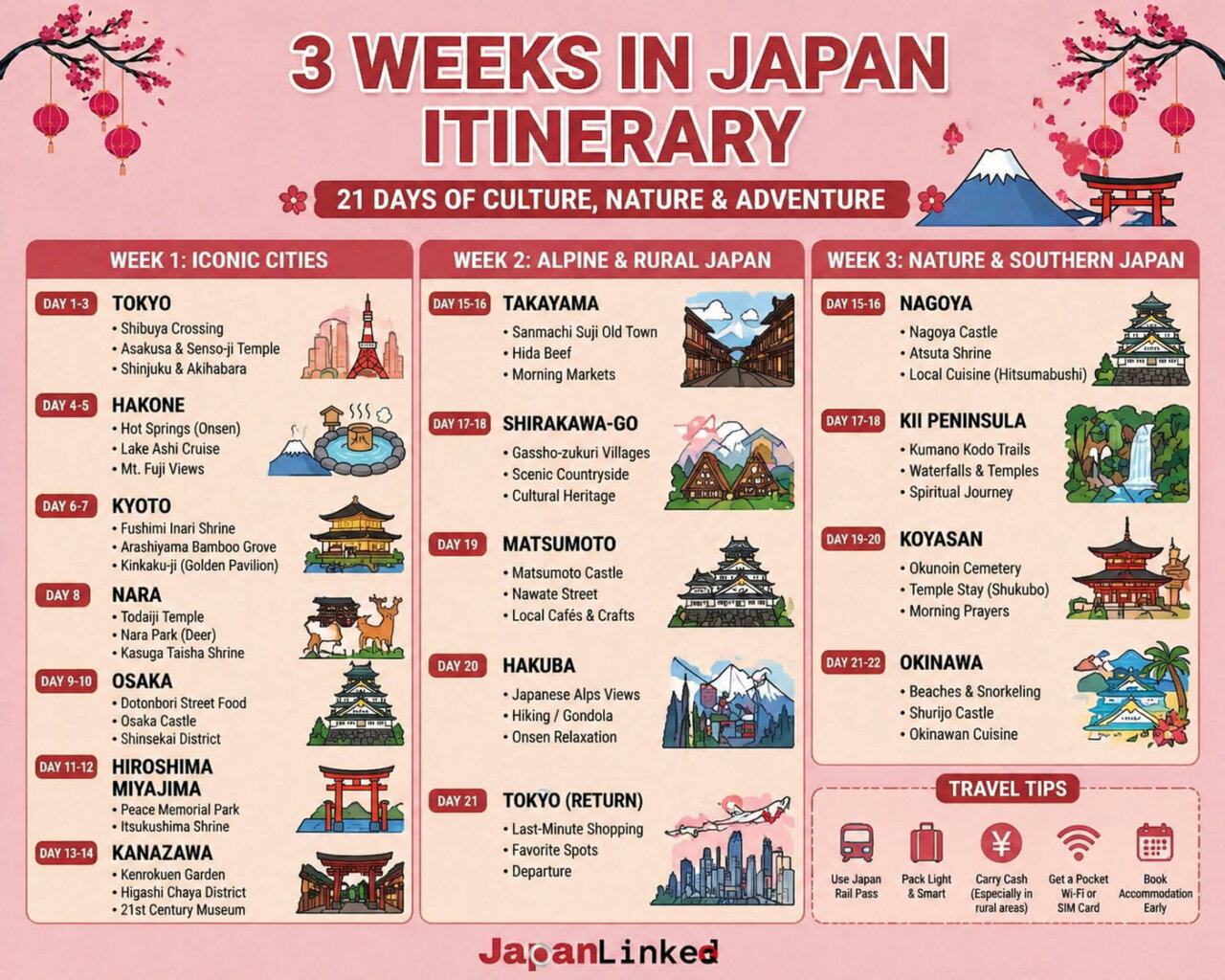
With three weeks, you can comfortably cover:
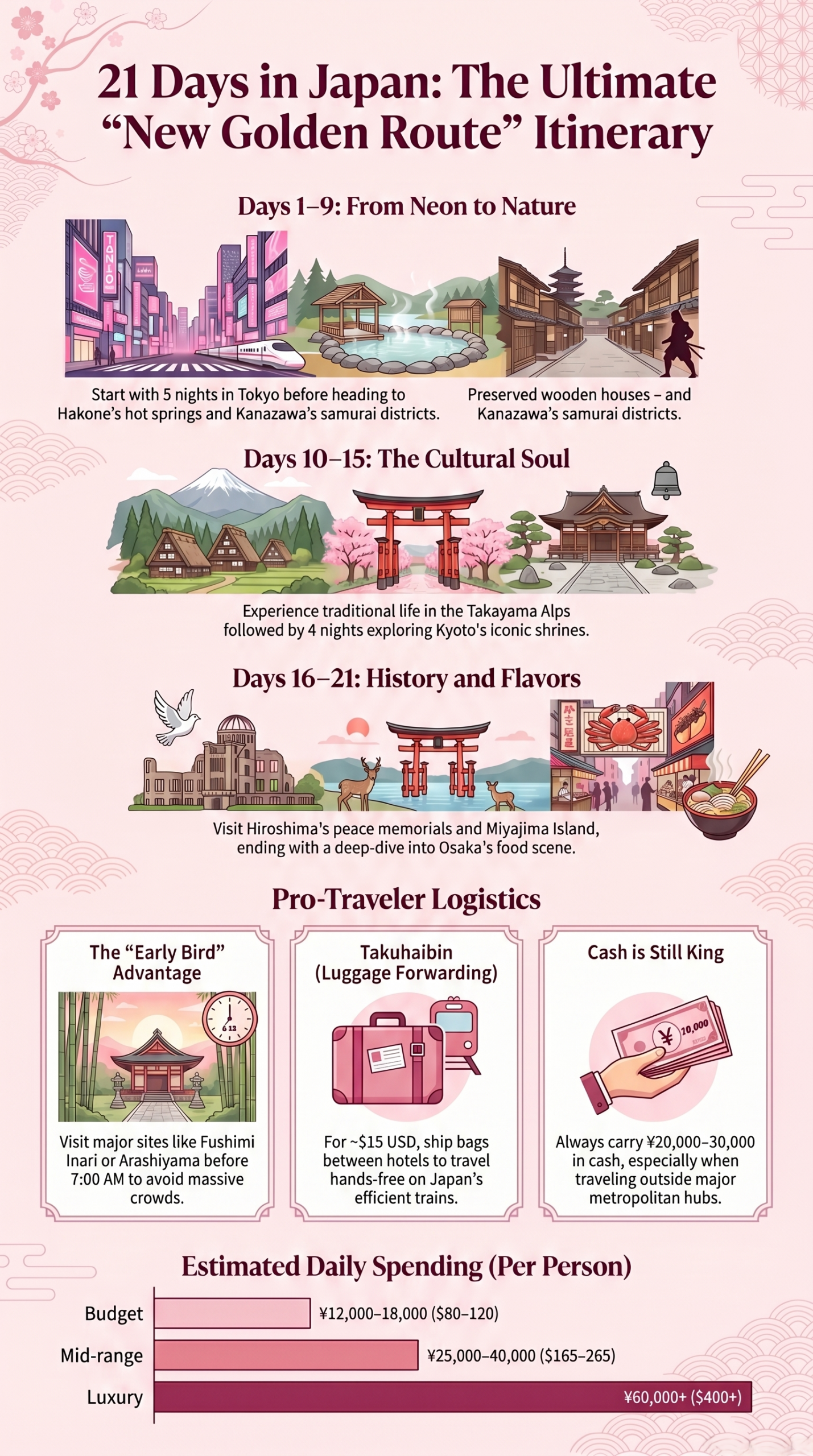
- 5 nights in Tokyo — enough to scratch the surface of the world’s most complex city
- 2–3 nights in the Japanese Alps — Takayama, Shirakawa-go, or Kanazawa
- 4 nights in Kyoto — the cultural soul of Japan
- 2 nights in Hiroshima and Miyajima — for history and one of Japan’s most iconic images
- 2–3 nights in Osaka — street food, nightlife, and the most enthusiastic locals in the country
- Flexible days for day trips, detours, and doing absolutely nothing
This itinerary follows what’s sometimes called the New Golden Route – an updated version of the classic tourist trail that weaves in the Japanese Alps and avoids some of the most congested spots. It’s designed to minimize backtracking and maximize contrast between stops.
Before You Go: Essential Japan Travel Logistics
JR Pass: Worth It or Not?
This is the most debated question in Japan travel right now. Here’s the honest answer: it depends on your route.
The 7-day Japan Rail Pass currently costs ¥50,000 (~$325 USD). A one-way Tokyo–Kyoto Shinkansen ticket runs about ¥13,320 (~$87 USD).
If you’re doing a multi-city itinerary hitting Tokyo, Kyoto, Hiroshima, and Osaka – along with a few day trips – the 21-day pass can still make sense.
But if you’re slow-traveling and spending 4–5 days in a single city, individual tickets may work out cheaper.
Pro tip: Use the Japan Guide Rail Pass Calculator before you buy. And if you do get the pass, purchase it through the official JR website before you go – a new price hike for agency-sold passes kicks in from October 2026.
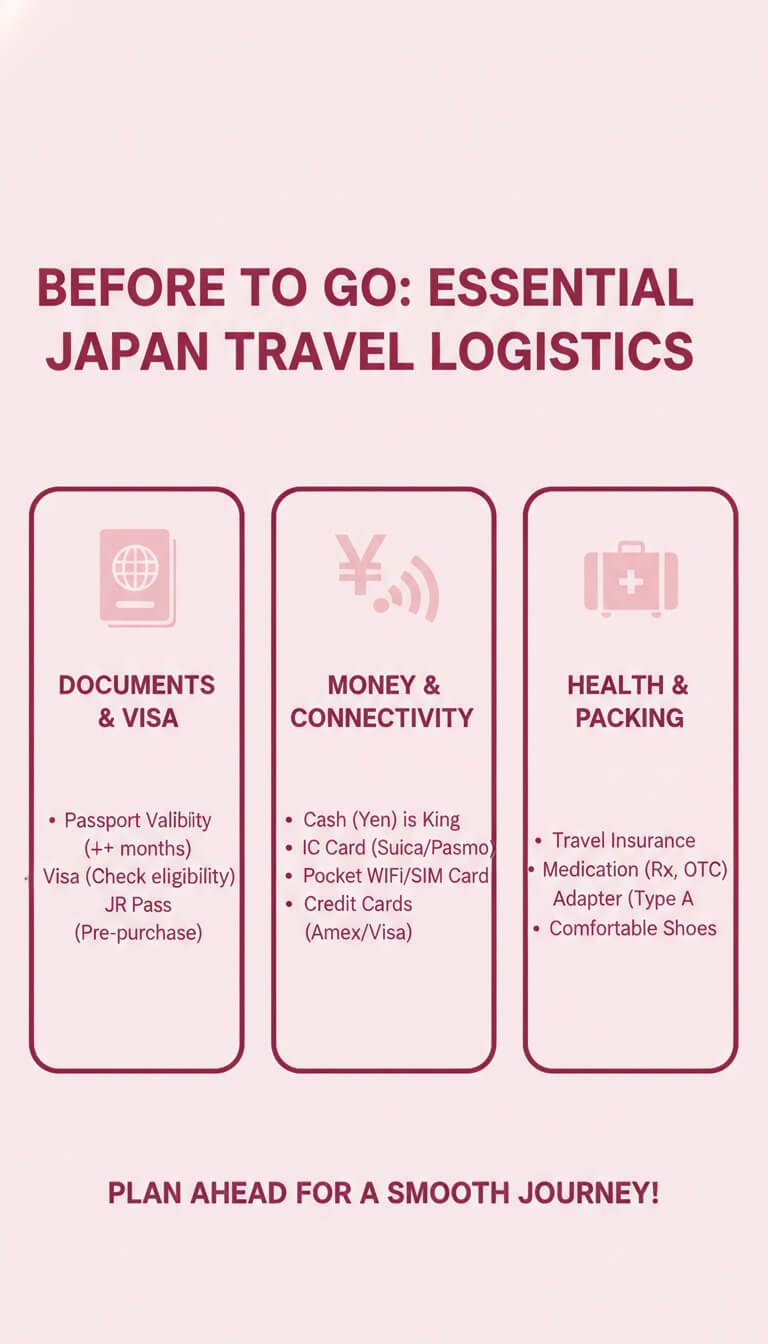
Also note: the JR Pass does not cover subway lines in Tokyo or Osaka, so you’ll still want a Suica or Pasmo IC card for daily urban transit.
Money and Budget
The weak yen has made Japan significantly more accessible for international travelers in 2024–2026. Here’s a rough daily budget breakdown:
| Travel Style | Daily Budget (¥) | Approx. USD |
|---|---|---|
| Budget | ¥12,000–18,000 | $80–120 |
| Mid-range | ¥25,000–40,000 | $165–265 |
| Luxury | ¥60,000+ | $400+ |
Japan is still largely a cash society. Withdraw yen from 7-Eleven or Japan Post ATMs — they reliably accept foreign cards. Carry ¥20,000–30,000 for stretches between ATM visits, especially outside the big cities.
Getting a SIM or eSIM
Having data in Japan is non-negotiable. Even if you know your way around, Japanese signage outside tourist areas is predominantly in Japanese. Pick up an eSIM before you fly – services like Airalo are widely used and easy to set up.
The 3-Week Japan Itinerary: Day-by-Day Breakdown
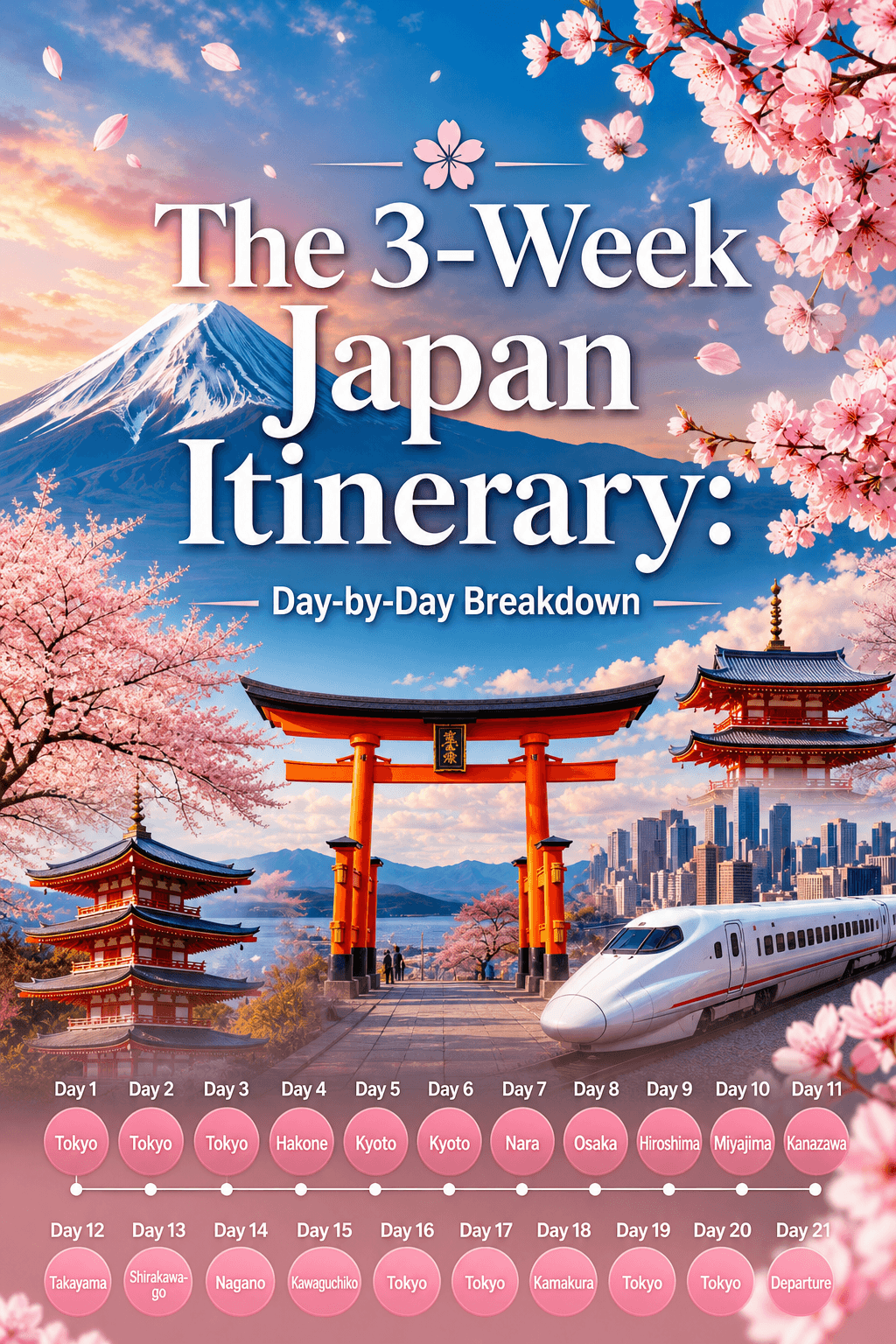
Days 1–5: Tokyo (5 nights)
Where to base yourself: Shinjuku, Shibuya, or Asakusa are all excellent central areas with great transport links.
Tokyo rewards slow exploration. With five days, you can actually pace yourself instead of speed-running the highlights.
Day 1–2: Getting Oriented
- Beat jet lag by getting up early and heading to Tsukiji Outer Market for a breakfast of fresh sushi (it opens around 5–6 AM)
- Spend the morning in Asakusa — visit Senso-ji Temple before 8 AM to avoid tour buses, then browse the Nakamise Dori shopping street
- Cross the river to Akihabara in the afternoon — even if you’re not into electronics, the energy is unlike anything else
- Evening: Shibuya crossing at night. Go before 9 AM or after 10 PM if you want fewer crowds for photos
Day 3–4: Neighborhoods and Views
- Harajuku in the morning (Takeshita Street is most photogenic before noon)
- Meiji Shrine — a jarring, beautiful contrast to the surrounding chaos
- Book Shibuya Sky observation deck in advance (2–3 weeks ahead on platforms like Klook for the best time slots)
- Day trip to Nikko or Kamakura — both are under 2 hours by train and offer a completely different side of Japan
Day 5: Tokyo Slow Day
- Explore Yanaka — a historic neighborhood that survived WWII bombing and still feels like old Tokyo
- Shimokitazawa for vintage shops, coffee, and the best people-watching in the city
- Dinner in Shinjuku — explore Memory Lane (Omoide Yokocho) for yakitori skewers and cold beer in a narrow alley
Don’t miss: The teamLab Planets digital art museum in Toyosu. Book weeks in advance — it sells out.
Days 6–7: Hakone (2 nights)
How to get there: Romancecar express from Shinjuku, about 85 minutes
Hakone is the ideal decompression between Tokyo’s intensity and Kyoto’s culture. It’s built around Mount Fuji views, volcanic hot springs, and mountain scenery — and it delivers on all three.
Hakone’s famous Hakone Round Course loops through different transport types: a mountain railway, cable car, ropeway over volcanic vents, a boat cruise across Lake Ashi, and a bus back to town. It’s genuinely one of the most scenic days you can have in Japan.
- Visit the Hakone Open-Air Museum — an outdoor sculpture park with a permanent Picasso pavilion
- Stay in a ryokan with an onsen (hot spring bath). This is your chance if it’s your first time — sleeping on a futon, wearing a yukata, eating a multi-course kaiseki dinner
- If the clouds cooperate, Lake Ashi offers one of Japan’s most iconic Mount Fuji views
Practical note: Get a Hakone Freepass for unlimited transport on the round course — it pays for itself in a single day.
Days 8–9: Kanazawa (2 nights)
How to get there: Shinkansen from Odawara or Shinagawa to Kanazawa, about 2.5–3 hours
Kanazawa is the most underrated major city in Japan and one of the best additions to any itinerary. It escaped wartime bombing, which means its geisha districts, samurai quarters, and castle town are intact and genuinely old — not reconstructed.
- Kenroku-en Garden – frequently listed as one of Japan’s top three gardens. Go at dawn before the tour groups
- Higashi Chaya — the best-preserved geisha district in Japan outside Kyoto, with beautiful amber-colored ochaya teahouses lining the streets
- 21st Century Museum of Contemporary Art – a circular museum that makes you feel like you’re inside an art installation
- The Omicho Market for fresh seafood — Kanazawa is famous for its crab and seasonal catches
Days 10–11: Takayama (2 nights)
How to get there: JR Thunderbird or Hida limited express from Kanazawa, about 1.5 hours
Takayama sits deep in the Japanese Alps and feels like Japan distilled to its most traditional form. The Sanmachi Suji historic district — narrow streets lined with wooden merchant houses, sake breweries, and tea shops — dates to the Edo period (1603–1868) and is perfectly preserved.
- Morning walk through Sanmachi Suji before the day-trippers arrive
- Hida Folk Village (Hida Minzoku Mura) — a collection of traditional thatched-roof farmhouses you can actually enter and explore
- Sample Hida beef — a high-fat wagyu variety that rivals anything you’ll find elsewhere in Japan
- Day trip to Shirakawa-go — a UNESCO-listed village of massive A-frame farmhouses that look like something out of a fairy tale, especially in winter or early spring
Days 12–15: Kyoto (4 nights)
How to get there: JR Wide View Hida to Nagoya, then Shinkansen to Kyoto — about 3.5–4 hours total
Four nights in Kyoto is the minimum to do it justice. The city has more UNESCO World Heritage Sites than most entire countries, and the temptation to rush from temple to temple is real — resist it.
Day 12: Eastern Kyoto
- Fushimi Inari Shrine — the famous tunnel of 10,000 torii gates. Leave by 6:30 AM to have it almost to yourself
- Kiyomizudera Temple — perched on a hillside with views over the city
- Walk through the Higashiyama district in the late afternoon when the light turns golden
Day 13: Arashiyama
- Bamboo Grove — go at dawn (before 7 AM) or you’ll be sharing it with every tourist in Japan
- Tenryu-ji Temple Garden — one of Kyoto’s most beautiful Zen gardens
- Boat ride on the Oi River or a walk along the Philosopher’s Path back toward central Kyoto
Day 14: Day Trip to Nara
- Nara Park — hundreds of freely roaming sika deer, and yes, you can feed them
- Todai-ji Temple — housing Japan’s largest bronze Buddha statue
- Back in Kyoto by evening, dinner in the Pontocho dining alley
Day 15: Nijo Castle and Hidden Kyoto
- Nijo Castle — the former shogun’s residence with famous “nightingale floors” that squeak to alert guards of intruders
- Afternoon wander through Gion — Kyoto’s geisha district, most atmospheric around dusk
- If timing allows, a traditional tea ceremony experience — many are bookable online for around ¥1,500–3,000
Days 16–17: Hiroshima & Miyajima (2 nights)
How to get there: Shinkansen from Kyoto to Hiroshima, about 1.5 hours
No Japan itinerary is complete without Hiroshima — not just for history, but because the city that was destroyed by an atomic bomb in 1945 has been reborn into one of Japan’s most liveable, welcoming places.
- Peace Memorial Park and Museum — go in the morning when it’s quieter. The museum is one of the most affecting in the world; budget at least 2 hours
- The A-Bomb Dome (Genbaku Dome) — the only building left standing near the epicenter, preserved as it stood after the blast
- Day trip to Miyajima Island — home to the floating torii gate of Itsukushima Shrine, one of Japan’s three most iconic views. The JR Ferry is covered by the JR Pass
- At low tide, you can walk right up to the torii gate — check tide tables before you go
- Hike up Mount Misen for panoramic views over the Seto Inland Sea
Local tip: Hiroshima is famous for its own style of okonomiyaki — a savory pancake layered with noodles, cabbage, and pork. It’s completely different from the Osaka version and deeply delicious.
Days 18–21: Osaka (3 nights + departure)
How to get there: Shinkansen from Hiroshima to Osaka, about 1.5 hours
Osaka is the obvious endpoint. It’s Japan’s food capital, its most extroverted city, and one of the best places in the world to simply eat your way through a neighborhood. After weeks of temple-hopping and scenic trains, Osaka is pure, unfiltered fun.
- Dotonbori — the neon-soaked entertainment district. Go hungry. Takoyaki (octopus balls), kushikatsu (deep-fried skewers), and fresh crab are all within a five-minute walk of each other
- Kuromon Ichiba Market — Osaka’s “kitchen” — a covered market where vendors have been selling fresh fish, wagyu, and street snacks for over 200 years
- Osaka Castle — beautiful grounds for a morning walk even if you skip the castle interior
- Day trip to Kobe if you haven’t had enough beef yet — Kobe wagyu prepared tableside is a genuinely moving experience
- Shinsekai neighborhood — old-school Osaka, with retro restaurants, sento bathhouses, and billiards halls that look like they haven’t changed since 1975
If you’re flying home from Osaka, Kansai International Airport (KIX) is well connected and easy to reach by the Haruka Express.
Practical Tips for Getting the Most Out of 3 Weeks in Japan
Book Ghibli Museum tickets immediately. Tickets are released on the 10th of each month for the following month. They sell out in minutes. If this is on your list, treat it like a concert — be on the site at exactly the right time.
Use luggage forwarding (takuhaibin). For about ¥2,000 per bag, you can send your suitcase from one hotel to the next and travel by train hands-free. This is one of Japan’s greatest unsung travel tools.
Convenience stores are not a backup plan. 7-Eleven, FamilyMart, and Lawson in Japan serve genuinely good food — onigiri, hot dishes, sandwiches, and desserts that would hold their own in a decent café anywhere else. Budget travelers can eat well for ¥500–900 per meal.
Get up early. Japan’s most iconic spots — Fushimi Inari, the Arashiyama Bamboo Grove, Senso-ji, Kenroku-en — are peaceful at dawn and overwhelming by 10 AM. Every early morning is worth it.
Download Google Maps offline. Even with data, having offline maps for each city you visit is worth doing. Japan’s addresses work differently from most countries and even native speakers use apps to navigate.
When to Go: Best Seasons for 3 Weeks in Japan
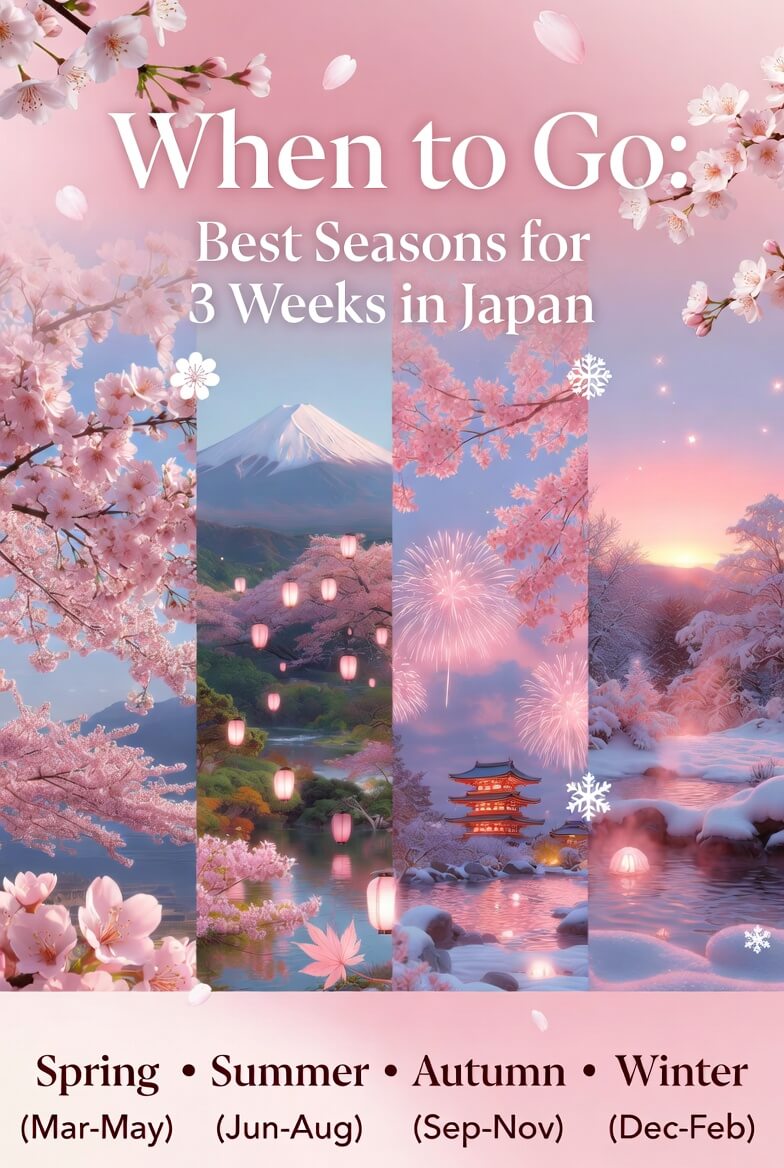
| Season | Pros | Watch Out For |
|---|---|---|
| Spring (Mar–May) | Cherry blossoms, mild weather | Extremely crowded, book 4–6 months ahead |
| Autumn (Oct–Nov) | Fall foliage, comfortable temps | Popular — book early, but less chaotic than spring |
| Winter (Dec–Feb) | Few tourists, mountain snow, lower prices | Cold; some alpine routes may be limited |
| Summer (Jun–Aug) | Vibrant festivals, full access everywhere | Hot and humid; rainy season in June |
Autumn – particularly October through mid-November – hits a sweet spot of beautiful weather, spectacular foliage, and slightly more breathing room than cherry blossom season. It’s widely considered the best time to travel to Japan for first-timers who want scenery without the crush.
Sample Budget for 3 Weeks in Japan

| Category | Budget Estimate (USD) |
|---|---|
| Flights (international, round-trip) | $600–1,400 |
| Accommodation (21 nights, mid-range) | $1,400–2,500 |
| Transport (JR Pass or individual tickets) | $400–700 |
| Food (3 weeks, mid-range) | $600–1,000 |
| Activities and entrance fees | $200–400 |
| Total (mid-range estimate) | $3,200–6,000 |
Budget travelers spending more time in hostels and convenience stores can come in closer to $2,500 total. Those opting for ryokans, kaiseki dinners, and private transport will spend significantly more – and won’t regret a yen of it.
Conclusion
Three weeks in Japan is one of those trips you come home from and immediately start planning to return. The country does something to you – a combination of beauty, efficiency, generosity, and genuine strangeness that’s unlike anywhere else on earth.
This 3-week Japan itinerary gives you the structure to see the best of it without rushing, while leaving room for the unplanned moments that become the best stories.
Start with Tokyo. End in Osaka. Eat everything. Wake up early. And don’t skip Kanazawa.
Japan has a way of exceeding every expectation you had while completely defying them. Three weeks is just enough time to start understanding why.
