
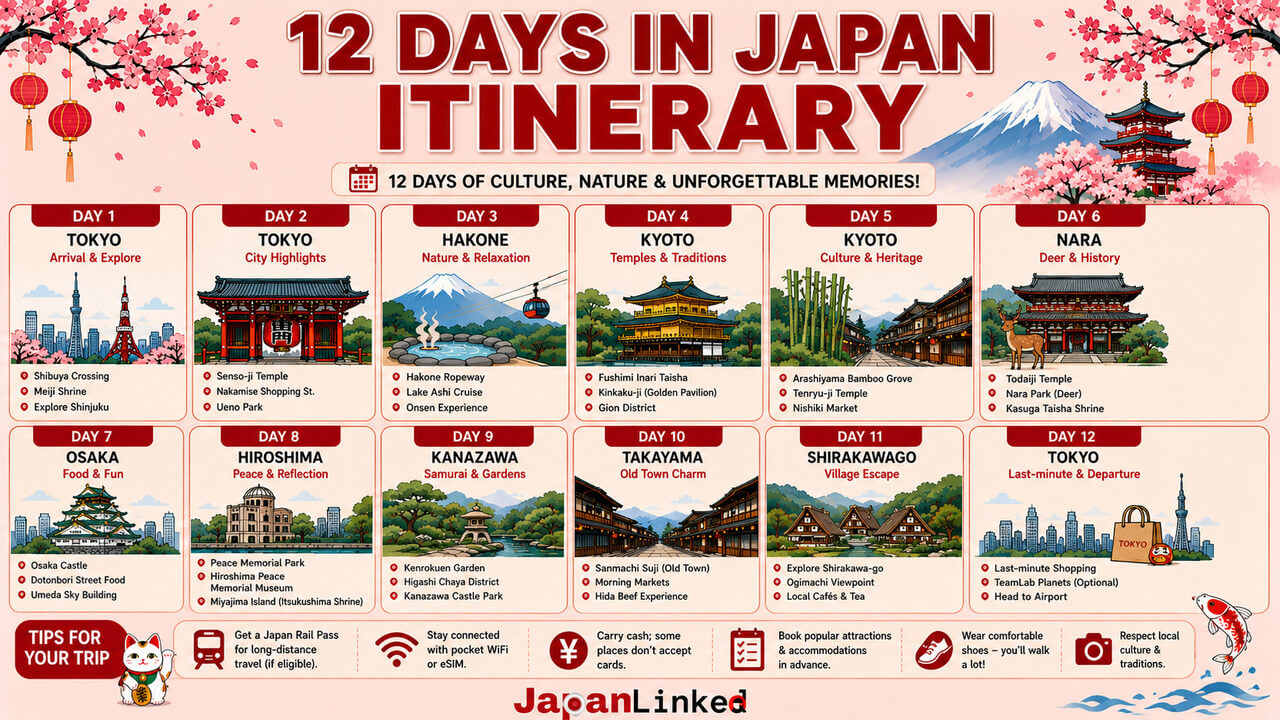
A 12-day itinerary in Japan is what separates first-time visitors from those who plan their trip properly.
It’s enough time to do the classic route – Tokyo, Kyoto, Osaka – and add the detour through the Japanese Alps that transforms a good Japan trip into an extraordinary one.
With 10 days, that Alpine loop is tight. In two weeks, you can wander it leisurely.
But 12 days in Japan hits the exact sweet spot: the full classical arc plus Takayama, Shirakawa-go, and Kanazawa, traveled at a pace that leaves room to linger, eat slowly, and wake up early.
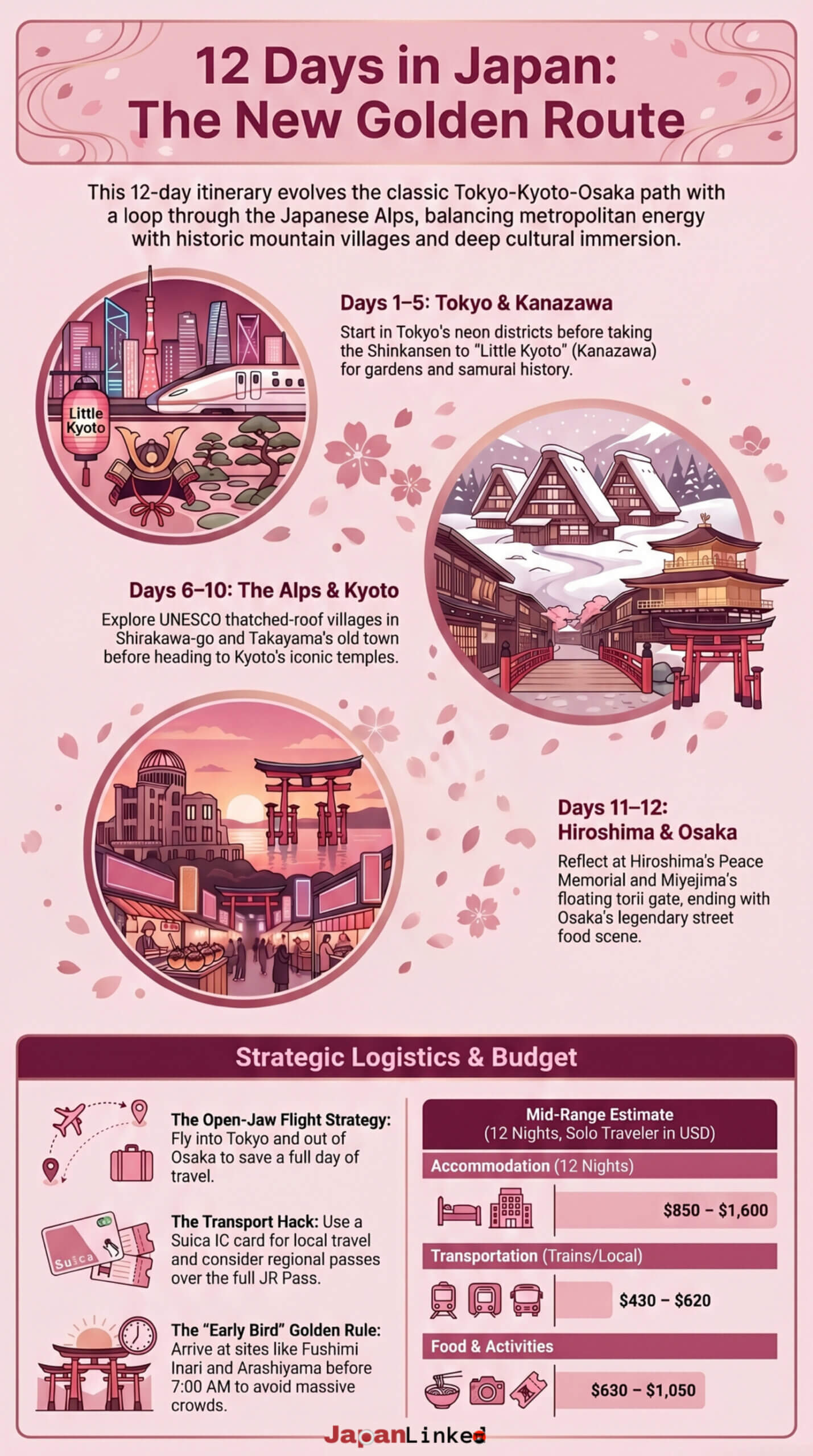
This is what’s known as Japan’s New Golden Route – an evolved version of the classic Tokyo–Kyoto–Osaka highway that loops through the country’s cultural and geographic heartland via the mountains.
Less traveled, more varied, and frankly more beautiful than the standard path.
This guide maps it out day by day, with honest transport advice, timing that actually works, and the specific details that make the difference between a trip you planned and one you’ll talk about for years.
Planning Your 12-Day Japan Trip: Logistics First
The Open-Jaw Flight – Non-Negotiable
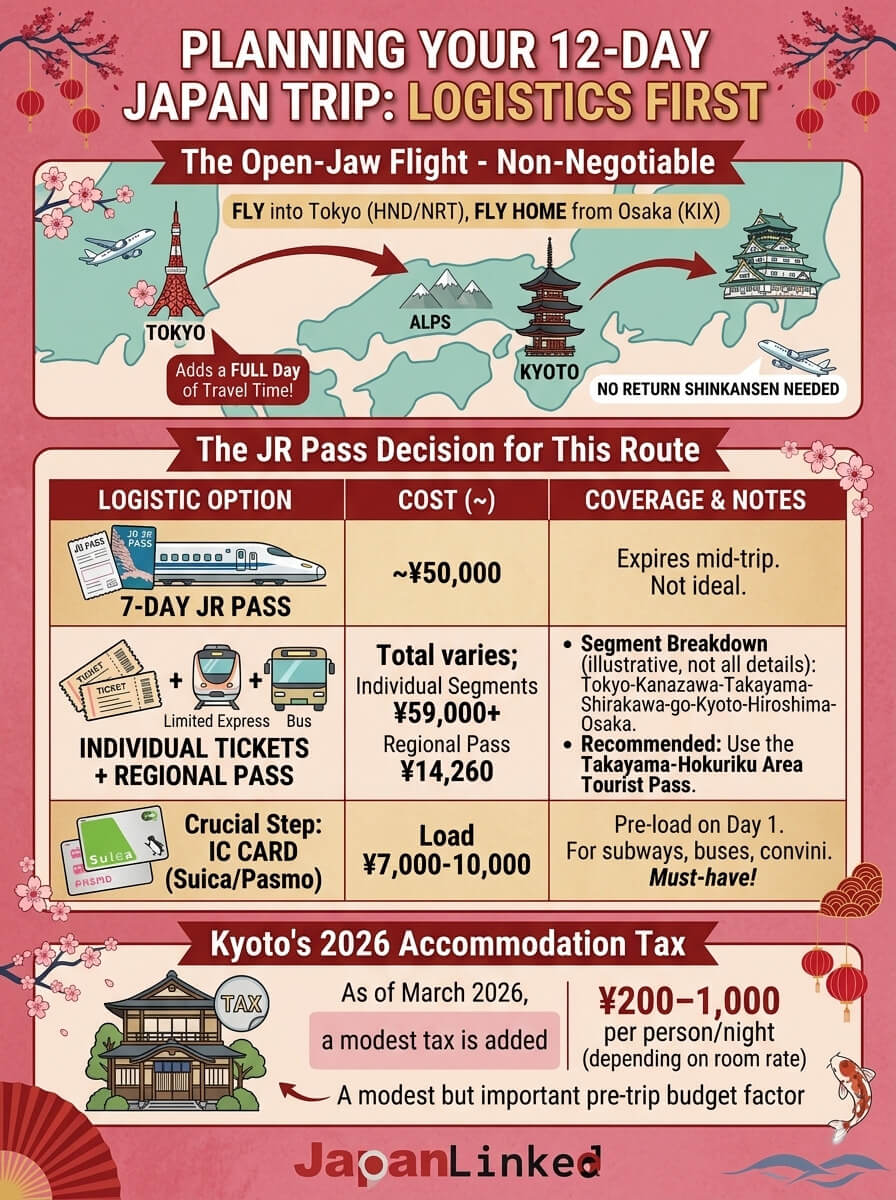
Fly into Tokyo, fly home from Osaka. This single booking decision adds a full day of usable travel time by eliminating the return Shinkansen to Tokyo from wherever you finish.
Most international airlines offer this at little or no extra cost over a round-trip. For a 12-day itinerary flowing Tokyo → Alps → Kyoto → Osaka, it’s geographically perfect and logistically clean.
The JR Pass Decision for This Route
For 12 days on the New Golden Route, this is genuinely worth calculating carefully.
The route involves several major Shinkansen legs plus regional trains through the Alps, and the numbers can tip either way depending on your exact stops.
Here’s the honest breakdown for this specific itinerary:
| Segment | Individual Ticket |
|---|---|
| Tokyo → Kanazawa (Hokuriku Shinkansen) | ¥14,380 |
| Kanazawa → Takayama (Limited Express via Toyama) | ¥6,050 |
| Takayama → Kyoto (Hida Express + Shinkansen) | ¥11,240 |
| Kyoto → Hiroshima (Shinkansen) | ¥10,960 |
| Hiroshima → Osaka (Shinkansen) | ¥11,510 |
| Shirakawa-go buses + JR Ferry Miyajima | ¥5,000+ |
| Total | ~¥59,000+ |
The 7-day JR Pass (¥50,000) doesn’t cover this route in full — you’d activate it in Tokyo, and it would expire mid-trip.
The 14-day JR Pass (¥80,000) covers everything but requires your individual ticket math to exceed that amount, which it does if you add day trips and local JR trains.
The cleaner option for this itinerary: buy individual Shinkansen tickets and consider the regional JR Takayama-Hokuriku Area Tourist Pass (¥14,260 for 5 days), which covers the Kanazawa–Takayama–Shirakawa-go segment specifically and saves meaningful money on that stretch.
Whatever you decide, get a Suica or Pasmo IC card at the airport on Day 1. Load it with ¥7,000–10,000. It covers all city subways, local buses, and convenience store purchases across every city on this route.
Kyoto’s 2026 Accommodation Tax
As of March 2026, Kyoto’s accommodation tax has increased. Budget roughly ¥200–1,000 per person per night, depending on your room rate – a modest addition but worth factoring into your pre-trip budget.
Also Read: 2 Week Japan Itinerary & 3 Week Japan Itinerary
The 12-Day Japan Itinerary: Day by Day
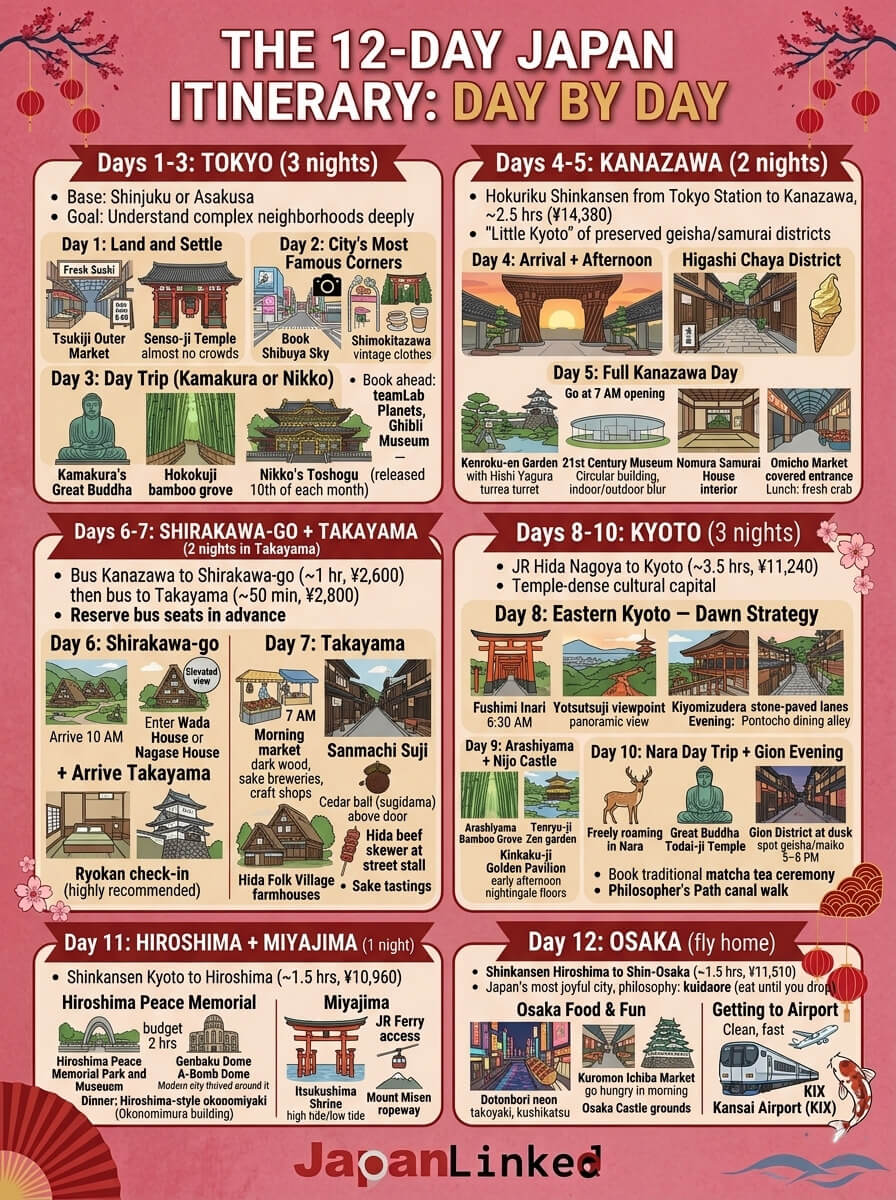
Days 1–3: Tokyo (3 nights)
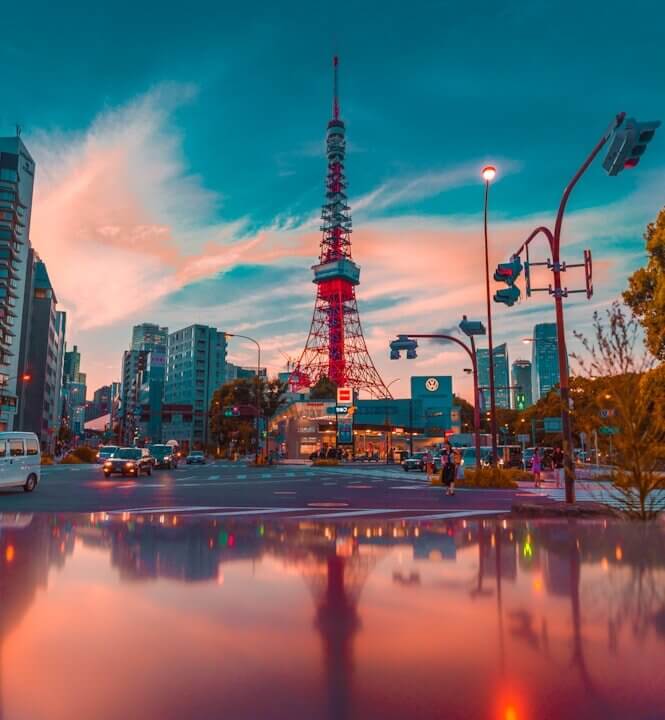
Where to base: Shinjuku or Asakusa — both give you strong transport links and two completely different flavors of the city.
Three nights in Tokyo is a focused, intentional introduction to the world’s most complex city. The goal isn’t to see everything — it’s to understand a few neighborhoods deeply before the rest of Japan unfolds.
Day 1: Land and Settle
Jet lag is your asset on the first morning.
- Tsukiji Outer Market opens around 5:30–6 AM. Fresh sushi for breakfast with vendors shouting across the stalls is one of the great ways to start any Japan trip — and the dawn timing works perfectly when your body thinks it’s midday
- Asakusa and Senso-ji — Tokyo’s oldest temple. Arrive by 7:30 AM to see the Kaminarimon gate with almost no crowds. Browse Nakamise Dori before the tour groups arrive at 9 AM
- Akihabara in the afternoon for the electronics and anime district’s particular brand of sensory overload
- Dinner in Shinjuku — the Omoide Yokocho alley of yakitori stalls has been feeding people here since the 1940s
Day 2: The City’s Most Famous Corners
- Shibuya Crossing — go before 9 AM or after 10 PM for the best experience and photos. Book Shibuya Sky (rooftop observation deck) 2–3 weeks ahead for sunset; it sells out reliably
- Harajuku (Takeshita Street) into Meiji Shrine — fashion chaos followed immediately by deep forest quiet. The contrast is deliberate and wonderful
- Shimokitazawa for the afternoon — independent record shops, vintage boutiques, and Tokyo’s best coffee scene without a tourist in sight
Day 3: Day Trip to Kamakura or Nikko
Get out of Tokyo on Day 3.
- Kamakura (1 hour south, ¥920 by JR Yokosuka Line) — seaside temple town, Great Buddha, Hokokuji bamboo grove, forested hiking trails. Perfect pace after two dense city days
- Nikko (2 hours north, ¥2,720 from Shinjuku) — Japan’s most ornate shrine complex in a mountain cedar forest. More dramatic, slightly more effort to reach, entirely worth it
Book before you go: teamLab Planets (Toyosu) 1–2 weeks ahead; Ghibli Museum tickets released on the 10th of each month for the following month — set a reminder and be fast.
Days 4–5: Kanazawa (2 nights)
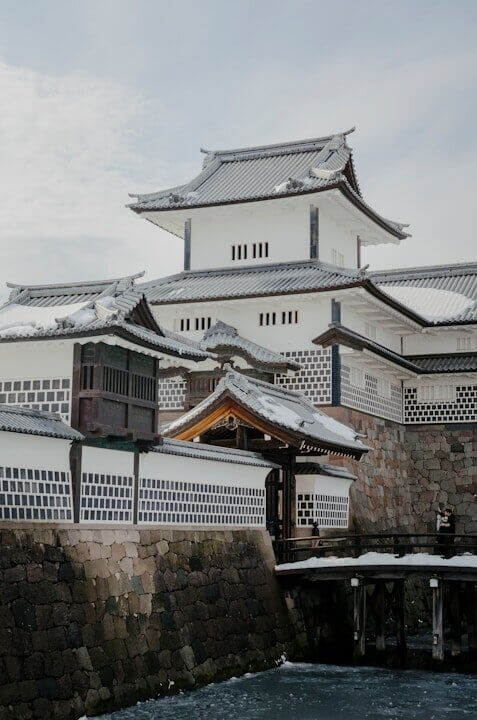
How to get there: Hokuriku Shinkansen from Tokyo Station to Kanazawa, about 2.5 hours (¥14,380)
This is where the New Golden Route diverges from every standard Japan itinerary — and immediately rewards the deviation. Kanazawa is one of Japan’s most significant cities that most first-time visitors never visit.
Known as “Little Kyoto” for its preserved geisha districts, samurai quarters, and castle town, it escaped wartime bombing and retains an architectural heritage that feels genuinely old rather than reconstructed.
The Hokuriku Shinkansen now connects it directly to Tokyo in 2.5 hours, making it far more accessible than its reputation as an “off-the-beaten-path” destination suggests.
Day 4: Arrival + Afternoon in Kanazawa
- Kanazawa Station itself — the futuristic glass-and-wood Tsuzumimon gate is one of Japan’s most photographed station entrances. First impressions here are strong
- Higashi Chaya District — Kanazawa’s best-preserved geisha quarter, with amber-tinted wooden teahouses (ochaya) lining stone lanes. Among the most intact geisha districts in Japan. Walk it in the late afternoon when the light is warm
- Gold leaf ice cream at Hakuichi — Kanazawa produces 99% of Japan’s gold leaf. The city eats it. This is mandatory
Day 5: Full Kanazawa Day
- Kenroku-en Garden — consistently ranked among Japan’s top three most beautiful gardens. Go at opening (typically 7 AM in peak season) before the day-trippers arrive. The garden dates to the 17th century and covers over 11 hectares of ponds, waterfalls, and ancient trees
- Kanazawa Castle — connected to Kenroku-en, the reconstructed castle grounds and moat are well worth the walk-through, especially the Hishi Yagura turret
- 21st Century Museum of Contemporary Art — a circular, boundary-less museum where indoor and outdoor exhibitions blur into each other. The Leandro Erlich “Swimming Pool” installation is worth the price of entry alone
- Nagamachi Samurai District for the afternoon — preserved samurai residences with mud-walled lanes. The Nomura Samurai House offers a particularly good interior visit (¥550)
- Omicho Market — Kanazawa sits on the Sea of Japan and its seafood is exceptional. The covered market has operated since the Edo period. Lunch here on fresh crab, sea urchin, or snow crab when in season
Also Read: 11 Days In Japan Itinerary & 10 Days In Japan Itinerary
Days 6–7: Shirakawa-go + Takayama (2 nights in Takayama)
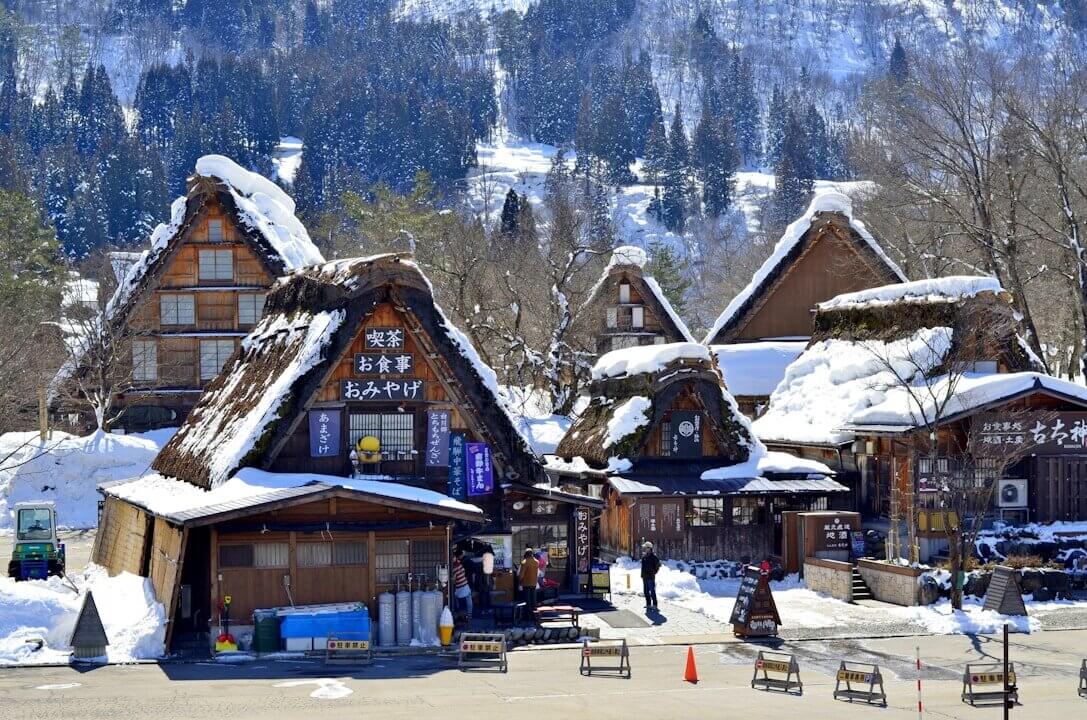
How to get there: Bus from Kanazawa to Shirakawa-go (about 1 hour, ¥2,600) then bus to Takayama (about 50 min, ¥2,800).
Reserve bus seats in advance – the Nohi Bus between these towns fills up, especially on weekends and in peak season.
This two-day stretch through the mountains is the emotional heart of the itinerary.
Two UNESCO World Heritage sites, Japan’s finest Edo-period old town, the country’s best regional wagyu beef, and mountain scenery that has no equivalent on the standard Golden Route.
Day 6: Shirakawa-go + Arrive Takayama
Shirakawa-go is a village of about 600 residents living in massive A-frame thatched-roof farmhouses (gassho-zukuri) surrounded by rice paddies and mountain forest.
It’s been listed as a UNESCO World Heritage Site since 1995 and looks exactly like the photographs, which is to say, it looks like a fairy tale.
- Catch the early bus from Kanazawa (first departure around 8–9 AM). Arrive by 10 AM for the quietest few hours before day-trippers arrive from Nagoya
- Ogimachi observation deck — a 10-minute walk up the hillside gives you the famous elevated view over the entire village. The best shot in the region, bar none
- Walk the village itself — enter the Wada House or Nagase House, two of the oldest farmhouses open to the public, to understand the scale of gassho-zukuri architecture from inside
- Leave Shirakawa-go by early afternoon and bus to Takayama (~50 min)
Arrive in Takayama mid-afternoon. Check into your hotel — this is an excellent place for a ryokan if you haven’t had one yet.
Day 7: Takayama
Takayama’s Sanmachi Suji historic district is one of the best-preserved merchant townscapes in Japan – narrow lanes of dark wooden buildings housing sake breweries, craft shops, and tea rooms that have stood since the Edo period (1603–1868).
It’s quieter than Kyoto, more intimate, and in autumn or winter, achingly beautiful.
- Morning market at Jinya-mae or along the Miyagawa Riverbank, open from around 7 AM. Local produce, pickles, crafts, and the best people-watching in town
- Sanmachi Suji historic district — walk it twice: once in the morning with the shops open, and again after 5 PM when the stalls close and the laneways fall quiet. The evening version is the better one
- Hida Folk Village (Hida no Sato) — an open-air museum of relocated traditional farmhouses, 20 minutes from the center. More interactive than Shirakawa-go in some ways, and far less crowded
- Hida beef — Takayama’s regional wagyu. Get it as a skewer (hoba miso beef on a magnolia leaf) from one of the street stalls in the historic district. It rivals anything available in Tokyo
Don’t miss: Sake. Takayama’s spring water from the Japanese Alps feeds a local brewing tradition dating to the 17th century. Several breweries on Sanmachi Suji offer tastings – look for the cedar ball (sugidama) hanging above the door, traditional indicator that the new season’s sake is ready.
Days 8–10: Kyoto (3 nights)
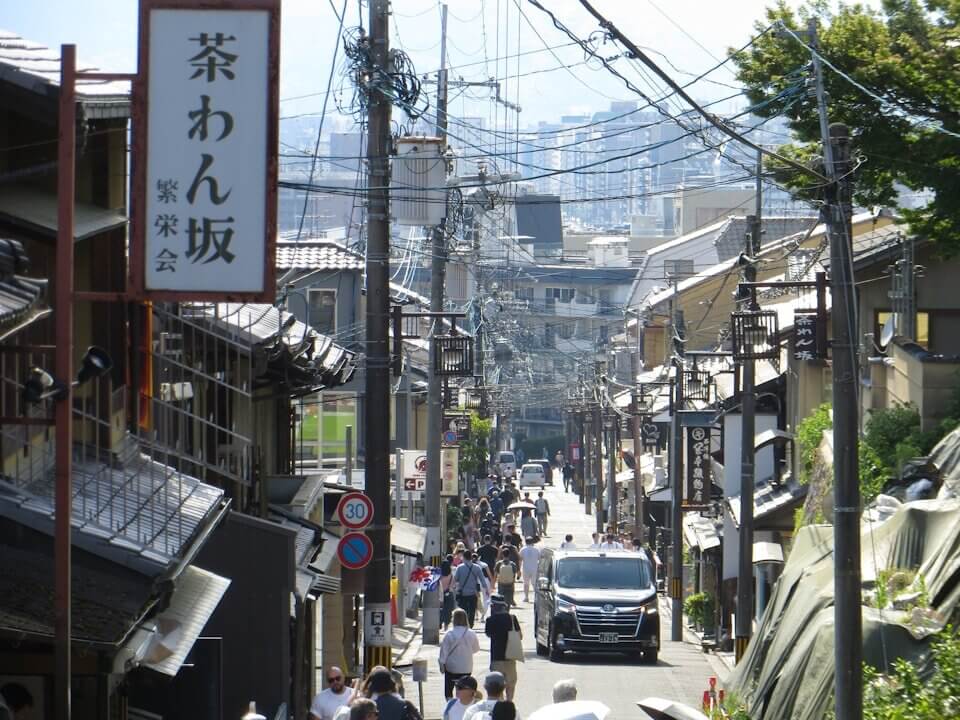
How to get there: JR Hida limited express from Takayama to Nagoya (~2.5 hours), then Shinkansen to Kyoto (~35 min). Total about 3.5 hours, ¥11,240.
After the mountains, Kyoto lands differently. The transition from deep-alpine quiet to temple-dense cultural capital is one of the great gear shifts in any Japan itinerary — and three nights here gives you room to absorb it properly.
Day 8: Eastern Kyoto — The Dawn Strategy
- Fushimi Inari Shrine at 6:30 AM — the tunnel of 10,000 red torii gates winding up a forested mountain. The difference between 6:30 and 9:30 AM is the difference between profound and gridlocked. Walk to the Yotsutsuji viewpoint halfway up (40 minutes from the base) for panoramic city views. Set the alarm. Every day of early rising on this trip has been worth it
- Kiyomizudera Temple in mid-morning — built into the Higashiyama hillside with a wooden veranda extending over the valley below. Allow 90 minutes
- Higashiyama District in the late afternoon — stone-paved historic lanes linking these temples, lined with wooden machiya townhouses. This is the preserved Kyoto of every travel photograph
Evening: Pontocho dining alley — a narrow lantern-lit corridor parallel to the Kamo River, with small restaurants and counter seating that make for some of Kyoto’s best and most atmospheric dining.
Day 9: Arashiyama + Nijo Castle
- Arashiyama Bamboo Grove at dawn — same principle as Fushimi Inari. Before 7 AM, the sound of bamboo in the wind and the filtered green light are extraordinary. By 9 AM it’s a crowd scene
- Tenryu-ji Temple Garden — a 14th-century UNESCO-listed Zen garden with a central pond framing the mountain scenery behind it
- Kinkaku-ji (Golden Pavilion) in the early afternoon — the gold-leafed Zen temple reflected in its mirror pond. Busy but genuinely beautiful; allow about 45 minutes
- Nijo Castle — the former Kyoto residence of the Tokugawa shogunate, famous for its “nightingale floors” engineered to squeak underfoot as an intruder-warning system. One of Japan’s most interesting castle interiors
Day 10: Nara Day Trip + Gion Evening
- Nara (45 min by Kintetsu Express, ¥760) — hundreds of freely roaming deer, the Great Buddha inside Todai-ji Temple (Japan’s largest bronze Buddha inside the world’s largest wooden building), and Kasuga Taisha Shrine deep in an ancient forest. One of Japan’s most memorable half-days
- Return to Kyoto by late afternoon
- Gion District at dusk — walk Hanamikoji-dori between 5–8 PM for the highest chance of spotting a geisha or maiko in transit. The street lit by lanterns at dusk is one of Kyoto’s defining images
Also worth it in Kyoto: A traditional matcha tea ceremony (¥1,500–3,500, 1 hour) in the Higashiyama area. Book online before your trip. The Philosopher’s Path — a 2 km canal walk lined with cherry trees — is spectacular in spring and still lovely year-round in the late afternoon.
Day 11: Hiroshima + Miyajima (overnight in Hiroshima)
How to get there: Shinkansen from Kyoto to Hiroshima, about 1.5 hours (¥10,960)
No Japan itinerary should end without Hiroshima. Not because it’s obligatory, but because the city that was destroyed by the world’s first atomic bomb on August 6, 1945 — and rebuilt into one of Japan’s most welcoming, liveable, and forward-looking cities — is one of the most profound things a traveler can experience anywhere on earth.
- Leave Kyoto early to arrive in Hiroshima by 9:30–10 AM
- Hiroshima Peace Memorial Park and Museum — budget at least 2 hours for the museum. It is deeply moving and benefits from time, not rushing. The rebuilt city visible through the windows as you exit creates a contrast that stays with you
- Genbaku Dome (A-Bomb Dome) — the reinforced concrete building preserved exactly as it stood after the blast, with the modern city thriving in every direction around it
- Hiroshima-style okonomiyaki for dinner – the city’s layered version of the savory pancake (noodles, cabbage, egg, all stacked rather than mixed) is the best in Japan. The dedicated Okonomimura building has over 25 stalls across five floors – sit at a counter and watch it being made in front of you
Miyajima
Take the JR Sanyo Line from Hiroshima to Miyajimaguchi Station (25 min) then the JR Ferry to the island (10 min, free with JR Pass). One of Japan’s officially designated “three scenic views.”
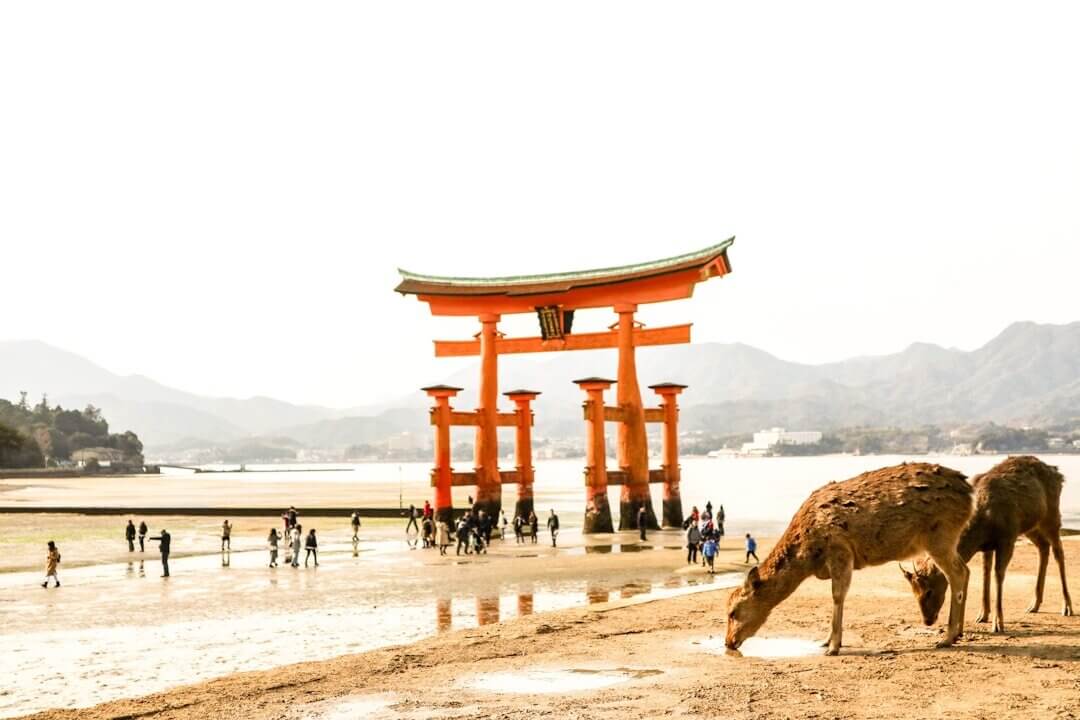
- The floating torii gate of Itsukushima Shrine – at high tide, it rises from the sea; at low tide, you can walk to its base. Check tide charts the night before; both versions are worth experiencing
- Itsukushima Shrine (¥300) — the Shinto complex built over the water
- Hike or take the ropeway up Mount Misen (535 m) for sweeping views across the Seto Inland Sea
Day 12: Osaka (fly home)
How to get there: Shinkansen from Hiroshima to Osaka (Shin-Osaka Station), about 1.5 hours (¥11,510)
Your final city is Japan’s most joyful one. Osaka’s philosophy of kuidaore — eat until you drop — has shaped an entire civic identity around food. Even half a day here delivers.
- Dotonbori — the neon canal district is the highest-density street food experience in Japan. Takoyaki (octopus balls), kushikatsu (deep-fried skewers — no double-dipping), and fresh crab are all within a five-minute walk
- Kuromon Ichiba Market — a 200-year-old covered market where vendors serve directly at the stall. Go hungry in the morning before sightseeing
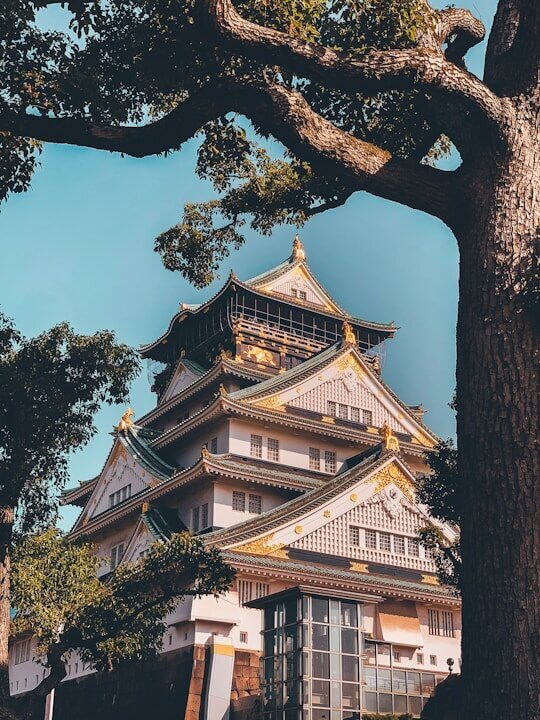
- Osaka Castle grounds — beautiful for a morning walk, even if you don’t go inside
Getting to Kansai Airport (KIX): The Haruka Express from Tennoji Station to KIX takes about 30 minutes. Clean, fast, and easy to navigate.
Also Read: 5 Days In Japan Itinerary & 7 Days In Japan Itinerary
Essential Tips for 12 Days in Japan
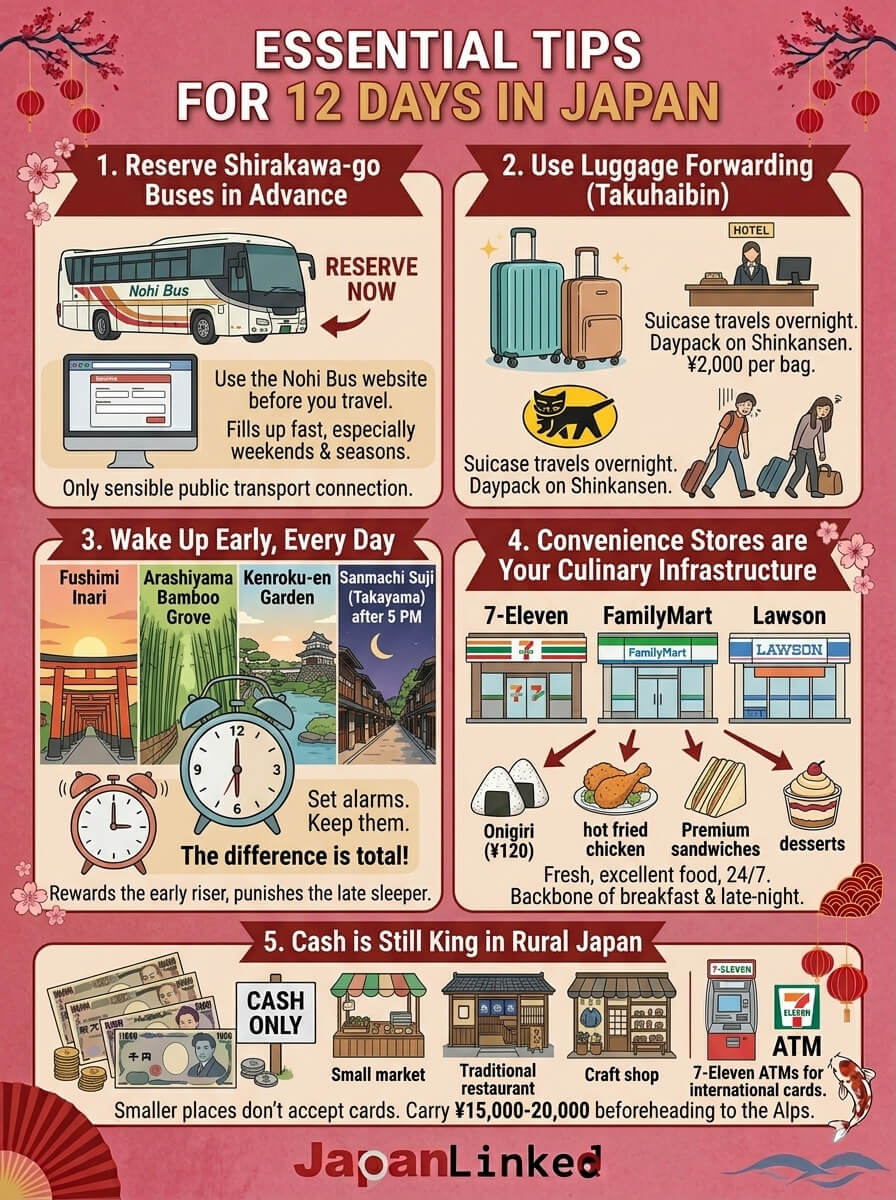
Reserve Shirakawa-go buses in advance. The Nohi Bus between Kanazawa and Takayama via Shirakawa-go is the only sensible public transport connection, and it fills up – especially on weekends, in cherry blossom season, and in winter when the snow-covered village draws photographers from across the country. Book seats through the Nohi Bus website before you travel.
Use luggage forwarding (takuhaibin) between cities. For about ¥2,000 per bag, your suitcase travels from hotel to hotel overnight. You board the Shinkansen with nothing but a daypack. This service is especially valuable on a 12-day multi-city trip — dragging luggage through crowded Shinkansen cars is unnecessary and exhausting.
Wake up early, every day. Fushimi Inari, Arashiyama Bamboo Grove, Kenroku-en Garden, Sanmachi Suji in Takayama after 5 PM — every iconic spot in Japan rewards the early riser and punishes the late sleeper. The difference between dawn and mid-morning at these places is total. Set alarms. Keep them.
Convenience stores are your culinary infrastructure. Japan’s 7-Eleven, FamilyMart, and Lawson serve legitimate, excellent food at every hour. Fresh onigiri from ¥120, hot dishes, premium sandwiches, and desserts that would hold their own in any city café. On a 12-day trip, they become the backbone of breakfast and late-night eating.
Cash is still king in rural Japan. Kanazawa, Takayama, and Shirakawa-go have ATMs, but smaller restaurants, market stalls, and craft shops often don’t accept cards. Carry at least ¥15,000–20,000 in cash before heading into the Alps, and use 7-Eleven ATMs to withdraw — they work reliably with all international cards.
Best Time for a 12-Day Japan Trip on the New Golden Route
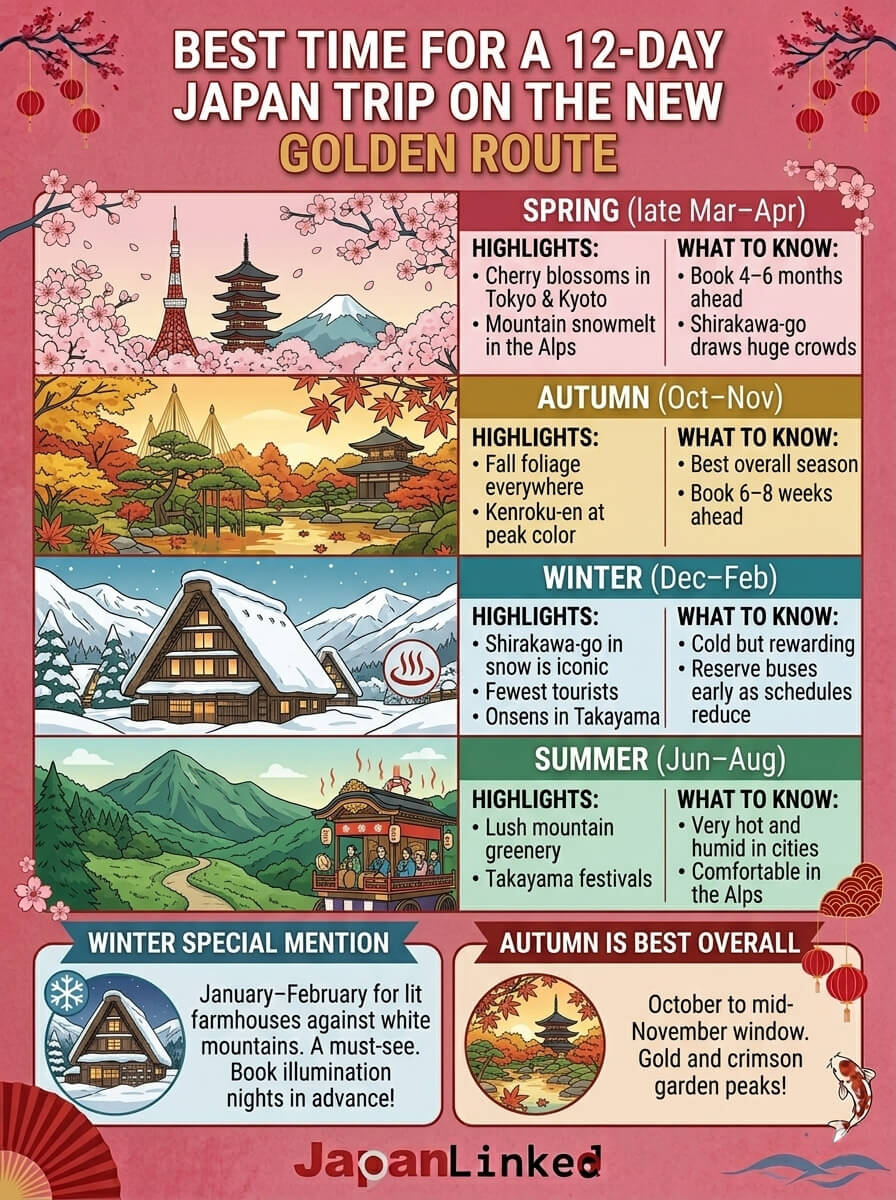
| Season | Highlights | What to Know |
|---|---|---|
| Spring (late Mar–Apr) | Cherry blossoms in Tokyo & Kyoto; mountain snowmelt in the Alps | Book 4–6 months ahead; Shirakawa-go draws huge crowds |
| Autumn (Oct–Nov) | Fall foliage everywhere; Kenroku-en at peak color | Best overall season; book 6–8 weeks ahead |
| Winter (Dec–Feb) | Shirakawa-go in snow is iconic; fewest tourists; onsens in Takayama | Cold but rewarding; reserve buses early as schedules reduce |
| Summer (Jun–Aug) | Lush mountain greenery; Takayama festivals | Very hot and humid in cities; comfortable in the Alps |
Winter deserves special mention for this specific route. Shirakawa-go, blanketed in snow — with lit farmhouses glowing against white mountains — is one of the most photographed images in Japan.
If you’re visiting January–February, going slightly out of your way for this scene is worth every degree of cold. The village even holds special illumination nights in winter with advance reservations.
Autumn remains the overall best season for a first 12-day trip: Kenroku-en Garden in gold and crimson, Kyoto temple gardens at peak foliage, and Takayama’s historic streets under fall light. October through mid-November is the window.
Budget Guide: 12 Days in Japan
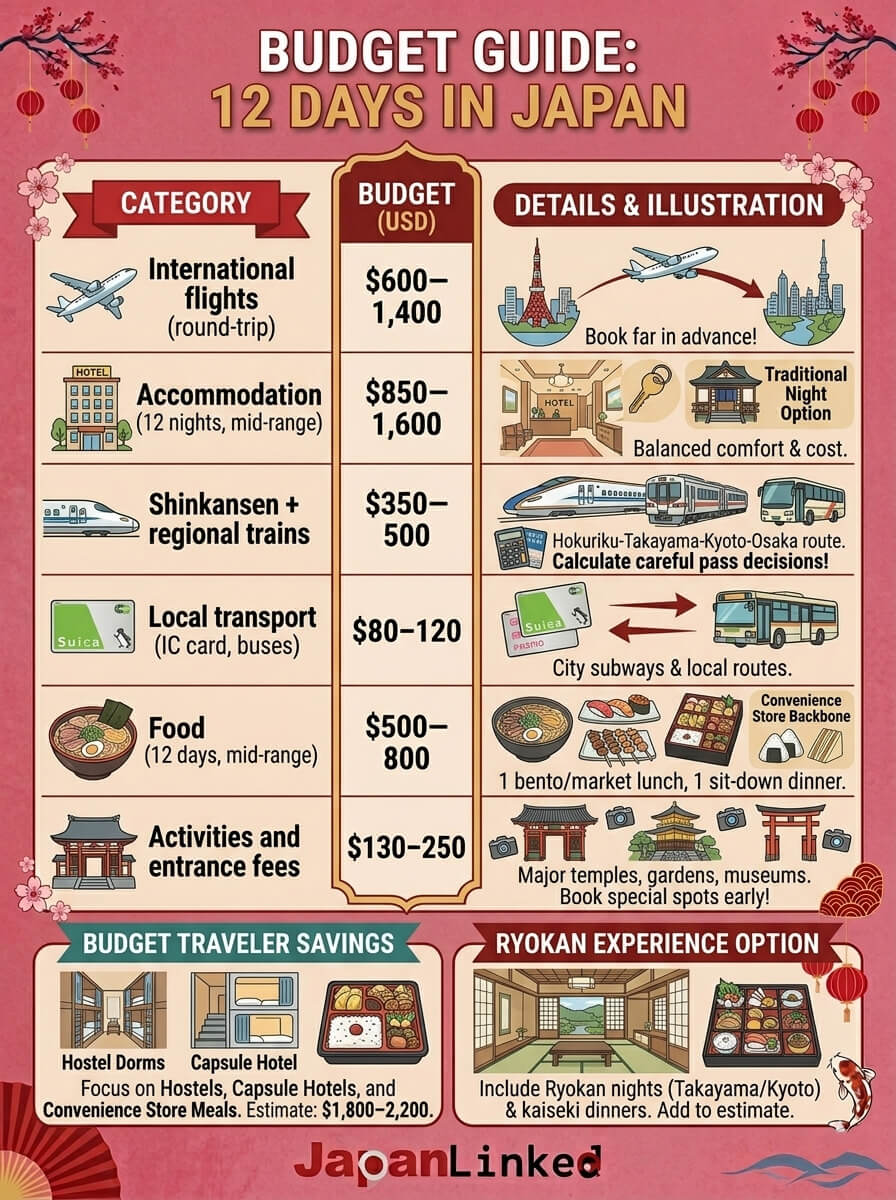
| Category | Budget (USD) |
|---|---|
| International flights (round-trip) | $600–1,400 |
| Accommodation (12 nights, mid-range) | $850–1,600 |
| Shinkansen + regional trains | $350–500 |
| Local transport (IC card, buses) | $80–120 |
| Food (12 days, mid-range) | $500–800 |
| Activities and entrance fees | $130–250 |
| Total mid-range estimate | $2,500–4,600 |
Budget travelers using hostels, capsule hotels, and convenience store meals can bring this closer to $1,800–2,200.
Ryokan nights (Takayama and/or Kyoto), kaiseki dinners, and premium experiences push it significantly higher – all of which are worth every yen.
Conclusion
Twelve days in Japan on the New Golden Route gives you something most first-time visitors never experience: the full contrast of Japan. Tokyo’s electric modern scale.
Kanazawa’s feudal refinement. Takayama’s Edo-era mountain is quiet. Shirakawa-go’s ancient village magic. Kyoto’s temple grandeur. Hiroshima’s weight and resilience.
And Osaka’s complete, unembarrassed devotion to the pleasures of eating. That’s not a list of destinations. It’s a country’s entire personality.
Come back with more time if you can. But for a first trip, this itinerary delivers everything Japan promises — and a few things it never advertised.
Wake up early, eat everything, let the mountains slow you down, and let Osaka speed you back up.
