
Five days in Japan forces a decision that every other Japan itinerary gets to avoid: you can’t have everything.
In a week, you can squeeze in Tokyo and a shinkansen trip to Kyoto. With ten days, you have room to breathe in both and still add Hiroshima.
But 5 days in Japan is the constraint that demands a real choice – and most itineraries dodge it by cramming in four cities, two day trips, and a bullet train ride on Day 4 that leaves you jet-lagged, rushed, and barely present for any of it.
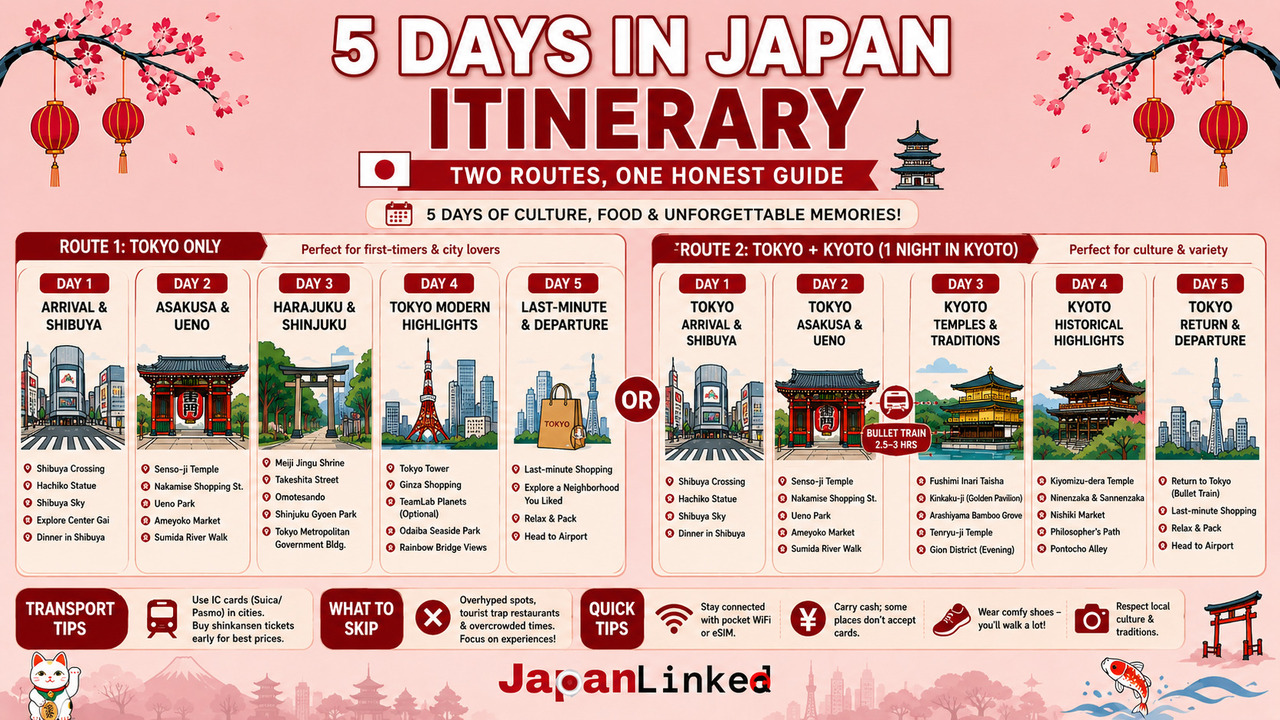
This guide doesn’t do that. Instead, I laid out two distinct 5-day Japan itineraries, each built around a different travel priority, and helps you choose the right one honestly.
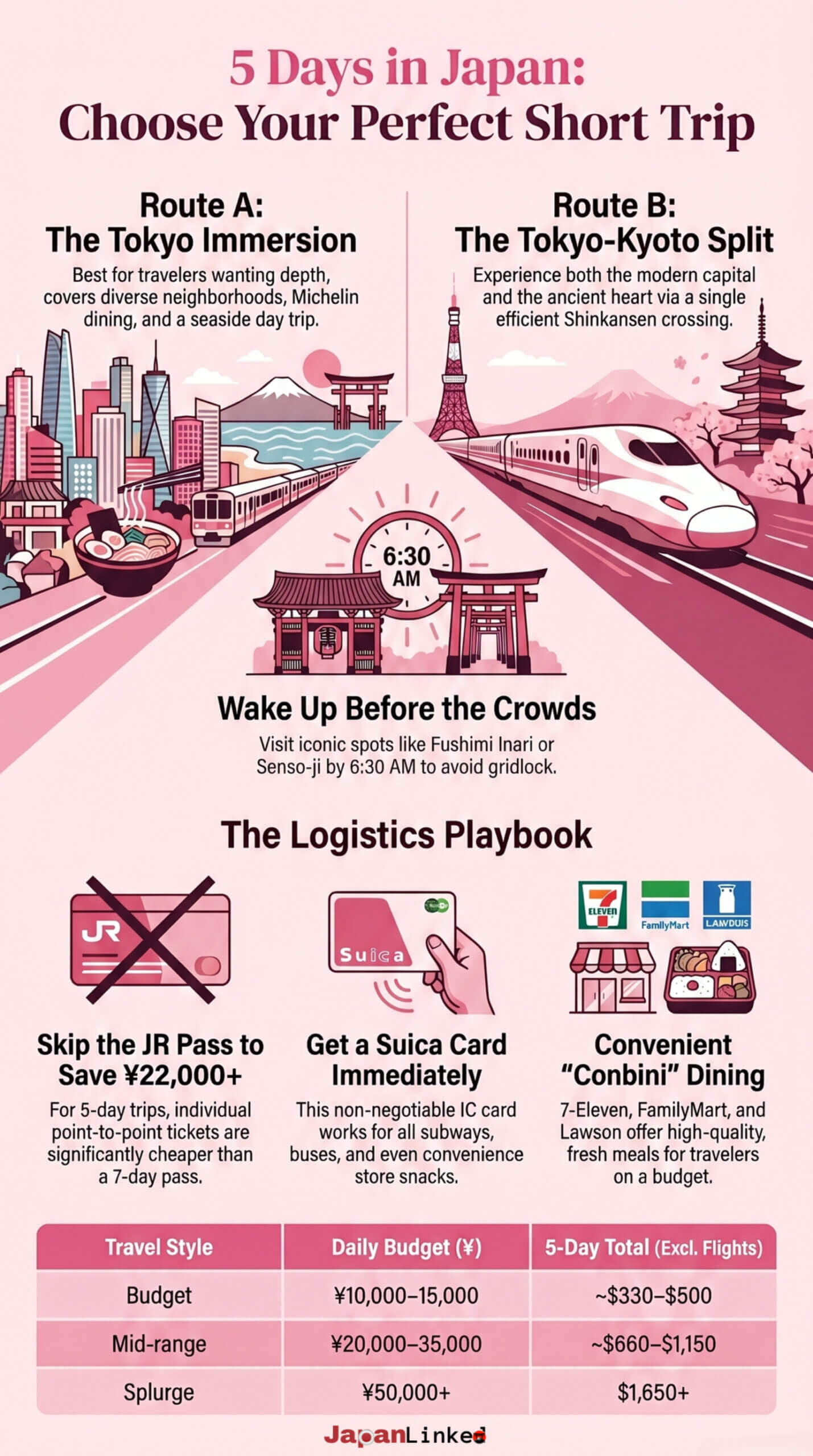
Route A keeps you in Tokyo the entire time – because Tokyo alone at a reasonable pace is one of the world’s great travel experiences.
Route B splits the trip between Tokyo and Kyoto – Japan’s modern capital and its ancient heart – with a single efficient Shinkansen crossing. Both are complete, satisfying, and genuinely doable. Neither requires you to eat breakfast on a bullet train.
Before You Go: The 5-Day Logistics Playbook
Skip the JR Pass – Completely
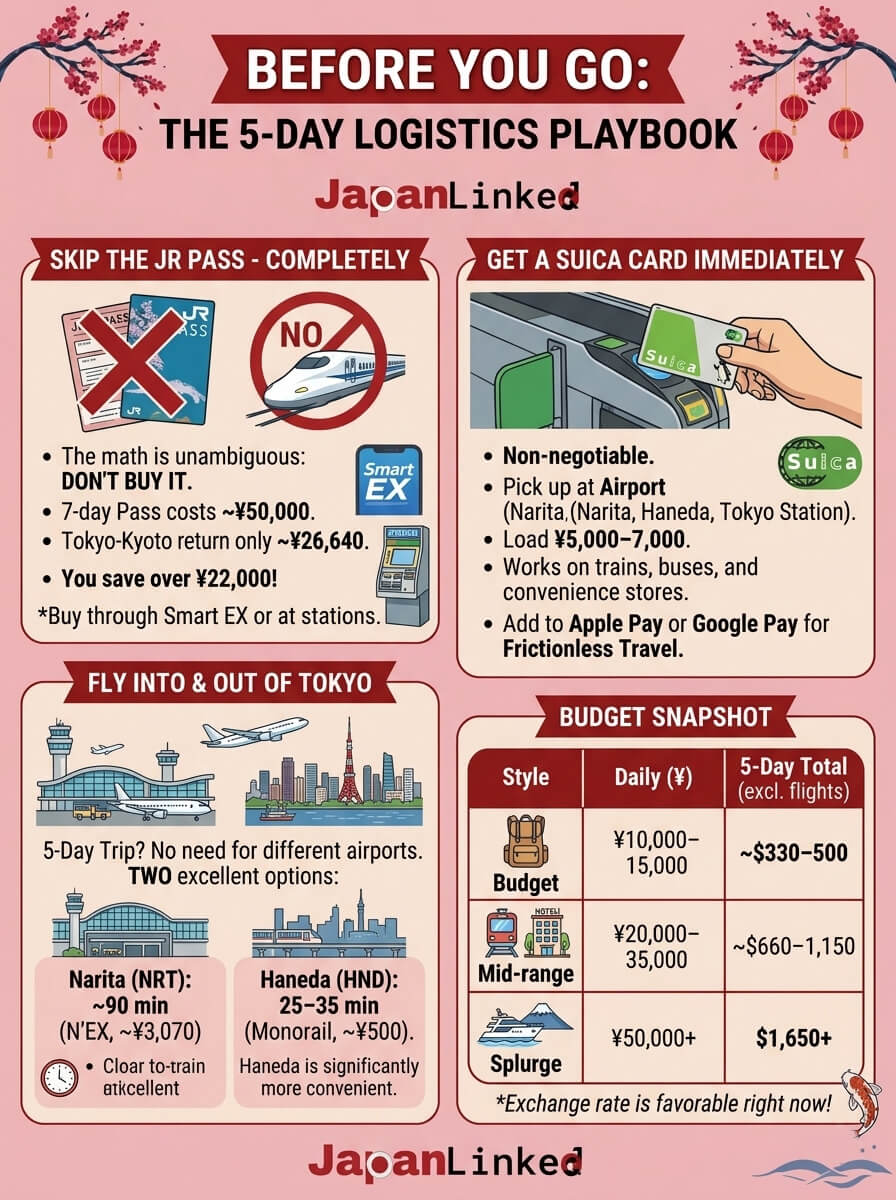
This is the one itinerary in the Japan travel universe where the JR Pass math is unambiguous: don’t buy it.
The 7-day Japan Rail Pass costs ¥50,000 (~$330 USD). For a Tokyo-only trip, you won’t come close to that in train costs.
For a Tokyo–Kyoto split, a one-way Shinkansen is ¥13,320 (~$88) and a return adds another ¥13,320 – a total of ¥26,640 even if you go back. That’s nearly ¥23,000 less than the pass price, with change left over for three bowls of ramen.
For a Tokyo–Kyoto one-way or return trip, individual tickets save over ¥22,000 compared to the JR Pass. The math is clear.
Buy point-to-point Shinkansen tickets through Smart EX (the official JR app) or at station ticket machines on the day of travel.
Get a Suica Card Immediately
This, however, is non-negotiable. Pick up a Suica or Pasmo IC card at the airport – either at Narita, Haneda, or Tokyo Station – the moment you arrive.
Load it with ¥5,000–7,000. It works on every subway line, local train, bus, and convenience store in Tokyo, Kyoto, and Osaka. Add it to Apple Pay or Google Pay for completely frictionless travel: tap in, tap out, done.
Fly Into – and Out Of – Tokyo
For a 5-day trip, there’s no reason to fly in and out of different airports. Tokyo has two excellent international options: Narita (90 minutes from the city by Narita Express, ~¥3,070) and Haneda (25–35 minutes by Tokyo Monorail, ~¥500). Haneda is significantly more convenient if your airline serves it. Check both when booking.
Budget Snapshot
| Travel Style | Daily Budget (¥) | 5-Day Total (excl. flights) |
|---|---|---|
| Budget | ¥10,000–15,000 | ~$330–500 |
| Mid-range | ¥20,000–35,000 | ~$660–1,150 |
| Splurge | ¥50,000+ | $1,650+ |
Japan’s favorable exchange rate right now makes these figures more accessible than they’ve been in years. A mid-range day comfortably covers a clean hotel, two proper restaurant meals, transit, and an attraction or two.
Also Read: 2 Week Japan Itinerary & 3 Week Japan Itinerary
Route A: 5 Days in Tokyo
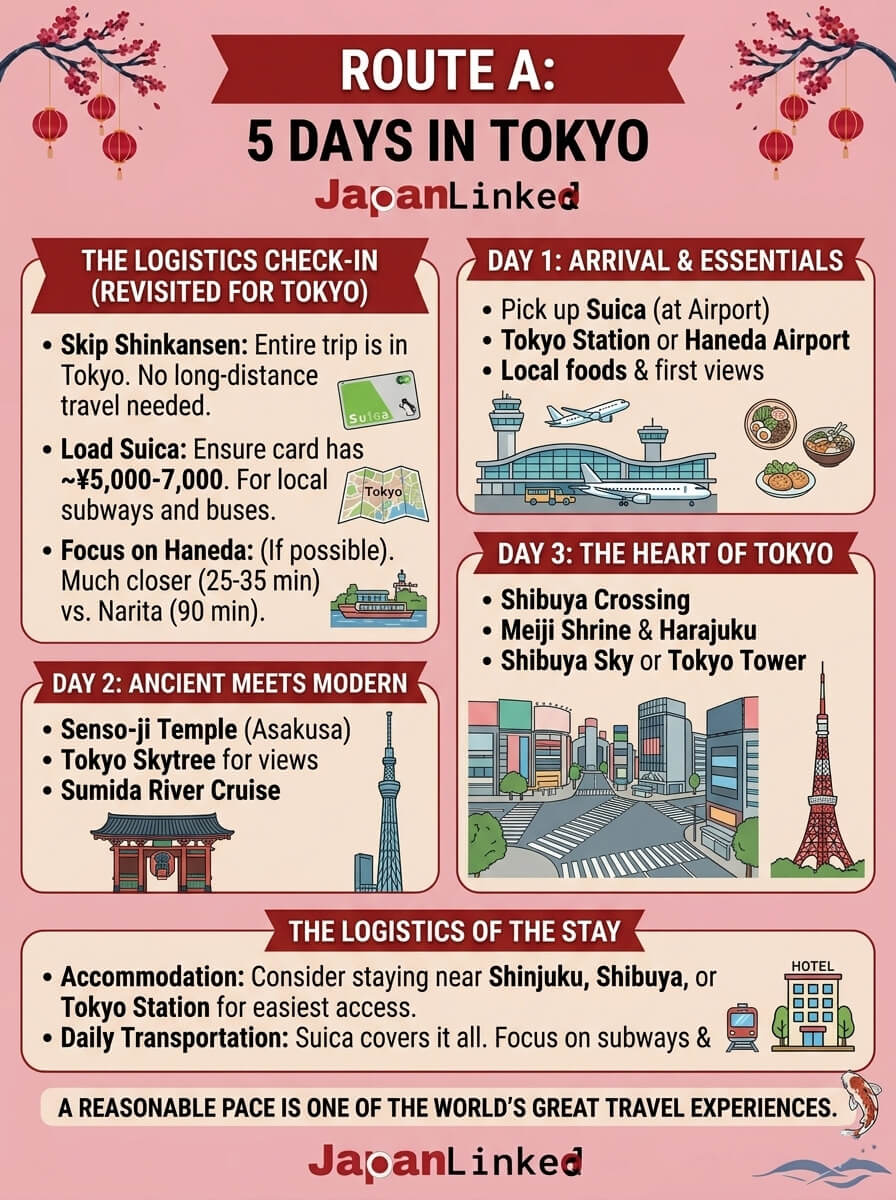
Best for: First-time visitors who want depth over breadth, travelers on a stopover from a longer trip, anyone who finds the idea of spending five days in the world’s most complex city genuinely exciting
Tokyo is not a city you “see.” It’s a city you inhabit. It contains more Michelin-starred restaurants than any city on Earth, more distinct neighborhoods than most countries have cities, and enough subcultures, markets, shrines, and street-level strangeness to fill a month. Five days here is not a consolation prize. It’s a proper immersion.
Day 1: Land and Anchor
Beat jet lag by letting it work for you.
- Tsukiji Outer Market (open from ~5:30 AM) — Arrive jet-lagged and hungry to one of the world’s great food markets. Fresh sushi at a standing counter, vendors shouting across stalls, steam rising from grills in the early morning quiet. This is Japan’s welcome ceremony
- Asakusa and Senso-ji Temple — Tokyo’s oldest and most beloved temple, with the famous Kaminarimon gate at the shopping street entrance. Arrive before 8 AM for near-solitude; by mid-morning it belongs to tour buses
- Akihabara — Cross the river for an afternoon in the city’s electronics and anime district. Even if neither is your thing, the layered, fluorescent energy is unlike anywhere else on the planet
- Omoide Yokocho, Shinjuku — A narrow alley of tiny yakitori stalls jammed into a space that feels unchanged since 1960. Sit at a counter with cold beer and grilled skewers. This is how Day 1 ends
Day 2: The Famous and the Fashionable
- Shibuya Crossing — The world’s most famous pedestrian scramble. Go before 9 AM for the cleanest photos, or revisit after 10 PM for the neon-lit version. Book Shibuya Sky (the rooftop observation deck) 2–3 weeks ahead — sunset slots sell out reliably
- Harajuku — Takeshita Street’s maximalist street fashion is best before noon. Walk five minutes and you’re in the towering forested calm of Meiji Shrine, one of the most jarring beautiful contrasts in the city
- Shimokitazawa — Tokyo’s most beloved local neighborhood: independent bookshops, vintage clothing stores, tiny live music venues, and coffee roasters. No tourist infrastructure, just the real city. Spend the afternoon here
Day 3: Old Tokyo
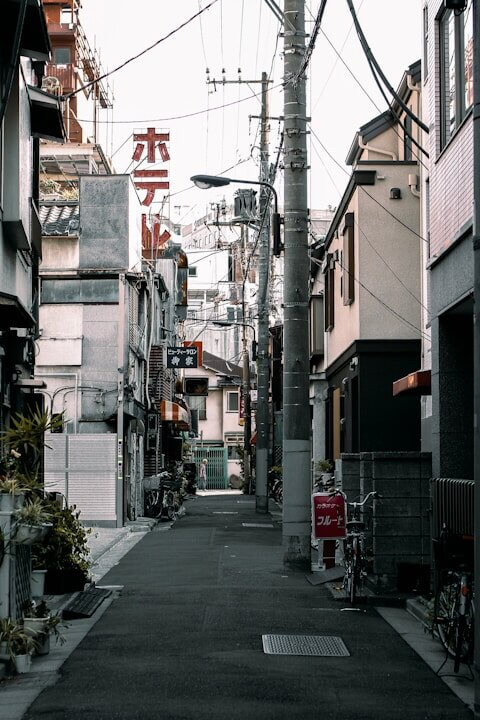
- Yanaka — A historic neighborhood that survived Tokyo’s wartime bombing and still looks like it did a century ago. Narrow lanes, wooden shopfronts, temple graveyards, and a covered shopping street that operates at about half the speed of the rest of the city
- Ueno Park — Home to four of Tokyo’s best museums (Tokyo National Museum, National Museum of Nature and Science, Tokyo Metropolitan Art Museum, National Museum of Western Art) and a large pond ringed with food stalls. Pick one museum and spend the rest of the time wandering
- Akihabara for those who missed it, or Koenji for an alternative Shimokitazawa vibe
Book in advance: teamLab Planets (digital art museum in Toyosu) needs booking 1–2 weeks ahead. The Ghibli Museum in Mitaka releases tickets on the 10th of each month for the following month — set a reminder. These sell out fast and cannot be bought at the door.
Day 4: Day Trip – Kamakura or Nikko
Use Day 4 to leave Tokyo entirely.
Option A: Kamakura (1 hour south by JR Yokosuka Line, ¥920 each way) A seaside temple town with the famous Great Buddha (Kotoku-in), the atmospheric bamboo grove of Hokokuji Temple, and hiking trails connecting Zen temples along forested ridgelines above the Pacific. Relaxed pace, completely different energy from the capital.
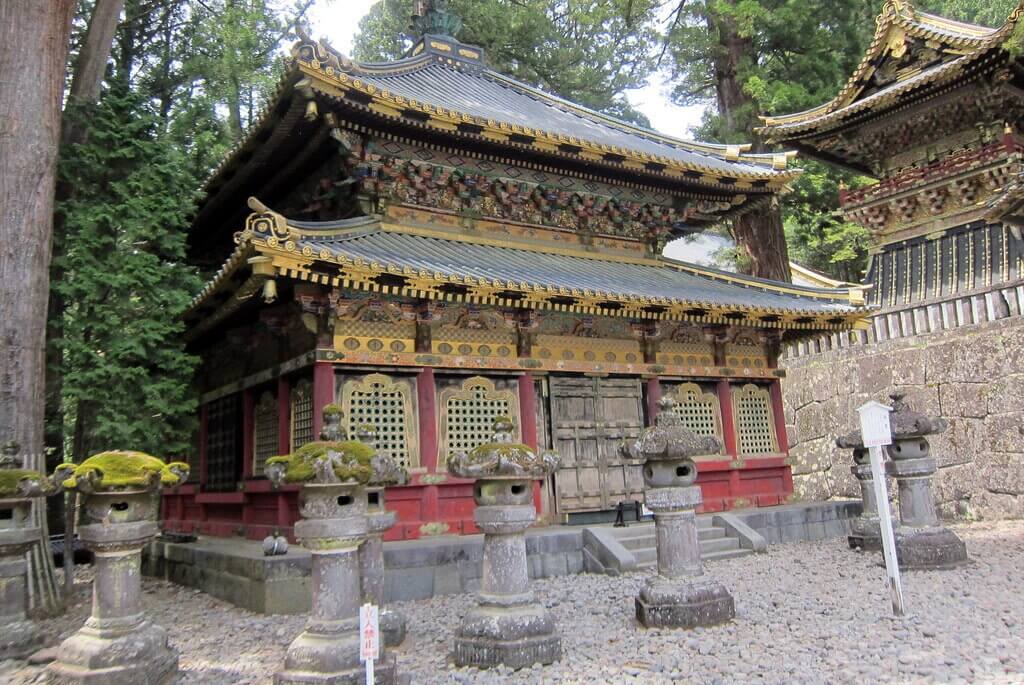
Option B: Nikko (2 hours north by JR from Shinjuku, ¥2,720 each way) Japan’s most ornately decorated shrine complex, set in a valley of ancient cedar forest. The Tosho-gu Shrine is a baroque explosion of gold leaf, lacquer, and carved animals – the polar opposite of Kyoto’s restrained Zen aesthetic. Dramatic and genuinely unlike anywhere else.
Option C: Hakone (85 minutes from Shinjuku by Romancecar express, ~¥2,200) Hot springs, mountain scenery, and – on a clear day – the best accessible views of Mount Fuji from Lake Ashi. If you want to tick Mount Fuji off the list without building a full day trip around it, Hakone is the answer. Note: the famous Hakone Round Course works better as an overnight, but a focused day hitting the ropeway and lake is still worthwhile.
Day 5: Slow Tokyo
Your last day should feel different from the first four. Pick one part of the city and go deep instead of wide.
- Shinjuku Gyoen — One of Tokyo’s best large parks, with a greenhouse and sections styled as French formal garden, English landscape garden, and traditional Japanese garden. Perfect for a slow morning
- Ginza for high-end shopping and gallery browsing, or Koenji for a record shop crawl
- Tokyo Tower at dusk — not as modern as Shibuya Sky but more charming, and the views of the city grid stretching in every direction are remarkable
- Final dinner in Shinjuku or Shibuya — both have enough restaurant density that you can wander and choose based on what looks right
Also Read: 11 Days In Japan Itinerary & 10 Days In Japan Itinerary
Route B: 5 Days Split – Tokyo + Kyoto
Best for: First-time visitors who need to tick both cities, anyone whose Japan bucket list centres on temples and traditional culture, travelers who’ve already seen Tokyo and want their first Kyoto experience
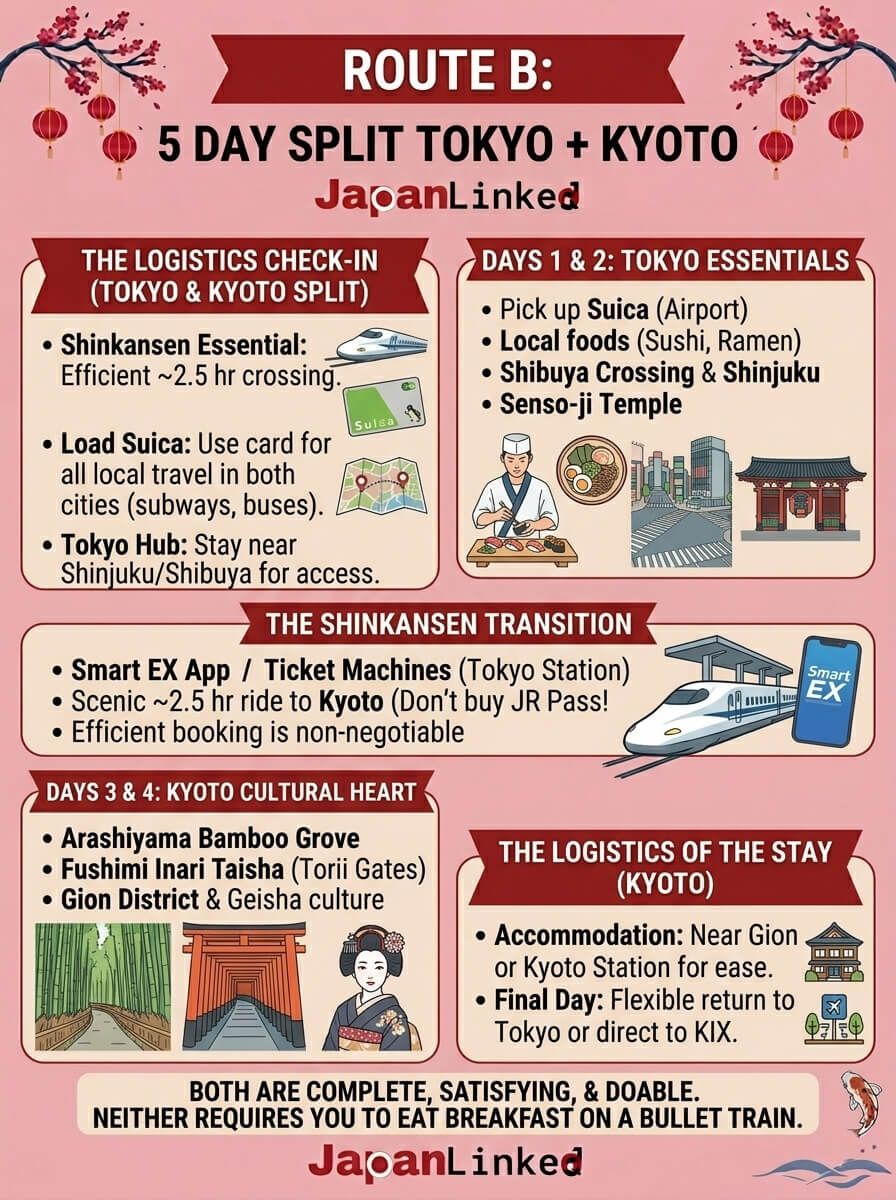
This route dedicates two full days to Tokyo, one half-day transit, and two full days to Kyoto. It is not the most relaxed way to do either city.
But it gives you the essential Japan contrast – the electric modern capital and the ancient cultural heartland – in a way that five days in Tokyo alone simply can’t.
The trade-off is honest: two days in Kyoto is genuinely tight. You’ll make choices and leave things out. That’s acceptable as long as you’re choosing the right two days rather than trying to cram in five days’ worth of temples.
Days 1–2: Tokyo (2 nights)
With only 48 hours in Tokyo, ruthless prioritization is required. Don’t try to see everything — pick two neighborhoods per day and go deep.
Day 1:
- Tsukiji Outer Market for breakfast at dawn (see above)
- Asakusa and Senso-ji in the morning
- Akihabara in the afternoon
- Shibuya Crossing in the evening (go for the view from Shibuya Sky — book ahead)
Day 2:
- Harajuku (Takeshita Street) + Meiji Shrine — the perfect morning pairing
- Shimokitazawa for the afternoon
- Final dinner in Shinjuku
Two Tokyo days is enough to feel the city’s energy without understanding it. That’s fine. Kyoto awaits.
Day 3: Transit to Kyoto + First Afternoon
Take an early Shinkansen from Tokyo Station. The 7:00–8:00 AM Hikari services arrive in Kyoto by 9:30–10:00 AM, giving you a near-full day.
The journey is spectacular – scan the right side of the train (seats D and E in unreserved cars) around Shizuoka for a clear-day view of Mount Fuji.
One-way Shinkansen ticket: ~¥13,320. Buy in advance through Smart EX or at the Tokyo Station ticket machines.
On arrival, store your main luggage in coin lockers at Kyoto Station (from ¥500/day) and head straight out.
Afternoon:
- Nishiki Market — Kyoto’s covered “kitchen” market, 400 metres of pickled vegetables, fresh tofu, matcha sweets, and skewered snacks. Go hungry
- Fushimi Inari Shrine — 10,000 red torii gates winding up a forested mountain. This is Japan’s most photographed site and deserves an early morning visit — which means going the next morning. Today, walk the lowest section in the late afternoon to see it in good light without the worst crowds
Evening: Check into your hotel. If you’re doing one ryokan night in Japan, Kyoto is the right city and tonight is the night — tatami, yukata, multi-course kaiseki dinner. Budget for ¥20,000–35,000 per person (dinner and breakfast included) at a mid-range ryokan.
Day 4: Full Day in Kyoto – The Essential Experiences
This is the day you plan the entire trip around.
Dawn: Fushimi Inari Leave by 6:15 AM. At 6:30, with morning light filtering through the vermillion gates and almost no one else around, you’ll understand why this is what it is. Walk at least to the Yotsutsuji viewpoint halfway up — 40 minutes from the entrance — for panoramic views over Kyoto below. By 9 AM it’s gridlocked with tour groups.
Morning: Higashiyama District Return to central Kyoto and walk the preserved stone-paved lanes of the Higashiyama historic district. These narrow streets connecting Kiyomizudera Temple to the Gion neighborhood are the most evocative stretch of the Japan you imagined before you arrived. Kiyomizudera itself (¥500), perched on a forested hillside with a wooden stage extending over the valley, is among the most beautiful temple complexes in the country.
Afternoon: Arashiyama Take bus or train west.
- Arashiyama Bamboo Grove — Again, you visited Fushimi Inari at dawn. Most people didn’t. The bamboo grove is busiest at midday; if you arrive around 1–2 PM on a weekday, it’s manageable. The sound of bamboo creaking and rustling in the wind is genuinely unlike anything else
- Tenryu-ji Temple Garden (¥500) — A UNESCO-listed Zen garden with a central pond framing borrowed mountain scenery. One of the most refined landscapes in Japan
Evening: Gion Walk the Hanamikoji-dori street in Gion between 5–8 PM. Traditional wooden townhouses, lanterns lit at dusk, and the chance — not guaranteed, but real — of spotting a geisha or maiko moving between appointments. Don’t photograph them directly; watch from a respectful distance.
Book before Kyoto: A traditional matcha tea ceremony (¥1,500–3,500, about 1 hour) in the Higashiyama area is worth booking online in advance. It’s one of those experiences that contextualizes everything else you see in Kyoto.
Day 5: Nara Day Trip + Return to Tokyo
Nara is 45 minutes from Kyoto by Kintetsu Express (¥760 one way) and one of Japan’s most memorable half-days.
- Nara Park — hundreds of freely roaming deer that have lived alongside humans in these grounds for over 1,200 years. They bow for rice crackers (¥150 from vendors at the entrance), making the whole experience veer into the surreal
- Todai-ji Temple (¥600) — Japan’s largest bronze Buddha inside the world’s largest wooden building. The scale in person is staggering; nothing prepares you for it
- Leave Nara by early afternoon
Return to Kyoto Station, collect your luggage from the coin lockers, and board the Shinkansen back to Tokyo for your flight.
Flight logistics: Narita Express from Tokyo Station to Narita takes 53–80 minutes. Leave Kyoto with enough buffer – allow at least 3.5 hours from Kyoto Station departure to flight boarding time at Narita.
Also Read: 1 Week In Japan Itinerary
Tips That Apply to Both Routes
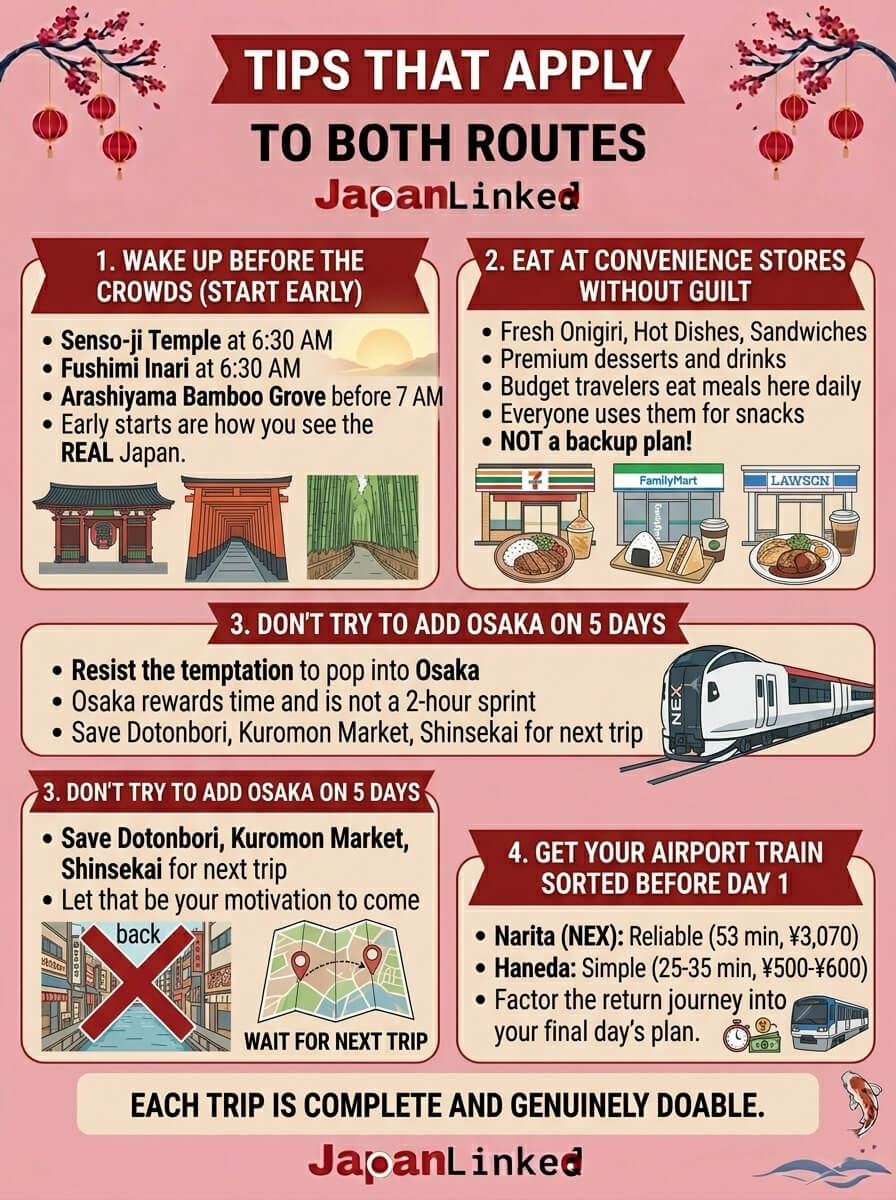
Wake up before the crowds. Senso-ji at 6:30 AM. Fushimi Inari at 6:30 AM. Arashiyama Bamboo Grove before 7 AM. Every single famous spot in Japan is a different place in the hour after dawn than it is at 10 AM. On a 5-day trip, those early starts are not optional – they’re how you see the real thing.
Eat at convenience stores without guilt. Japan’s 7-Eleven, FamilyMart, and Lawson stores serve genuinely excellent food — fresh onigiri, hot dishes, premium sandwiches, and desserts that would hold their own in any café. Budget travelers eat multiple meals here daily. Everyone uses them for snacks. They are not a backup plan.
Don’t try to add Osaka on 5 days. If you’re doing Route B, the temptation to pop into Osaka from Kyoto for even a few hours is real. Resist it. Osaka rewards time — wandering Dotonbori, eating your way through Kuromon Market, getting lost in Shinsekai — and a two-hour sprint between bullet trains leaves you with nothing except the memory of being rushed. Save it for your next trip, and let that be motivation to come back.
Get your airport train sorted before Day 1. Narita Airport is further from Tokyo than most international airports are from their cities. The Narita Express (NEX) from Tokyo Station is the most reliable option (53 min, ¥3,070). Haneda is far simpler — Tokyo Monorail or Keikyu Line, 25–35 min from the city. Factor the return journey into your final day’s plan.
Best Time for a 5-Day Japan Trip
| Season | What to Expect | Key Consideration |
|---|---|---|
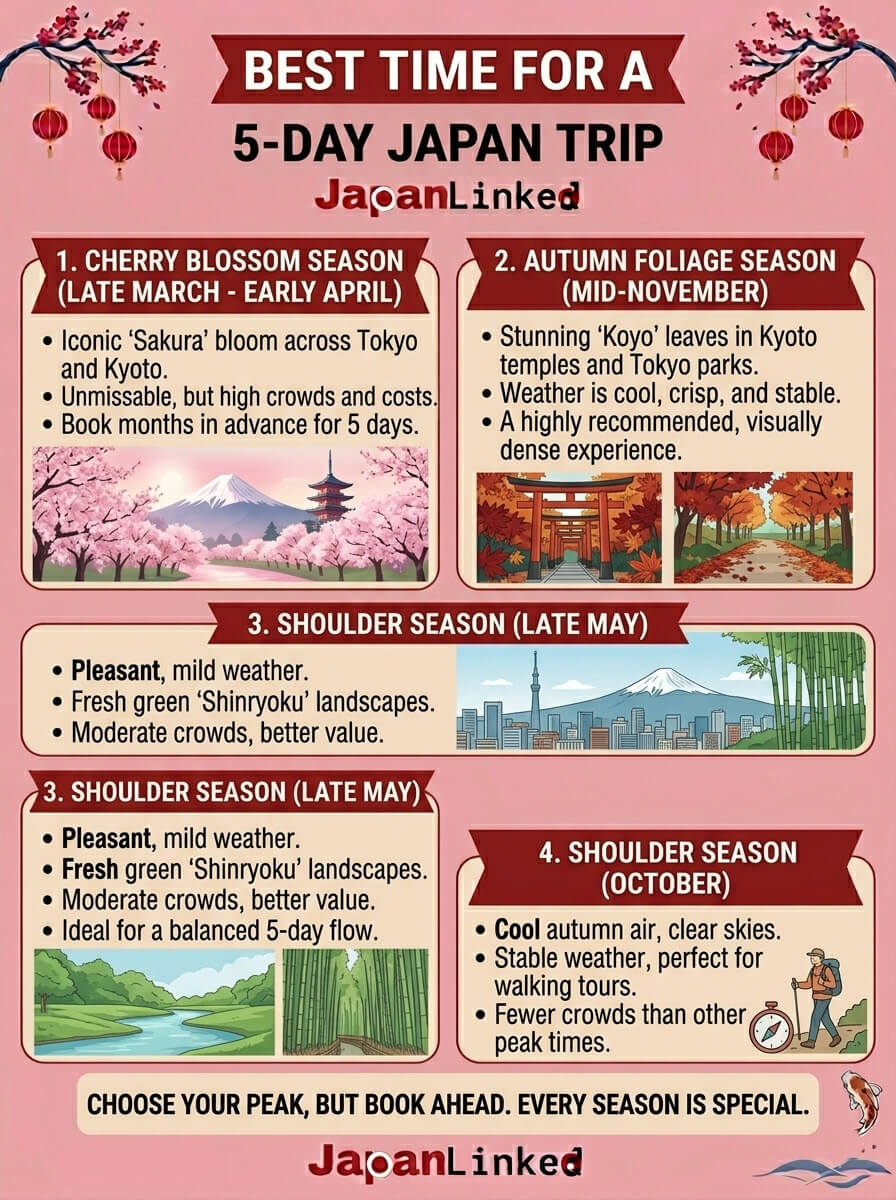
| Spring (late Mar–Apr) | Cherry blossoms; pink-tinted Tokyo and Kyoto | Book hotel 3–5 months ahead; prices spike significantly |
| Autumn (Oct–Nov) | Fall foliage, comfortable weather | Best season for short trips; less intense than spring |
| Winter (Dec–Feb) | Fewest crowds, lowest prices | Cold but manageable; Kyoto in snow is exceptional |
| Summer (Jun–Aug) | Festivals and fireworks | Very hot and humid; June is rainy season |
For a 5-day trip specifically, autumn is the most forgiving choice. October through mid-November brings comfortable walking temperatures, vivid foliage in Kyoto’s temple gardens, and noticeably less crowd pressure than cherry blossom season, which is spectacular but requires booking months in advance and tolerating extraordinary congestion at every popular site.
Avoid Golden Week (late April–early May) entirely. Japan’s domestic holiday period overwhelms trains, temples, and hotels. A 5-day trip during Golden Week risks spending half of it navigating crowds rather than experiencing the country.
Conclusion
Five days in Japan is not a compromise. It’s a commitment to doing less, better — and that’s exactly the right philosophy for a country this rewarding.
If you take Route A, you’ll leave Tokyo with a genuine understanding of why people keep coming back.
If you take Route B, you’ll leave with the two most iconic Japan experiences under your belt and enough unfinished business to start planning your return before the plane lands.
Either way: get a Suica card, wake up early, eat everything in sight, and let Japan do what Japan does – exceed expectations you didn’t know you had.
