
Japan has been quietly perfecting romance for centuries. It just doesn’t advertise it the way other destinations do.
There are no beachside proposals scripted by resort staff here, no generic “couples’ packages” involving rose petals and clichéd sparkling drinks.
What Japan offers instead is something rarer and more lasting: beauty that asks nothing of you except presence.
Ancient lantern-lit streets where you walk close together because the lanes are narrow.
Private hot spring baths steaming under an open mountain sky. A kaiseki dinner where twelve courses arrive over three hours, and you lose track of time entirely. A bamboo forest at dawn, where the only sound is the wind.
A Japan honeymoon delivers all of this – and it does so across a country dramatic enough to feel like an adventure, refined enough to feel like a luxury retreat, and surprising enough that two people experiencing it together will have something to talk about for the rest of their lives.
This guide offers a Japan honeymoon itinerary centered on the country’s most romantic experiences, with planning advice and seasonal guidance to make your trip beautiful.
Why Japan Is One of the World’s Great Honeymoon Destinations
Japan consistently ranks among the top honeymoon destinations globally – and for good reason.
It combines the intimacy of traditional culture with the comfort of impeccable service, the drama of natural landscapes with the ease of world-class infrastructure.
A few things Japan does better than almost anywhere else for honeymooners:
- Ryokan hospitality — traditional inns where everything is arranged for your comfort: tatami rooms, yukata robes, multi-course dinners served privately, and hot spring baths that feel designed for exactly this moment
- Private onsen experiences — rooms with dedicated open-air baths (kashikiri rotenburo) where you soak together in mineral spring water overlooking mountain forest or snow-covered gardens
- Kaiseki cuisine — Japan’s haute cuisine, served course by course over hours, is one of the world’s most intimate dining experiences. The pacing is built for conversation
- Cultural experiences for two — tea ceremonies, kimono dressing, sake tastings, pottery classes — Japan has an exceptional density of shared experiences that become couple’s memories
Historically, Japan may have invented the honeymoon itself. Ryoma Sakamoto, one of the most celebrated figures of the Meiji Restoration, took what is considered Japan’s first documented honeymoon with his wife, Oryo, in 1866, traveling to Kirishima in Kyushu to recover from injuries and explore the hot springs together. The tradition runs deep.
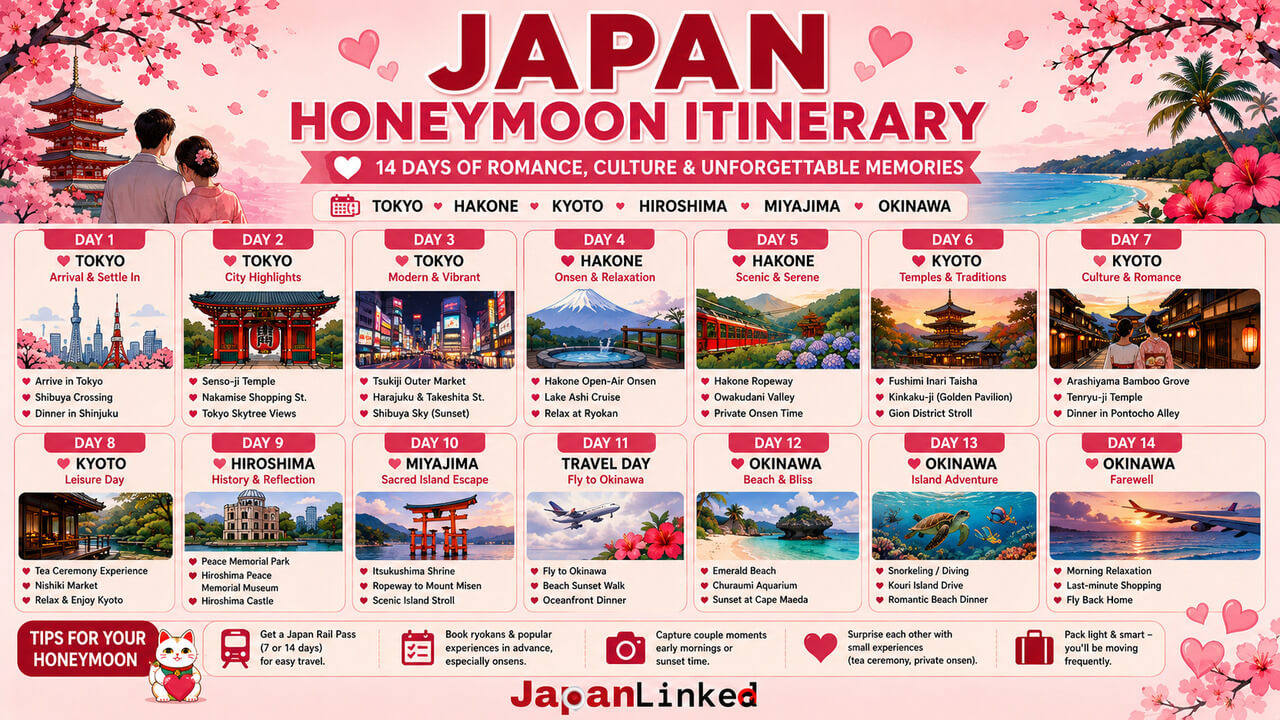
The Japan Honeymoon Itinerary: 14 Days
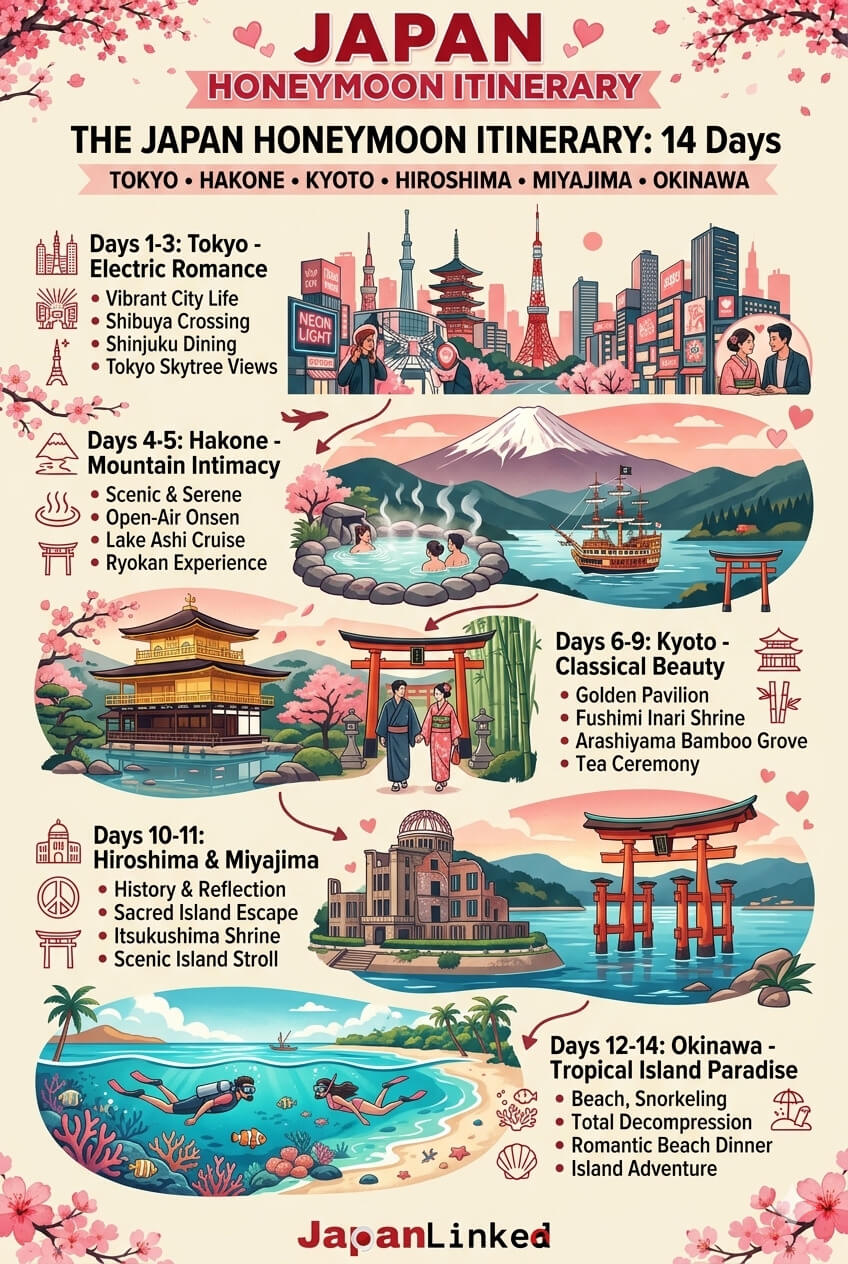
This itinerary is designed for two weeks – the ideal length for a Japan honeymoon.
It flows from Tokyo’s electric romance through Hakone’s mountain intimacy, into Kyoto’s classical beauty, and ends with a few days in Okinawa – Japan’s tropical island paradise – for beach, snorkeling, and total decompression.
Overview:
- Days 1–3: Tokyo
- Days 4–5: Hakone
- Days 6–9: Kyoto
- Days 10–11: Hiroshima & Miyajima
- Days 12–14: Okinawa
Fly into Tokyo (Narita or Haneda), fly home from Okinawa’s Naha Airport. The open-jaw routing eliminates backtracking and ends the honeymoon on a beach – exactly as it should.
Also Read: 2 Week Japan Itinerary & 3 Week Japan Itinerary
Days 1–3: Tokyo – Romance in the World’s Most Layered City
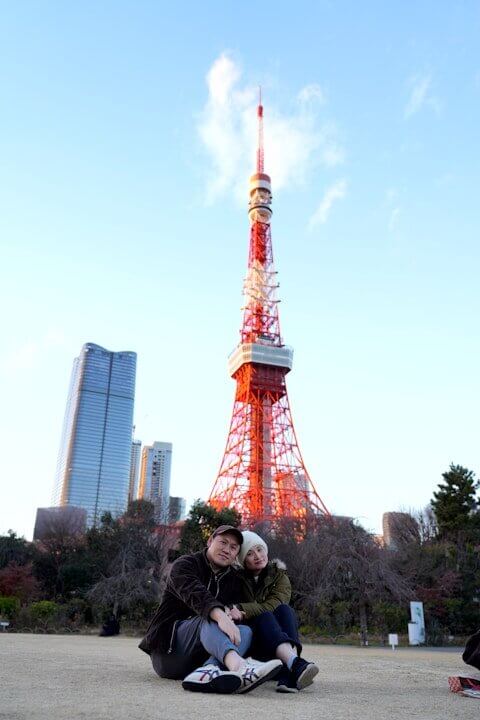
Tokyo is overwhelming in the best possible way. For a honeymoon, the key is filtering its infinite options into experiences that feel personal and unhurried.
Three days here is the right amount – enough to fall in love with the city without letting it exhaust you.
Day 1: Arrive and Breathe
Your first evening should be slow. Jet lag is real; don’t fight it.
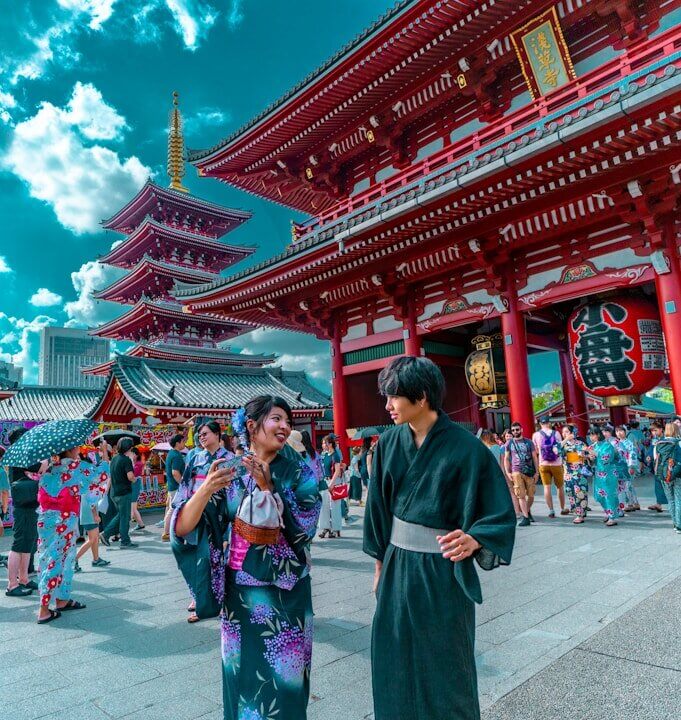
- Check into your hotel and take a walk through Asakusa after dinner — the illuminated Senso-ji Temple at night, with paper lanterns glowing along the Nakamise Dori, is one of Tokyo’s most quietly romantic scenes
- Find a small izakaya (Japanese pub) in the backstreets near Asakusa for your first Japanese meal together: skewered yakitori, cold draft beer, sake poured from small ceramic flasks. Izakayas are convivial and intimate in a way that larger restaurants aren’t
- Early to bed — you’ll want to be up before dawn tomorrow
Day 2: Iconic Tokyo for Two
- Meiji Shrine at dawn — the forested approach to the shrine before the crowds arrive is one of Tokyo’s great experiences. Write your wishes together on ema (wooden prayer plaques) and hang them among the hundreds of others already there
- Shimokitazawa for the afternoon – Tokyo’s most charming neighborhood: independent bookshops, vinyl record stores, flower-filled cafés, and the kind of unhurried street energy that invites you to slow down and wander without a plan
- Shibuya Sky observation deck at sunset — book this 2–3 weeks ahead. The rooftop view of Tokyo at golden hour, with the city spread in every direction, is genuinely breathtaking. This is the photograph you’ll frame
Day 3: Couples’ Experiences
Tokyo has an exceptional concentration of shared experiences designed for two.
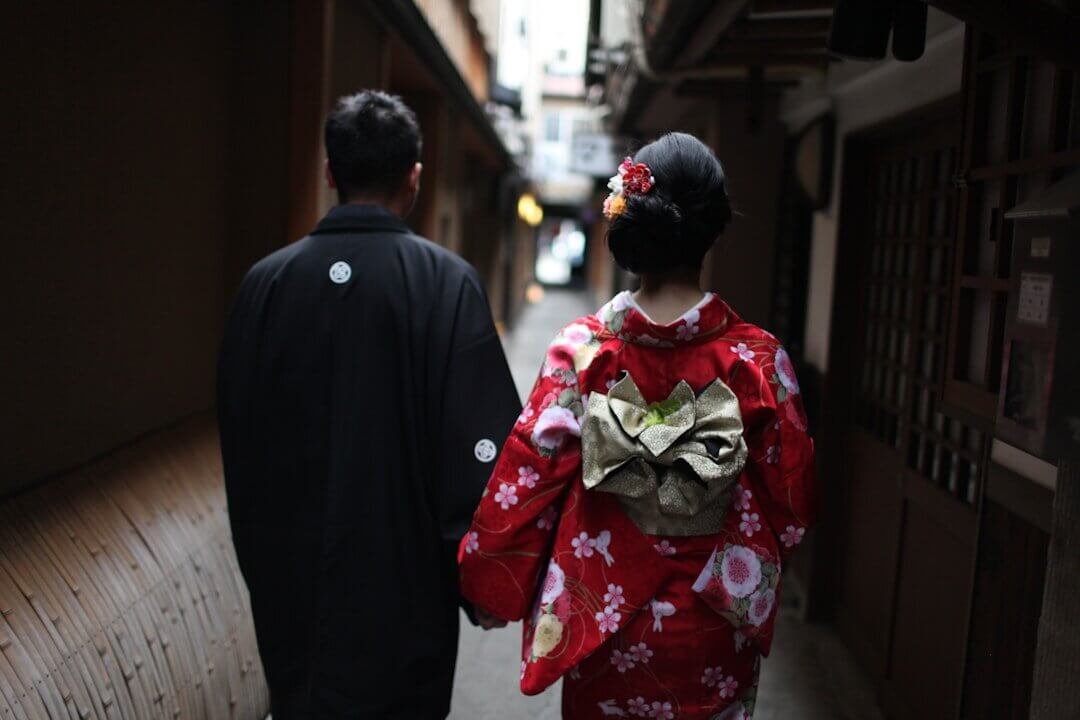
- Kimono rental in Asakusa — dress in traditional kimono together and walk through the Asakusa historic district. Several rental shops offer full styling including hair; allow 2–3 hours. The photographs from this morning will be among the best of the entire trip
- Cooking class — a private or small-group sushi, ramen, or wagyu class in Tokyo is a wonderful honeymoon activity. Several operators in Shinjuku and Ginza offer 2–3 hour sessions for about ¥12,000–18,000 per person
- Dinner at a kappo or omakase restaurant — for a truly romantic Tokyo dinner, book an omakase sushi counter where the chef prepares dishes personally, course by course. Budget ¥20,000–40,000 per person for a memorable experience at a well-regarded counter; book weeks in advance
Tokyo honeymoon tip: For something uniquely intimate, book a private tea ceremony for two. Several studios in Tokyo offer private (rather than group) sessions for around ¥8,000–15,000. Sitting across from each other in a tatami room while a practitioner walks you through the ritual of preparing and receiving matcha creates a quiet, surprisingly moving experience.
Days 4–5: Hakone – The Onsen Honeymoon

How to get there: Romancecar express from Shinjuku, about 85 minutes
Hakone is where your honeymoon shifts into a different register entirely. This mountain resort town — built around volcanic hot springs, dramatic scenery, and views of Mount Fuji — has been a couple’s retreat for generations of Japanese honeymooners. There is a reason for this.
Choosing Your Ryokan
For Hakone, the accommodation is the experience. Choose a ryokan with a private open-air onsen bath in the room (kashikiri rotenburo).
You’ll soak together in mineral spring water with the mountains or a garden visible through steam, wearing yukata robes, while dinner is laid out in courses in your room. This is the archetypal Japan honeymoon night.
Mid-range ryokan with private onsen in Hakone typically run ¥30,000–60,000 per couple per night (dinner and breakfast included).
The price includes everything: the room, yukata, access to communal baths, multi-course kaiseki dinner served in your room, and a traditional breakfast. The experience is worth every yen.
Look for properties around Kowakidani or Miyanoshita for the most atmospheric settings.
Day 4: The Hakone Round Course
The famous Hakone Round Course is a chain of transport modes — mountain railway, cable car, ropeway over volcanic vents, lake boat, bus — that loops through Hakone’s most dramatic scenery in a single day.
- Ride the Hakone Tozan Railway, zigzagging up the mountain through forest and seasonal flowers
- Take the ropeway over Owakudani — active volcanic vents billowing sulfur, with Mount Fuji appearing ahead on a clear day
- Cruise across Lake Ashi on the replica galleon boat with Fuji reflected on the water
- Pick up the Hakone Freepass (¥5,000–6,000 from Shinjuku) which covers all transport on the loop plus discounts at several attractions
Check into your ryokan by late afternoon. The evening — onsen, yukata, kaiseki dinner — is yours.
Day 5: Mount Fuji Views + Slow Morning
- If the weather is clear, a morning bus to Lake Kawaguchiko (one of the Fuji Five Lakes) for the reflection shot is worth the 45-minute journey. The calm water mirroring the mountain in morning light is Japan’s most recognizable image for a reason
- Hakone Open-Air Museum — a hilltop sculpture garden with 120 works across the hillside and a permanent Picasso collection. Allow 2 hours; the views from the upper terraces are exceptional
- A long afternoon in the onsen. You’re on a honeymoon. There is nothing else you need to do
Also Read: 11 Days In Japan Itinerary & 10 Days In Japan Itinerary
Days 6–9: Kyoto – Classical Romance
How to get there: Shinkansen from Odawara to Kyoto, approximately 2.5 hours
Kyoto is where Japan’s romance becomes architectural. Four nights here gives you room to move slowly, to sit in a garden without checking the time, to eat well without rushing to the next temple. The city rewards couples who come with no agenda except beauty.
Day 6: Eastern Kyoto at Dawn
- Fushimi Inari Shrine at 6:30 AM — the tunnel of 10,000 vermillion torii gates at first light, with almost no one else present. Walk hand in hand up the forested mountain path to the Yotsutsuji viewpoint. At dawn, this is one of the most romantic walks in Japan
- Kiyomizudera Temple in the morning — built into the Higashiyama hills with a wooden stage extending over the valley. The surrounding temple complex is vast; allow 90 minutes
- Higashiyama District in the late afternoon — wander the stone-paved preserved lanes with no particular destination. This is the Japan of every romantic imagination
Evening: Make a reservation at a Pontocho restaurant – particularly one with a terrace extending over the Kamo River (kawayuka seating, available May–September). Dining above the river, with lanterns reflecting on the water below, is one of Kyoto’s defining experiences.
Day 7: Arashiyama
- Arashiyama Bamboo Grove before 7 AM — the green-filtered light and the sound of bamboo in the wind at dawn. Go early. The difference between dawn and mid-morning here is absolute
- Tenryu-ji Temple Garden — a UNESCO-listed Zen garden of extraordinary beauty. Sit on the veranda and look at the pond for longer than you think you have time for
- Sagano Scenic Railway — a 25-minute open-air train ride through the Hozugawa River gorge, running between Torokko Sagano and Torokko Kameoka stations. One of the most scenic short rail journeys in Japan; particularly beautiful in autumn foliage
Afternoon: Consider a private tea ceremony for two in Arashiyama — several historic machiya townhouses offer private sessions in beautiful garden settings.
Day 8: Nara + Gion Evening
- Nara (45 minutes by Kintetsu Express) — the ancient capital’s 1,200-year-old deer park, the Great Buddha at Todai-ji, and the vermillion forest shrine of Kasuga Taisha. Take the afternoon slowly; Nara rewards wandering
- Return to Kyoto for Gion at dusk — walk the Hanamikoji-dori lantern-lit street between 5–8 PM. The chance of seeing a geisha or maiko passing between appointments adds to the sense of stepping back in time
- Dinner at a Gion restaurant — the neighborhood has some of Kyoto’s finest restaurants tucked behind wooden noren curtains
Day 9: Private Kyoto
Save this day for the experiences you couldn’t rush earlier.
- Kinkaku-ji (Golden Pavilion) in the early morning before crowds — the gold-leafed temple shimmering in its reflection pond is Kyoto at its most visually spectacular
- Nijo Castle — the shogun’s palace with “nightingale floors” designed to squeak as a security measure. The painted fusuma sliding doors inside are among the finest examples of Edo-period art
- Private sake tasting in Fushimi, Kyoto’s sake-brewing district — several kura (breweries) offer private tastings. Fushimi’s spring water has produced sake since the 8th century
Kyoto honeymoon splurge: A traditional kaiseki dinner at a Kyoto ryotei (formal Kyoto restaurant) is among the world’s great dining experiences. Budget ¥30,000–60,000 per person for a top-tier restaurant; book at least one month ahead. The meal will unfold over three hours across twelve or more courses tied to the season. It is not just dinner — it is an education in Japanese aesthetics.
Days 10–11: Hiroshima & Miyajima
How to get there: Shinkansen from Kyoto, approximately 1.5 hours
Day 10: Hiroshima
No Japan itinerary – honeymoon or otherwise – should skip Hiroshima. The city rebuilt after 1945 into something hopeful and alive, carrying a weight that draws couples closer together.
- Peace Memorial Park and Museum in the morning — allow 2 hours for the museum. Go before the tour groups arrive
- Hiroshima-style okonomiyaki for lunch at Okonomimura — the city’s layered savory pancake, made at the counter in front of you
- The afternoon is yours — Hiroshima is a beautiful, walkable city with excellent cafés, covered shopping arcades (shotengai), and a relaxed pace that feels genuinely different from Kyoto’s intensity
Day 11: Miyajima Island
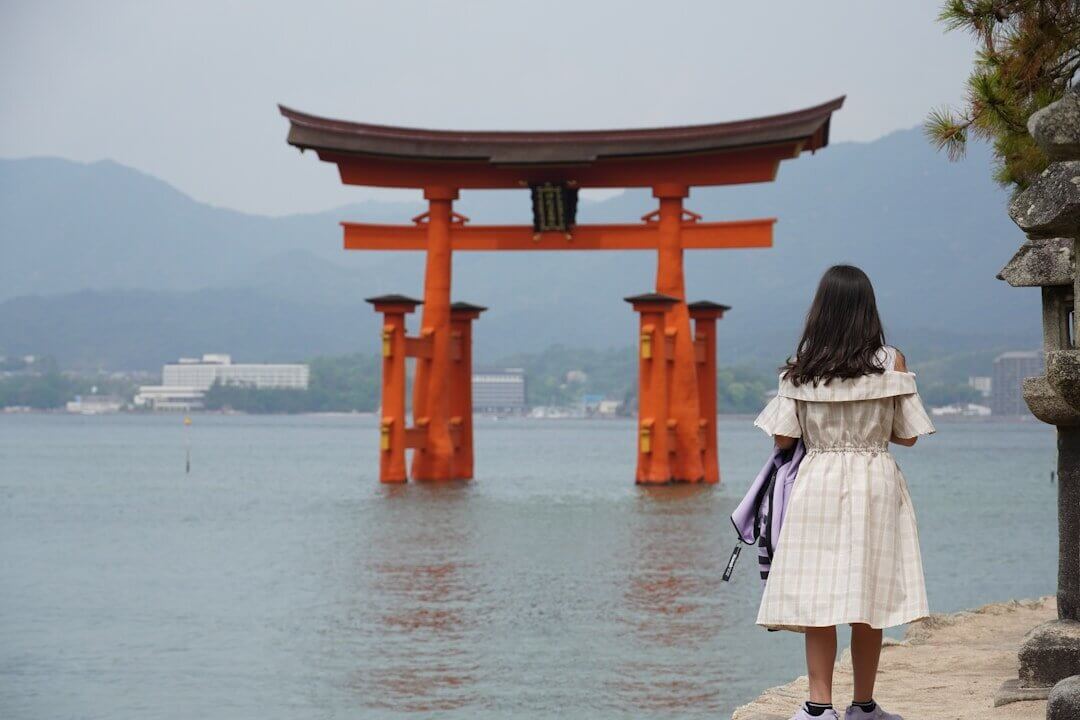
- The floating torii gate of Itsukushima Shrine — check tide tables; both high tide (gate rising from the sea) and low tide (walk to the base) are beautiful for different reasons
- Take the ropeway up Mount Misen for panoramic Seto Inland Sea views — particularly beautiful at sunset
- The island is peaceful and small; spend the afternoon wandering, eating maple-leaf cakes (momiji manju) fresh from bakeries, and watching the deer
If your schedule allows, an overnight on Miyajima transforms the experience. The shrine at dawn, before the ferries start running, belongs to you and almost no one else.
Days 12–14: Okinawa – The Beach Finale
How to get there: Fly from Hiroshima or Osaka to Naha, Okinawa (approximately 2 hours). Domestic flights with ANA or JAL run frequently.
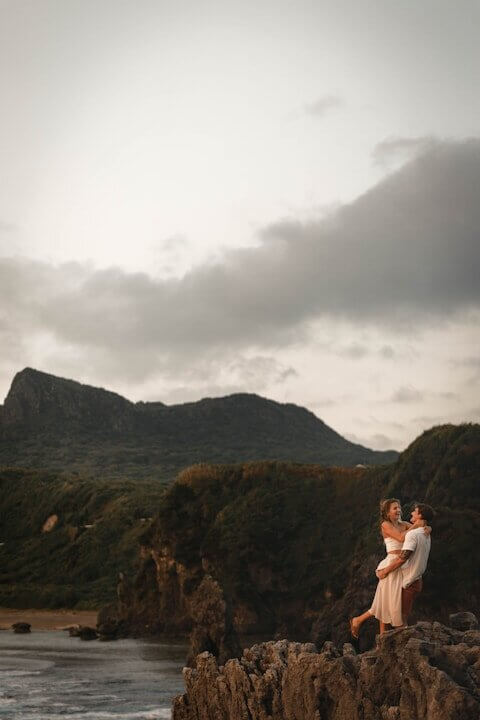
Every honeymoon needs a beach chapter. Okinawa – Japan’s southernmost prefecture, a chain of subtropical islands stretching toward Taiwan – is a world apart from mainland Japan.
The water is the kind of blue that makes you stop and stare. The pace drops to something close to Caribbean.
And the culture, shaped by the Ryukyu Kingdom, has its own music, cuisine, and craft traditions entirely distinct from the Japan you’ve spent the past ten days exploring.
Day 12: Arrive Naha + Explore
- Kokusai-dori (International Street) — Naha’s lively main shopping boulevard, good for Okinawan crafts (bingata fabric, shisa lion statues, awamori spirits)
- Shurijo Castle — the reconstructed palace of the Ryukyu Kingdom, designated a UNESCO World Heritage Site, with distinctive red lacquer architecture unlike anything on the mainland
- Dinner featuring Okinawan cuisine — goya champuru (bitter melon stir-fry), rafute (braised pork belly), and freshly caught reef fish
Day 13–14: Island Beaches and Water
Base yourself in the Churaumi area of northern Okinawa or take a short ferry to one of the smaller Kerama Islands (Zamami or Aka Island) for the most pristine water.
- Snorkeling or diving on coral reefs in Kerama Blue water — the Kerama Islands have some of the clearest water and healthiest coral in Japan, with sea turtles, tropical fish, and rays visible in just a few metres of water
- Sunset cruise across the Kerama Strait — many operators offer small-boat sunset tours that make for one of the most romantic evenings of the entire trip
- Glass-bottom kayaking around Zamami Island — exploring the coastline together at your own pace, the seafloor visible beneath you
- A final night in a beachfront resort, watching the sky over the Pacific
Fly home from Naha Airport (OKA) – well-connected to most major international hubs via Tokyo or Osaka.
Also Read: 12 Days In Japan Itinerary & 5 Days In Japan Itinerary
Romantic Japan Experiences Worth Booking in Advance
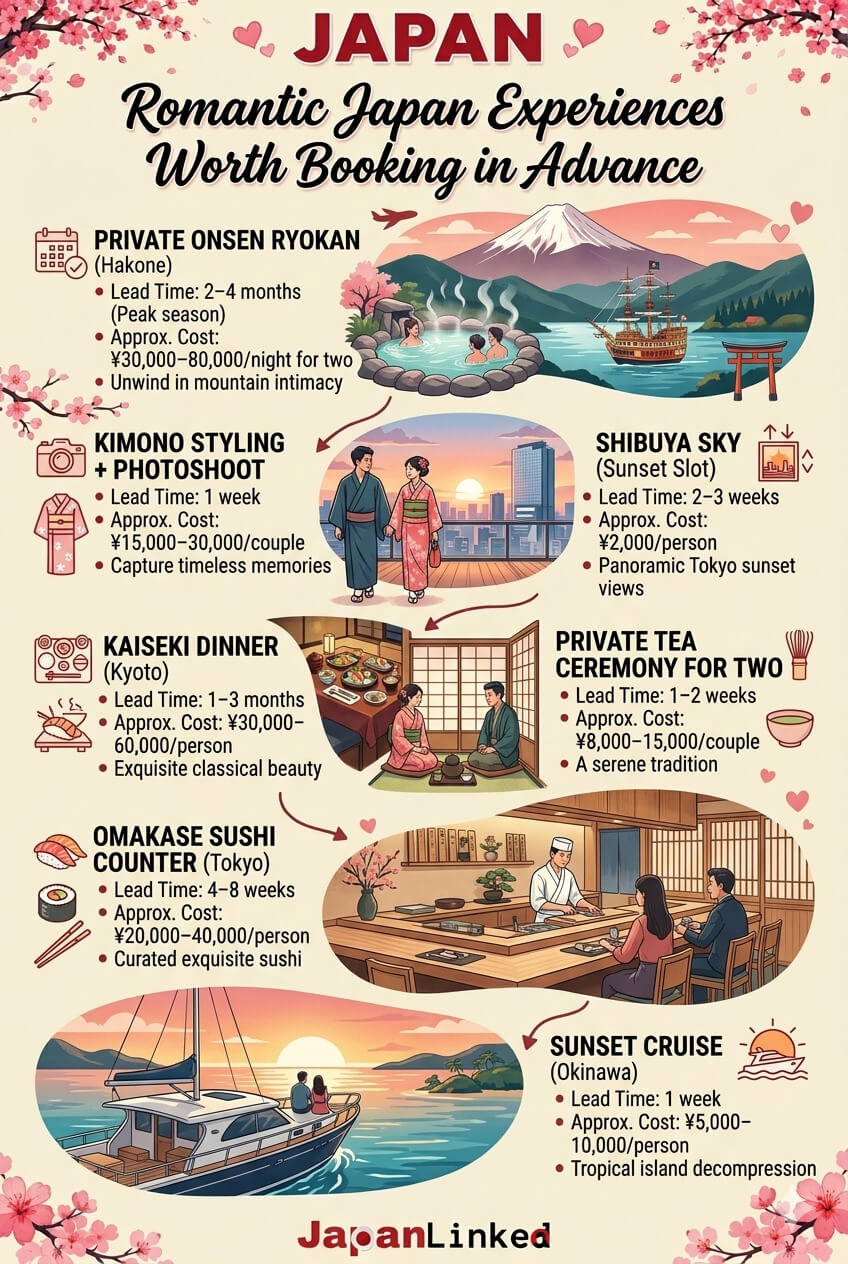
These honeymoon-specific experiences require advance reservations — sometimes weeks or months ahead:
| Experience | Lead Time | Approx. Cost |
|---|---|---|
| Private onsen ryokan (Hakone, peak season) | 2–4 months | ¥30,000–80,000/night for two |
| Kaiseki dinner at top Kyoto ryotei | 1–3 months | ¥30,000–60,000/person |
| Omakase sushi counter (Tokyo) | 4–8 weeks | ¥20,000–40,000/person |
| Private tea ceremony for two | 1–2 weeks | ¥8,000–15,000/couple |
| Kimono styling + photoshoot | 1 week | ¥15,000–30,000/couple |
| Shibuya Sky (sunset slot) | 2–3 weeks | ¥2,000/person |
| Sunset cruise, Okinawa | 1 week | ¥5,000–10,000/person |
Also Read: 7 Days In Japan Itinerary
Best Time for Honeymoon in Japan
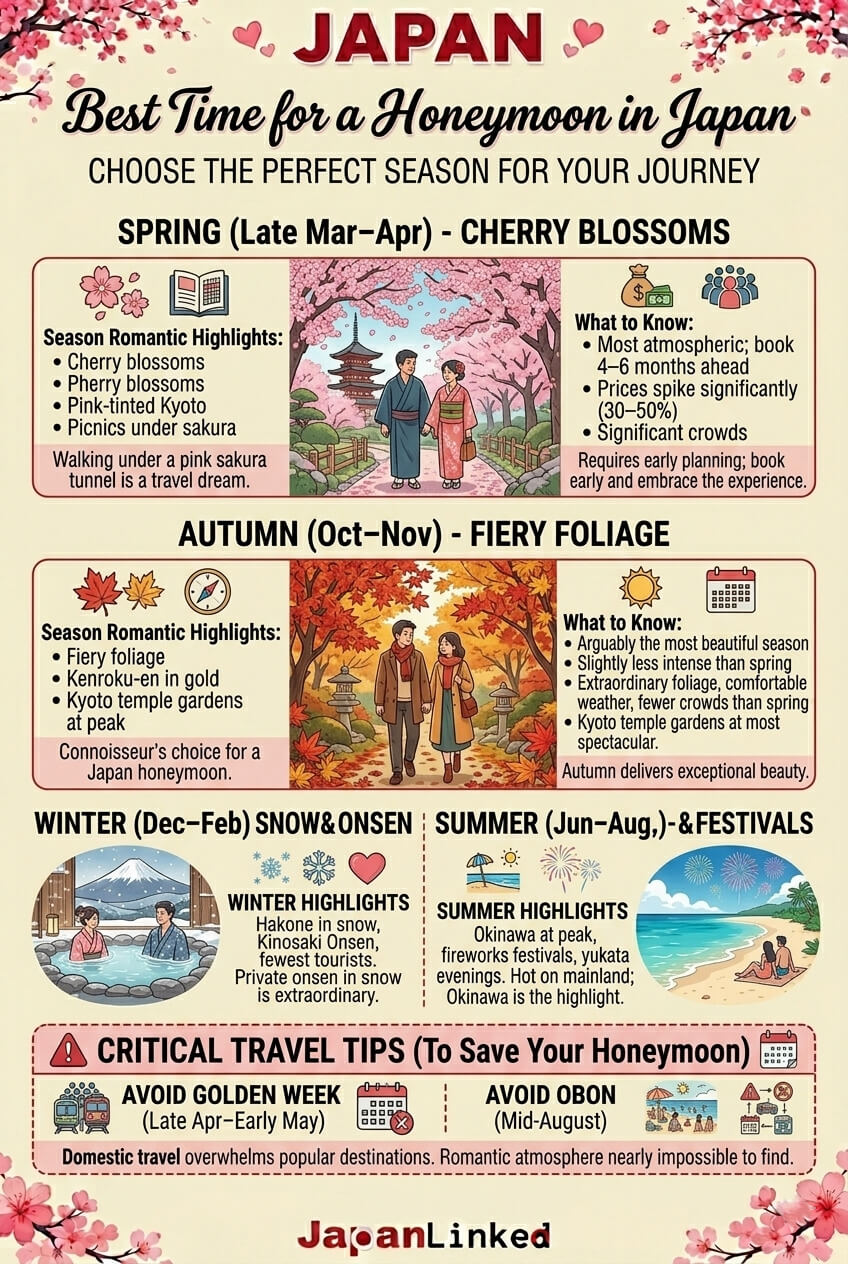
Japan is a year-round destination for couples, but each season offers a distinctly different experience:
| Season | Romantic Highlights | What to Know |
|---|---|---|
| Spring (late Mar–Apr) | Cherry blossoms, pink-tinted Kyoto, picnics under sakura | Most atmospheric; book 4–6 months ahead. Prices spike significantly |
| Autumn (Oct–Nov) | Fiery foliage, Kenroku-en in gold, Kyoto temple gardens at peak | Arguably the most beautiful season; slightly less intense than spring |
| Winter (Dec–Feb) | Hakone in snow, Kinosaki Onsen, fewest tourists | Cold but deeply romantic; private onsen in snow is extraordinary |
| Summer (Jun–Aug) | Okinawa at peak, fireworks festivals, yukata evenings | Hot on the mainland; Okinawa is the highlight of this season |
Spring cherry blossom season is the most romanticized – and justifiably so. Walking under a tunnel of pink sakura petals with your new spouse in Kyoto is an image from every travel dream.
But it requires planning months in advance, accepting significant crowds at famous locations, and budget increases of 30–50% at many hotels. Book early and embrace the experience.
Autumn is the connoisseur’s choice for a honeymoon in Japan. October through mid-November combines extraordinary foliage, comfortable walking weather, fewer crowds than spring, and Kyoto temple gardens at their most spectacular. If you have flexibility on timing, autumn delivers.
Avoid Golden Week (late April–early May) and Obon (mid-August) completely – domestic travel demand overwhelms popular destinations and makes the romantic atmosphere nearly impossible to find.
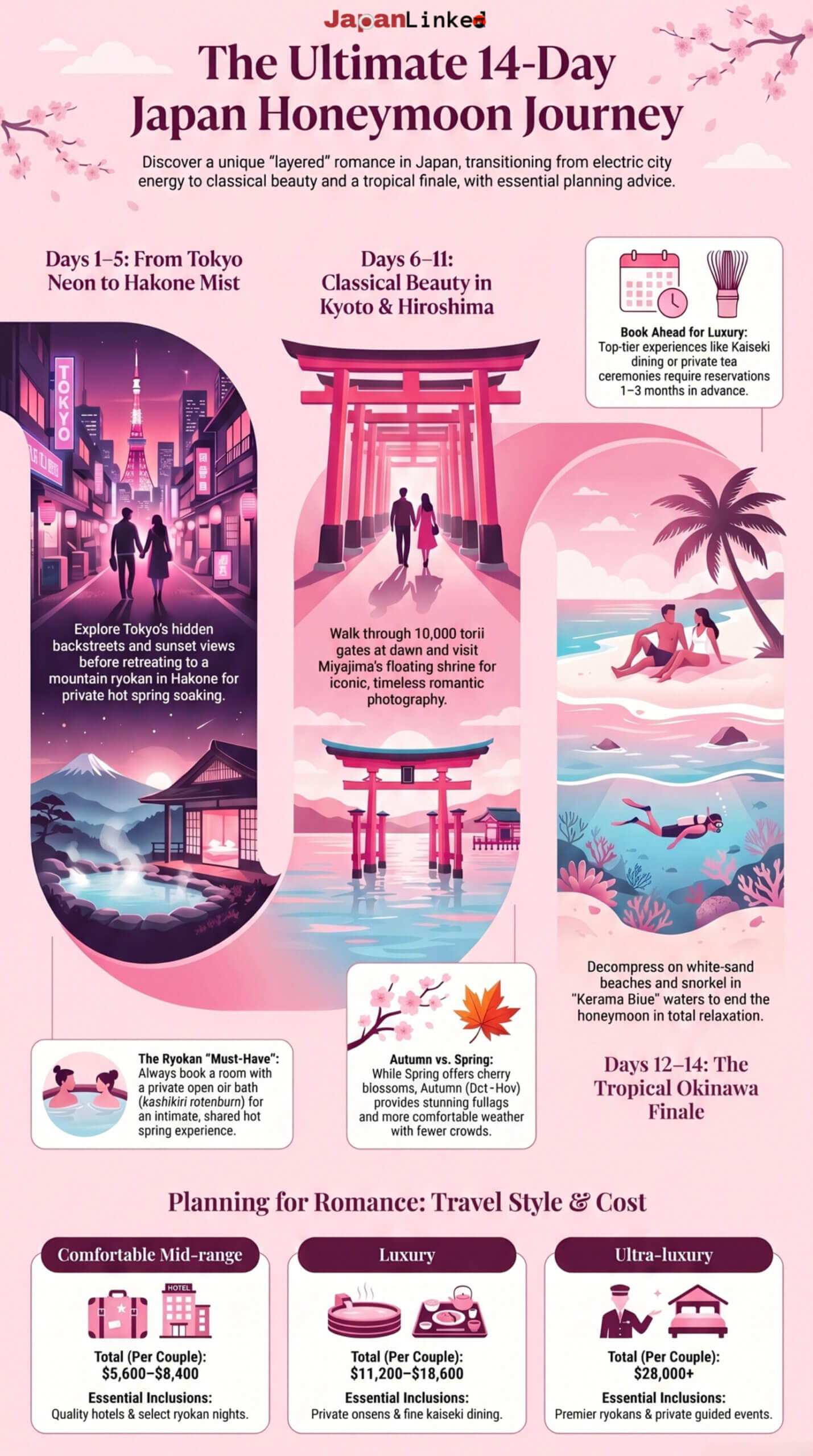
Japan Honeymoon Budget Guide
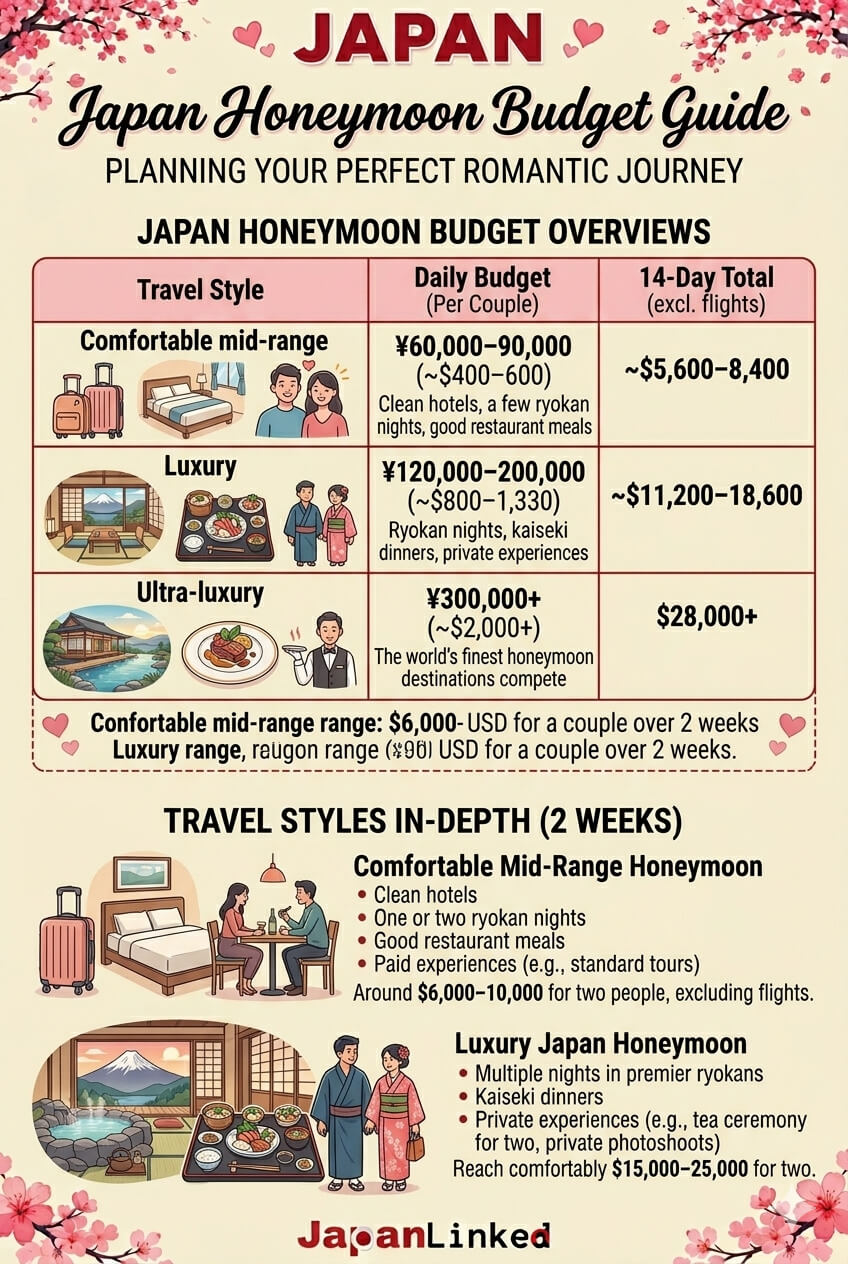
| Travel Style | Daily Budget (Per Couple) | 14-Day Total (excl. flights) |
|---|---|---|
| Comfortable mid-range | ¥60,000–90,000 (~$400–600) | ~$5,600–8,400 |
| Luxury (ryokan nights, kaiseki) | ¥120,000–200,000 (~$800–1,330) | ~$11,200–18,600 |
| Ultra-luxury | ¥300,000+ (~$2,000+) | $28,000+ |
A comfortable honeymoon – clean hotels, one or two ryokan nights, good restaurant meals, and the paid experiences listed above – comes in around $6,000–10,000 for two people over two weeks, excluding international flights.
A luxury Japan honeymoon with multiple nights in premier ryokan, kaiseki dinners, and private experiences comfortably reaches $15,000–25,000 for two, and this is where Japan genuinely competes with the world’s finest honeymoon destinations.
Practical Japan Honeymoon Tips
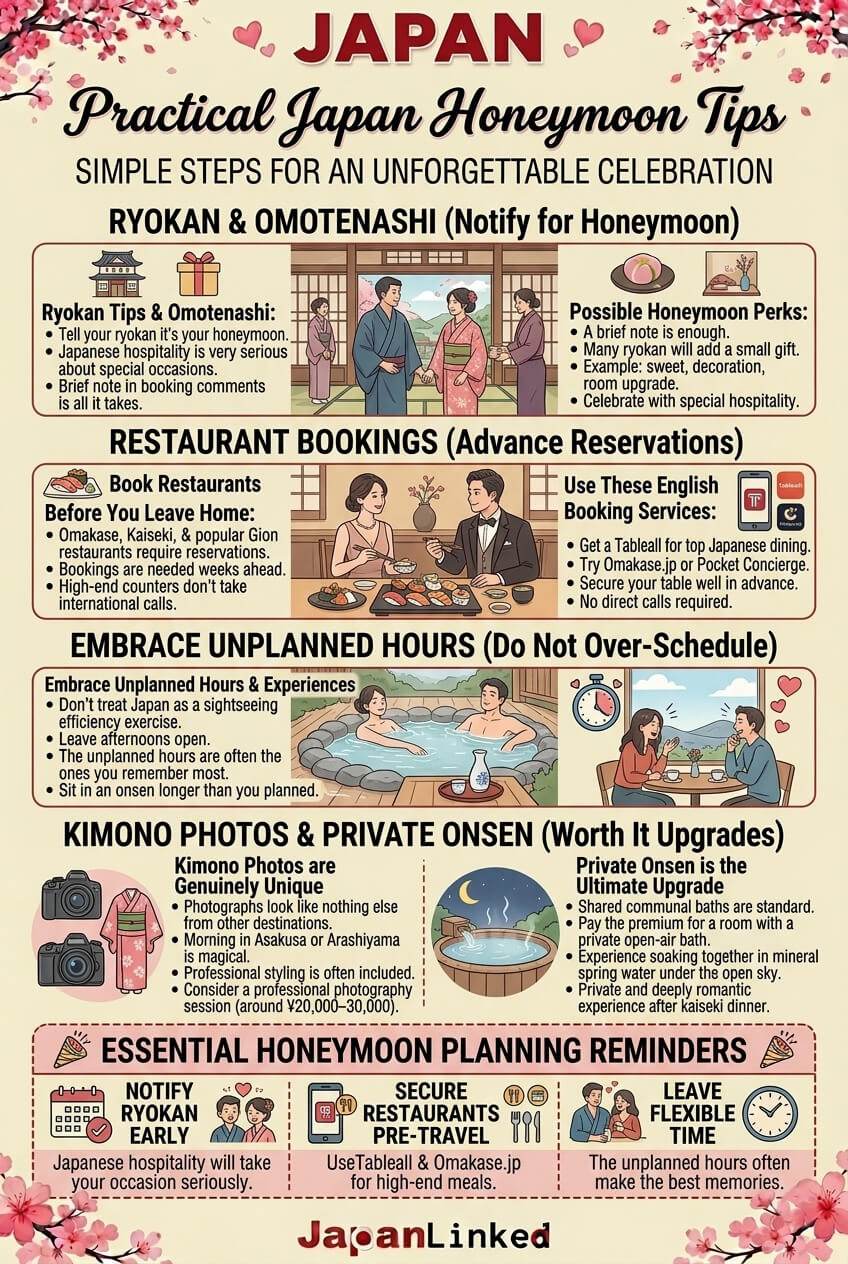
Tell your ryokan it’s your honeymoon. Japanese hospitality culture (omotenashi) takes special occasions seriously. Many ryokan will add a small gift – a sweet, a room decoration, a complimentary upgrade – when they know you’re celebrating. A brief note in the booking comments is all it takes.
Book restaurants before you leave home. Tokyo omakase counters, Kyoto kaiseki ryotei, and popular Gion restaurants all require reservations, often weeks ahead. Use services like Tableall, Omakase.jp, or Pocket Concierge for English-language bookings at high-end Japanese restaurants that don’t accept direct international reservations.
Don’t over-schedule. The honeymoon mistake most couples make is treating Japan as a sightseeing efficiency exercise. Leave afternoons open. Sit in an onsen longer than you planned. Order another round of sake and keep talking. The unplanned hours are often the ones you remember most.
Kimono photos are worth it. Spending a morning in kimono together in Asakusa or Arashiyama produces photographs that genuinely look like nothing else from any other honeymoon destination. Most rental shops include professional styling; some offer add-on photography sessions with a professional photographer for around ¥20,000–30,000.
Private onsen = the upgrade worth paying for. Standard ryokan rooms share communal baths (gender-separated). For a honeymoon, pay the premium for a room with a private open-air bath (rotenburo). The experience – soaking together in mineral spring water under open sky, in yukata, after a kaiseki dinner – is unlike anything else travel offers.
Conclusion
A honeymoon in Japan is not like any other honeymoon. It doesn’t offer turquoise infinity pools or white-sand beaches as its primary romantic currency.
What it offers instead is depth – a country so layered in beauty, ritual, craftsmanship, and human warmth that every day together becomes a story.
The bamboo grove at dawn that you saw before anyone else. The private onsen where you watched snow fall over a Japanese mountain garden.
The twelve-course meal that made you both forget what time it was.
Japan’s first documented honeymooners took to the hot springs of Kyushu in 1866.
A century and a half later, the country still understands exactly what newly married couples need: beauty, quiet, exquisite food, and a complete sense of being cared for.
Start planning early, book the experiences that sell out, and leave room for the moments that can’t be scheduled. Japan will give you both.
