
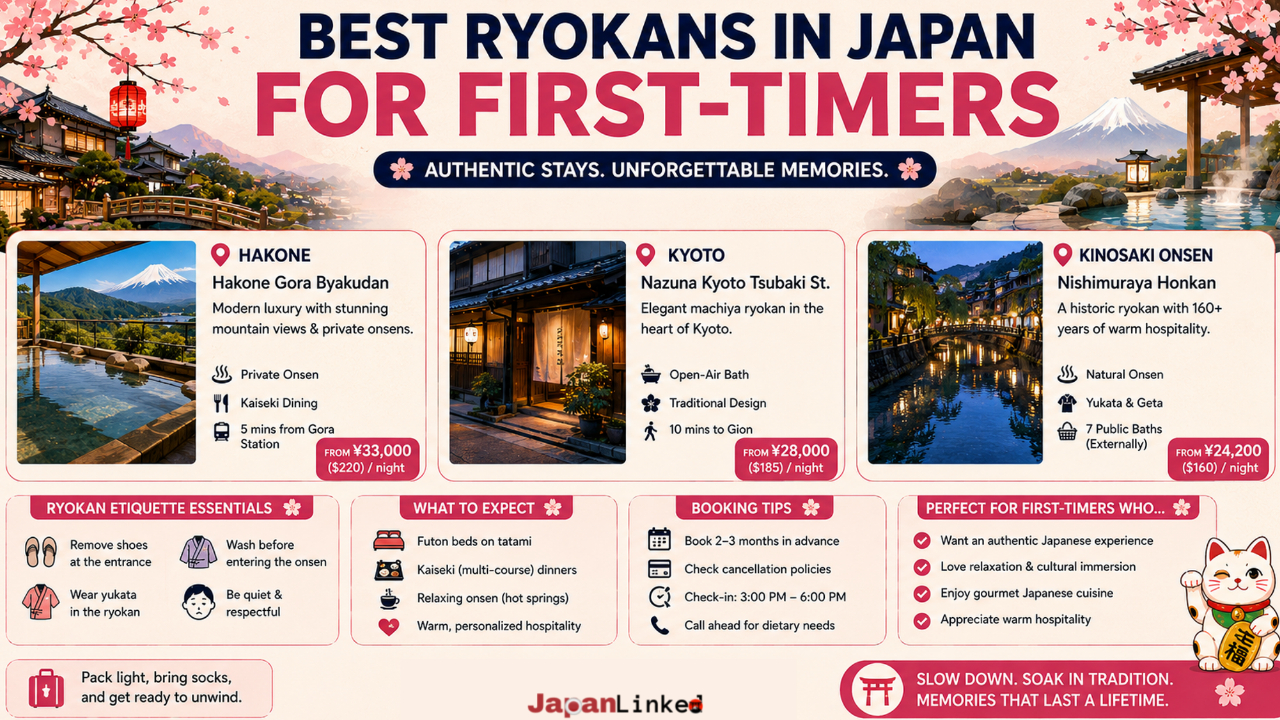
There is no accommodation experience in the world quite like a Japanese ryokan.
The first time you step into one, sliding off your shoes at the entrance and being led across tatami to a low table already set with matcha and a wagashi sweet, you’ll understand why people fly across the world for this.
The futon laid out while you were at dinner. The water in the bath rising from underground. The seven-course kaiseki that arrives one beautiful dish at a time.
But for first-timers, choosing the right ryokan for a first visit matters enormously.
Book the wrong one – too remote, too formal, too light on English-speaking staff – and what should be magical feels confusing and isolating.
This guide cuts through the noise: the best beginner-friendly ryokans by location, real prices, the etiquette essentials you need before you arrive, and the one question almost nobody asks that could save your trip.
What Is a Ryokan, Really? (And Why It’s Nothing Like a Hotel)
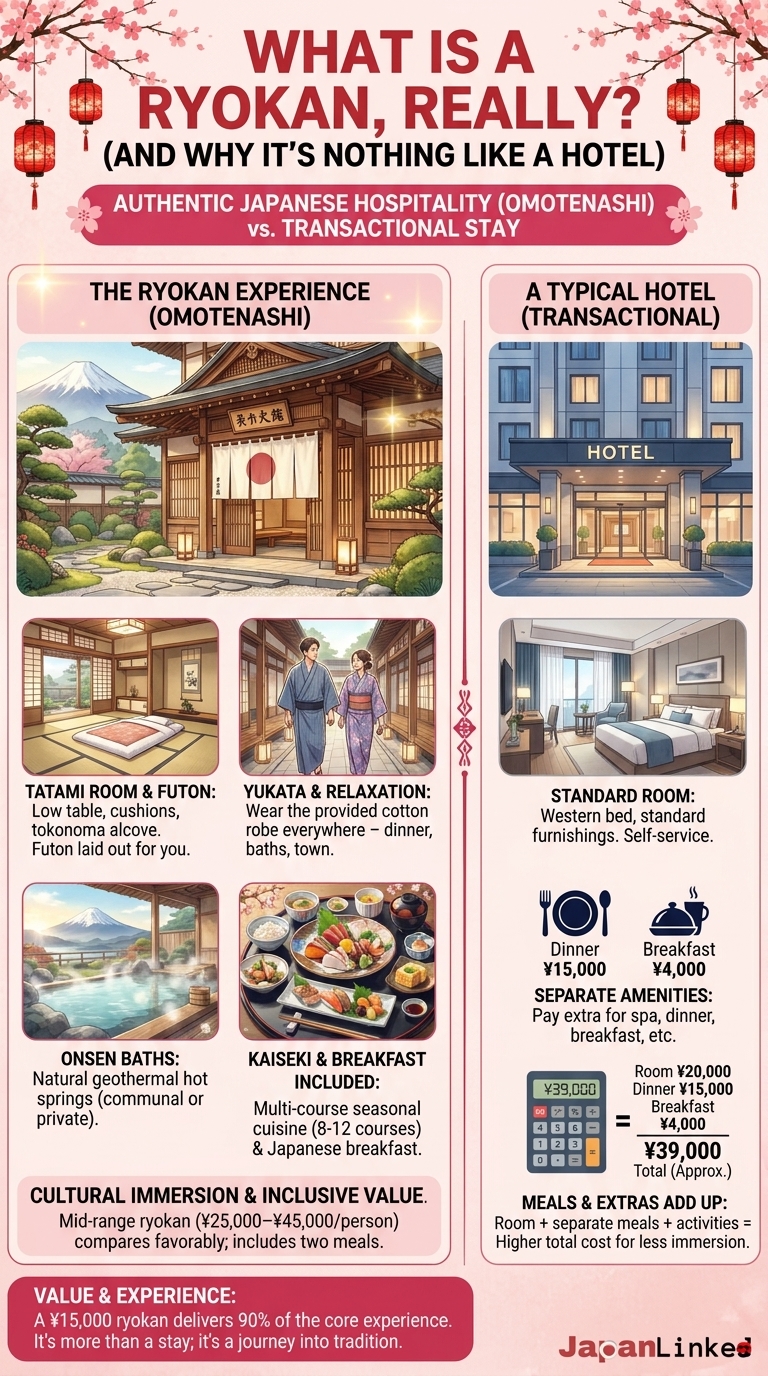
A ryokan (旅館) is a traditional Japanese inn built around the concept of omotenashi – hospitality that anticipates your needs before you express them.
Japan is home to over 40,000 ryokan ranging from simple family-run guesthouses at ¥8,000 per night to imperial-estate retreats exceeding ¥100,000 per person. The experience at both ends is structurally the same.
What a ryokan always includes:
- A tatami-floored room with a low table, floor cushions, and a tokonoma alcove (a decorative recess with seasonal art or flowers)
- A futon laid out by staff while you’re at dinner – and folded away again each morning
- A cotton robe called a yukata that you wear throughout your stay: to dinner, to the baths, even for evening walks in an onsen town
- Communal or private hot spring baths (onsen), fed by natural geothermal water
- A kaiseki dinner (multi-course seasonal cuisine, typically 8–12 courses) and a Japanese breakfast, both usually included in the price
The reason a mid-range ryokan (¥25,000–¥45,000 per person per night) compares more favorably to a hotel than the sticker price suggests is that the price includes two meals.
A couple at a typical Kyoto hotel spending ¥20,000 on the room, then ¥15,000 on dinner and ¥4,000 on breakfast is already at ¥39,000 – and they haven’t experienced any of the cultural immersion of the ryokan.
As one expert framing puts it: a ¥15,000 mid-range ryokan delivers about 90% of the core ryokan experience. The jump to luxury buys refinement and rarity – not a fundamentally different thing.
Also Read: South Japan Itinerary & North Japan Itinerary
The Best Locations for a First Ryokan Stay
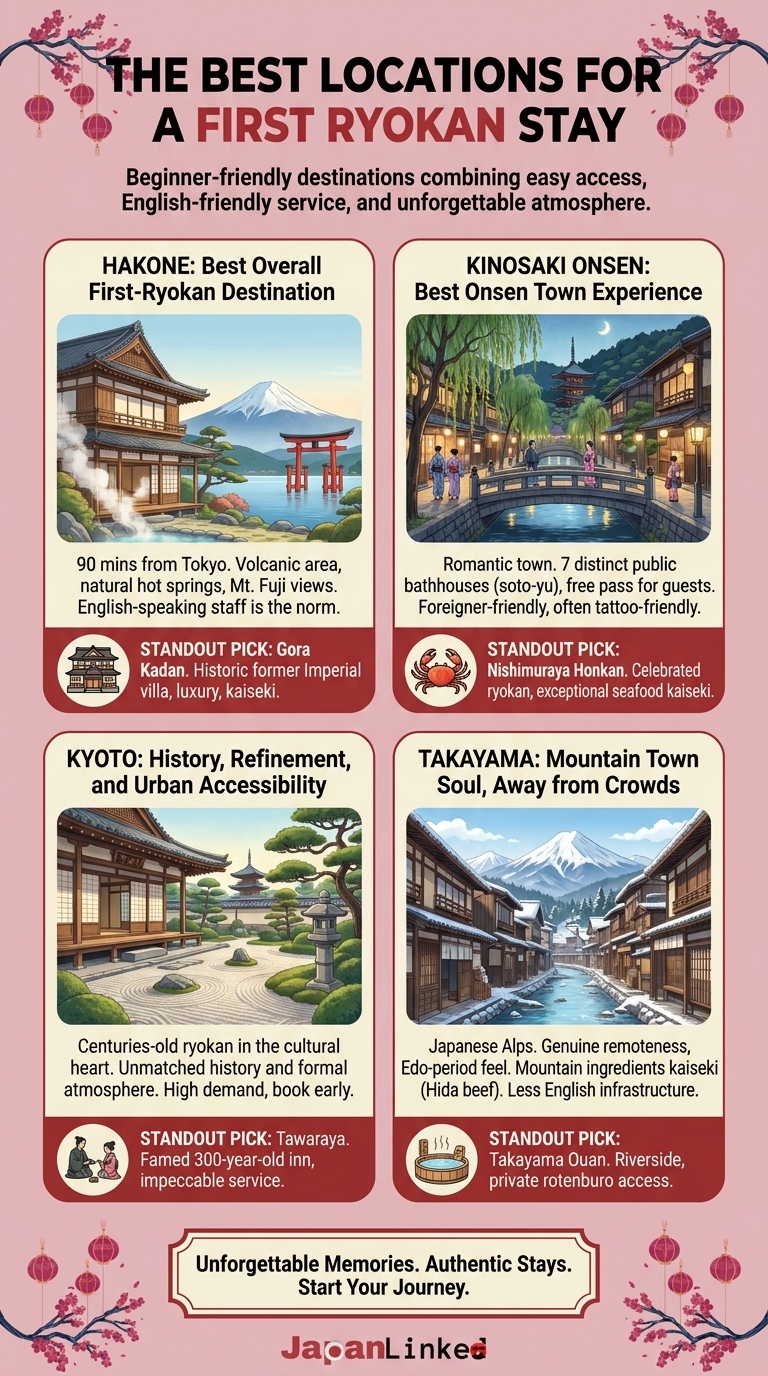
Not all ryokan destinations are equally beginner-friendly. Some require navigating rural bus routes; others plunge you into a purely Japanese-language environment with no English-speaking staff.
The locations below were chosen specifically because they combine easy access from major transit hubs, English-friendly properties, and the kind of atmospheric setting that makes a first ryokan experience genuinely unforgettable.
Hakone – The Best Overall First-Ryokan Destination
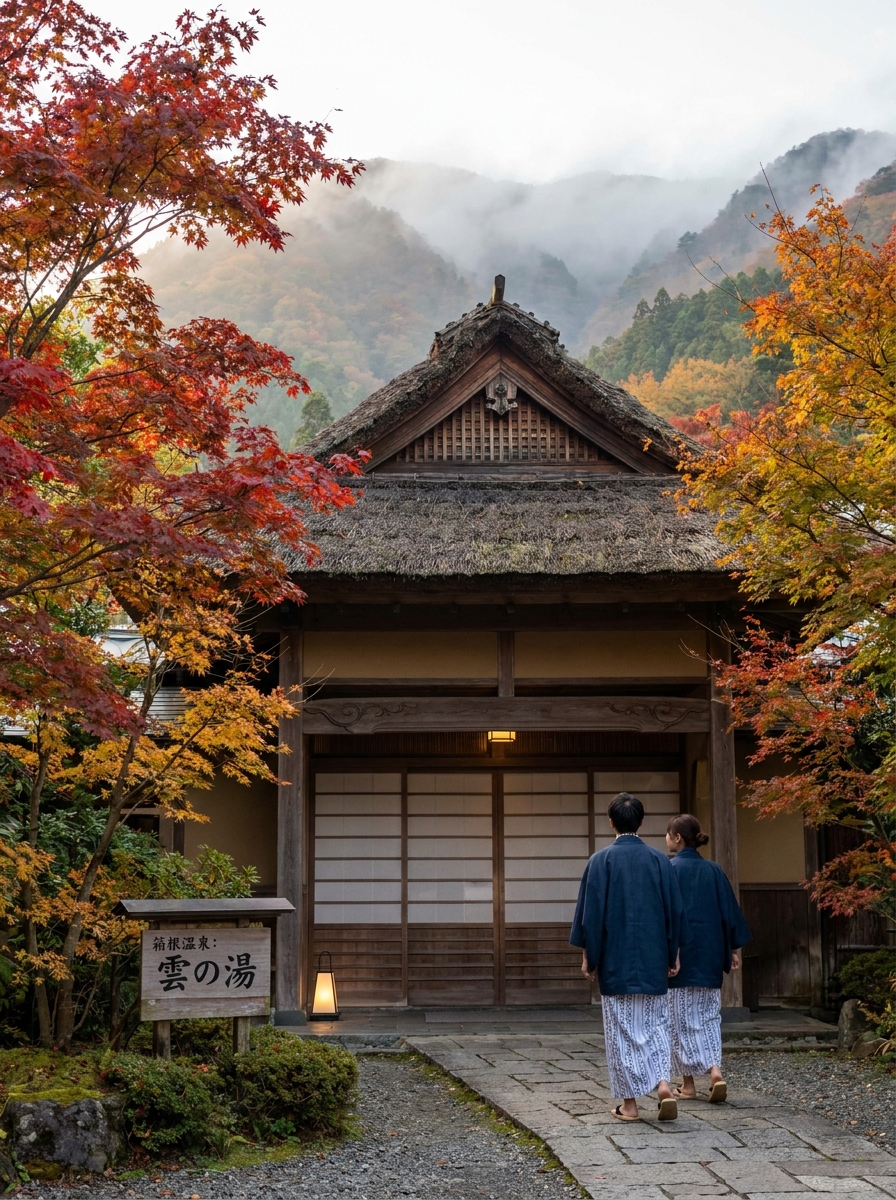
Hakone is the answer to “where should I stay in a ryokan for the first time?” more often than anywhere else – and for good reason.
Located about 90 minutes from Tokyo by train (the Romancecar from Shinjuku is worth taking), Hakone sits in a volcanic mountain area with dozens of natural hot spring sources, Mt. Fuji views on clear days, and a concentration of ryokan that have decades of experience hosting international guests.
English-speaking staff is the norm rather than the exception. The scenery – mountain forested ridges, steaming volcanic vents, Lake Ashi with its torii gate – is genuinely dramatic.
Who it’s best for: First-timers doing the Tokyo–Kyoto route who want to add one unforgettable night without a complicated detour.
Standout picks:
- Gora Kadan – Set on the grounds of a former Imperial family villa and Japan’s only Relais & Châteaux ryokan since 1992. Eighteen rooms, three distinct hot spring sources, a spa with shiatsu therapy, and a kaiseki dinner built around eight seasonal turning points in the Japanese calendar. Best for first-time luxury ryokan stays; the near-universal “start here” recommendation for first-timers with budget. From approximately ¥60,000+ per person per night including meals.
- Hakone Kowakien TEN-YU – A larger property (unusual for a ryokan), excellent for those who want private hot spring baths in their room but find the smallest boutique inns intimidating. Rated exceptional by over 1,700 guest reviews. Reliably English-friendly. From approximately ¥35,000 per person.
- Ichinoyu Honkan – A beautifully preserved historic property with genuine ryokan atmosphere at a more accessible price point than the top-tier properties. Strong on tradition; a great option for travelers who want the full tatami-and-onsen experience without the luxury price tag. From approximately ¥18,000 per person.
Kinosaki Onsen – The Best Onsen Town Experience
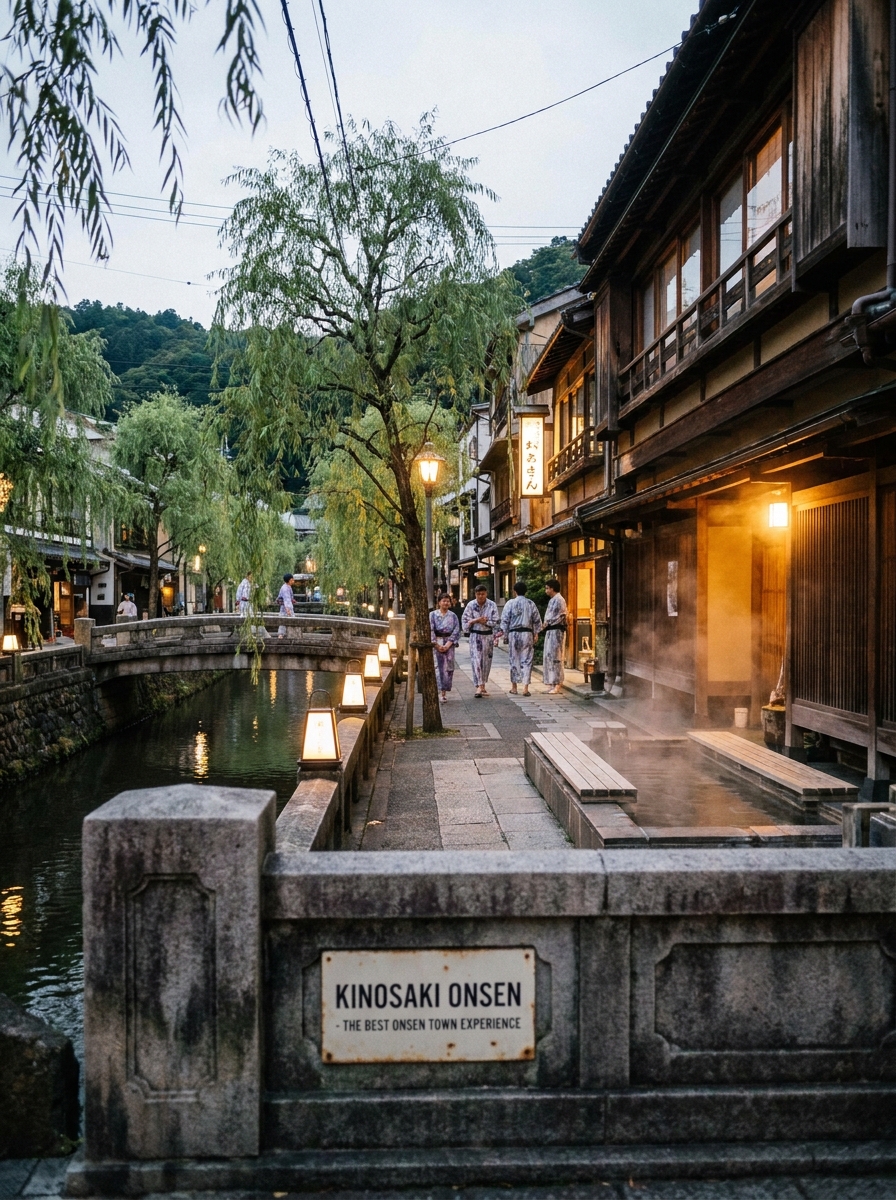
If Hakone is the easiest first ryokan experience, Kinosaki Onsen is the most romantic one.
A small canal-lined town in Hyogo Prefecture, about 2.5 hours by direct train from Kyoto or Osaka, Kinosaki is built around seven distinct public bathhouses (soto-yu) scattered through the town.
When you check into your ryokan, you receive a free pass to all seven. Every evening, guests change into their yukata and wooden geta sandals and wander between bathhouses along willow-shaded canals – it’s like stepping into a woodblock print.
Kinosaki is also notably foreigner-friendly for an onsen town of its size. Signs are bilingual, many properties have English-speaking staff, and – importantly for tattooed travelers – many of the public baths here allow tattoos, which is rare in traditional onsen towns.
Standout pick:
- Nishimuraya Honkan – Kinosaki’s most celebrated ryokan, with some of the highest verified guest satisfaction ratings of any ryokan in Japan. Multiple private and communal baths on-site in addition to the free pass to town’s seven bathhouses. The kaiseki here is outstanding, drawing on the region’s exceptional seafood from the Sea of Japan (snow crab in season is extraordinary). From approximately ¥40,000–¥80,000 per person including meals.
Budget alternative: Many smaller Kinosaki ryokan run excellent one-night packages in the ¥15,000–¥25,000 per person range – more than sufficient to experience the town’s famous evening bathhouse circuit.
Kyoto – History, Refinement, and Urban Accessibility
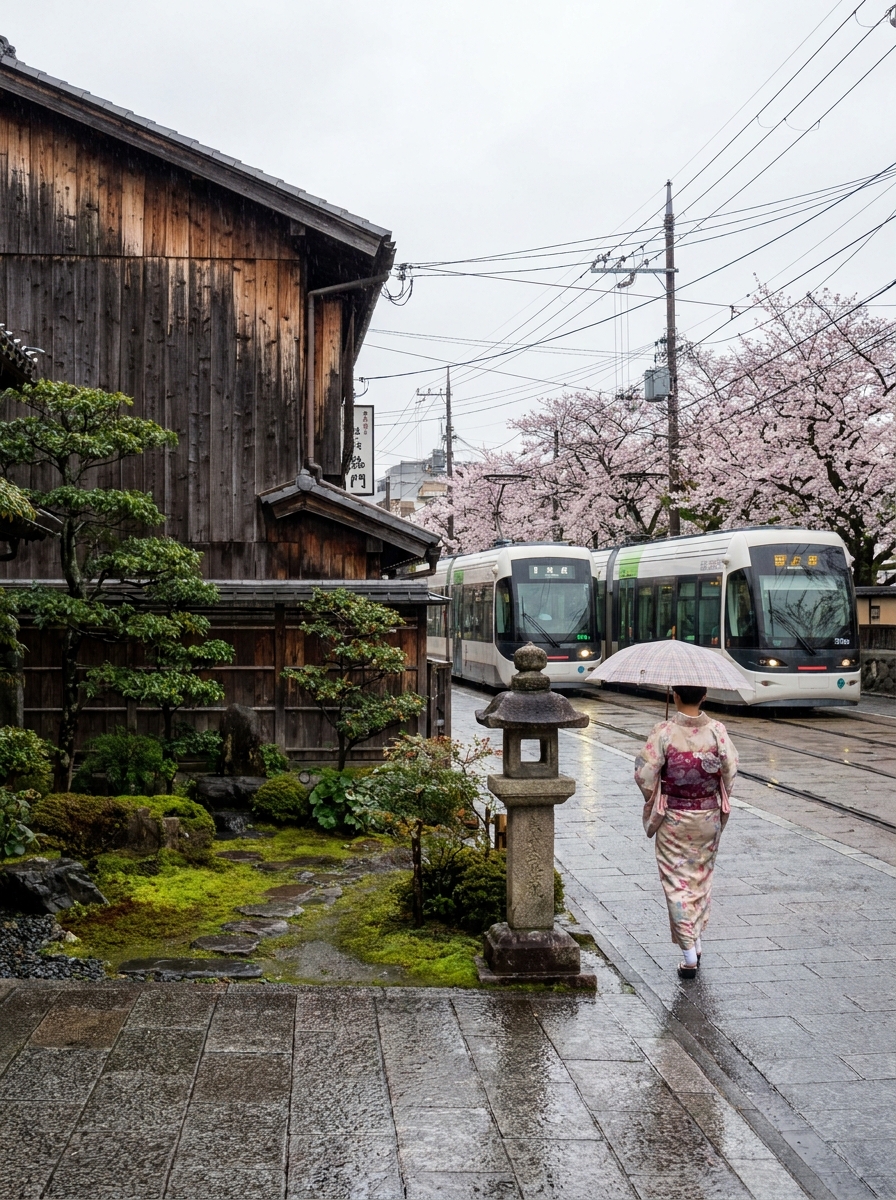
Staying in a ryokan in Kyoto adds a layer to the city that no hotel can replicate.
The best Kyoto ryokan have been in continuous operation for centuries – Hiiragiya, founded in 1818, has hosted emperors, prime ministers, and Nobel laureates.
Tawaraya, dating to the early 18th century, is frequently cited as one of the finest ryokan in the world.
The tradeoff for first-timers: the very top Kyoto ryokan are among the most expensive and most formal in Japan, and they book out months in advance.
But Kyoto also has excellent mid-range options that deliver the tatami-and-garden experience without the six-month booking window.
Standout picks:
- Tawaraya – Founded in the early 1700s, it remains a benchmark for what a ryokan can be. Gardens, impeccable kaiseki, wood and paper architecture that makes you feel genuinely transported. Expect a long waitlist for peak season. From approximately ¥80,000+ per person.
- Ryokan Yacchiyo (Nanzenji) – Set beside the Nanzenji temple complex in Kyoto’s Eastern Hills, this mid-range property offers serene garden views, private rooms, and genuinely warm service at a fraction of the top-tier price. One of the best-value Kyoto ryokan for first-timers who want the real experience without the top-tier price tag. From approximately ¥20,000–¥35,000 per person.
Takayama – Mountain Town Soul, Away from the Crowds
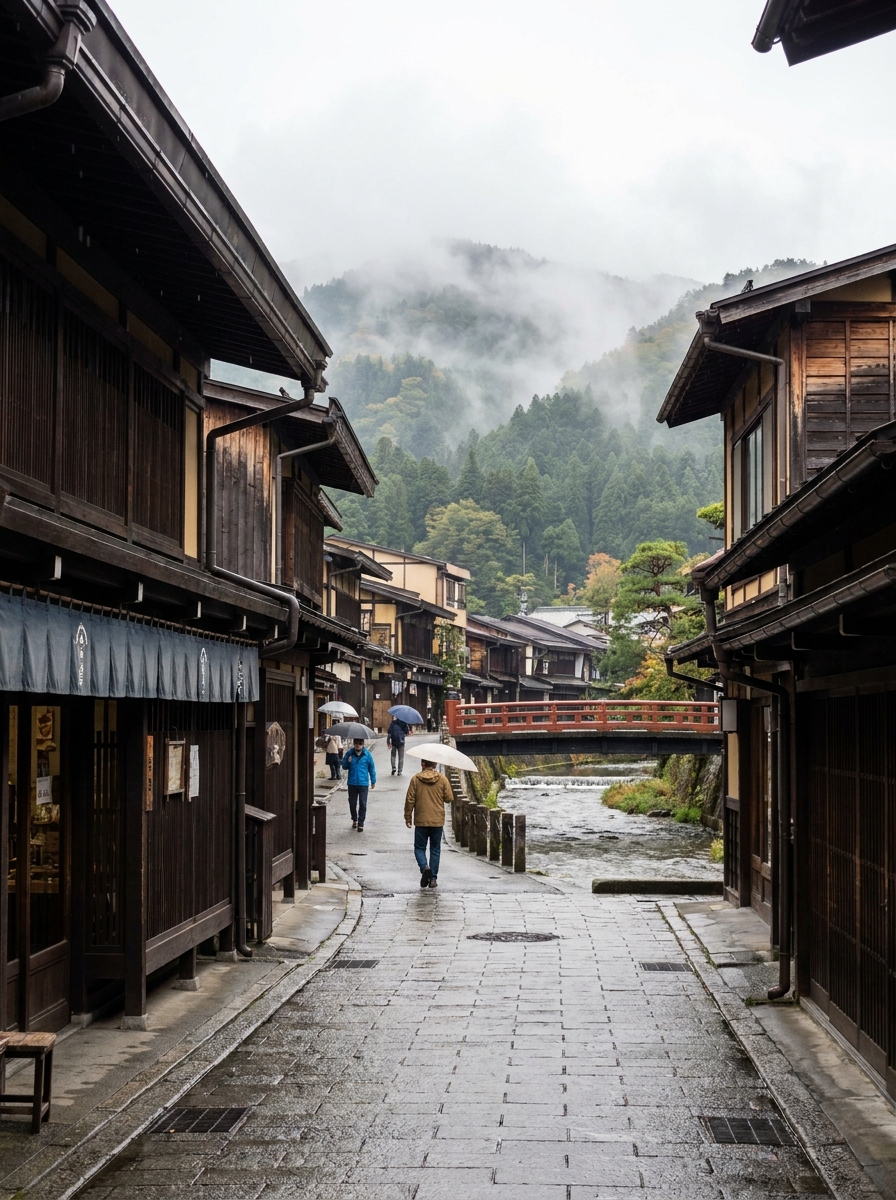
Takayama in the Japanese Alps offers something the Hakone and Kyoto ryokan circuit doesn’t: genuine remoteness and a town that feels like stepping into Edo-period Japan.
The river-district ryokan here are smaller and more personal, often family-operated across multiple generations.
The kaiseki draws on mountain ingredients – local hida beef, mountain vegetables, freshwater fish – rather than the coastal seafood of Hakone or Kinosaki.
This is the better pick for second-time ryokan visitors or travelers doing an off-the-beaten-path Japan route.
For a first ryokan experience, the limited English infrastructure can add an anxiety layer that detracts from the experience – though many properties now accommodate international guests well.
Standout pick:
- Takayama Ouan – A boutique riverside ryokan consistently praised for its balance of traditional atmosphere, excellent food, and approachable staff for non-Japanese guests. Private rotenburo (open-air bath) access and kaiseki featuring hida-gyu (local wagyu) served in-room. From approximately ¥30,000–¥50,000 per person.
Also Read: 2 Week Japan Itinerary & 3 Week Japan Itinerary
Ryokan Price Guide for First-Timers
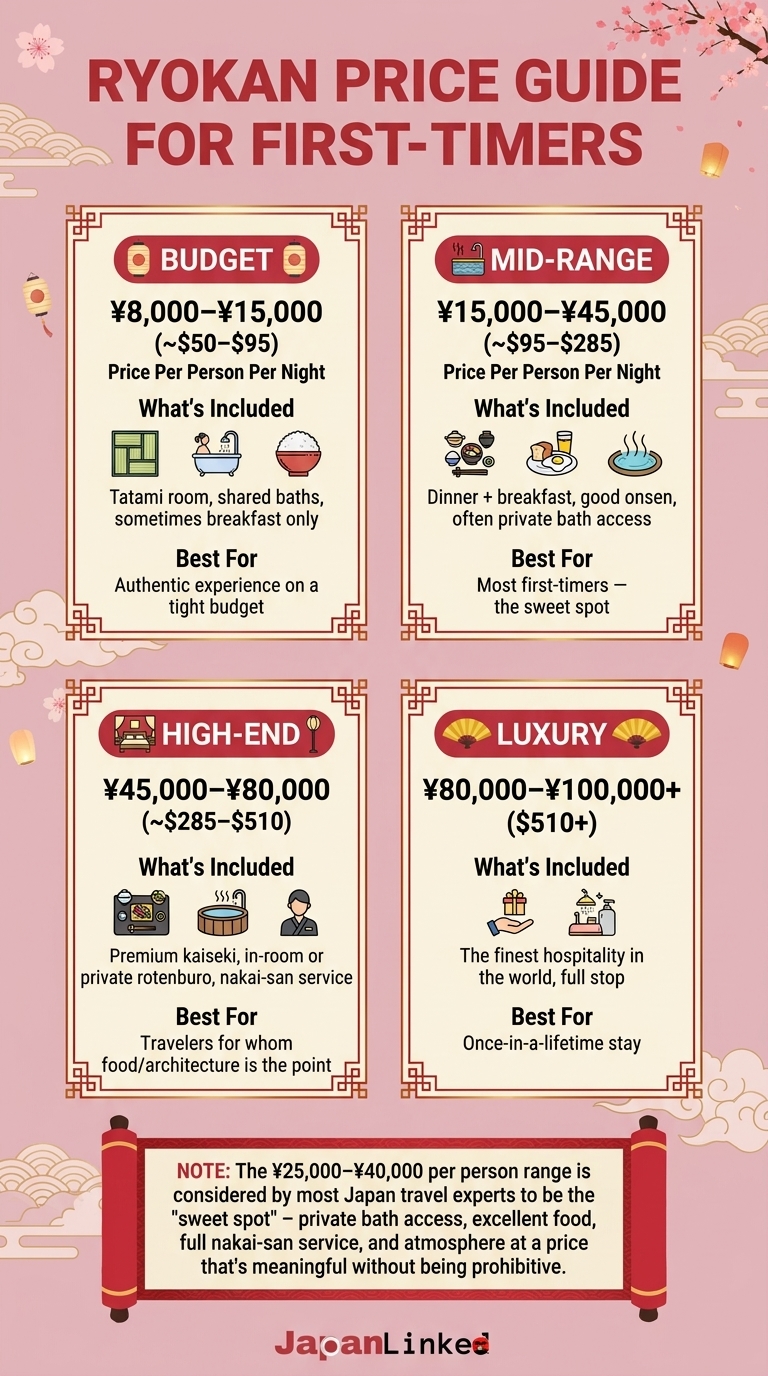
| Tier | Price Per Person Per Night | What’s Included | Best For |
|---|---|---|---|
| Budget | ¥8,000–¥15,000 (~$50–$95) | Tatami room, shared baths, sometimes breakfast only | Authentic experience on a tight budget |
| Mid-range | ¥15,000–¥45,000 (~$95–$285) | Dinner + breakfast, good onsen, often private bath access | Most first-timers — the sweet spot |
| High-end | ¥45,000–¥80,000 (~$285–$510) | Premium kaiseki, in-room or private rotenburo, nakai-san service | Travelers for whom food/architecture is the point |
| Luxury | ¥80,000–¥100,000+ ($510+) | The finest hospitality in the world, full stop | Once-in-a-lifetime stay |
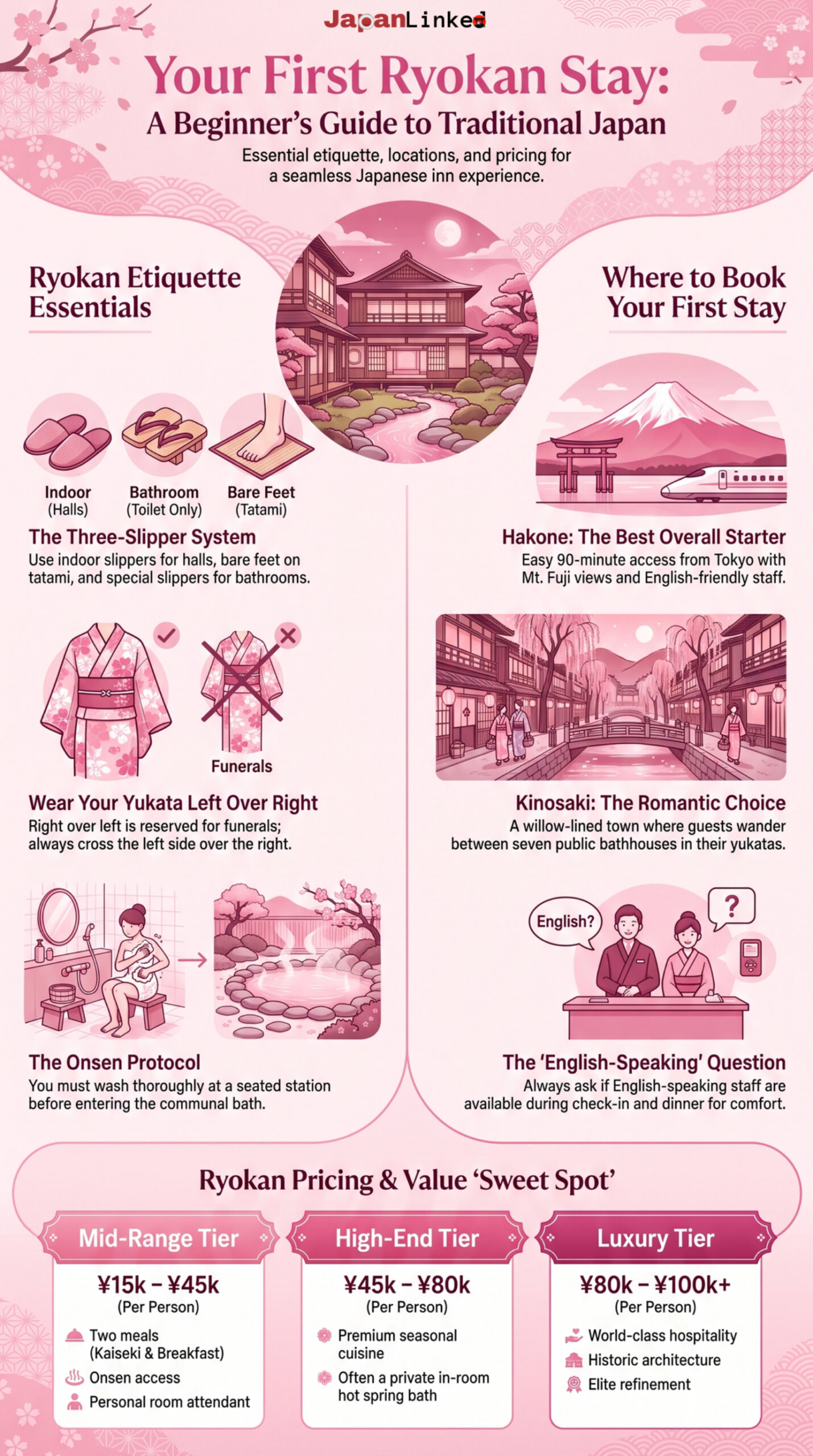
Note: The ¥25,000–¥40,000 per person range is considered by most Japan travel experts to be the “sweet spot” – private bath access, excellent food, full nakai-san (personal room attendant) service, and atmosphere at a price that’s meaningful without being prohibitive.
Also Read: Luxury Japan Itinerary & Japan Honeymoon Itinerary
Ryokan Etiquette for First-Timers: What Nobody Tells You
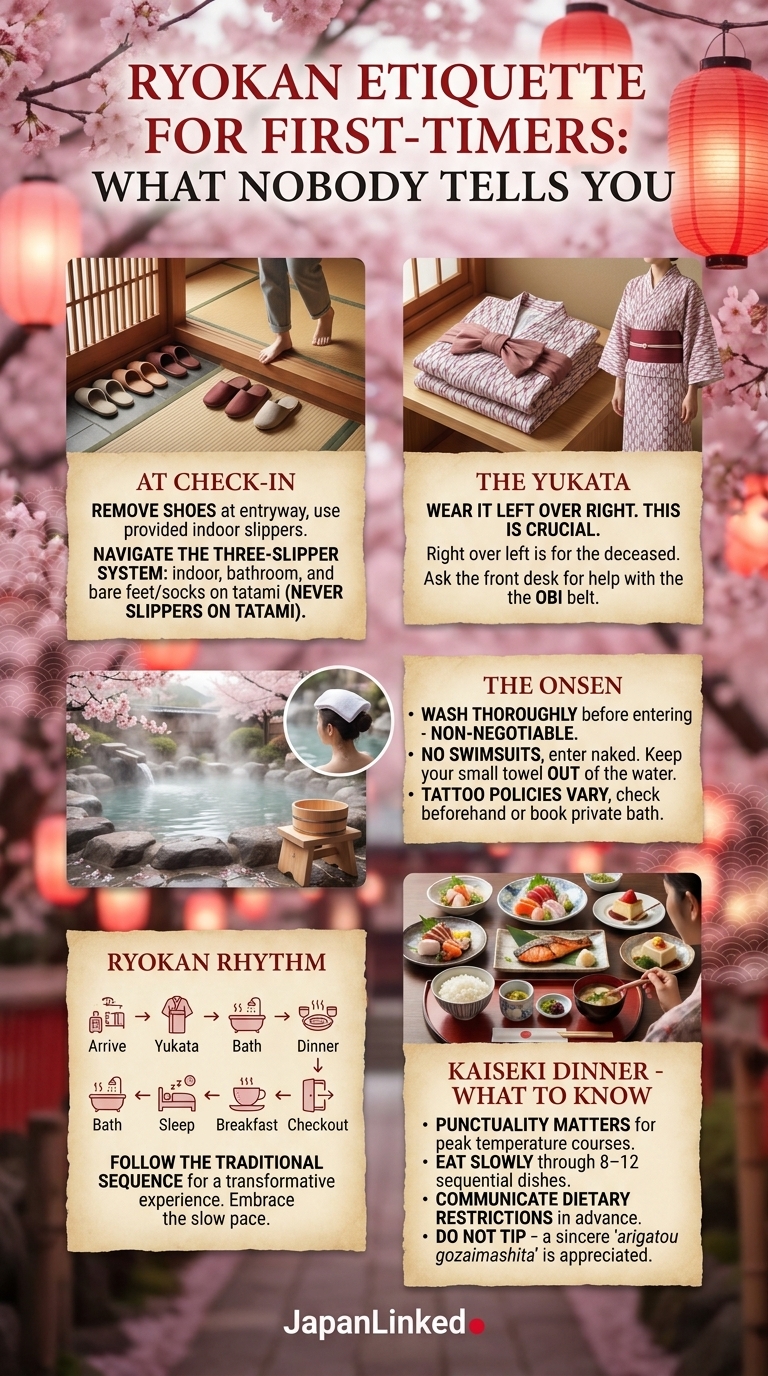
The etiquette around a ryokan stay looks complicated on paper and feels natural within about two hours. Here’s what actually matters.
At Check-In
Remove your shoes at the genkan (entryway) and step into the provided indoor slippers.
You’ll navigate a three-slipper system throughout your stay: indoor slippers for hallways, bare feet or socks on tatami (never slippers on tatami – the mats are easily damaged), and separate bathroom slippers for, well, the bathroom. You’ll forget once. Everyone does.
The Yukata
In your room, you’ll find a yukata (cotton robe) folded on the shelf. This is your outfit for the entire stay – meals, baths, evening walks.
Wear it left side over right. This is not a small detail: right over left is the traditional way the deceased are dressed for burial. It’s one of the most important etiquette points at a ryokan, and the easiest to get wrong.
The obi (fabric belt) can feel baffling to tie. Ask the front desk. They will not be surprised. They show guests how to do this several times a day.
The Onsen
The communal hot spring bath is the centerpiece of the ryokan experience and has its own firm set of rules:
- Wash thoroughly before entering the bath – Seated shower stations are provided outside the bath. This is non-negotiable. Entering without washing is the most serious breach of onsen etiquette.
- No swimsuits – Communal baths are entered naked. Baths are gender-separated.
- Keep your small towel out of the water – Place it on your head or beside the bath, never in the water.
- Tattoo policies vary significantly – Many ryokan prohibit tattooed guests from communal baths. If you have tattoos, book a room with a private kashikiri bath, or confirm the policy directly before booking. Kinosaki Onsen’s public bathhouses are an exception – most allow tattoos.
The traditional ryokan rhythm: arrive → change into yukata → bath before dinner → kaiseki dinner in-room → second bath before bed → sleep on futon → Japanese breakfast → check out.
Following this sequence transforms the stay from “interesting accommodation” into something that genuinely feels like a different way of living.
Kaiseki Dinner – What to Know
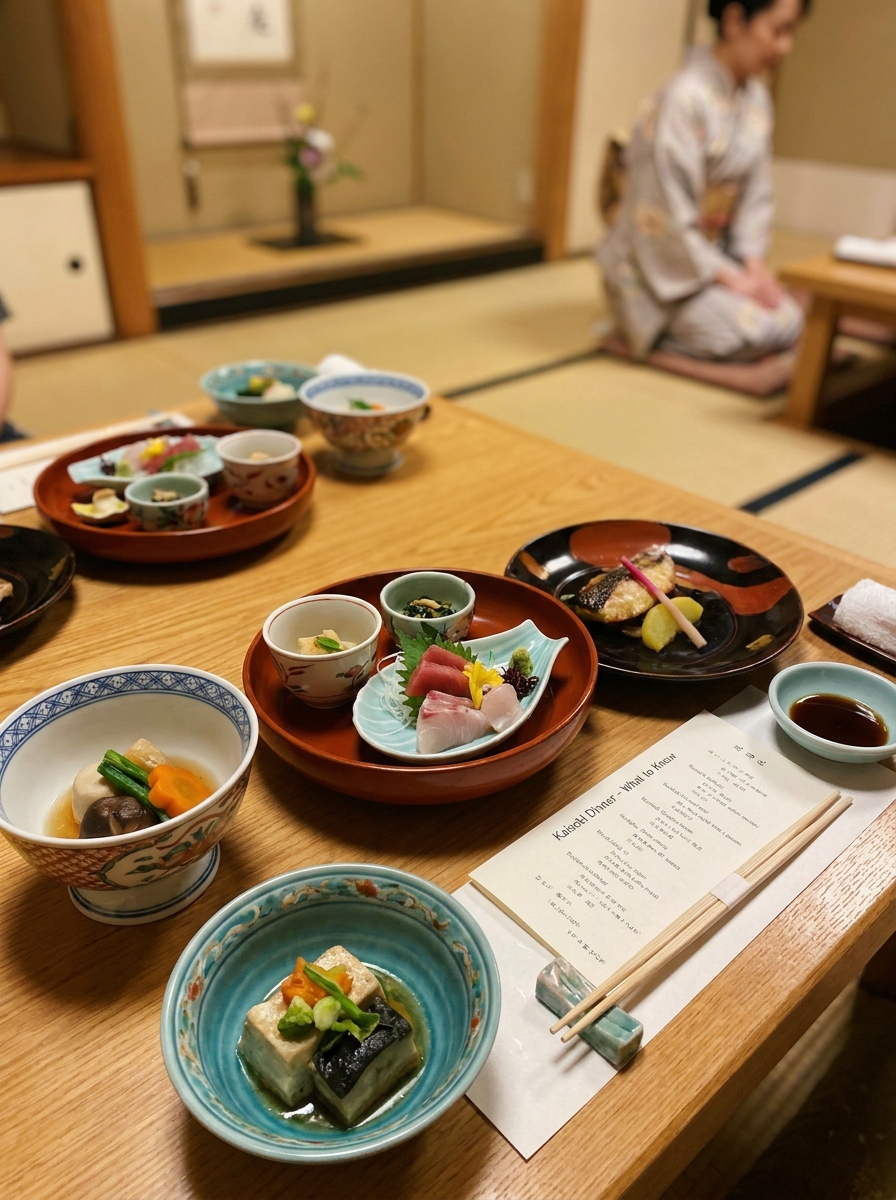
Dinner is served at a fixed time you’ll agree with staff on arrival – typically between 6:00 PM and 7:30 PM. Punctuality matters because each course is prepared to arrive at its precise temperature and peak.
A kaiseki meal involves 8–12 small dishes served sequentially: seasonal appetizers, sashimi, a grilled dish (often fish or wagyu), simmered vegetables, rice, miso soup, pickles, and dessert.
You will almost certainly be full before the rice course. Eat slowly. This is not a meal to rush.
If you have dietary restrictions, communicate them before arrival, not at check-in. Most ryokan can accommodate vegetarian, vegan, or allergen requirements with sufficient notice (usually 3–5 days minimum).
One thing nobody mentions: Do not tip. In Japan, tipping is not practiced and can cause awkwardness. A sincere arigatou gozaimashita (thank you very much) or a small souvenir from your home country is genuinely appreciated far more.
Also Read: 30 Days In Japan Itinerary & Japan Family Trip Itinerary
How Far in Advance to Book (And Why You Can’t Wait)
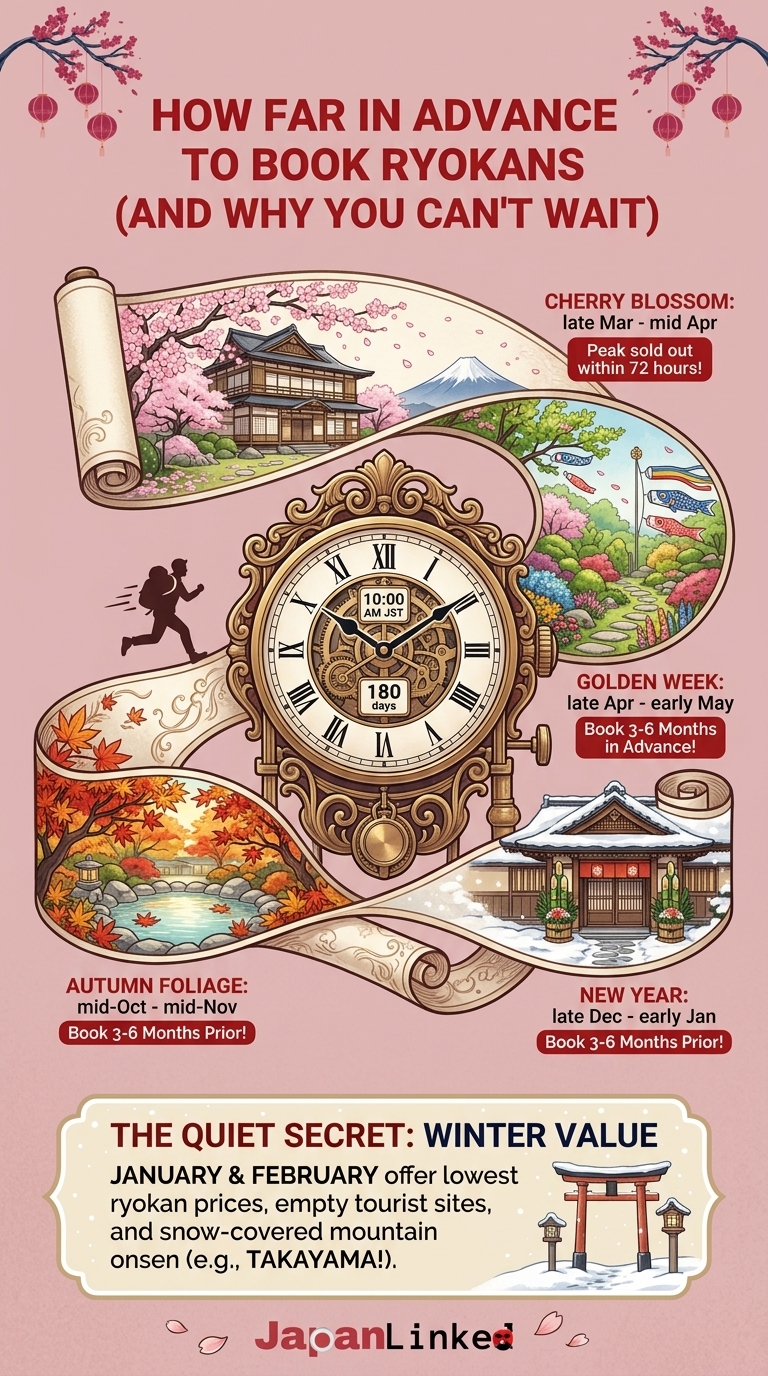
This is the question most first-time ryokan visitors get wrong.
Top-tier properties in Hakone, Kyoto, and Kinosaki are booking out 3–6 months in advance for peak season dates.
Cherry blossom weekends at properties like Gora Kadan sold out within 72 hours of the reservation window opening in October 2025.
Many properties open reservations at exactly 10 AM JST, 180 days in advance – mark that date if a specific property matters to you.
For weekdays outside peak periods (January, February, early June), 6–8 weeks is typically sufficient even for popular mid-range properties.
Peak seasons requiring early booking:
- Cherry blossom: late March to mid-April
- Golden Week: late April to early May
- Autumn foliage: mid-October to mid-November
- New Year: late December to early January
Best value seasons for first-timers: January and February offer some of the lowest ryokan prices of the year, empty tourist sites, and the particular beauty of snow-covered mountain onsen – especially in Takayama and mountain ryokan. A winter ryokan stay is quietly one of Japan’s best travel secrets.
The One Question First-Timers Forget to Ask
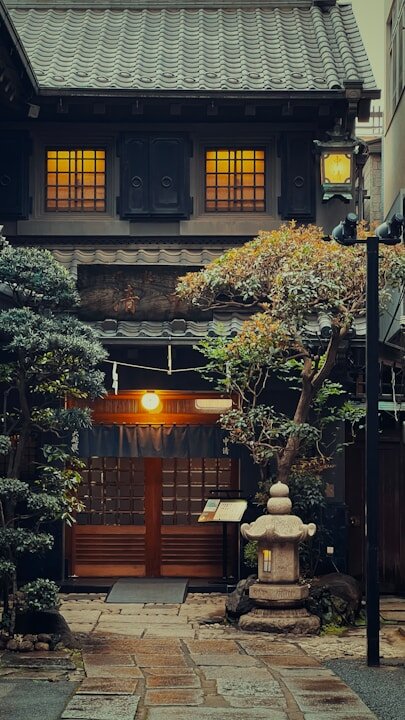
Before you book, ask the ryokan this: “Do you have English-speaking staff available during check-in and dinner?”
For a first ryokan experience, this single factor determines more of your comfort than the room tier, the price, or the location.
A ¥20,000 property with warm, English-capable staff who can guide you through the slipper system, explain each kaiseki course, and help you find the right bathhouse is a far better first experience than a ¥60,000 property where the nakai-san delivers dinner in silence and you’re left unsure which dish to eat first.
The best beginner-friendly ryokan – Gora Kadan in Hakone, Nishimuraya in Kinosaki, Yacchiyo in Kyoto – combine genuine traditional atmosphere with the infrastructure to make international guests feel held rather than adrift.
Conclusion: One Night Changes Everything
The fear most first-timers have about staying in a ryokan – that it will be confusing, formal, or alienating – almost universally dissolves within the first hour.
By the time dinner arrives and a staff member quietly lays out your futon while you’re at the table, and you realize you haven’t thought about your phone in two hours, you’ll already be planning when to come back.
Start in Hakone if you want reliability and a dramatic setting. Go to Kinosaki if you want the full onsen town romance.
Choose Kyoto if food and history matter most to you. But whichever you pick – book it early, wear the yukata left over right, wash before the bath, and eat every course.
The best ryokan stay isn’t the most expensive one. It’s the one you were present for.
