
Most people give Japan two weeks. That’s enough to scratch the surface – but not enough to feel it.
One month in Japan is a different experience entirely. It’s the difference between visiting Kyoto and understanding Kyoto.
Between rushing through Tokyo’s highlights and actually getting lost in its neighborhoods on purpose.
If you’ve secured a precious month off and you’re wondering how to build the perfect one month Japan itinerary, you’re in exactly the right place.
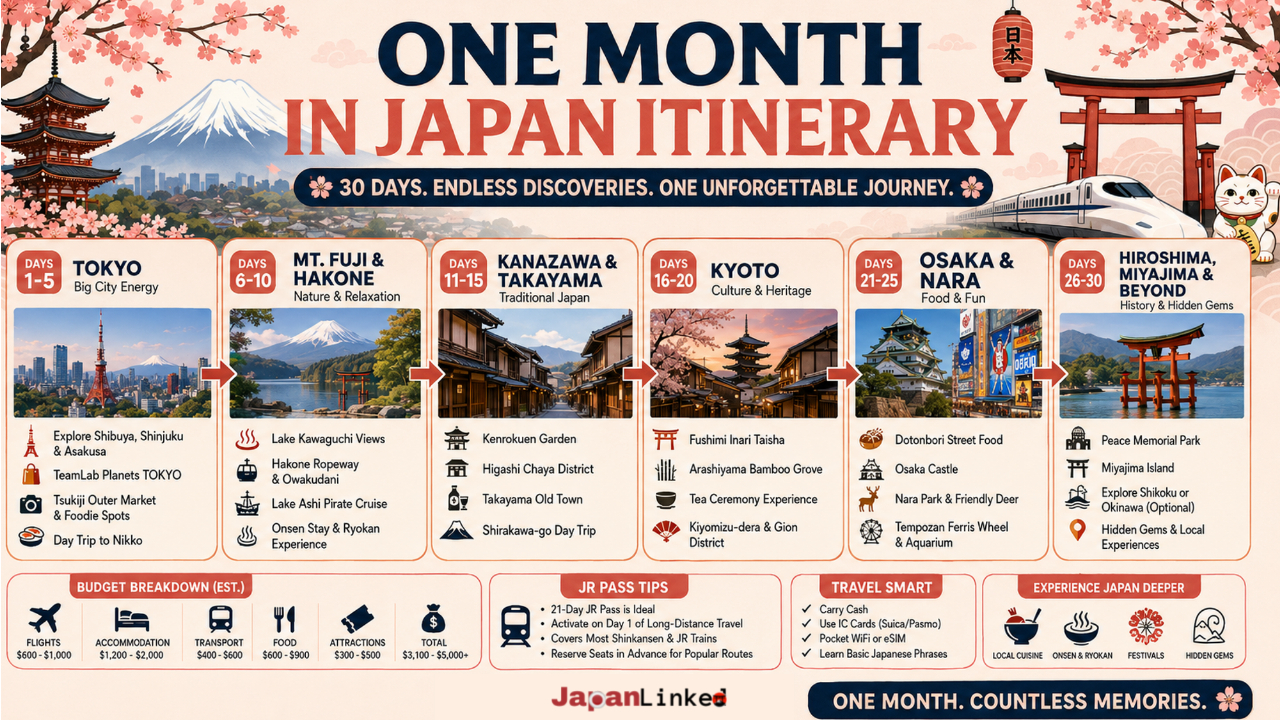
This guide maps out 30 days of travel across Japan’s most iconic cities and its lesser-known gems – with day-by-day structure, practical tips, and honest budget numbers.
The Big Picture: How to Structure a One Month Japan Itinerary
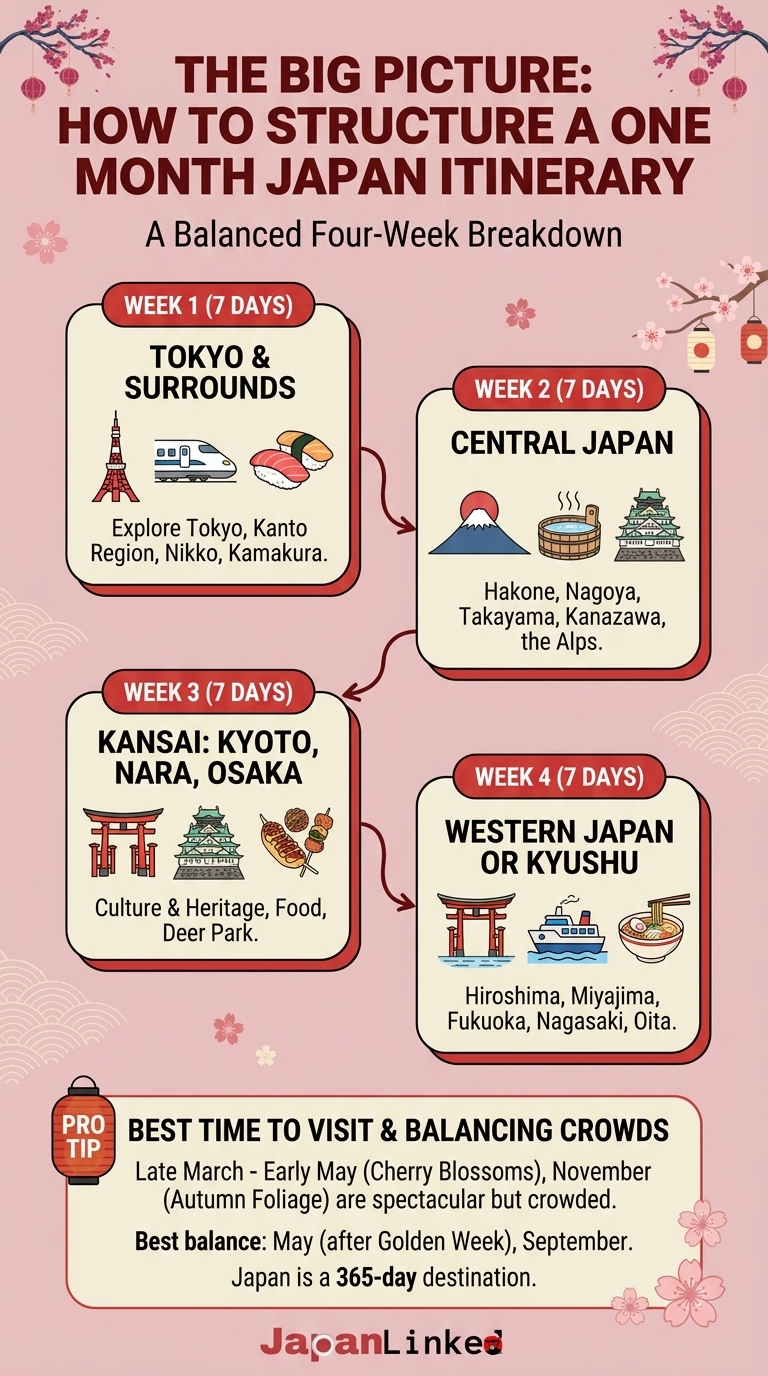
Before diving into the day-by-day breakdown, it helps to think in four-week blocks. A well-balanced one month Japan itinerary typically looks like this:
- Week 1 – Tokyo and surrounds (7 days)
- Week 2 – Central Japan: Hakone, Nagoya, and the Alps (7 days)
- Week 3 – Kansai: Kyoto, Nara, and Osaka (7 days)
- Week 4 – Western Japan or Kyushu (7 days)
This structure gives you breathing room, lets you explore depth over breadth, and avoids the classic trap of spending your entire trip rushing between Shinkansen platforms.
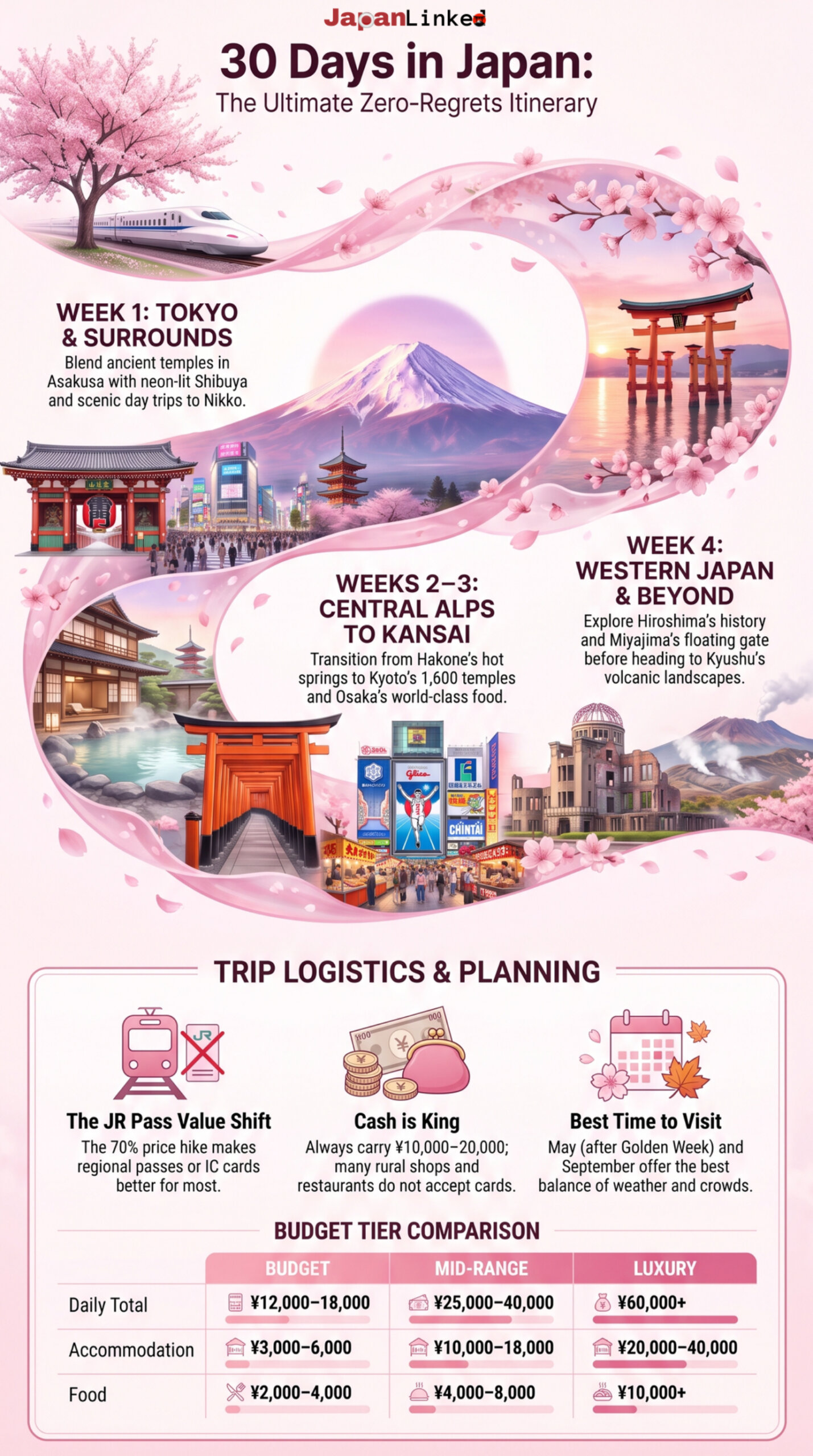
Pro Tip: Japan is a 365-day destination. That said, late March to early May (cherry blossom season) and November (autumn foliage) are the most spectacular – and the most crowded. May after Golden Week and September offer the best balance of good weather and thinner crowds.
Week 1 – Tokyo (Days 1–7)
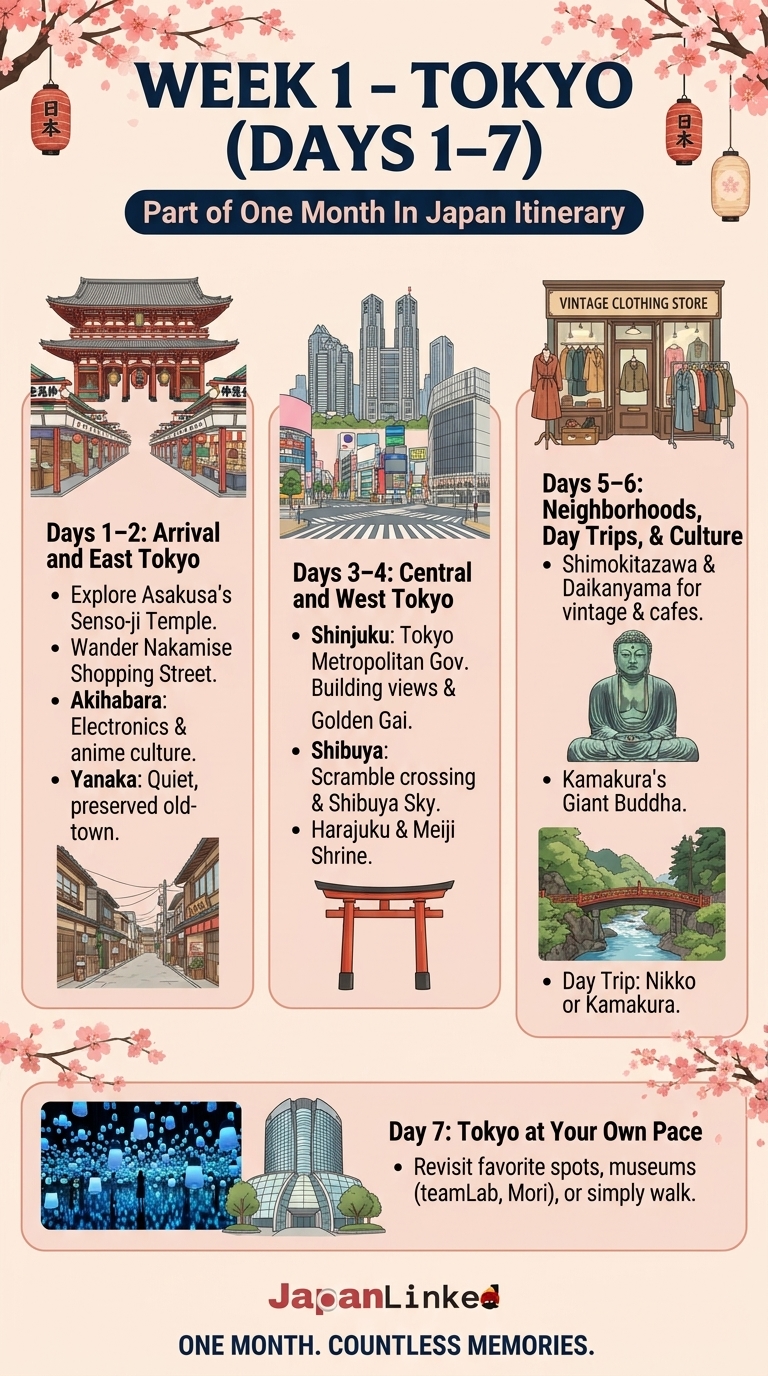
Days 1–2: Arrival and East Tokyo
Tokyo deserves at least seven days, and you’ll still leave wanting more. Start your first full day in East Tokyo – specifically Asakusa, where the ancient Senso-ji temple sits at the heart of one of Tokyo’s oldest neighborhoods.
Wander Nakamise Shopping Street, pick up snacks, and let yourself wander without a plan.
On Day 2, head to Akihabara (electronics and anime culture at its most gloriously chaotic), then dip into the quiet riverside area of Yanaka – Tokyo’s best-preserved old-town neighborhood and a world away from the neon madness a few stops away.
Days 3–4: Central and West Tokyo
Day 3 belongs to Shinjuku – vast, bewildering, and endlessly entertaining. Hit the Tokyo Metropolitan Government Building for free panoramic views, then lose a few hours in Shinjuku’s legendary Golden Gai bar district after dark.
Day 4: Shibuya and Harajuku. The famous Shibuya scramble crossing is best experienced from the Starbucks above it or the Shibuya Sky observation deck. Walk north to Harajuku’s Takeshita Street, then find calm in the forested grounds of Meiji Shrine.
Days 5–6: Neighborhoods, Day Trips, and Culture
Shimokitazawa – Tokyo’s coolest neighborhood for vintage shopping, live music, and great coffee – deserves its own half-day. So does Daikanyama, the city’s most relaxed upscale area.
Use one of these days for a day trip to Nikko (ornate mountain shrines about 2 hours north) or Kamakura (seaside town famous for its giant Buddha statue and coastal hiking trails).
Day 7: Tokyo at Your Own Pace
Build a free day into the Tokyo block. Use it to revisit somewhere that moved you, explore a museum you missed (the Mori Art Museum and the teamLab digital art spaces are both exceptional), or simply walk. Tokyo rewards people who slow down.
Also Read: 2 Week Japan Itinerary & 3 Week Japan Itinerary
Week 2 – Hakone, Nagoya, and the Japanese Alps (Days 8–14)
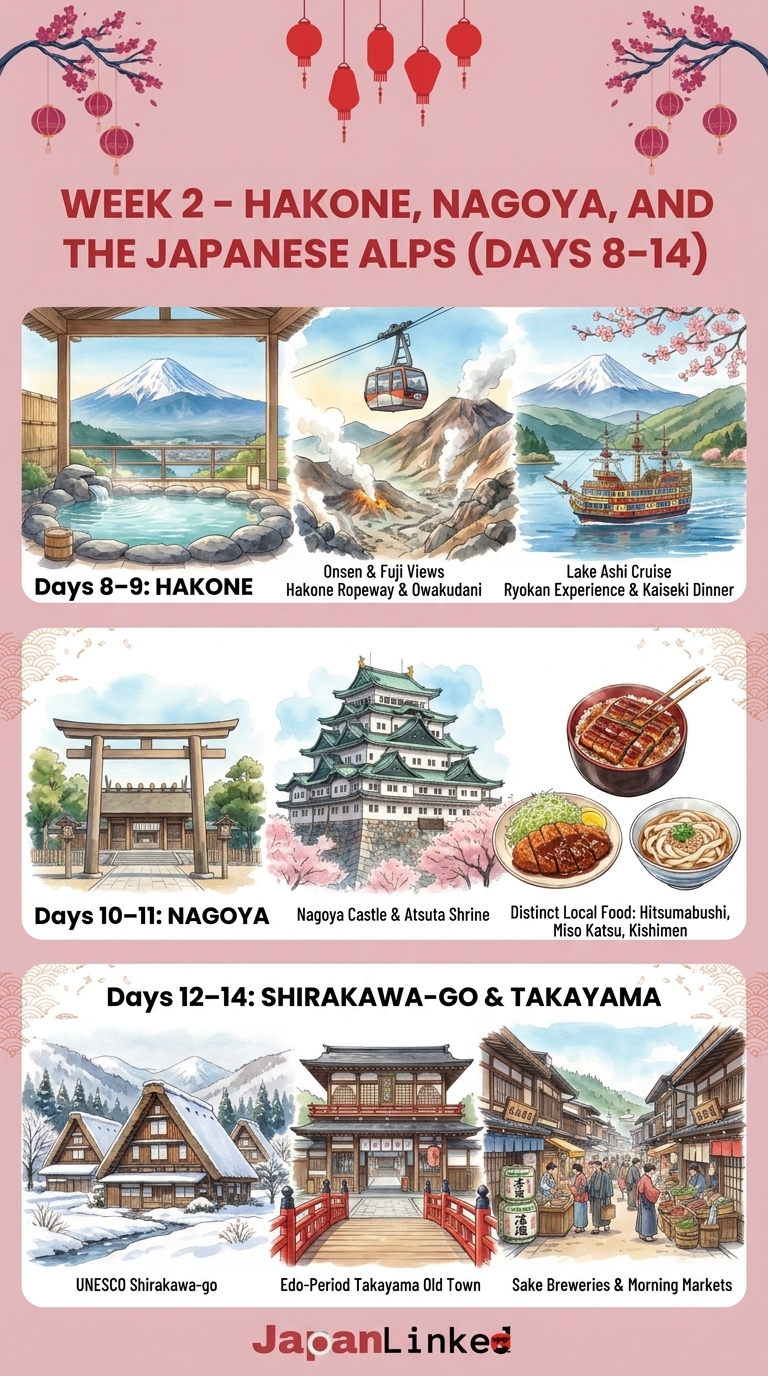
Days 8–9: Hakone
Two hours from Tokyo, Hakone is where Japan’s famous natural beauty announces itself. Soak in an outdoor onsen with views of Mount Fuji on clear days.
Take the Hakone Ropeway over volcanic Owakudani valley. Cruise Lake Ashi. This is where the pace of your trip shifts – from exhilarating to restorative.
Stay in a ryokan (traditional inn) here if you can. The full experience – multi-course kaiseki dinner, futon on tatami, communal baths – is one of Japan’s great pleasures and surprisingly affordable at mid-range properties.
Days 10–11: Nagoya
Often overlooked, Nagoya is one of Japan’s most underrated cities. Nagoya Castle is one of the finest in the country, the Atsuta Shrine is among Japan’s most sacred, and the local food scene is genuinely distinct – try hitsumabushi (grilled eel over rice), miso katsu, and kishimen flat noodles.
Days 12–14: Shirakawa-go and Takayama
This stretch is the one that surprises people the most. Shirakawa-go is a UNESCO World Heritage village of steep-roofed, snow-country farmhouses that look like they’ve barely changed in 300 years.
Stay overnight if you can – once the day-trippers leave, the village becomes magical.
Takayama is a beautifully preserved Edo-period town in the mountains, with excellent sake breweries, morning markets, and an old town district that genuinely earns the “Little Kyoto” nickname. Two nights here is not too many.
Also Read: 1 Week Japan Itinerary & Japan Family Trip Itinerary
Week 3 – Kansai: Kyoto, Nara, and Osaka (Days 15–21)
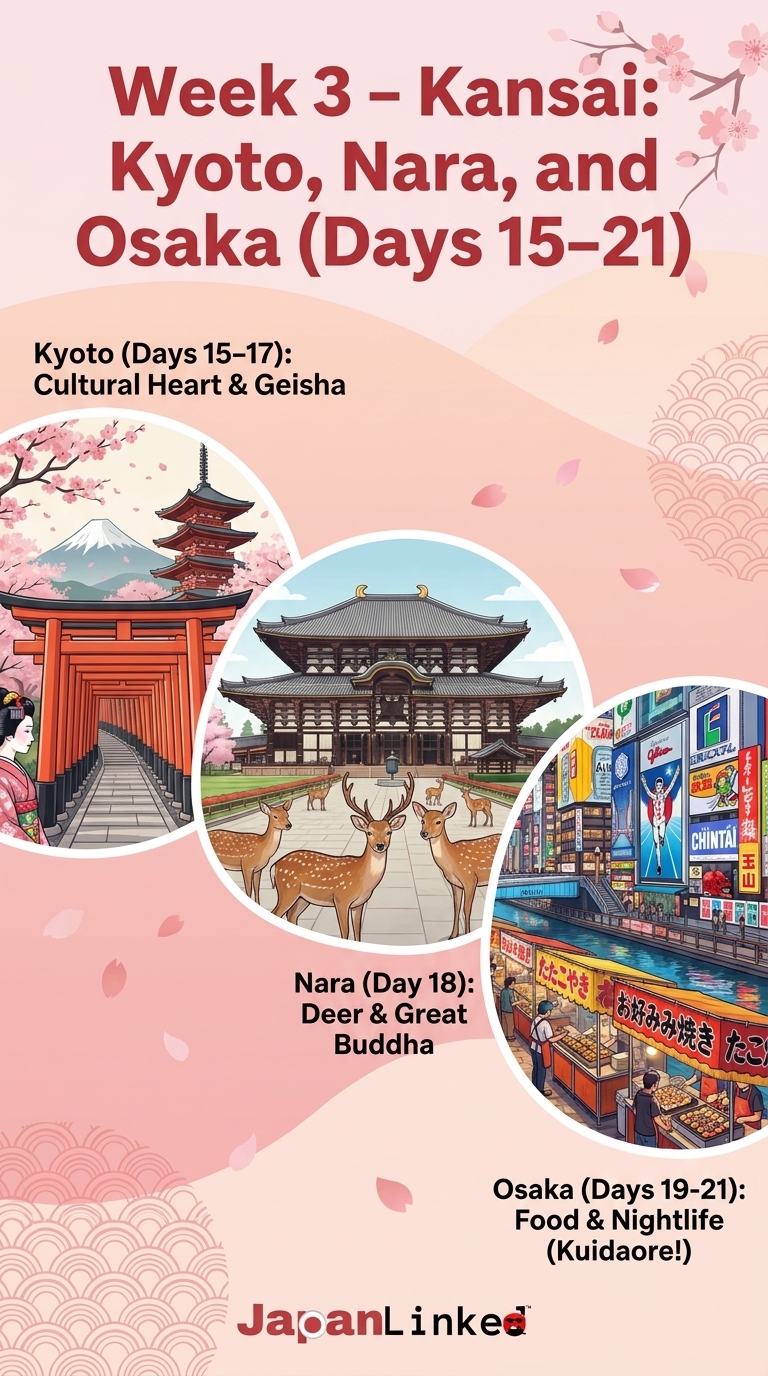
Days 15–17: Kyoto
The cultural heart of Japan. Three full days in Kyoto barely scratches the surface – it has over 1,600 temples and shrines – but here’s how to prioritize:
- Fushimi Inari Shrine (thousands of vermilion torii gates; go at dawn to beat the crowds)
- Arashiyama bamboo grove, the nearby Tenryu-ji temple garden, and a boat ride on the Hozu River
- Gion district in the early evening, where you might spot a geiko (Kyoto’s geisha) heading to an appointment
- Philosopher’s Path lined with cherry trees and small temples
- A tea ceremony or sake tasting at one of the many cultural experience studios
| Area | Best Time to Visit | Don’t Miss |
|---|---|---|
| Fushimi Inari | Early morning | Upper torii gates, fewer crowds |
| Arashiyama | Morning | Tenryu-ji garden, river cruise |
| Gion | Early evening | Hanamachi streets |
| Higashiyama | Weekday morning | Kiyomizudera temple |
Day 18: Nara
An easy 45-minute train from Kyoto, Nara is famous for its freely roaming deer and the enormous Todai-ji Temple, home to Japan’s largest bronze Buddha.
The deer park is charming and the Kasuga-taisha Shrine’s stone lantern-lined path is deeply atmospheric. Half a day is enough; a full day is even better.
Days 19–21: Osaka
Osaka is Japan’s most food-obsessed city, and that’s saying a lot. The phrase kuidaore – “eat until you drop” – was coined here.
Spend your evenings in Dotonbori and Namba, eating takoyaki (octopus balls), okonomiyaki (savory pancakes), and kushikatsu (deep-fried skewers). Explore the cool Shinsekai neighborhood for a more local atmosphere.
Day trip options from Osaka include Himeji (Japan’s most spectacular castle, a 30-minute Shinkansen ride west) and Kobe (port city famous for its beef and cosmopolitan atmosphere).
Also Read: North Japan Itinerary & South Japan Itinerary
Week 4 – Hiroshima, Miyajima, and Kyushu (Days 22–30)
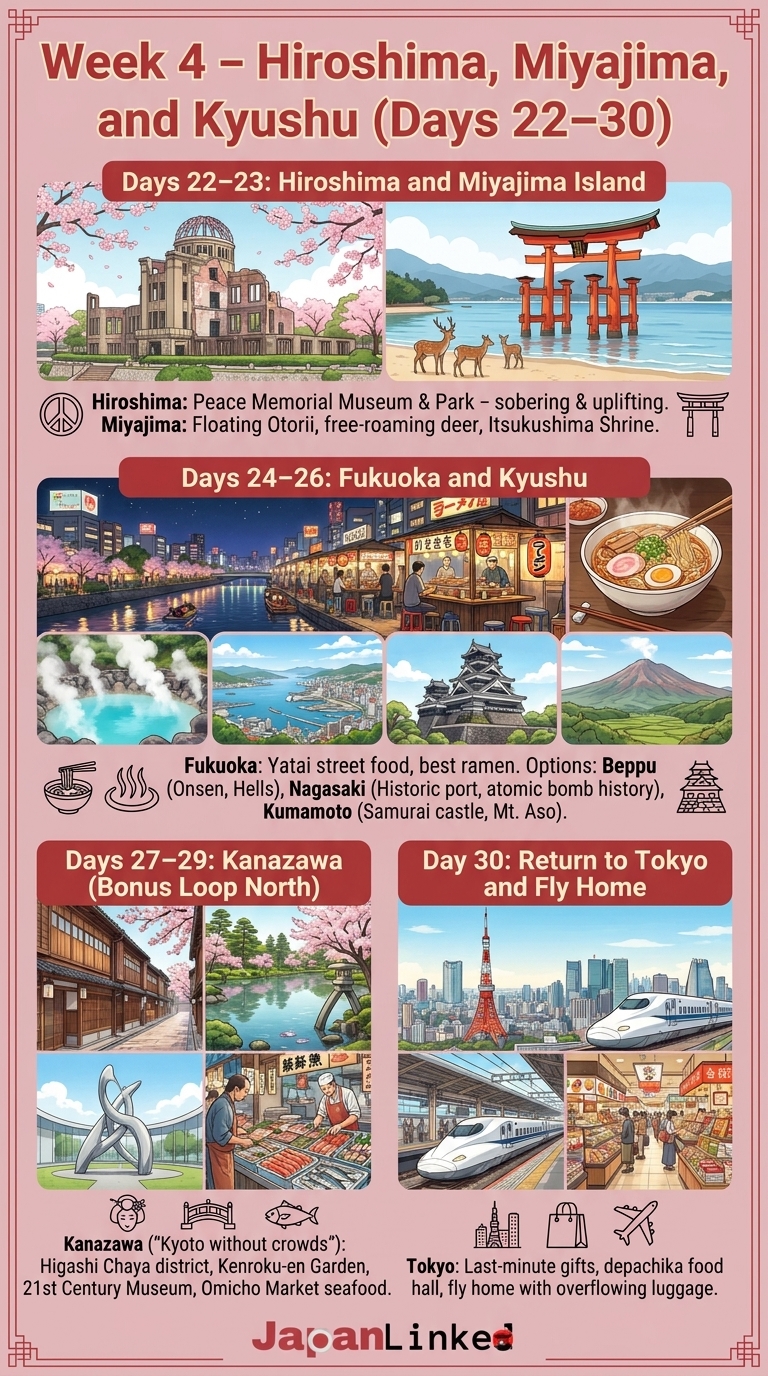
Days 22–23: Hiroshima and Miyajima Island
Hiroshima is one of the most profound stops on any Japan itinerary. The Peace Memorial Museum is sobering, essential, and ultimately uplifting – it’s a testament to resilience and an argument for peace.
The surrounding Peace Memorial Park is beautifully maintained and deeply moving.
From Hiroshima, take a short ferry to Miyajima Island, home of the famous “floating” Otorii gate that appears to rise from the sea at high tide.
The island also has free-roaming deer and the beautiful Itsukushima Shrine – one of Japan’s most photographed scenes, and one of the few that fully lives up to its reputation.
Days 24–26: Fukuoka and Kyushu
Fukuoka is one of Japan’s most livable cities and the gateway to Kyushu. It’s famous for its street food stalls (yatai) that line the Nakasu riverfront – some of the best ramen in Japan, served at outdoor counters after dark.
From Fukuoka, options include:
- Beppu – Japan’s most geothermally active city, famous for its 2,800+ onsen hot springs and the steaming “Hells” (hells being colorful pools of boiling water used as tourist attractions)
- Nagasaki – historic port city with a fascinating mix of Japanese, Chinese, and Dutch influences and its own powerful atomic bomb history
- Kumamoto – samurai castle, Mt. Aso’s active volcanic crater, and excellent local beef
Days 27–29: Kanazawa (Bonus Loop North)
Alternatively for Week 4, cut back across to Kanazawa – nicknamed “Kyoto without the crowds” by Japanese travelers themselves.
The Higashi Chaya geisha district rivals Gion in atmosphere but with a fraction of the visitors. Kenroku-en is one of Japan’s three great gardens. The 21st Century Museum of Contemporary Art is world-class.
And the Omicho Market is where you eat incredibly fresh seafood straight from the Sea of Japan.
Kanazawa survived World War II largely intact, preserving its samurai and geisha districts, traditional crafts, and one of Japan’s three celebrated gardens – a rare thing in Japan’s major cities.
Day 30: Return to Tokyo and Fly Home
Budget a final night in Tokyo to decompress, pick up any last-minute gifts at a department store basement food hall (the depachika experience is unmissable), and catch your flight home with overflowing luggage and at least 400 new food photos.
Also Read: 11 Days In Japan Itinerary & 10 Days In Japan Itinerary
Budget Breakdown for a One Month Japan Itinerary
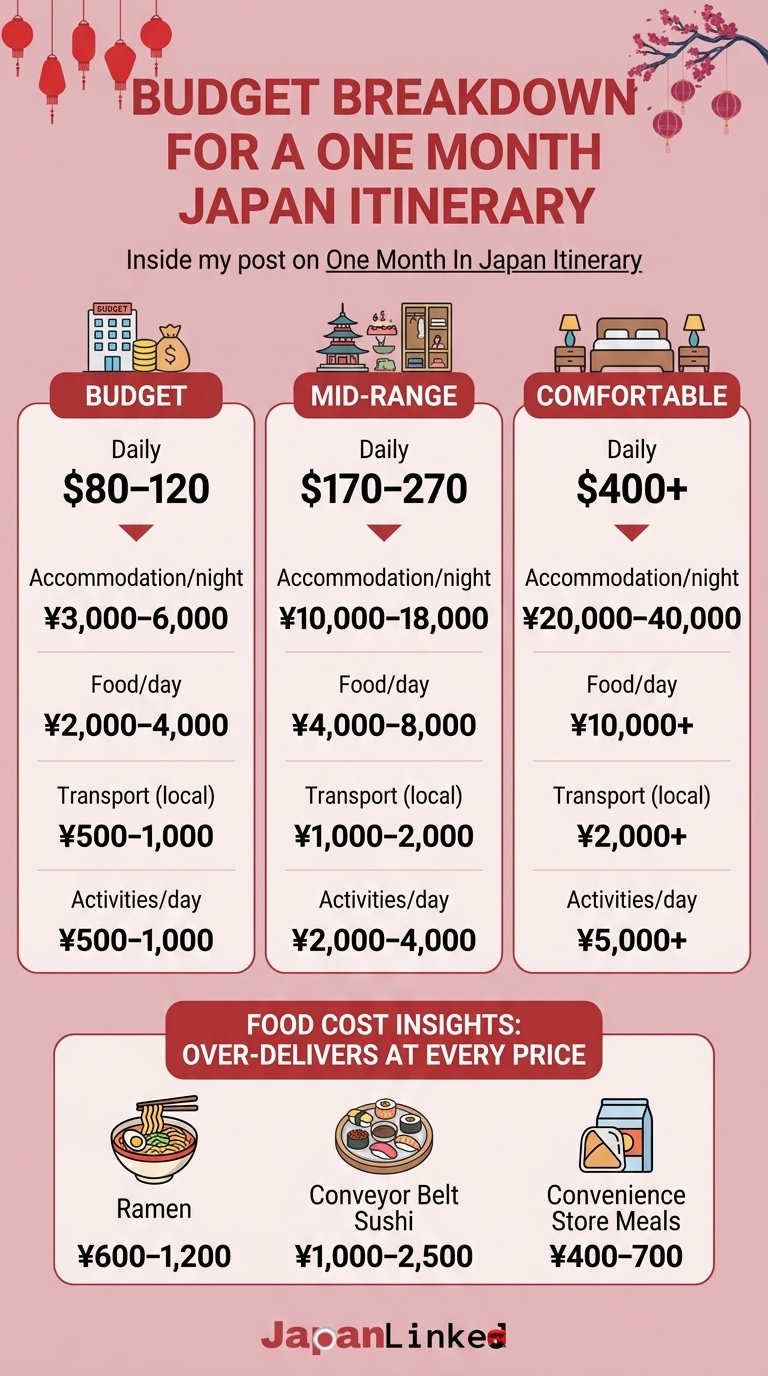
Japan has a reputation for being expensive, but the reality is more nuanced. The yen has remained weak against the US dollar, British pound, euro, and Australian dollar, making it more affordable for international visitors.
Daily costs in Japan range from ¥12,000–18,000 ($80–120) for budget travelers, ¥25,000–40,000 ($170–270) for mid-range comfort, and ¥60,000+ ($400+) for luxury experiences.
| Category | Budget | Mid-Range | Comfortable |
|---|---|---|---|
| Accommodation/night | ¥3,000–6,000 | ¥10,000–18,000 | ¥20,000–40,000 |
| Food/day | ¥2,000–4,000 | ¥4,000–8,000 | ¥10,000+ |
| Transport (local) | ¥500–1,000 | ¥1,000–2,000 | ¥2,000+ |
| Activities/day | ¥500–1,000 | ¥2,000–4,000 | ¥5,000+ |
On food: Japan genuinely over-delivers at every price point. Ramen bowls run ¥600–1,200 ($4–8), conveyor belt sushi ¥1,000–2,500 ($7–17), and convenience store meals ¥400–700 ($3–5) – all offering quality that exceeds Western equivalents at those prices.
The JR Pass Question: Do You Need One?
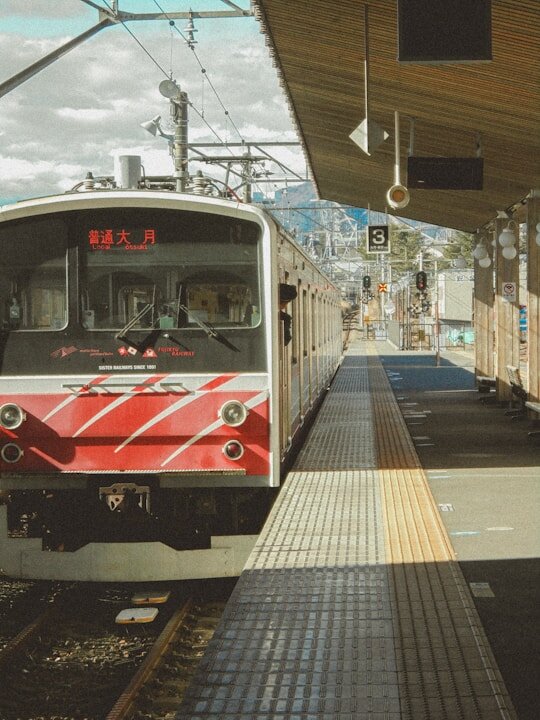
The JR Pass is one of the most-debated topics in Japan travel planning, and the answer is: it depends on your route.
The Japan Rail Pass increased in price by approximately 70% in October 2023, fundamentally changing the value calculation for most itineraries.
A 7-day JR Pass now costs around $330. The pass only pays for itself if you’re making at least three long-distance Shinkansen trips within the pass period.
For a full month, many travelers find that two regional passes plus IC card top-ups works out cheaper than back-to-back national passes.
What’s always worth buying: an IC card (Suica or Pasmo). These rechargeable smart cards work on almost all subway, bus, and local rail lines and save you from buying individual tickets every time.
Essential Japan Travel Tips For 30 Day Trip
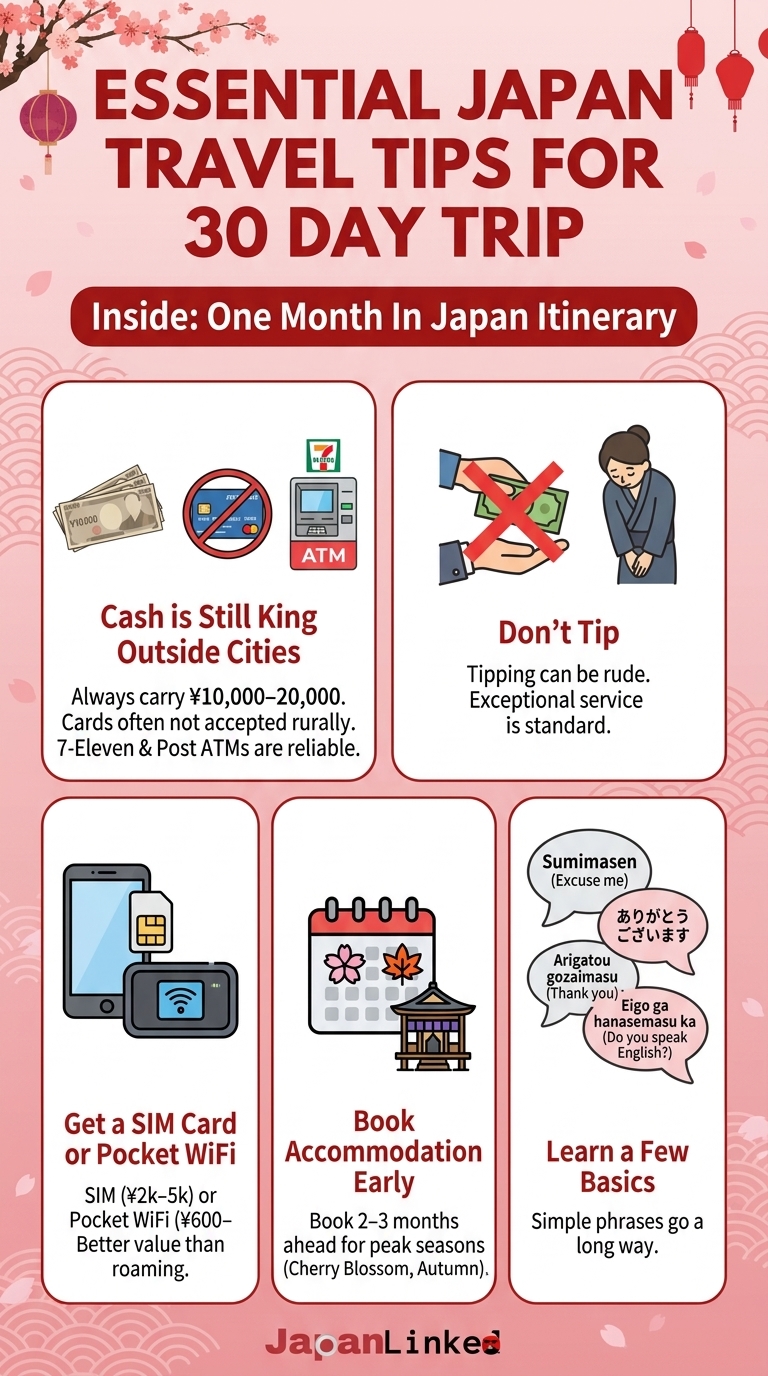
Cash is still king outside cities. While major urban areas increasingly accept cards, rural areas and small restaurants often don’t. Always carry ¥10,000–20,000 in cash. ATMs at 7-Eleven and Japan Post reliably accept foreign cards.
Don’t tip. Japan does not have a tipping culture – in fact, tipping can be considered rude. Exceptional service is the standard, not something to reward with extra payment.
Get a SIM card or eSIM. Rent pocket WiFi (¥600–1,000 daily) or buy a Japanese SIM card (¥2,000–5,000 for 1–4 weeks) – both provide better value than international roaming.
Book accommodation early for popular seasons. Book accommodation 2–3 months ahead for popular destinations and seasons – especially for cherry blossom and autumn foliage periods when even budget hostels sell out months in advance.
Learn a few basics. You don’t need to speak Japanese to navigate Japan comfortably. The transport system is well-signposted in English, and Google Translate’s camera feature helps with signs. But knowing sumimasen (excuse me), arigatou gozaimasu (thank you), and eigo ga hanasemasu ka (do you speak English?) goes a long way.
Best Time to Visit Japan for a Month-Long Trip
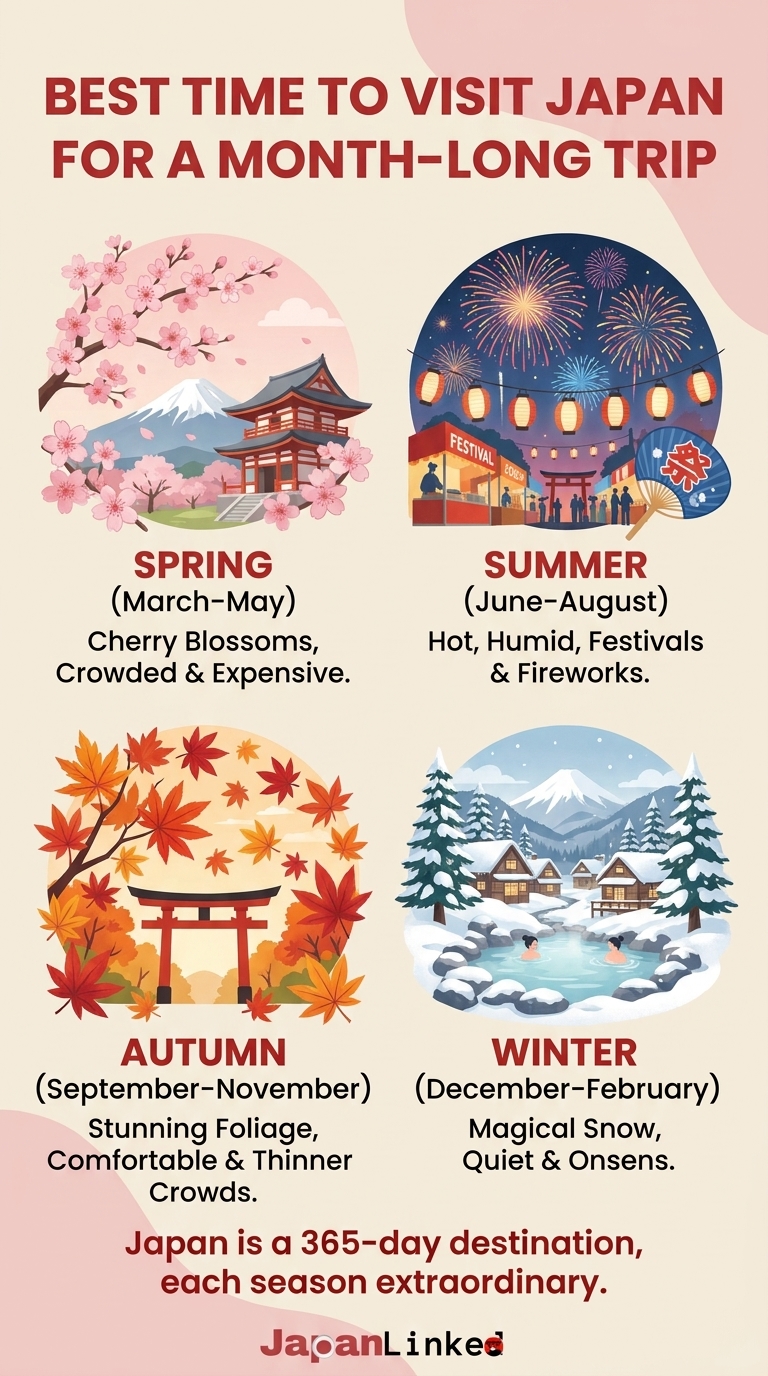
No single “best” season exists – each is extraordinary in its own way.
- Spring (March–May): Cherry blossoms peak late March to mid-April. Spectacular but crowded and expensive.
- Summer (June–August): Hot, humid, and rainy in June – but festival season is electric. Fireworks displays (hanabi) throughout July and August are a highlight.
- Autumn (September–November): Many experienced travelers’ favorite. Comfortable temperatures, stunning foliage, thinner crowds than spring.
- Winter (December–February): Quiet, cold, and magical – especially onsen towns blanketed in snow. Ski resorts in Hokkaido and Nagano are world-class.
Japan is a 365-day destination, with trips in the depths of winter just as satisfying as ones in the heart of summer.
Final Thoughts
A one month Japan itinerary gives you something rare in modern travel: enough time to stop performing the trip and start actually living it.
Enough time to wander down the wrong street, discover a tiny ramen shop with no English menu, order by pointing, and have one of the best meals of your life.
Enough time to sit in a garden and do nothing while watching light move through maple leaves.
Japan is endlessly, generously complex. A month won’t exhaust it – but it will give you exactly enough to understand why so many people go once and spend the rest of their lives trying to get back.
Start planning. Book the flight. The itinerary above is a framework, not a cage – let Japan surprise you.
