
Japan is one of the few places on earth where luxury doesn’t feel borrowed from somewhere else.
It’s entirely its own – built from centuries of omotenashi (the art of selfless, anticipatory hospitality), a culinary culture that has more Michelin stars than any city on earth, and a design philosophy that finds beauty in restraint.
If you’ve ever wondered what it feels like to be truly, quietly taken care of, a luxury Japan itinerary will answer that question in ways no other destination quite can.
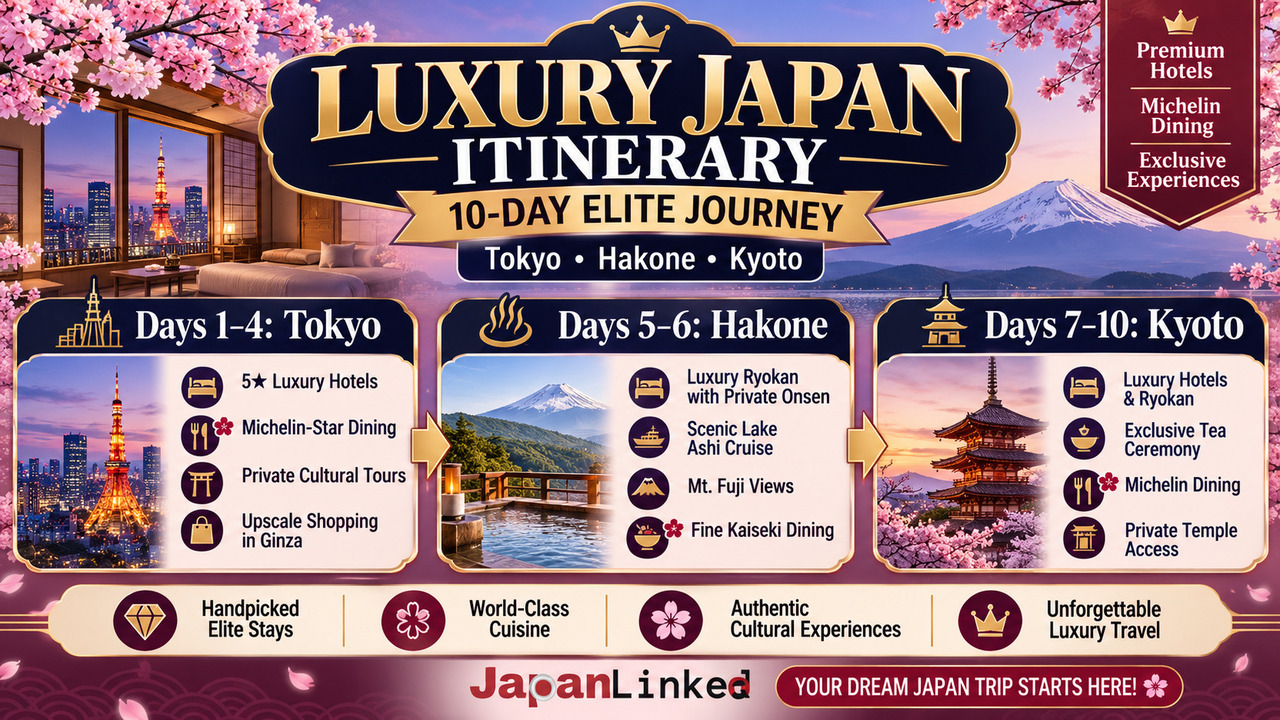
This guide lays out a 10-day luxury Japan itinerary covering Tokyo, Hakone, and Kyoto – the golden triangle for first-time luxury travelers – with hotel picks, dining recommendations, and exclusive experiences drawn from the best the country currently offers.
Whether you’re planning a honeymoon, a milestone anniversary, or simply a trip where comfort and culture are non-negotiable, this is your starting point.
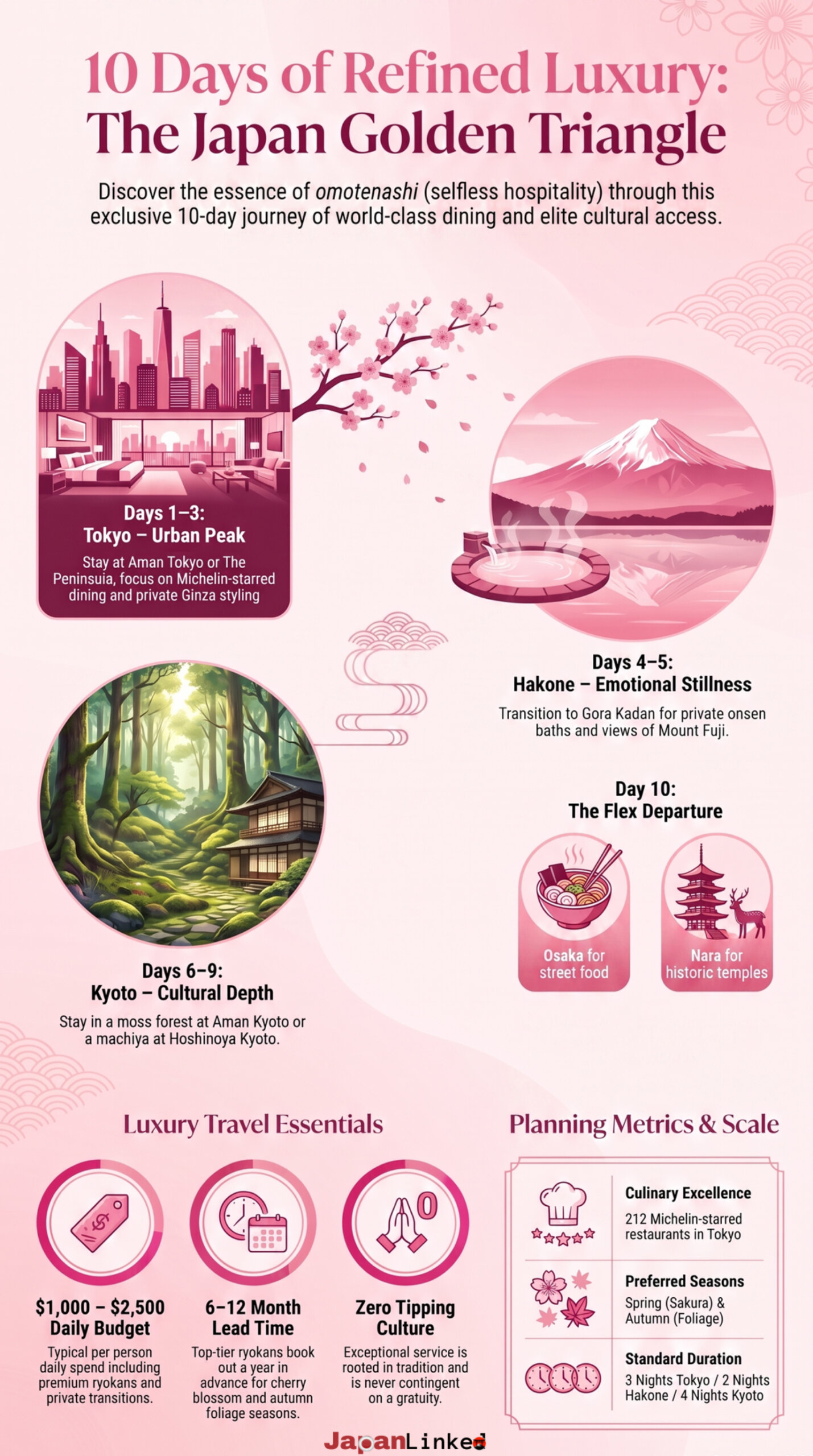
Why Japan Is the World’s Premier Luxury Destination Right Now
Japan’s luxury travel market is surging. Advance bookings for premium experiences have risen sharply in recent years, and the best ryokans now fill up 6 to 12 months ahead during peak seasons. There’s a reason demand is outpacing supply.
No other country balances these elements in a single trip:
- World-class hospitality rooted in tradition, not performance
- The planet’s densest concentration of Michelin-starred restaurants (Tokyo alone had 212 starred restaurants in the 2026 Michelin Guide)
- Seamless, punctual infrastructure – bullet trains, private transfers, airport precision
- A natural landscape that shifts dramatically with the seasons
- An extraordinary level of personal safety and ease for travelers
The ideal luxury Japan trip isn’t about covering the most ground. It’s about choosing the right places, slowing down inside them, and trusting that the country will handle the rest.
Also Read: Southern Japan Itinerary & Northern Japan Itinerary
The Golden Itinerary: 10 Days in Tokyo, Hakone & Kyoto
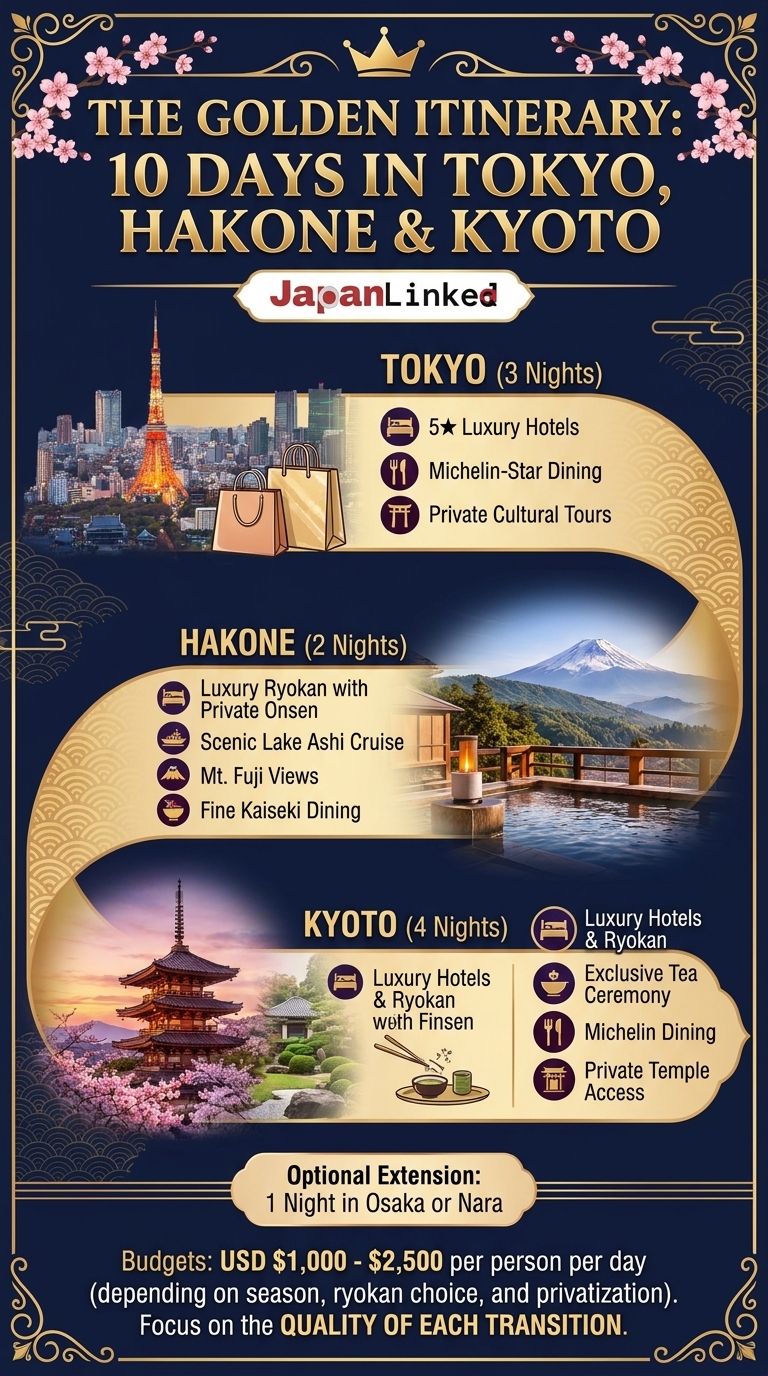
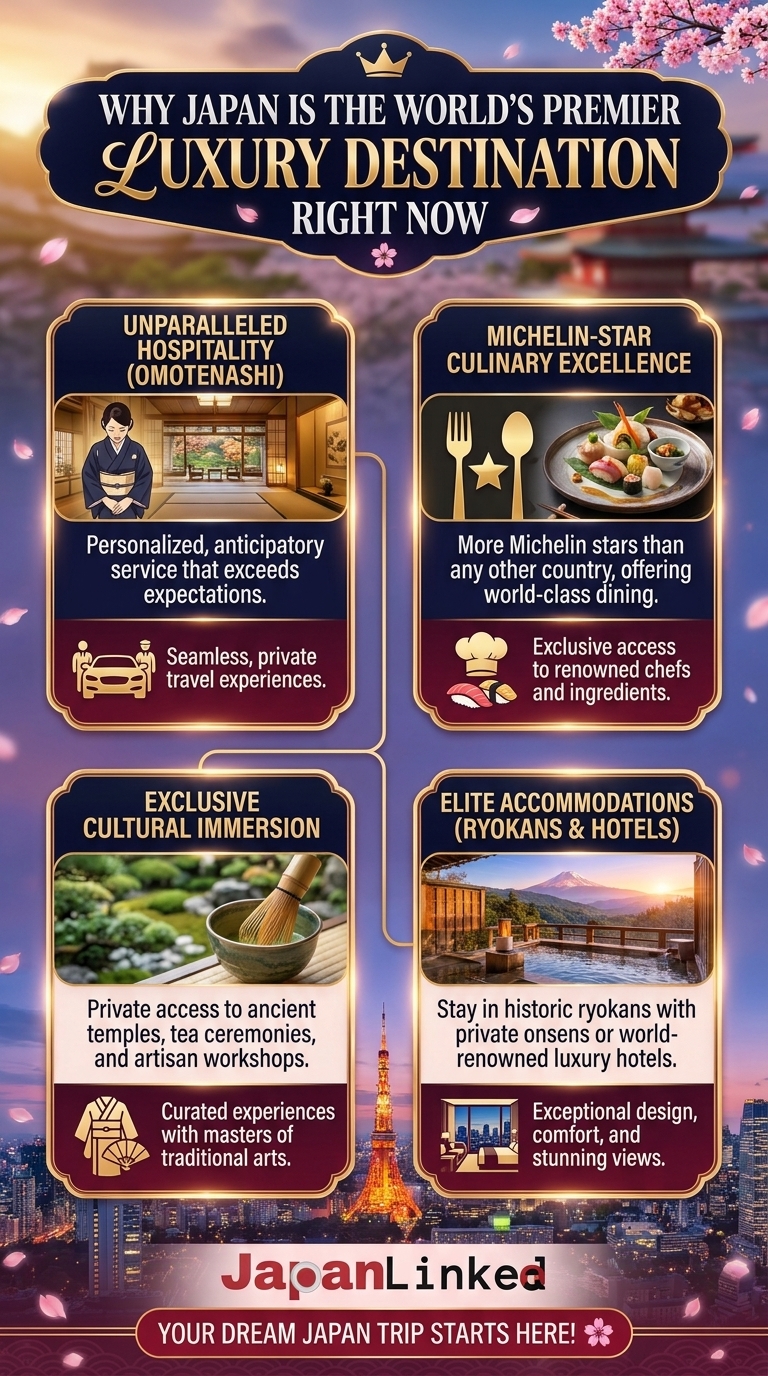
The structure most recommended by luxury travel specialists holds firm: 3 nights in Tokyo → 2 nights in Hakone → 4 nights in Kyoto, with one night to spare for optional extension into Osaka or Nara.
Budgets typically range from USD $1,000 to $2,500 per person per day at this tier, depending on season, ryokan choice, and degree of privatization.
This isn’t about rushing. It’s about the quality of each transition.
Also Read: Japan Honeymoon Itinerary & Japan Countryside Itinerary
Days 1–3: Tokyo – Urban Luxury at Its Absolute Peak
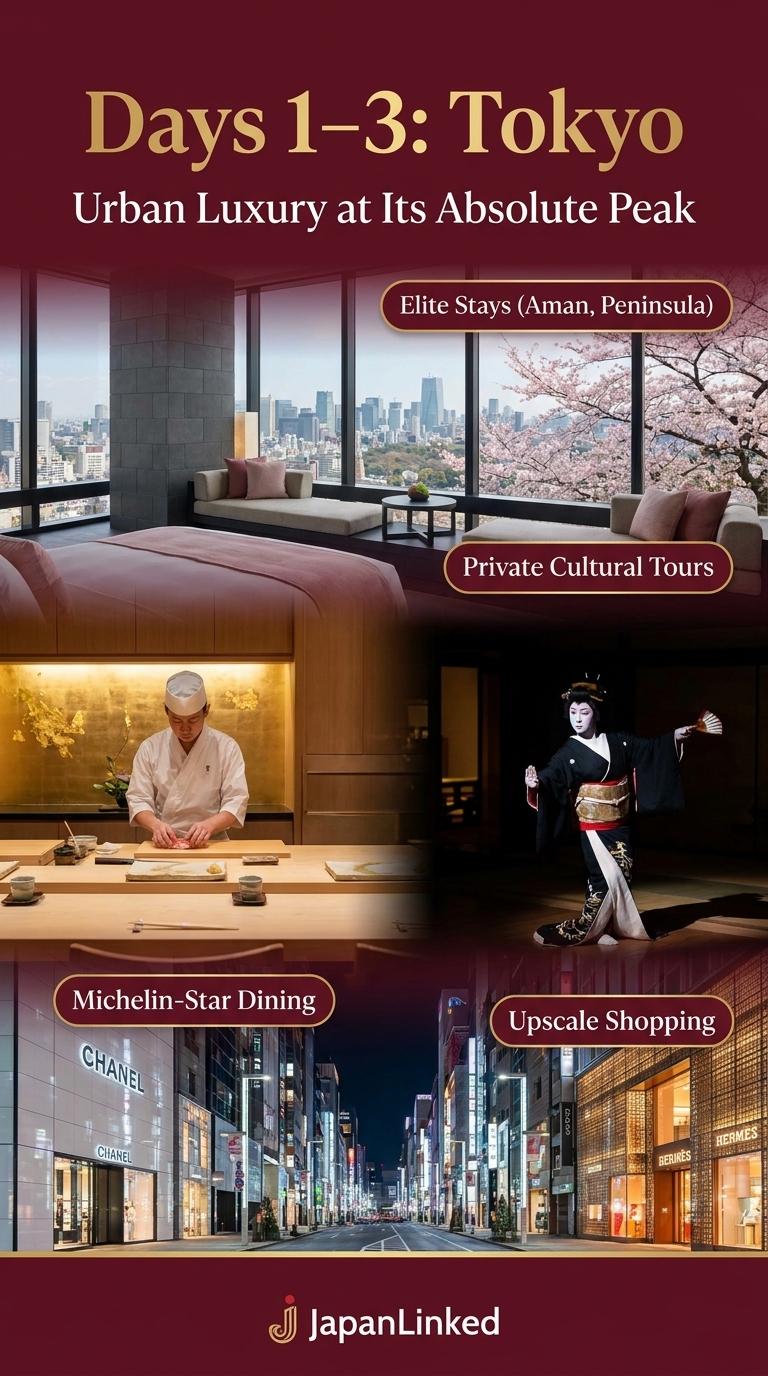
Tokyo is a city of controlled extremes. The streets are immaculate, the service operates on a different frequency from anywhere else in the world, and the food – well, it explains the Michelin star count on its own.
Where to Stay in Tokyo
Aman Tokyo remains the benchmark for 2026. Occupying the top six floors of the Otemachi Tower, the property was designed around the concept of a vertical ryokan – washi paper walls, camphor wood surfaces, ceilings that rise 33 metres in the lobby, and standard rooms that begin at 71 square metres.
Book two to three months in advance for preferred rooms; during cherry blossom season, suites sell out by November of the prior year.
For an alternative with its own distinct character, The Peninsula Tokyo holds a prime position opposite the Imperial Palace. It combines genuine city views with the international polish Peninsula properties are known for.
What to Do in Tokyo
On your first morning, resist the temptation to tick boxes. Instead, consider a slow start: an early walk through the Imperial Palace gardens before the crowds arrive, followed by coffee in the Aman lobby where the silence of the space feels almost architectural.
- Private Tsukiji or Toyosu Market tour: A private guide changes the experience entirely – you move at your own pace, stop where you want, and get context that group tours can’t provide.
- Kabukiza Theatre: Book premium seats at the Kabukiza Theatre in Ginza for kabuki. Pair it with a private guide and the four-hour performance becomes comprehensible and genuinely moving.
- Ginza shopping: The flagship stores of Chanel, Hermès, and Louis Vuitton sit alongside extraordinary Japanese designers, artisanal jewelers, and bespoke leather workshops. Private styling sessions are available on request at most major houses.
Where to Eat in Tokyo
Tokyo is a food city disguised as a capital city. The 2026 Michelin Guide awarded stars to 212 Tokyo restaurants – a number that puts every other city on earth in second place.
| Restaurant | Style | What Makes It Special |
|---|---|---|
| Sukiyabashi Jiro (Ginza) | Sushi omakase | The original; strict pacing, minimal conversation, extraordinary craft |
| Narisawa | Modern Japanese | Nature-driven tasting menus; Japanese forests, waters, and seasons on the plate |
| Den | Creative Japanese | Playful but high-end; widely loved for warmth and genuine character |
| Ishikawa (Kagurazaka) | Kaiseki | The knife work, the broth, the final bowl of rice — everything is equal |
| Florilège | Modern counter | Intimate, celebratory, couples-friendly |
For sushi, note that Sushi Saito is the most-admired name in the city’s elite tier, but getting a reservation typically requires connections.
Sushi Yoshitake is a strong alternative with a refined mood and a more accessible path to booking.
Use a service like PocketConcierge (English-supported) for reservations, or ask your hotel concierge to handle it on arrival.
Also Read: 5 Days Japan Itinerary & 1 Week Japan Itinerary
Days 4–5: Hakone – Where Japan Becomes Emotionally Memorable
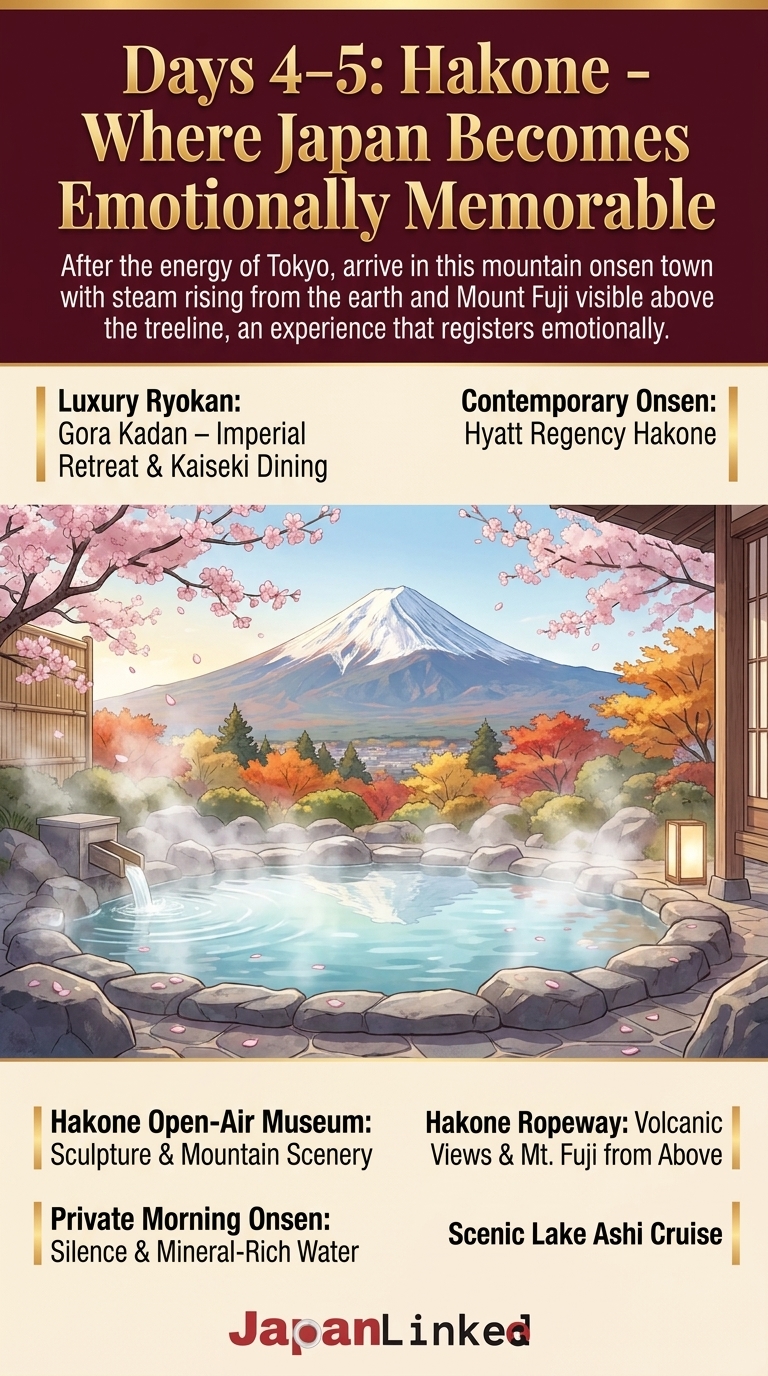
The Hakone transition is the emotional heart of the itinerary. After the energy of Tokyo, arriving in this mountain onsen town – with steam rising from the earth and Mount Fuji visible above the treeline on a clear morning – registers on a level that a second Tokyo hotel never could.
Where to Stay in Hakone
Gora Kadan is consistently placed among Japan’s finest ryokans. Originally an imperial family retreat, it sits in forested hills above Gora with views that reveal themselves slowly as the season changes.
Each room is individual; the kaiseki dinner is prepared with the season in mind, and breakfast the following morning is equally considered.
For travelers who want onsen in a slightly more contemporary register, Hyatt Regency Hakone offers oversized rooms, a fireplace lounge with complimentary evening drinks, and an onsen-inspired spa.
The Deluxe Room with Terrace is the room to request for morning mountain air.
What to Do in Hakone
Hakone is not a sightseeing destination in the conventional sense. It’s a place for slowing down. That said, it rewards exploration:
- The Hakone Open-Air Museum: One of Japan’s finest sculpture parks, set against mountain scenery with works by Rodin, Picasso, and Moore alongside Japanese masters.
- Hakone Ropeway: Views of Owakudani’s volcanic activity and, on clear days, Mount Fuji from above.
- Hakone Art Museum: Small, peaceful, with an extraordinary moss garden.
- Morning onsen: Rise before 6 a.m. and use your ryokan’s private bath. The light, the silence, and the mineral-rich water are worth the early alarm.
The kaiseki dinner your first evening – multiple small courses built around seasonal ingredients, served in your tatami room or a private dining space – is the experience many travelers cite as their most memorable of the entire trip. Don’t rush it.
Also Read: 2 Week Japan Itinerary & 3 Week Japan Itinerary
Days 6–9: Kyoto – The Cultural Heart of Luxury Japan Travel
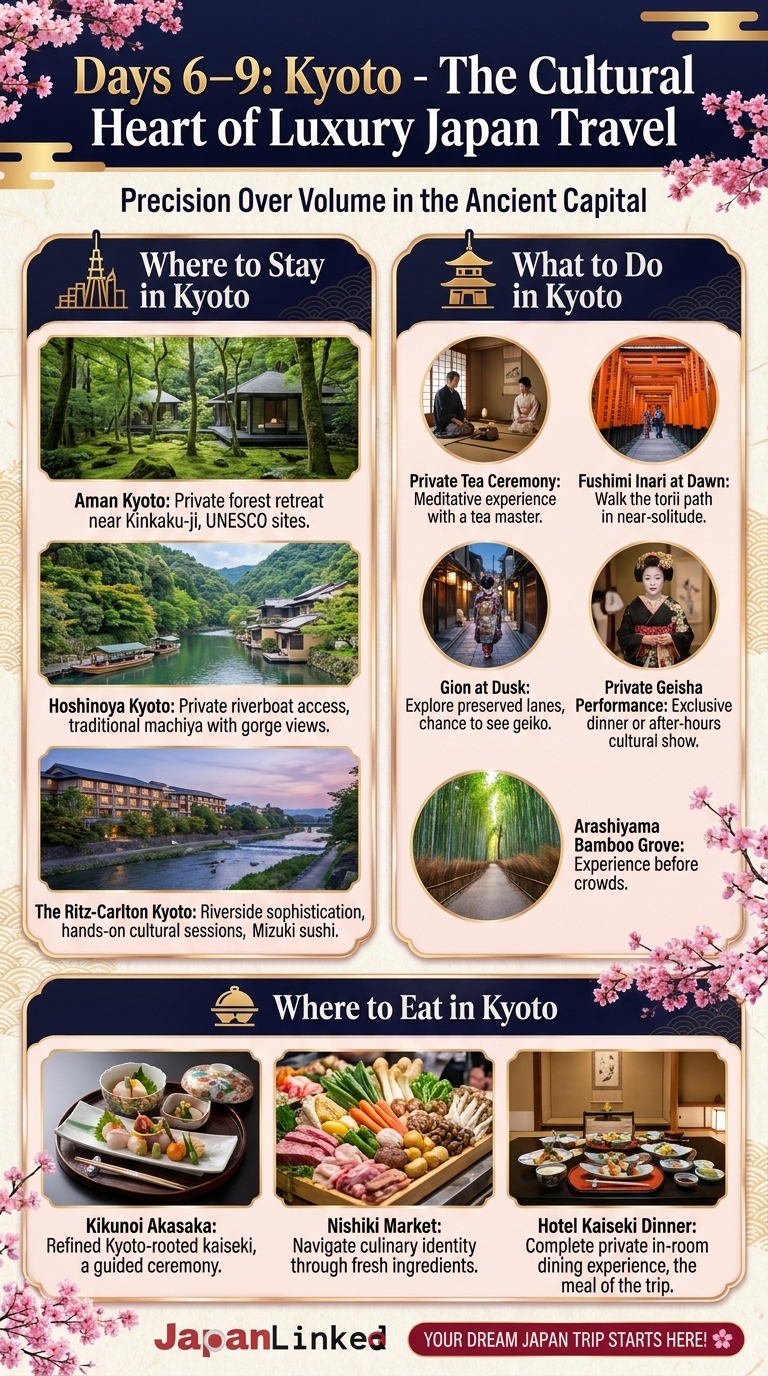
Kyoto is where the itinerary reaches its greatest depth. Four nights is the right number: enough time to visit the temples that deserve time, to eat the meals that require advance booking, and to move slowly through the wooden streets of Gion without feeling the pressure to be somewhere else.
Poor pacing in Kyoto is the most common mistake luxury travelers make. An overly packed day of sightseeing turns one of the world’s most refined cities into an endurance test. The goal is precision over volume.
Where to Stay in Kyoto
Three properties cover different moods, and the right one depends on what you’re looking for:
Aman Kyoto sits in a private mossy forest garden near Kinkaku-ji Temple, surrounded by 16 UNESCO World Heritage Sites. Pavilions float among maple trees, paths lead to onsen baths, and guided temple walks begin from the property itself. The hush of the grounds is genuine – this is as close to a private forest retreat in the middle of a major city as exists anywhere.
Hoshinoya Kyoto is reachable only by private riverboat up the Oi River through Arashiyama’s bamboo-lined gorge – a detail that sets the tone for the entire stay. The 25 rooms occupy traditional machiya-style buildings cascading down the hillside, with the gorge’s seasonal transformation framed in every window.
The Ritz-Carlton Kyoto suits those who want riverside sophistication with temples nearby. It offers hands-on cultural sessions, two distinct restaurants (including Mizuki for sushi), and a spa that balances Kyoto minimalism with five-star service.
What to Do in Kyoto
- Private tea ceremony in a historic machiya: Guided by a tea master in a centuries-old townhouse or garden setting, this is one of the most meditative experiences on the itinerary. Book a private session through your hotel concierge rather than a group tour.
- Fushimi Inari Shrine before dawn: The famous torii gate path is walkable in near-solitude at 5:30 a.m. After 8 a.m., it fills quickly. An early start is essential.
- Gion at dusk: Walk the preserved lanes of the Gion district in the late afternoon when the light is soft and the chance of spotting a geiko (Kyoto’s term for geisha) is highest.
- Private geisha performance: Several luxury tour operators can arrange private geisha dinners or after-hours cultural performances – an experience that requires a significant lead time to secure.
- Arashiyama Bamboo Grove: Equally crowd-sensitive, and equally worth visiting early. The grove is extraordinary before 7 a.m.
Where to Eat in Kyoto
Kyoto’s food culture is built around kyo-kaiseki – a seasonally precise expression of Japanese cuisine that reaches its purest form in the old capital.
The Michelin Guide’s 2026 Kyoto and Osaka selection added 25 new starred restaurants, confirming the city’s continued culinary ambition.
Restaurant recommendations:
- Kikunoi Akasaka (Tokyo branch, but the Kyoto original is essential): Kyoto-rooted kaiseki at its most refined – elegant broths, pristine timing, a meal that feels like a guided ceremony.
- Nishiki Market: Not a restaurant, but a navigational priority. Walk the narrow market with a guide and you’ll understand Kyoto’s culinary identity through its ingredients rather than a menu.
- Hotel kaiseki dinner (your ryokan): This cannot be replaced by any external restaurant in terms of the complete experience. Dinner at your ryokan, in a private room, served in the traditional multi-course format, is the meal of the trip.
Also Read: 11 Days In Japan Itinerary & 10 Days In Japan Itinerary
Day 10: Departure, or an Optional Extension
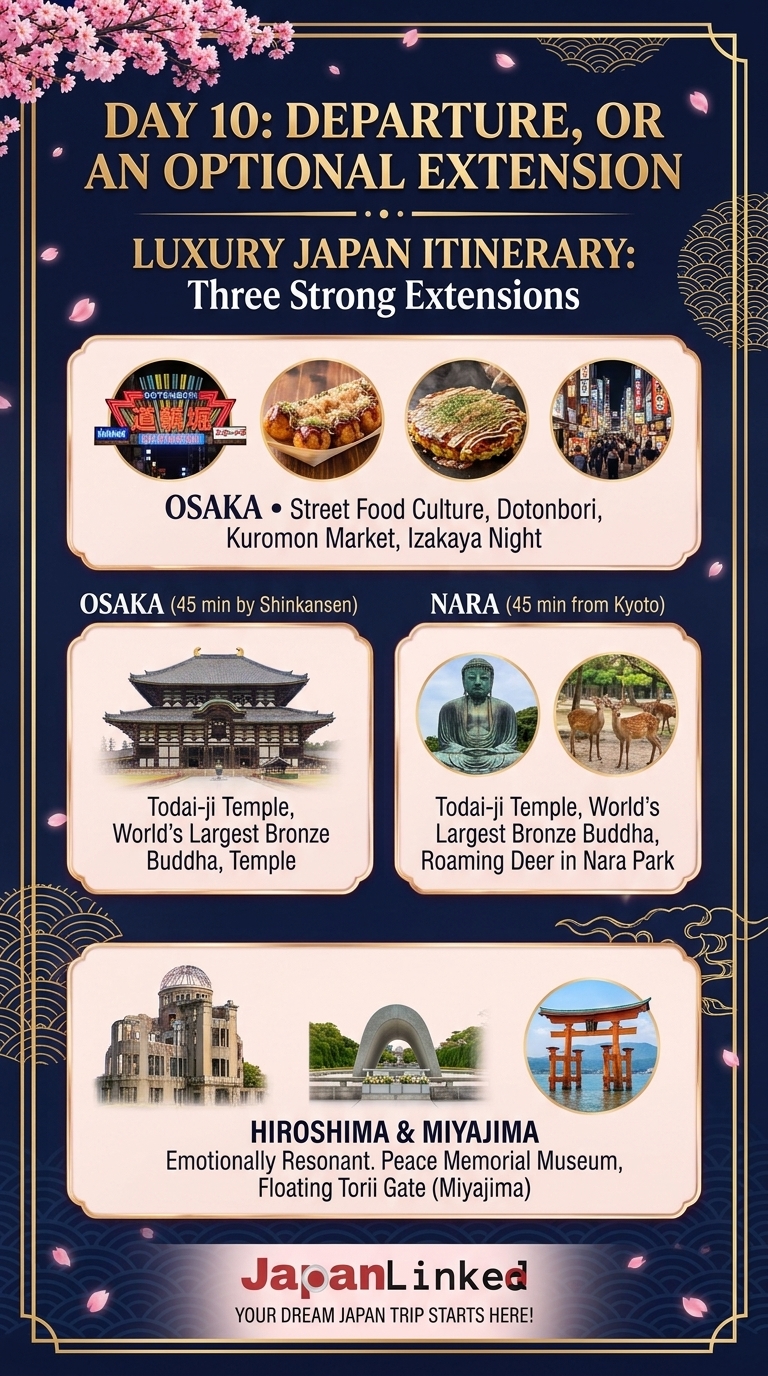
Three strong extensions add a day or two without disrupting the rhythm of the trip:
- Osaka (45 minutes by Shinkansen): For street food culture that operates on a completely different frequency from Kyoto. Dotonbori, Kuromon Market, and a night of izakaya eating make a satisfying final chapter.
- Nara (45 minutes from Kyoto): Todaiji Temple, the world’s largest bronze Buddha, and hundreds of freely roaming deer in Nara Park. A morning trip that fits easily into a final day.
- Hiroshima and Miyajima Island: A more emotionally resonant extension. The Peace Memorial Museum is one of the most significant sites in modern history; Miyajima’s floating torii gate at high tide is one of Japan’s most photographed images for good reason.
Practical Notes for the Luxury Traveler
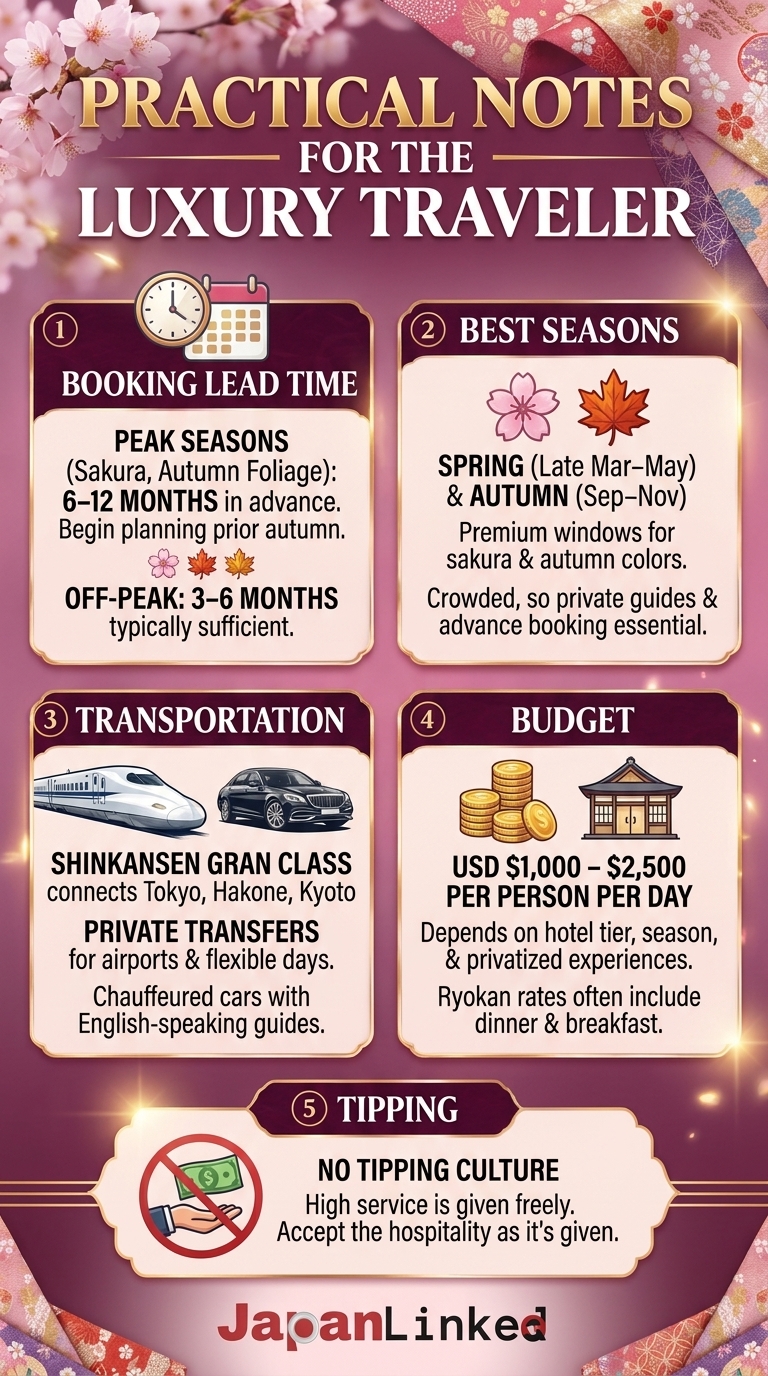
Booking lead time: The best ryokans book 6 to 12 months in advance for cherry blossom (late March–mid April) and autumn foliage (mid November–early December) periods. For peak season, begin planning by the prior autumn. For off-peak travel, 3 to 6 months is typically sufficient.
Best seasons: Spring (late March–May) and autumn (September–November) are the premium windows. Spring brings cherry blossoms; autumn brings a slow-building wave of gold and crimson across the entire country. Both are crowded at the top tier – which is exactly why private guides and advance booking matter.
Transportation: The Shinkansen bullet train in first-class (Gran Class) connects Tokyo, Hakone, and Kyoto seamlessly. Private transfers are the right call for airport arrivals and departures, and for any day where flexibility matters. Many luxury operators provide chauffeured cars with English-speaking guides.
Budget: At the luxury level, expect to budget USD $1,000 to $2,500 per person per day, depending on hotel tier, season, and how many experiences are privatized. Ryokan rates typically include dinner and breakfast, which offsets the headline price considerably.
Tipping: Japan does not have a tipping culture. The level of service you receive is not contingent on a gratuity and is not enhanced by one. Accept the hospitality as it’s given.
Also Read: 10 Days Winter Japan Itinerary & 10 Days In Summer Japan In Itinerary
Conclusion
A luxury Japan itinerary isn’t a checklist. It’s a sequence of considered choices – the right hotel in the right city at the right time of year, the right dinner, the right early morning walk through a temple before the crowds arrive.
Japan rewards travelers who approach it with intention and patience, and it’s one of the few destinations where the planning process itself is part of the pleasure.
Tokyo for energy and extraordinary food. Hakone for stillness and the most distinctly Japanese night of the trip.
Kyoto for the culture, the temples, and the quiet certainty that you’ve arrived somewhere that took centuries to become what it is.
Start with those three, and you’ll understand why people come back.
