
While 42.7 million people visited Japan in 2025 — a record number — the overwhelming majority of them never made it north of Tokyo.
They followed the Golden Route: bullet train to Kyoto, a day in Nara, three nights in Osaka, done.
Which means that northern Japan – the vast, dramatic arc of Tohoku and Hokkaido that stretches from the mountains of Miyagi to the volcanic coastlines of Hokkaido’s far east – remains one of the most extraordinary and least-visited regions in the entire country.
This is not a secret that needs protecting. It’s an invitation. A northern Japan itinerary takes you through samurai towns where Edo-period residences still stand behind weeping cherry trees.
Through onsen villages that look like set designs for a Miyazaki film, wooden ryokan steaming beside mountain rivers.
Through UNESCO World Heritage temples older than most European cathedrals. Through Hokkaido’s open farmland, powder-snow ski mountains, and wild national parks where brown bears still roam untouched forests.
This guide covers the best of both regions in a 14-day itinerary – practical, honest, and built for travelers who’ve done the Golden Route and are ready for the Japan that most visitors never find.
Northern Japan 101: Tohoku vs. Hokkaido
Before the itinerary, a quick orientation.
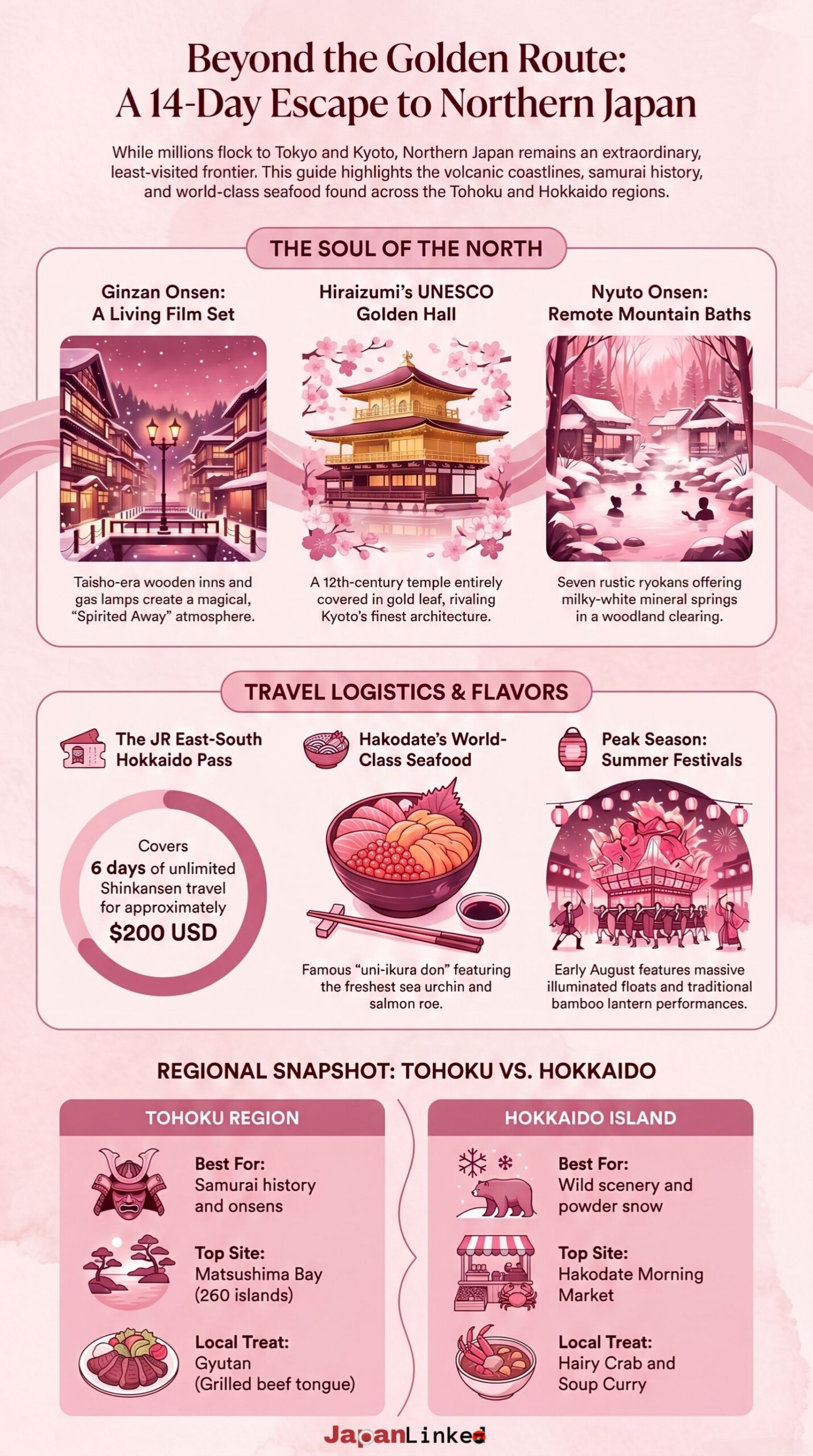
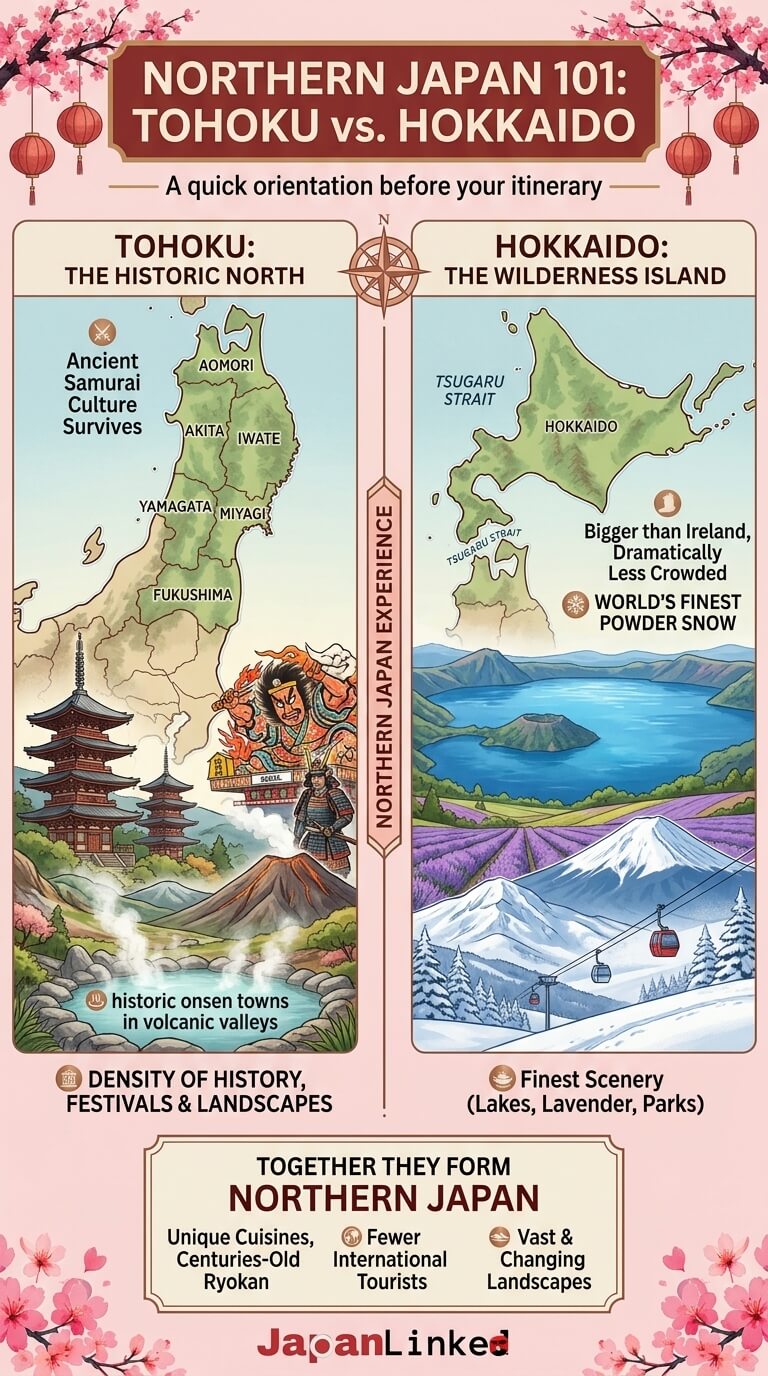
Tohoku is the northern third of Japan’s main island (Honshu). It covers six prefectures — Miyagi, Iwate, Akita, Yamagata, Aomori, and Fukushima — and contains an extraordinary density of history, hot springs, festivals, and landscape.
This is where Japan’s samurai culture survived longest, where onsen towns developed in volcanic mountain valleys, and where summer festivals attract millions of domestic visitors who never appear in international travel guides.
Hokkaido is Japan’s northernmost and second-largest island, separated from Honshu by the Tsugaru Strait.
It’s bigger than Ireland, dramatically less crowded than any comparable Japanese region, and home to some of the country’s finest scenery: volcanic caldera lakes, lavender fields, ski resorts with the world’s finest powder snow, and wilderness national parks with near-zero foot traffic.
Together, they form northern Japan — a region where you can travel for two weeks without encountering more than a handful of other international tourists, eating food you’ve never heard of, staying in ryokan that have existed for centuries, and watching landscapes that change entirely between prefectures.
Getting Around Northern Japan: The JR East Pass
This is the most important logistics decision for a northern Japan itinerary, and the answer is clearer than almost anywhere else in Japan: buy the JR East Pass.
The JR East-South Hokkaido Pass covers unlimited travel for 6 days within a 14-day window on all JR East lines in Tohoku, plus the Hokkaido Shinkansen and some Hokkaido local lines, for ¥30,000 (~$200 USD).
The JR East Pass (Tohoku area) covers unlimited travel for 5 days within a 14-day window across all Tohoku Shinkansen lines and local JR trains for ¥20,000 (~$133 USD).
For context: a single Tokyo → Sendai Shinkansen ticket costs around ¥13,000 one way. A Sendai → Shin-Aomori return costs about ¥25,000. The pass pays for itself in a day and a half of travel.
The national 7-day JR Pass (¥50,000) also covers these routes, but for a Tohoku-focused trip, the regional pass is significantly cheaper.
Buy the JR East Pass through the JR East website or at major JR stations; it requires activation at a staffed gate.
Get a Suica card for all local transport within cities – buses, subways, and convenience stores. The JR East Pass covers intercity trains; the Suica handles everything else.
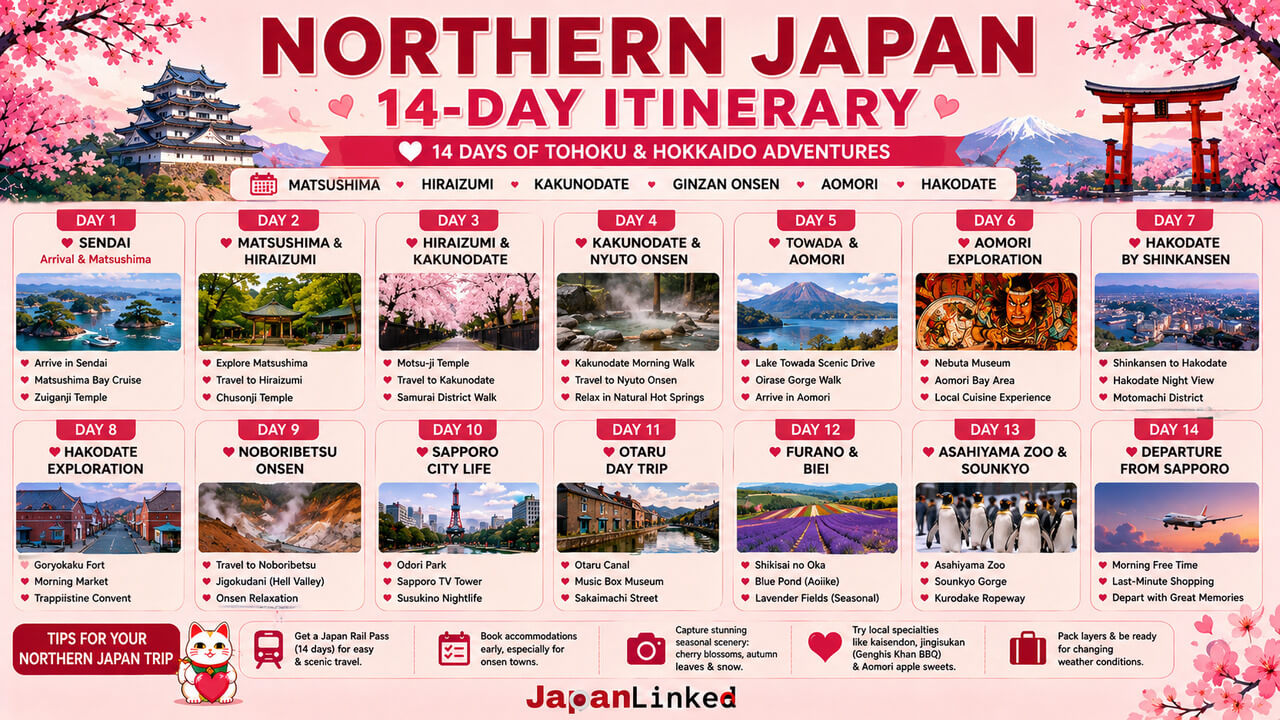
The 14-Day Northern Japan Itinerary
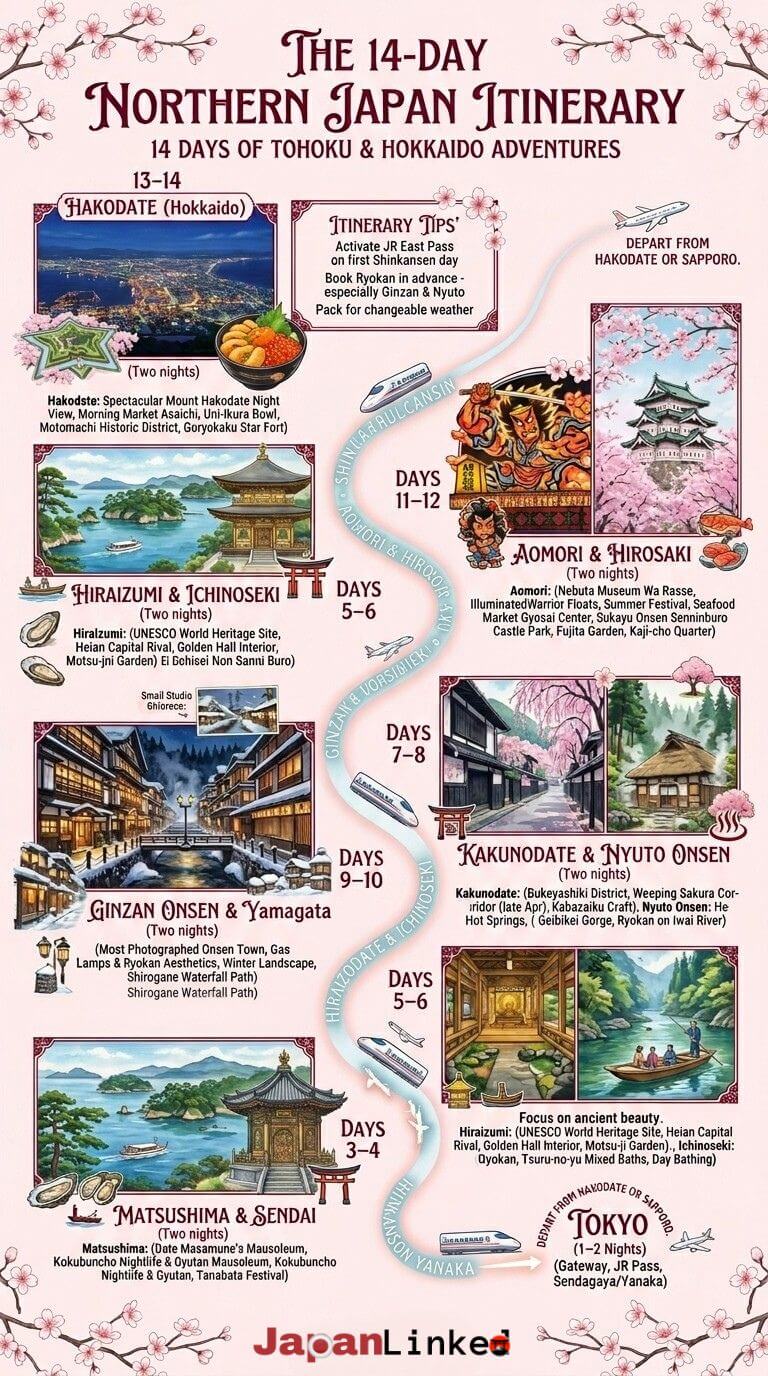
Days 1–2: Tokyo (Base)
Most international flights land in Tokyo. Use 1–2 nights here before heading north — enough to recover from jet lag, pick up your JR East Pass at Tokyo Station’s JR East Travel Service Center, and have one proper meal.
If you have time: Sendagaya or Yanaka are the Tokyo neighborhoods that most closely echo what Tohoku will feel like — old, unhurried, locally lived-in. A gentle warm-up.
Activate your JR East Pass the morning you board the Tohoku Shinkansen — not on arrival in Tokyo, unless you’re using it for Tokyo-area JR trains. Every day of validity counts.
Days 3–4: Matsushima & Sendai (2 nights)
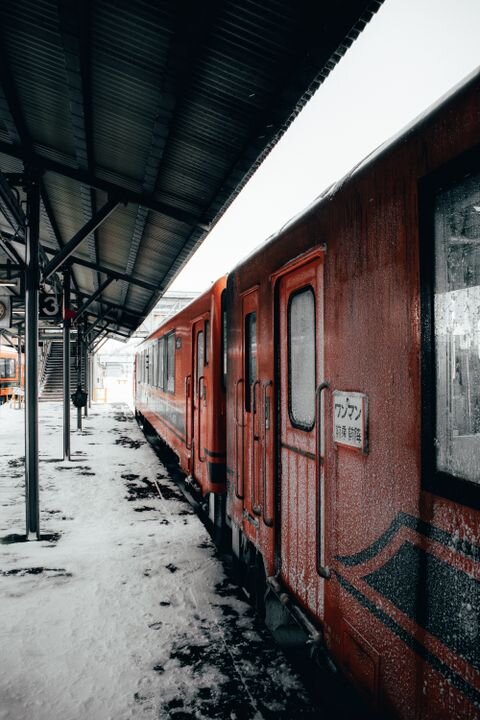
How to get there: Tohoku Shinkansen from Tokyo to Sendai, approximately 1.5 hours (Hayabusa service). One of Japan’s fastest rail journeys.
Sendai is the largest city in Tohoku and your gateway to the north. It’s a clean, pleasant city with good food and easy orientation — and the launching pad for two of the region’s most celebrated sites.
Matsushima
One of Japan’s officially designated “three views of scenic beauty,” Matsushima is an archipelago of over 260 pine-covered islands scattered across Matsushima Bay, 30 minutes northeast of Sendai.
The scenery is exactly what the designation suggests: small volcanic islands trailing dark pines against grey water, best experienced by boat.
- Rent a boat for a 50-minute cruise through the islands — several operators run regular departures from Matsushima Pier
- Zuiganji Temple (¥700) — one of the finest Zen temples in Tohoku, dating from the 9th century, with cedar-lined approach and rock caves carved with Buddhist reliefs
- Godaido Hall — a small thatched pavilion on a tiny connected island in the bay, one of the region’s most photographed scenes
- The famous Matsushima oysters — available fresh at stalls along the waterfront. Miyagi Prefecture produces more oysters than any other in Japan. Eat them grilled, steamed, or raw
Sendai
- Zuihoden Mausoleum — the ornate mausoleum of Date Masamune, the “One-Eyed Dragon” feudal lord who built Sendai into the powerful castle town it was. The reconstruction in Momoyama-style is elaborate and striking
- Kokubuncho — Sendai’s nightlife district, described by travelers as “Kabukicho without the aggression.” Lively izakayas, excellent gyutan (grilled beef tongue, Sendai’s famous local specialty), and genuine local atmosphere
- Sendai Tanabata Festival — if visiting in early August, this is one of Tohoku’s three great summer festivals, filling the city’s covered arcades with elaborate paper and bamboo streamers five to seven meters long
Days 5–6: Hiraizumi & Ichinoseki (2 nights)
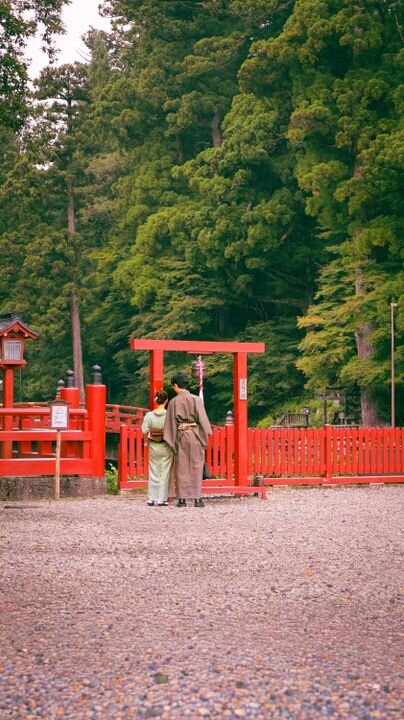
How to get there: Tohoku Shinkansen from Sendai to Ichinoseki, approximately 25 minutes
Hiraizumi is arguably the single most underrated destination in all of Japan. A small town in Iwate Prefecture that was, in the 12th century, the second largest city in the country — a cultural and religious capital that briefly rivaled Kyoto in power, beauty, and architectural ambition before being destroyed in war.
What survived was designated a UNESCO World Heritage Site in 2011.
- Chuson-ji Temple — the temple complex that survived from Hiraizumi’s golden Heian-era period. The Konjikido Golden Hall, built in 1124, is entirely covered in gold leaf inside and out. It’s one of the most astonishing interiors in Japan and sees a fraction of the visitors that Kyoto’s golden pavilion attracts. Allow 2 full hours for the complex
- Motsu-ji Temple Garden — the most intact example of a Pure Land Paradise Garden from the Heian period (11th–12th centuries), a style of garden designed to recreate the Buddhist Western Paradise. The curved pond and carefully arranged stones in the mowing grass are quietly extraordinary
- Geibikei Gorge (20 minutes from Ichinoseki) — flat-bottomed boats poled by boatmen through a towering narrow canyon, the river flowing green and clear between 50-meter rock walls. Boatmen sing traditional Japanese songs on the return journey. One of the most quietly magical experiences in Tohoku
Hiraizumi tip: The temple complex is manageable in a day but genuinely rewards an overnight stay in the area. Ichinoseki has several good ryokan with onsen along the Iwai River.
Days 7–8: Kakunodate & Nyuto Onsen (2 nights)
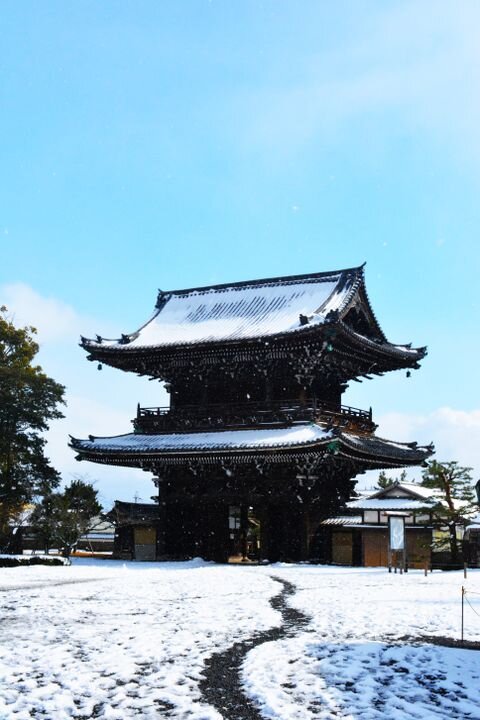
How to get there: Shinkansen from Ichinoseki to Morioka, then Akita Shinkansen to Kakunodate. Total about 1.5 hours.
Kakunodate is known as “Little Kyoto of Tohoku” — and while the comparison is slightly oversold, the town’s Bukeyashiki (samurai quarter) is the most intact collection of Edo-period samurai residences outside Kanazawa.
Wide earthen lanes lined with centuries-old black-walled compounds, weeping cherry trees arching over the streets, and working craft traditions that have survived to the present day.
- Bukeyashiki District — six of the original samurai residences are open to visitors (free or ¥300–500 each). The Aoyagi House in particular contains 7,000 artifacts from the Edo and Meiji periods, a genuine museum within a working historic home
- Kakunodate cherry blossoms — if visiting late April to early May, the weeping cherry trees along the Hinokinai River form one of Japan’s most celebrated sakura corridors. Over 400 trees, many over 300 years old, line the riverbank for 2 km. One of the most beautiful hanami experiences in the entire country — and with Tohoku’s later bloom timing, often a second chance if you missed cherry blossoms in Tokyo
- Kabazaiku craft — Kakunodate is the center of Japan’s kabazaiku tradition: decorative objects made from the beautiful marbled bark of wild cherry trees. Shops on the main street sell everything from tea caddies to wallets. If you’re buying one craft souvenir in northern Japan, buy it here
Nyuto Onsen
From Kakunodate, take a bus to Nyuto Onsen — a cluster of seven remote mountain hot spring ryokan at the foot of Nyuto Mountain in the Tazawa-ko area. This is as remote and atmospheric as onsen culture gets in Japan.
- Each of the seven ryokan has its own distinct mineral spring with different water chemistry — some milky white (shirako no yu), some a deep rust-orange (kuroyu), some clear with a sulfur bite
- The most famous is Tsuru-no-yu — a 300-year-old inn with outdoor mixed baths in a woodland clearing, traditional thatched-roof buildings, and a deliberate absence of modernity. It’s booked months in advance in peak season; reserve well ahead
- Day-pass bathing (¥500–800 per person) allows access to multiple ryokan’s public baths without staying — a worthwhile afternoon if you can’t get a room
Days 9–10: Ginzan Onsen & Yamagata (2 nights in Ginzan)
How to get there: Akita Shinkansen back to Morioka or Kakunodate, then JR to Oishida Station, then bus to Ginzan Onsen (about 35 minutes, ¥1,000 — not covered by JR Pass)
Ginzan Onsen is the most photographed onsen town in Japan — and unlike most over-photographed places, it looks better in person than in any photograph.
A narrow valley in the mountains of Yamagata Prefecture, Ginzan Onsen consists of a single river lined on both sides by Taisho-era wooden ryokan built in the 1920s–1930s, lit by gas lamps, their balconies extending over the water.
The scene — especially in winter, when snow blankets the roofs, and steam rises into cold air — is indistinguishable from a Studio Ghibli film.
The town’s aesthetic reportedly inspired the bathhouse in Spirited Away, though Miyazaki has neither confirmed nor denied this.
- The entire “town” is five minutes end to end. Its greatness lies in arriving, walking, soaking, eating, and leaving at the pace the place demands — which is very slow
- Stay overnight — a ryokan night in Ginzan is the experience. Rooms book up months ahead in winter and autumn peak; reserve early
- Walk the Shirogane Waterfall path above the town — a 15-minute forest walk to a waterfall hidden in the mountain above the ryokan strip
- The best time to experience Ginzan is early morning (before day-trippers arrive from Sendai and Yamagata) or after 8 PM when the gas lamps are fully lit and the streets are nearly empty
Winter at Ginzan: December–March, Ginzan Onsen implements car restrictions for non-guests to manage snow safety. If visiting in winter without a reservation, take the bus. The town in deep snow is worth any extra logistics.
Days 11–12: Aomori & Hirosaki (2 nights)
How to get there: JR Yamagata Shinkansen from Yamagata to Fukushima, then Tohoku Shinkansen to Shin-Aomori. About 3.5 hours total.
Aomori sits at the very tip of Honshu — the last major city before Hokkaido. It’s a working port city with excellent seafood, a world-class summer festival, and two destinations within easy reach that are among northern Japan’s finest.
- Nebuta Museum Wa Rasse — even outside festival season, this museum houses the massive illuminated floats (nebuta) from the annual Aomori Nebuta Festival (early August): one of Japan’s three great summer festivals, attracting over 3 million visitors for its parade of enormous papier-mâché warrior figures lit from within, carried through the streets at night. The museum recreates the atmosphere year-round with several full-scale floats dramatically displayed
- Aomori Gyosai Center — the city’s seafood market. Aomori sits on the border of two cold ocean currents and produces extraordinary seafood: tuna (Oma’s bluefin is Japan’s most expensive), scallops, sea urchin, and in winter, crab. This is a local fish market, not a tourist attraction — and the better for it
- Sukayu Onsen — a 300-year-old onsen inn 40 minutes outside Aomori on a mountain plateau, famous for its enormous mixed-gender wooden bath (senninburo, literally “a thousand-person bath”) that remains one of Japan’s most authentic onsen experiences. Day-visit from ¥900
Hirosaki
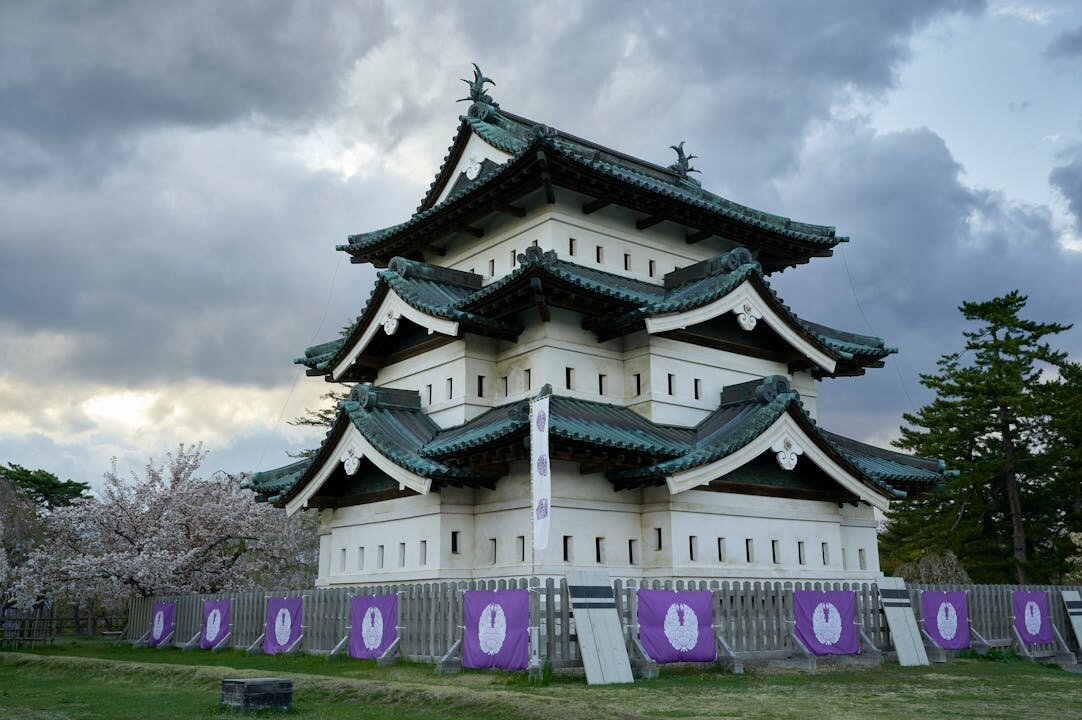
30 minutes from Aomori by JR, Hirosaki is a castle town with over 2,600 cherry trees around the castle moat — one of Japan’s most celebrated sakura destinations.
- Hirosaki Castle — one of the few original castle towers surviving from the Edo period (1611), surrounded by 52 hectares of park. In late April, over 2,600 cherry trees in bloom around the moats create a scene that genuinely rivals anything in Kyoto — with a fraction of the crowds
- Fujita Memorial Japanese Garden — a large traditional strolling garden with exceptional autumn foliage, considered one of the finest gardens in Tohoku
- Kaji-cho traditional quarter — samurai residences, merchant warehouses, and old townhouses within walking distance of the castle
Days 13–14: Hokkaido — Hakodate (2 nights)
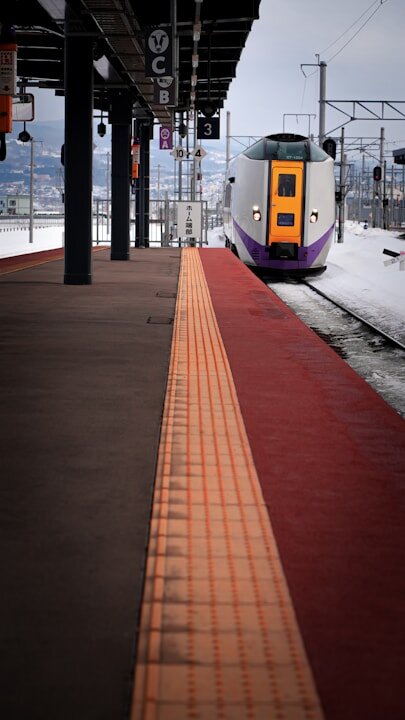
How to get there: Hokkaido Shinkansen from Shin-Aomori to Shin-Hakodate-Hokuto, approximately 1 hour. Covered by JR East-South Hokkaido Pass.
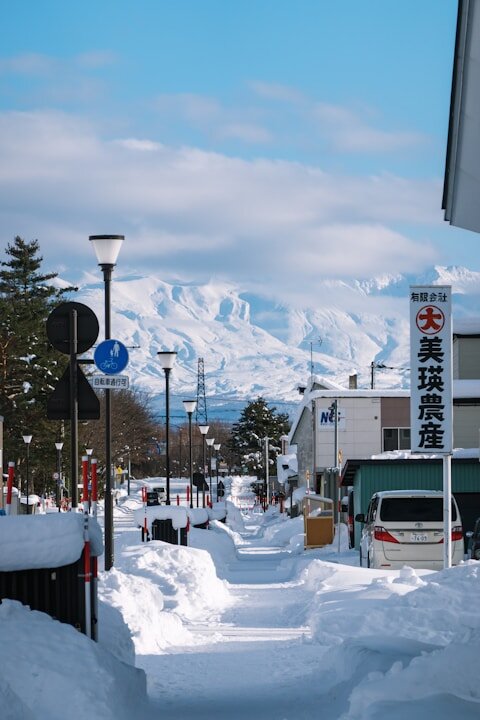
Crossing into Hokkaido feels like entering a different country. The scale opens up, the vegetation changes, the air cools, and the pace drops to something close to a rural pace.
Hakodate is the ideal first Hokkaido stop — a port city with genuine historic character, exceptional seafood, and one of Japan’s most famous night views.
- Mount Hakodate night view — consistently ranked one of Japan’s three best night views. Take the ropeway up after dark; the city lights spread across a narrow peninsula between two bays in the shape of a glowing figure eight
- Hakodate Morning Market (Asaichi) — opens at 5 AM, packed with the most extraordinary seafood: live hairy crabs in tanks, Hokkaido uni (the best sea urchin in the world), salmon roe, scallops, and squid so fresh it’s still moving. The iconic experience here is a uni-ikura don — a bowl of rice piled with both sea urchin and salmon roe. It will ruin all other seafood for you
- Motomachi Historic District — the hillside neighborhood above the port where foreign traders settled in the 1850s when Hakodate became one of Japan’s first opened ports. A mix of Japanese merchant houses, Western-style consular buildings, and Russian Orthodox churches that exists nowhere else in Japan
- Goryokaku Fort — the star-shaped Western-style fort built in 1864, best appreciated from the tower overlooking it. Spectacular cherry blossoms in late April when the entire star outline fills with pink
Fly home from Hakodate Airport or Sapporo’s New Chitose Airport — both are well-connected to Tokyo and international hubs.
Also Read: Japan Honeymoon Itinerary
Seasonal Guide for a Northern Japan Trip
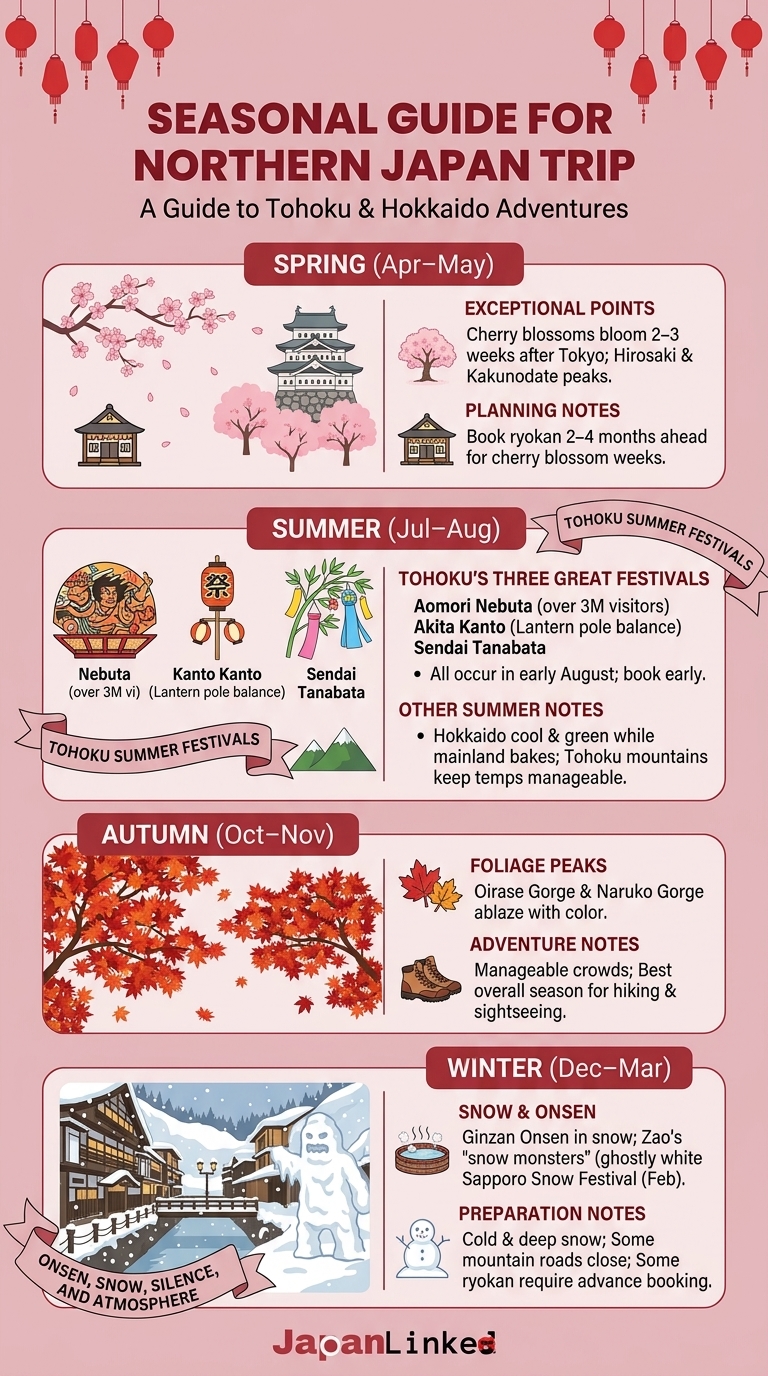
Northern Japan’s seasons are more extreme than the rest of the country, which makes timing particularly important.
| Season | What Makes It Exceptional | Watch Out For |
|---|---|---|
| Spring (late Apr–May) | Cherry blossoms bloom 2–3 weeks after Tokyo; Hirosaki and Kakunodate at peak | Book ryokan 2–4 months ahead for cherry blossom weeks |
| Summer (Jul–Aug) | Tohoku’s three great festivals; Hokkaido cool and green while mainland bakes | Nebuta (Aomori), Kanto (Akita), Tanabata (Sendai) all in early Aug; book early |
| Autumn (Oct–Nov) | Foliage peaks; Oirase Gorge and Naruko Gorge ablaze with color | Manageable crowds; best overall season for hiking and sightseeing |
| Winter (Dec–Mar) | Ginzan Onsen in snow; Zao’s “snow monsters”; Sapporo Snow Festival (Feb) | Cold and deep snow; some mountain roads close; some ryokan require advance booking |
Summer deserves special mention for Tohoku specifically. While most of Japan swelters in muggy heat, Tohoku’s mountains keep temperatures manageable — and the concentration of festivals in early August is unmatched anywhere in Japan.
The Aomori Nebuta Festival (over 3 million visitors), Akita’s Kanto Festival (bamboo poles with lanterns balanced by performers), and Sendai’s Tanabata all occur within days of each other. Attending even one of them is worth building an entire itinerary around.
Winter at Ginzan and Zao is spectacular for a specific type of traveler: those who want onsen, snow, silence, and atmosphere.
Zao’s juhyo — trees completely encased in windblown ice, forming ghostly white figures across the mountainside — are among Japan’s most surreal natural phenomena, visible from January through March.
Also Read: 11 Days In Japan Itinerary & 10 Days In Japan Itinerary
Essential Tips for Northern Japan Travel
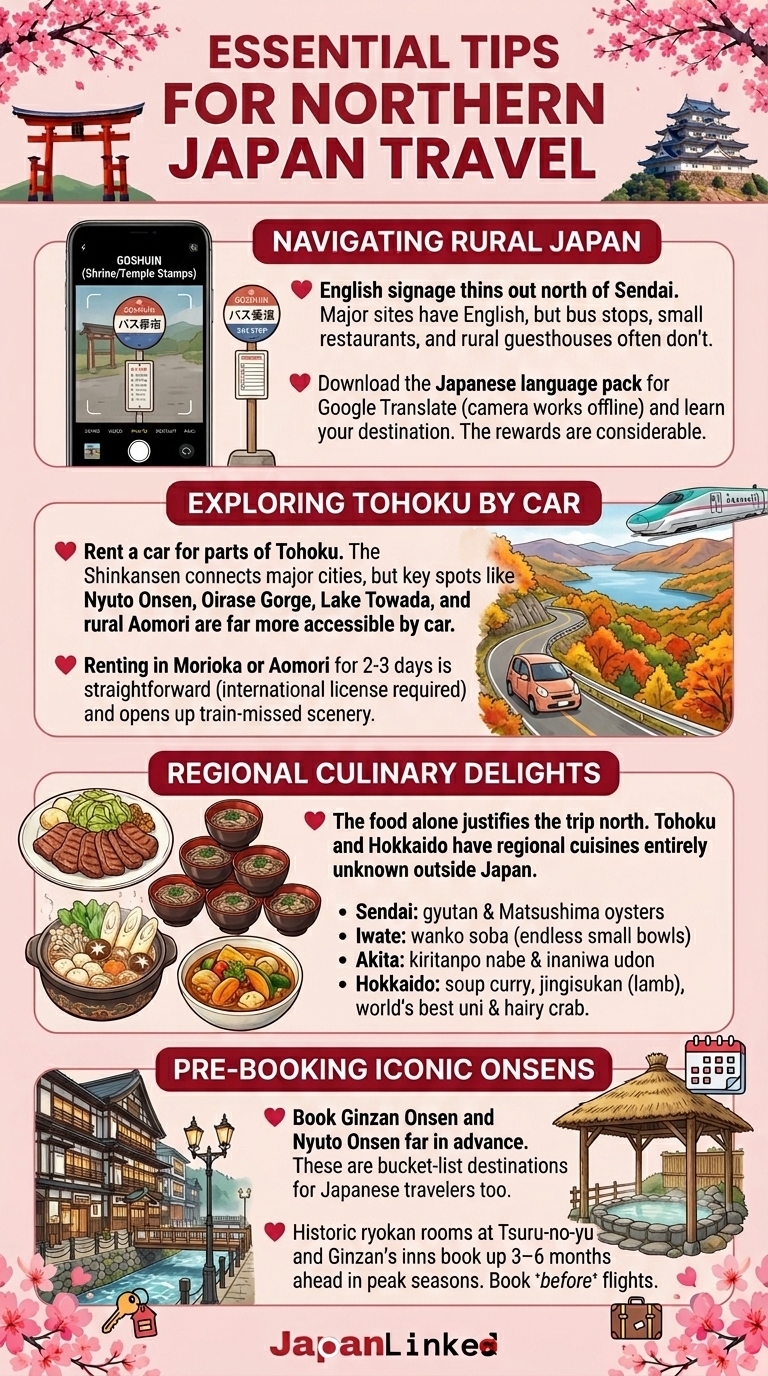
English signage thins out north of Sendai. The major sites have information in English, but bus stops, smaller restaurants, and rural guesthouses often don’t. Download the Japanese language pack for Google Translate (camera translation mode works offline) and learn how to say your destination in Japanese. The inconvenience is minor and the rewards for persisting are considerable.
Rent a car for parts of Tohoku. The Shinkansen connects the major cities efficiently, but several of the best places — Nyuto Onsen, Oirase Gorge, Lake Towada, rural Aomori — are significantly more accessible by car. Renting a car in Morioka or Aomori for two or three days is straightforward (an international driving license is required) and opens up scenery that train travelers miss.
The food alone justifies the trip north. Tohoku and Hokkaido have regional cuisines that are almost entirely unknown outside Japan:
- Sendai: gyutan (grilled beef tongue), Matsushima oysters
- Iwate: wanko soba (endless small bowls of soba in Morioka, refilled until you surrender)
- Akita: kiritanpo nabe (pounded rice sticks in hot pot), inaniwa udon (the finest flat udon in Japan)
- Hokkaido: soup curry (Sapporo’s invention), jingisukan (grilled lamb), the world’s best uni and hairy crab
Book Ginzan Onsen and Nyuto Onsen far in advance. These are bucket-list destinations for Japanese travelers, too.
The most sought-after ryokan rooms at Tsuru-no-yu and Ginzan’s historic inns book up 3–6 months ahead in peak seasons. Put these reservations in before you book flights.
Also Read: 2 Week Japan Itinerary & 3 Week Japan Itinerary
Budget Guide: 14 Days in Northern Japan
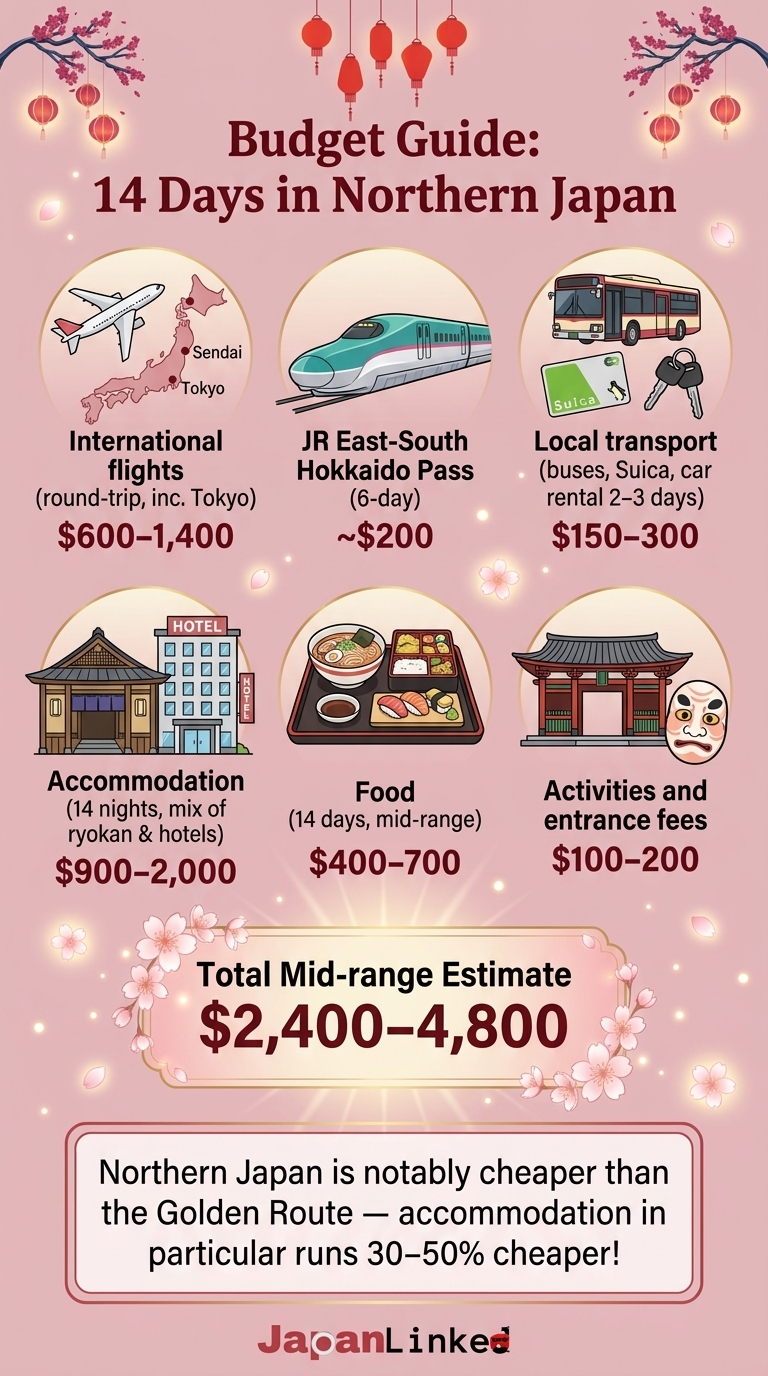
| Category | Budget (USD) |
|---|---|
| International flights (round-trip, inc. Tokyo) | $600–1,400 |
| JR East-South Hokkaido Pass (6-day) | ~$200 |
| Local transport (buses, Suica, car rental 2–3 days) | $150–300 |
| Accommodation (14 nights, mix of ryokan & hotels) | $900–2,000 |
| Food (14 days, mid-range) | $400–700 |
| Activities and entrance fees | $100–200 |
| Total mid-range estimate | $2,400–4,800 |
Northern Japan is notably cheaper than the Golden Route — accommodation in particular runs 30–50% lower than comparable quality in Kyoto, and many of the region’s finest experiences (walking Hiraizumi’s temple grounds, watching the Matsushima boat cruise, exploring Kakunodate’s samurai district) cost very little.
Also Read: 1 Week In Japan Itinerary & 5 Days In Japan Itinerary
Conclusion
Northern Japan is the country’s best-kept open secret. It’s not hidden — the UNESCO designations, the travel awards, the breathless descriptions from the travelers who make it here are all publicly available.
It’s just that the Golden Route is so well-trodden, so thoroughly indexed, that most first-time visitors follow it without questioning what else the country might offer.
What northern Japan offers is Japan at its most unhurried. Samurai towns that survived because history passed them by.
Onsen towns that look unchanged from a century ago because no one had a reason to redevelop them.
Festivals that have run continuously for over a thousand years. Seafood of a quality that makes everything you’ve eaten elsewhere seem like a rough draft.
Come for the Ginzan Onsen photographs. Stay for the uni-ikura don at Hakodate’s dawn market.
Leave with a list of places you need to return to — because two weeks in northern Japan is enough to understand that you’ve barely started.
