
Ask any parent who has taken their kids to Japan and they’ll tell you the same thing: it ruined every other family holiday.
Not in a bad way — in the way that sets an impossible standard. The streets are clean and safe enough for older kids to wander.
Ramen costs less than a fast food combo. Deer walk up to your children in a UNESCO park and bow their heads. A bullet train ride at 320 km/h is, for most kids, the highlight of the entire trip.
Japan is one of the most family-friendly countries on earth, and it only keeps getting easier to visit.
With digital ticketing now standard at Universal Studios Japan and Tokyo Disneyland, and improvements to the Japan Rail Pass, the logistics have never been smoother.
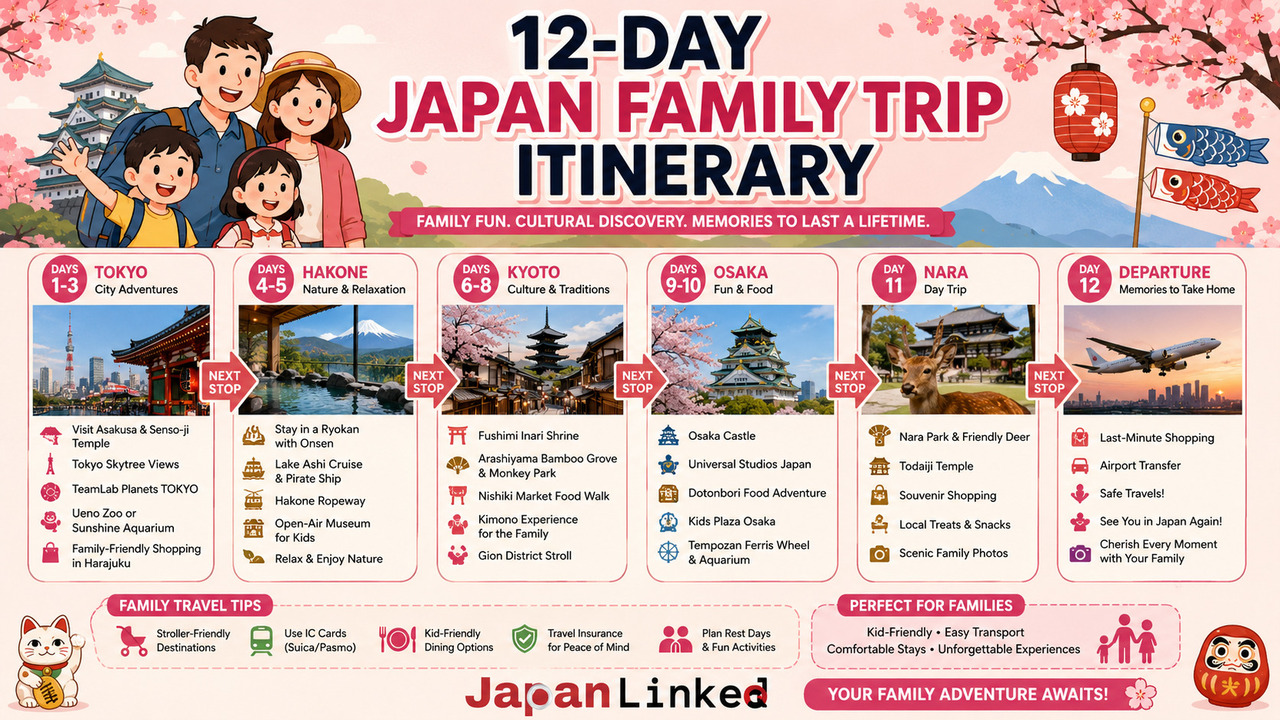
This Japan family trip itinerary covers 12 days across Tokyo, Hakone, Kyoto, and Osaka — the route that gives you the right mix of theme parks, cultural experiences, nature, and food adventures for kids of all ages.
Let’s plan the trip they’ll talk about for years.
Why Japan Is Perfect for Family Travel
Before diving into the day-by-day plan, it’s worth understanding what makes Japan such an exceptional destination for families — because it’s not just the theme parks.
Japan is extraordinarily safe. It consistently ranks among the world’s lowest crime-rate countries. Older children can explore convenience stores, arcades, and market streets independently without parents hovering anxiously. That freedom is something most international destinations can’t offer.
The infrastructure is built for families. Nearly all JR and metro stations have elevators. Trains have priority seating for parents with young children. Major department stores, stations, and shopping malls have nursing rooms and clean baby-changing facilities as standard. Convenience stores stock diapers, baby wipes, and formula at all hours.
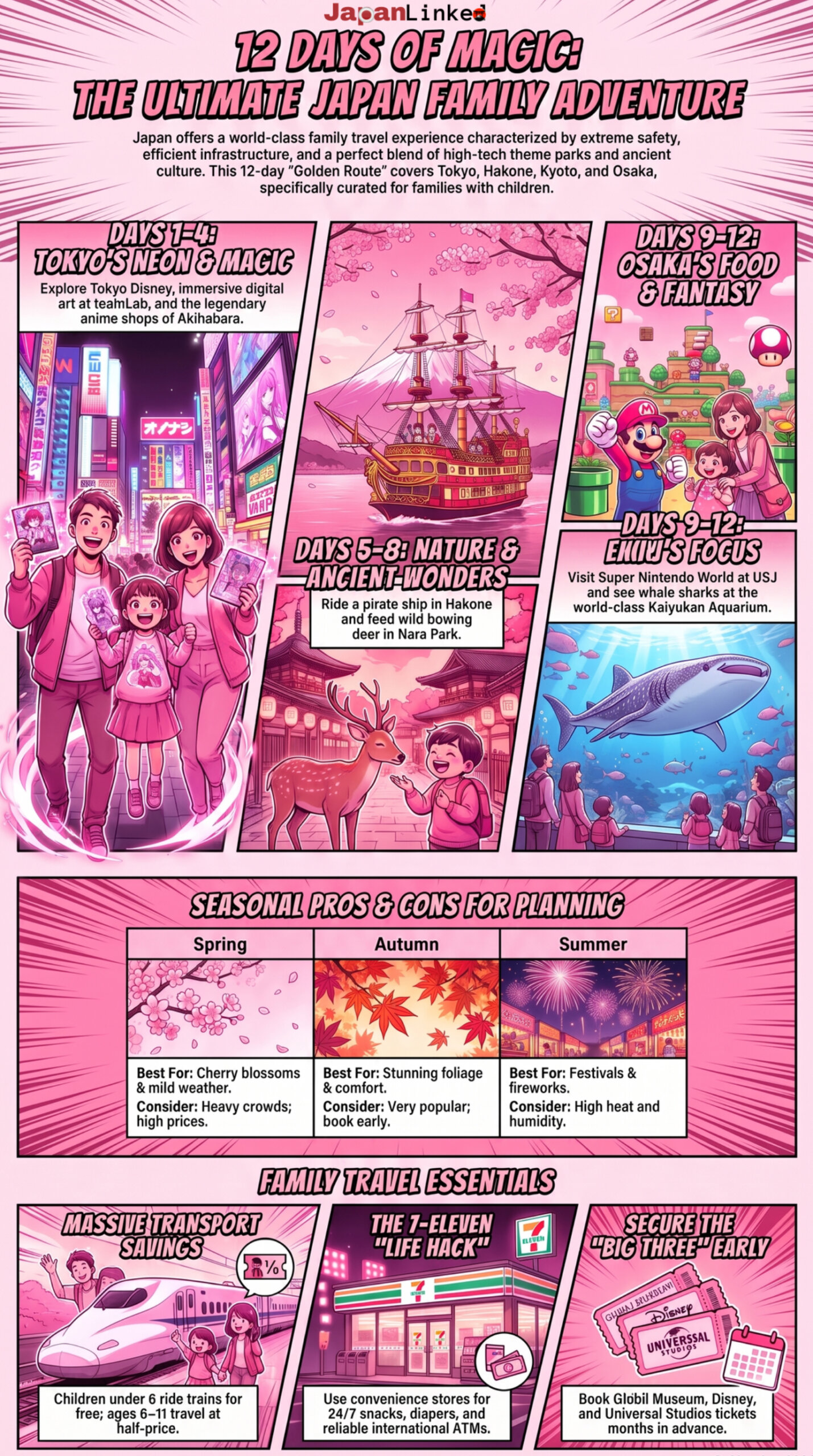
Children under 6 ride trains for free, and ages 6–11 travel at roughly half price — a meaningful saving for families covering multiple cities by Shinkansen. The JR Pass for a Tokyo–Kyoto–Osaka route can save a family of four several hundred dollars compared to buying individual tickets.
The food question is easier than you think. Ramen, udon, soba, tempura, yakitori, onigiri, sushi (cooked options are everywhere), convenience store snacks, and sweet red bean treats from every second street corner — Japanese food is genuinely loved by most children after the first day or two. Plastic food displays in restaurant windows make ordering simple even without language skills.
The sweet spot age for Japan with kids: Ages 6–10 is widely considered ideal. This group handles theme parks, temples, animal encounters, and interactive museums equally well — and they have the stamina for full days without losing the sense of wonder that makes everything feel magical.
Also Read: Luxury Japan Itinerary & Japan Honeymoon Itinerary
The 12-Day Japan Family Itinerary: Overview
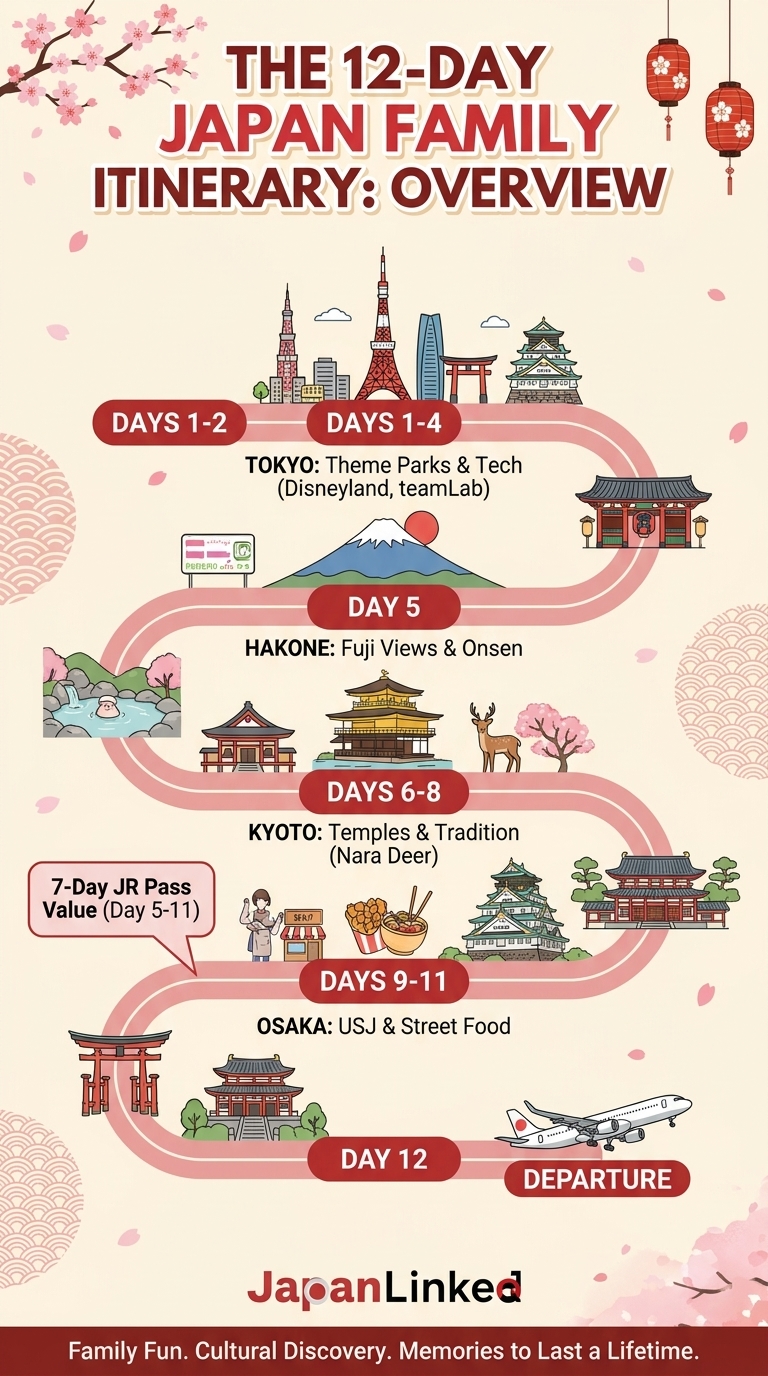
This itinerary is built for families with children aged 5–14, with notes throughout on what works best for different age groups.
| Days | Destination | Focus |
|---|---|---|
| 1–4 | Tokyo | Disneyland/DisneySea, teamLab, Akihabara, Ghibli, Shinjuku |
| 5 | Hakone | Mount Fuji views, pirate ship, onsen intro |
| 6–8 | Kyoto | Temples (without the fatigue), ninja/samurai, Nara deer |
| 9–11 | Osaka | Universal Studios Japan, aquarium, street food |
| 12 | Departure | Osaka or Tokyo fly-out |
A 7-day JR Pass activated from Day 5 onwards covers the Shinkansen between Tokyo and Kyoto, all Kyoto–Nara–Osaka rail travel, and the Osaka airport transfer — excellent value for families.
Days 1–4: Tokyo – The Best City in the World for Families with Kids
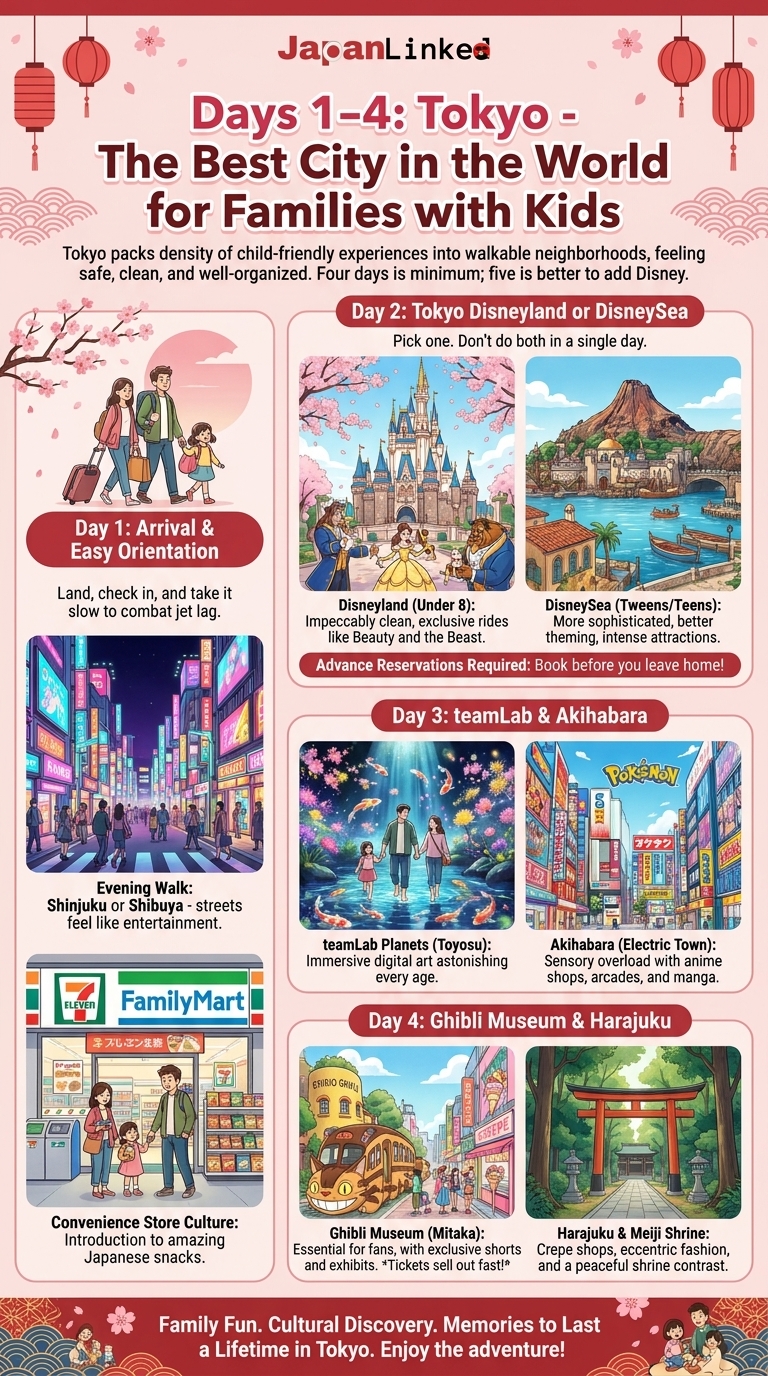
Tokyo earns its reputation. No other city packs this density of child-friendly experiences into walkable neighborhoods, all wrapped in the comfort of a city that feels safe, clean, and absurdly well-organized.
Four days is the minimum; five is better if your family wants to add Disney to the itinerary without rushing.
Day 1: Arrival & Easy Orientation
Land, check in, and resist the urge to do too much. Jet lag is real, and Tokyo’s neighborhoods reward a slow start.
- Walk Shinjuku or Shibuya in the evening — even the streets feel like entertainment here, with giant screens, neon arcades, and every kind of food stall
- Stop at a 7-Eleven or FamilyMart for an introduction to Japanese convenience store culture — a genuine highlight for children (and adults)
- Early bedtime: you’ll need the energy
Day 2: Tokyo Disneyland or DisneySea
Pick one. Don’t try to do both in a single day.
Tokyo Disneyland is the classic choice for younger children (under 8). The Enchanted Tale of Beauty and the Beast is a world-exclusive ride exclusive to this park and one of the most technically impressive Disney attractions anywhere.
The Japanese hospitality applied to the Disney model — impeccably clean, impossibly organized, staff who genuinely seem to love their jobs — makes even a veteran Disney family see the experience differently.
Tokyo DisneySea skews older and is widely considered the more sophisticated park. Tweens and teens often prefer it for the theming and the range of more intense attractions.
Many families with older kids do two DisneySea days and skip Disneyland entirely.
Both parks now require advance date reservations — book before you leave home, especially during school holidays when tickets sell out weeks ahead.
Day 3: teamLab & Akihabara
TeamLab Planets (Toyosu) is one of those rare attractions that genuinely astonishes every age group in the family simultaneously.
Walk barefoot through ankle-deep water that ripples light around you, stand inside a room of infinite floating flowers, and watch digital koi scatter from your children’s footsteps.
It’s immersive digital art that feels more like stepping inside a dream. Book timed-entry tickets in advance.
After, make your way to Akihabara — Tokyo’s legendary “Electric Town” — for an afternoon of total sensory overload.
Multi-story anime shops, retro gaming arcades, the Pokémon Center, claw machines, and floors of manga create an environment that most children never want to leave. Budget two to three hours minimum, more if you have anime fans in the family.
Day 4: Ghibli Museum & Harajuku
Studio Ghibli Museum in Mitaka is the most essential booking on the entire trip for families with Ghibli fans.
A life-sized Catbus children can climb into, a working Totoro-themed gift shop (accessible only with a museum ticket), exclusive short films in a mini theater, and exhibits on how animation actually works — it’s a complete experience rather than a static museum.
Tickets go on sale on the 10th of each month for the following month and sell out almost immediately. Set a calendar reminder.
The afternoon in Harajuku covers Takeshita Street’s crepe shops, eccentric fashion, and the kind of visual candy that teenagers in particular find irresistible.
The nearby Meiji Shrine provides a genuinely peaceful contrast — the 700-meter forested path leading to the shrine is calm enough that even young children tend to slow down and absorb it.
Also Read: 2 Week Japan Itinerary & 3 Week Japan Itinerary
Day 5: Hakone – Pirate Ships, Mount Fuji & a First Taste of Onsen
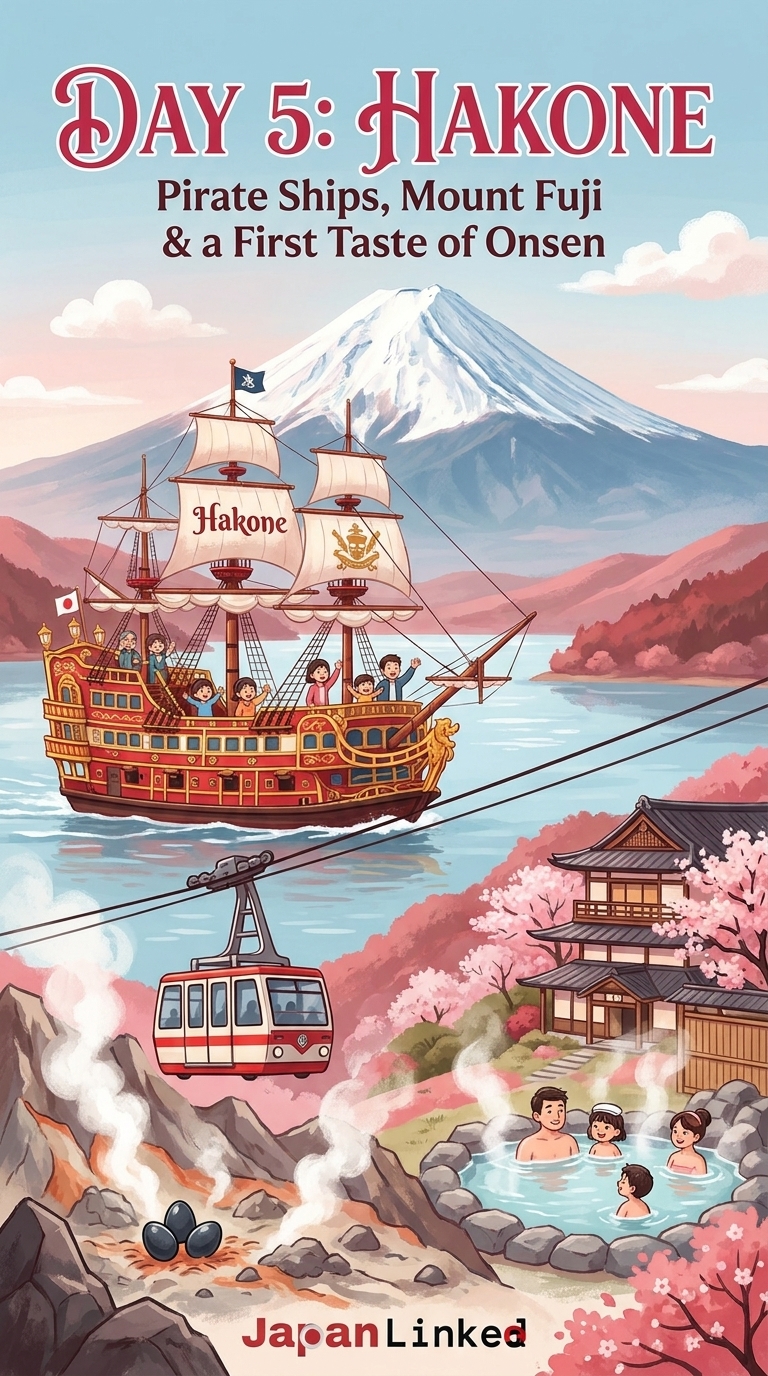
The Hakone day trip (or one-night stay, highly recommended) is where the itinerary shifts gear. After the energy of Tokyo, this mountain onsen town provides a different kind of Japan — slower, quieter, and visually stunning.
The Hakone Pirate Ship on Lake Ashi is exactly what it sounds like: a large, ostentatiously decorated galleon crossing a lake with Mount Fuji rising above it on clear days. Children love it unreservedly.
On clear mornings (October and November tend to be reliable), the Fuji views from the lake are among the most iconic you’ll see in Japan.
The Hakone Ropeway takes you over Owakudani’s active volcanic area, with steam vents and the famous black eggs (boiled in the sulphur springs, said to add seven years to your life — children immediately want several). Views across the mountains on a clear day are spectacular.
If you’re staying overnight, this is the ideal moment to introduce children to onsen culture. Many family-run ryokans have private family baths you can book by the hour — a perfect introduction without the social complexity of communal bathing.
The mineral-rich hot spring water, the tatami floors, the Japanese breakfast the next morning — even a single ryokan night leaves a lasting impression.
Days 6–8: Kyoto – Culture That Kids Actually Love
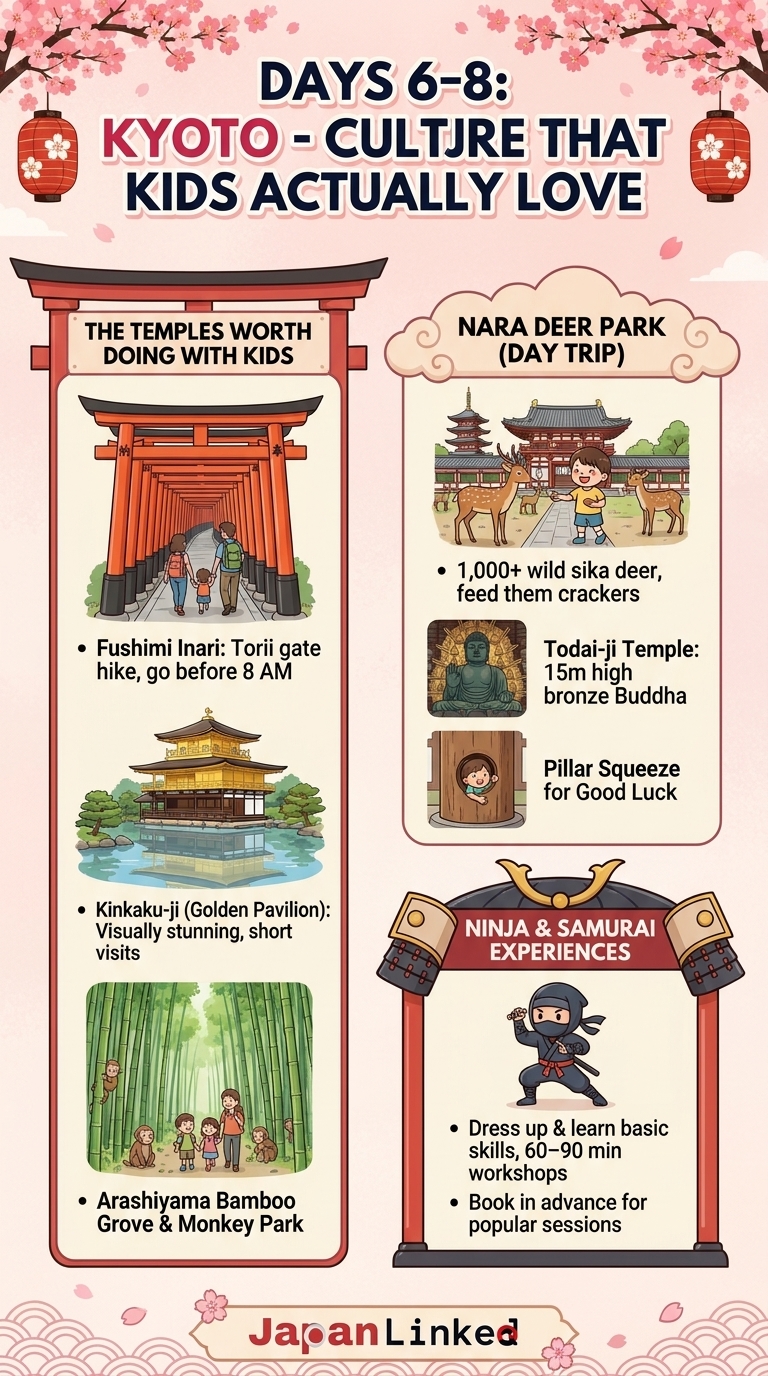
Kyoto is where families worry most — and usually end up most surprised. The key is avoiding “temple fatigue,” which sets in fast when parents try to visit too many cultural sites in a single day.
Two or three well-chosen experiences, done properly, are worth far more than six rushed checkboxes.
The Temples Worth Doing With Kids
Fushimi Inari Shrine: The thousands of torii gates winding up the mountain are genuinely impressive to children, particularly if you frame it as a hike. You don’t need to reach the summit — even the lower section is striking. Go before 8 a.m. to avoid crowds.
Kinkaku-ji (Golden Pavilion): The reflection of the gold-leafed pavilion in the surrounding pond is one of the most visually immediate landmarks in Japan. Visits are short and self-guided, which suits families perfectly.
Arashiyama Bamboo Grove: The towering green corridor is atmospheric and genuinely beautiful. Combine it with the Arashiyama Monkey Park, where Japanese macaques roam freely on a hillside above the city — a huge hit with younger children.
The Nara Deer Park (Day Trip, 45 Minutes from Kyoto)
Nara Park is one of those experiences that appears in holiday photos for generations.
Over 1,000 wild sika deer roam freely among ancient temples, approaching visitors to accept deer crackers (shika senbei) sold by vendors throughout the park.
Children who have been mildly engaged with temples are suddenly completely invested.
The nearby Todai-ji Temple houses one of the world’s largest bronze Buddha statues — at 15 metres high, it’s genuinely scale-breaking, and children tend to go quiet when they see it.
A wooden pillar inside has a hole at its base (the same size as one of the Buddha’s nostrils) that visitors squeeze through for good luck — a physical, memorable activity that ties the cultural experience to something tangible.
Ninja & Samurai Experiences
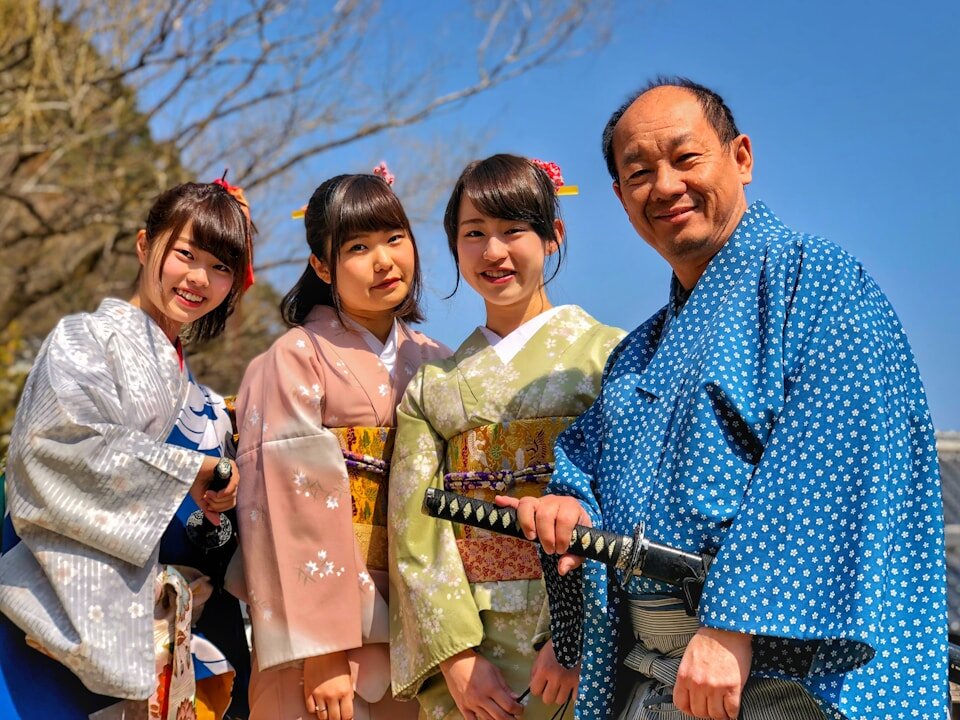
Kyoto has excellent options for children to dress up in ninja or samurai gear and learn basic skills from instructors.
These workshops — typically 60 to 90 minutes — are consistently among the experiences families rate most highly. Book in advance, as the popular English-language sessions fill up.
Also Read: Southern Japan Itinerary & Northern Japan Itinerary
Days 9–11: Osaka – Theme Parks, Food & Pure Fun
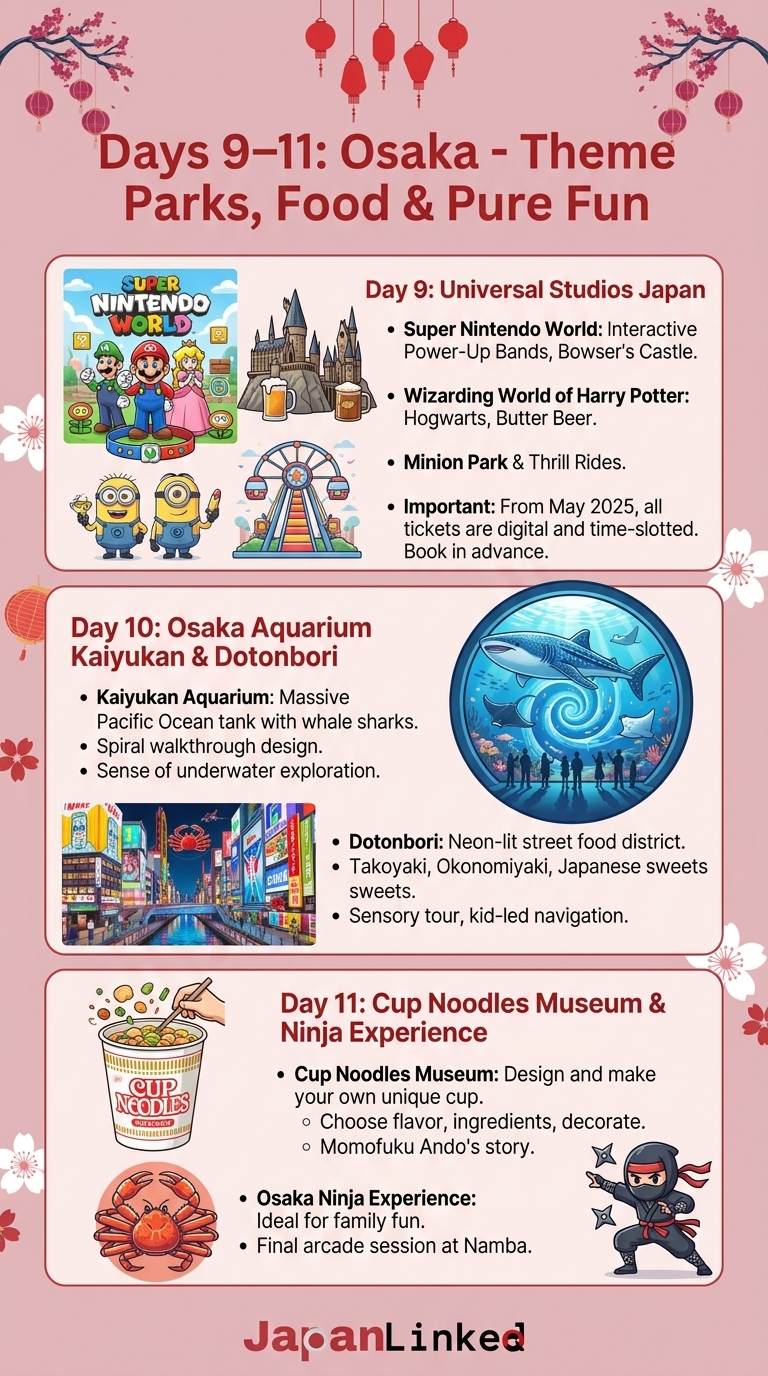
Osaka closes the itinerary on an energy high. The city is more compact and more casual than Tokyo, with a local culture built around food and fun. Families often find it the most relaxed of the three cities.
Day 9: Universal Studios Japan
Universal Studios Japan (USJ) in Osaka is home to Super Nintendo World — an extraordinarily well-executed interactive area where children wear Power-Up Bands that connect to the game environment, collecting coins and unlocking content as they move through the park.
The detail in the environment is extraordinary: Question Blocks respond to physical hits, and Bowser’s Castle is full of moments that blur the line between the game world and the real one.
The Wizarding World of Harry Potter at USJ is consistently ranked among the best Harry Potter experiences globally — Hogwarts Castle, Butter Beer, and Hogsmeade village are all here.
Minion Park handles the younger contingent, and the broader park offers enough thrill rides for teenagers to fill an entire day independently.
From May 2025, all tickets are digital and time-slotted — no on-site booth purchases. Book before departure.
Day 10: Osaka Aquarium Kaiyukan & Dotonbori
Osaka Aquarium Kaiyukan is one of the largest aquariums in the world, built around a 9-metre-deep Pacific Ocean tank housing whale sharks.
The spiral walkthrough design takes visitors from the ocean surface to the deep over multiple floors, creating a sense of genuine underwater exploration. Even blasé teenagers tend to be arrested by the whale sharks.
The evening belongs to Dotonbori, Osaka’s neon-lit street food district, where the combination of takoyaki (octopus balls), okonomiyaki (savory pancakes), giant crabs on illuminated signs, and every kind of Japanese sweet creates a self-guided sensory tour. Let the kids lead — the navigation here is half the experience.
Day 11: Cup Noodles Museum & Ninja Experience
The Cup Noodles Museum in Osaka Ikeda lets children design and make their own unique instant noodle cup — choosing the flavor, ingredients, and decorating the packaging to take home.
It’s interactive, inexpensive, and produces a souvenir that’s genuinely personal.
The museum also tells the story of Momofuku Ando, who invented instant noodles in 1958 and changed the way the world eats — a story even younger children find fascinating.
The afternoon is ideal for an Osaka ninja experience — many families hold back on Tokyo’s version to save Osaka for this — or a final session at Namba’s arcades before packing up for the journey home.
Also Read: 11 Days In Japan Itinerary & 10 Days In Japan Itinerary
Practical Tips for Families Traveling To Japan
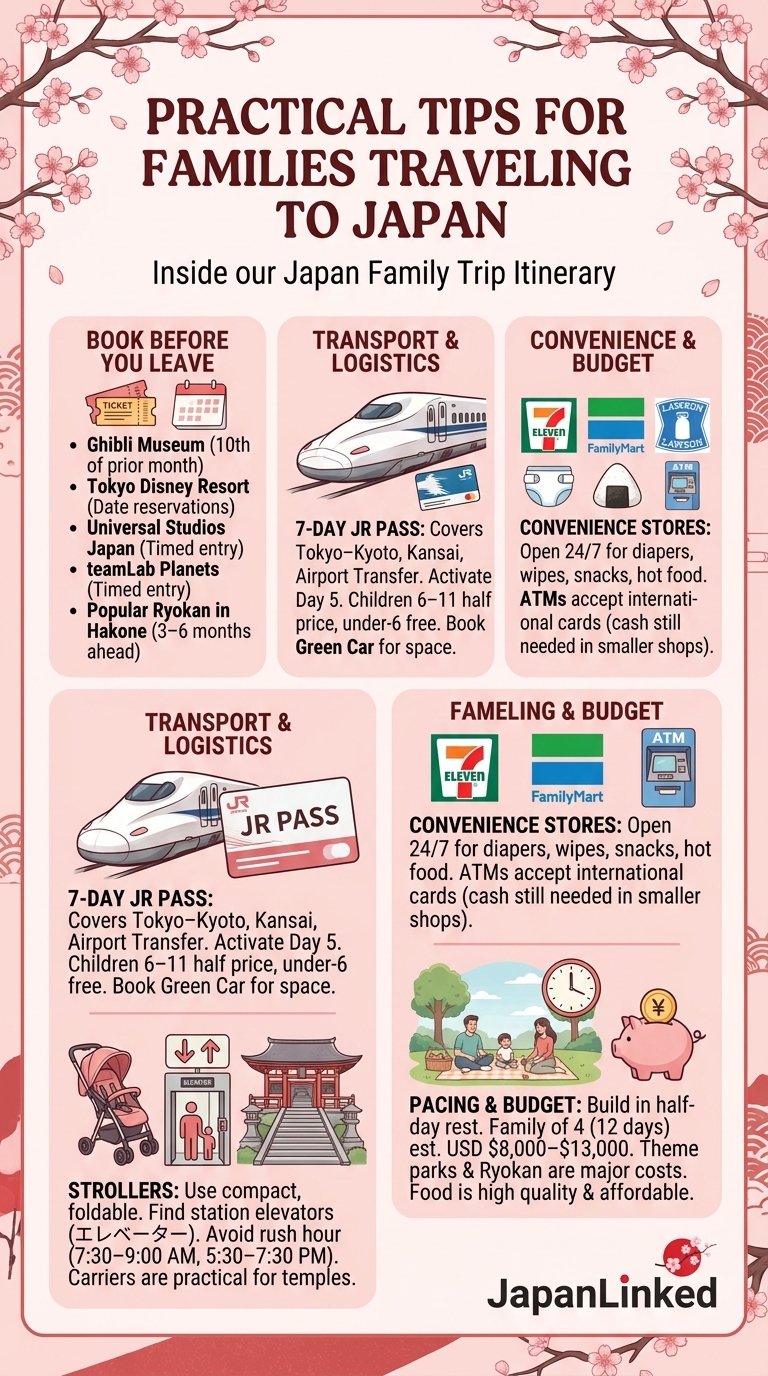
Book these before you leave home:
- Ghibli Museum (10th of each month, for following month — sells out same day)
- Tokyo Disneyland or DisneySea (date reservations required)
- Universal Studios Japan (digital, time-slotted tickets only)
- teamLab Planets (timed entry)
- Any popular ryokan for Hakone (3–6 months ahead for spring/autumn)
JR Pass: A 7-day JR Pass activated from Day 5 of this itinerary covers the Tokyo–Kyoto Shinkansen, all Kansai-area JR trains, and the Osaka airport transfer. Children ages 6–11 pay roughly half price; under-6s travel free without a seat. The Hikari Shinkansen (not the Nozomi) accepts the JR Pass. Book the Green Car for families — wider seats, more space, and boarding positions closer to elevators.
Strollers: A compact, foldable stroller is strongly recommended over a large buggy. Most major train stations have elevators, though they can be hard to find — look for エレベーター signs or ask station staff. Avoid trains during rush hour (7:30–9:00 AM and 5:30–7:30 PM) with strollers. Many families find a baby carrier more practical for temple areas with stone paths and stairs.
Convenience stores are your logistics partner. 7-Eleven, FamilyMart, and Lawson stock diapers, baby wipes, formula, children’s snacks, onigiri, and hot foods at all hours. They also have ATMs that reliably accept international cards — useful since many smaller restaurants and shops are still cash-only.
Pacing: The biggest mistake on Japan family trips is too many full days back-to-back. Build in one half-day per city for wandering, eating, and doing nothing specific. A playground, a convenience store trawl, or an afternoon in a park often produces the moments children remember most.
Budget (family of 4): A mid-range 12-day Japan family trip typically runs between USD $8,000 and $13,000 all-in, including flights, hotels, transport, activities, and food. Theme park days and ryokan nights are the biggest individual cost drivers. Japan’s food, however, punches well below its quality — a family ramen lunch costs less than a sandwich shop in most Western cities.
Best Time of Year for a Japan Family Trip
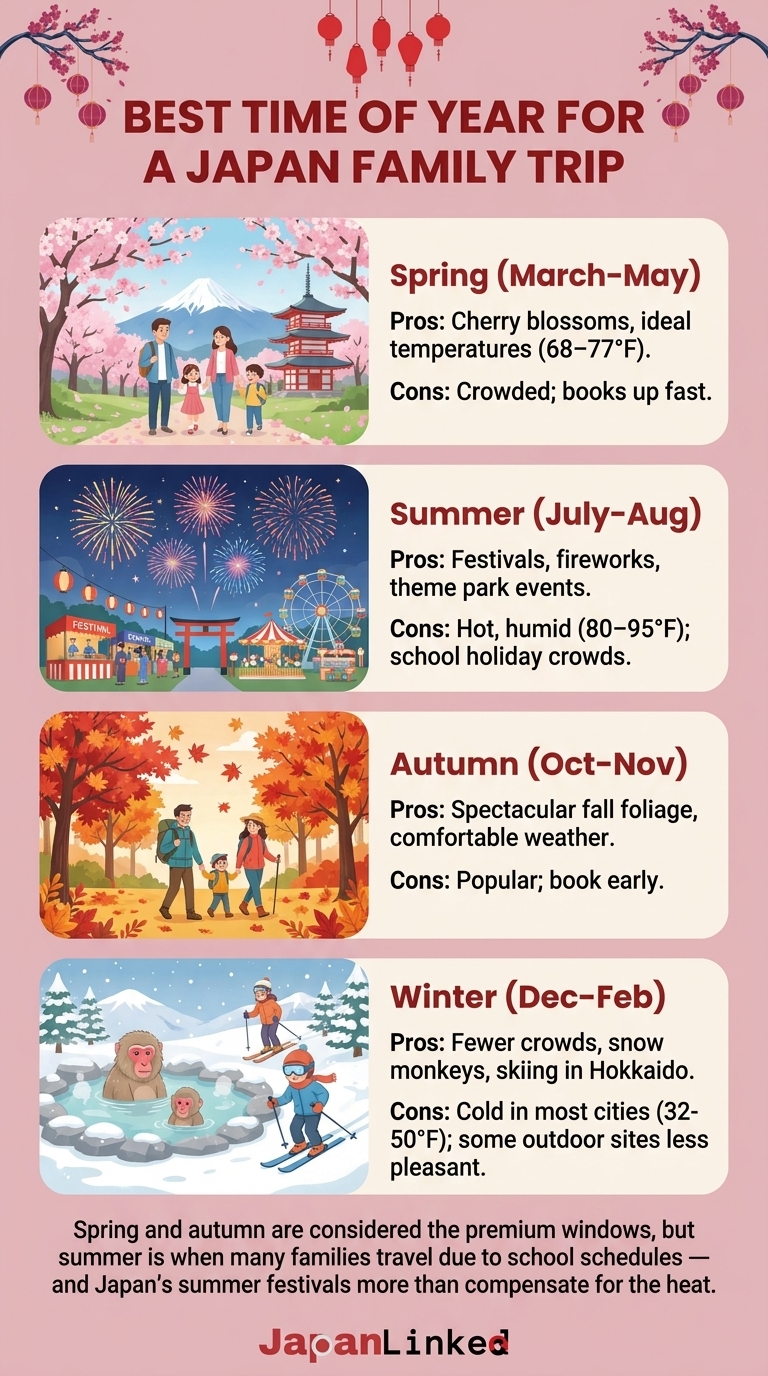
| Season | Pros | Cons |
|---|---|---|
| Spring (March–May) | Cherry blossoms, ideal temperatures | Crowded; books up fast |
| Summer (July–Aug) | Festivals, fireworks, theme park events | Hot, humid; school holiday crowds |
| Autumn (Oct–Nov) | Spectacular fall foliage, comfortable weather | Popular; book early |
| Winter (Dec–Feb) | Fewer crowds, snow monkeys, skiing in Hokkaido | Cold in most cities; some outdoor sites less pleasant |
Spring and autumn are considered the premium windows, but summer is when many families travel due to school schedules — and Japan’s summer festivals more than compensate for the heat.
Conclusion
Japan with kids isn’t a compromise. It’s a country that happens to have built an extraordinary family travel infrastructure inside one of the world’s most culturally rich, visually stunning, and culinarily inventive destinations.
Deer that bow, bullet trains that arrive to the second, noodles that cost almost nothing and taste like they cost everything, arcades that seem to go on forever – the experiences that delight children here aren’t the ones you manufacture. They’re just Japan, doing what it does.
Plan ahead for the must-book attractions, pack a foldable stroller, buy the JR Pass, and give yourself permission to slow down in between the big days.
The trip you’re planning won’t just be a holiday. It’ll be the story your family tells for years.
