
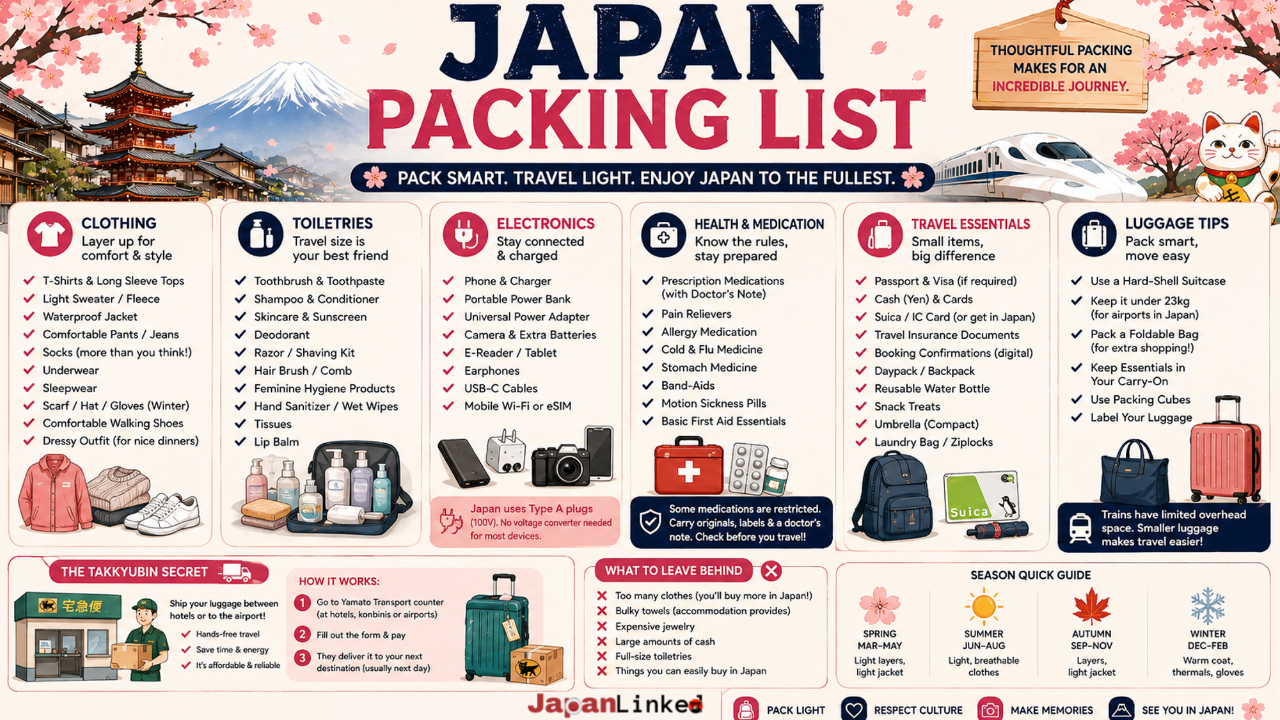
Most Japan packing guides tell you to bring comfortable shoes and a portable charger. Groundbreaking.
What they don’t tell you is that the cold medicine in your bathroom cabinet might land you in Japanese customs detention – or that Japan’s luggage forwarding system is so good you can move between eight cities without ever dragging a suitcase onto a train.
This Japan packing list is built differently. It’s based on what actually matters, what experienced Japan travelers wish they’d known before their first trip, and – crucially – what not to bring.
Because the single biggest mistake most people make isn’t forgetting something. It’s packing too much of the wrong things.
Whether you’re heading to Japan for two weeks or two months, this guide covers clothing, tech, money, medications, luggage strategy, and the hidden rules that can make or break your trip.
The Japan Packing Philosophy: Pack Less Than You Think
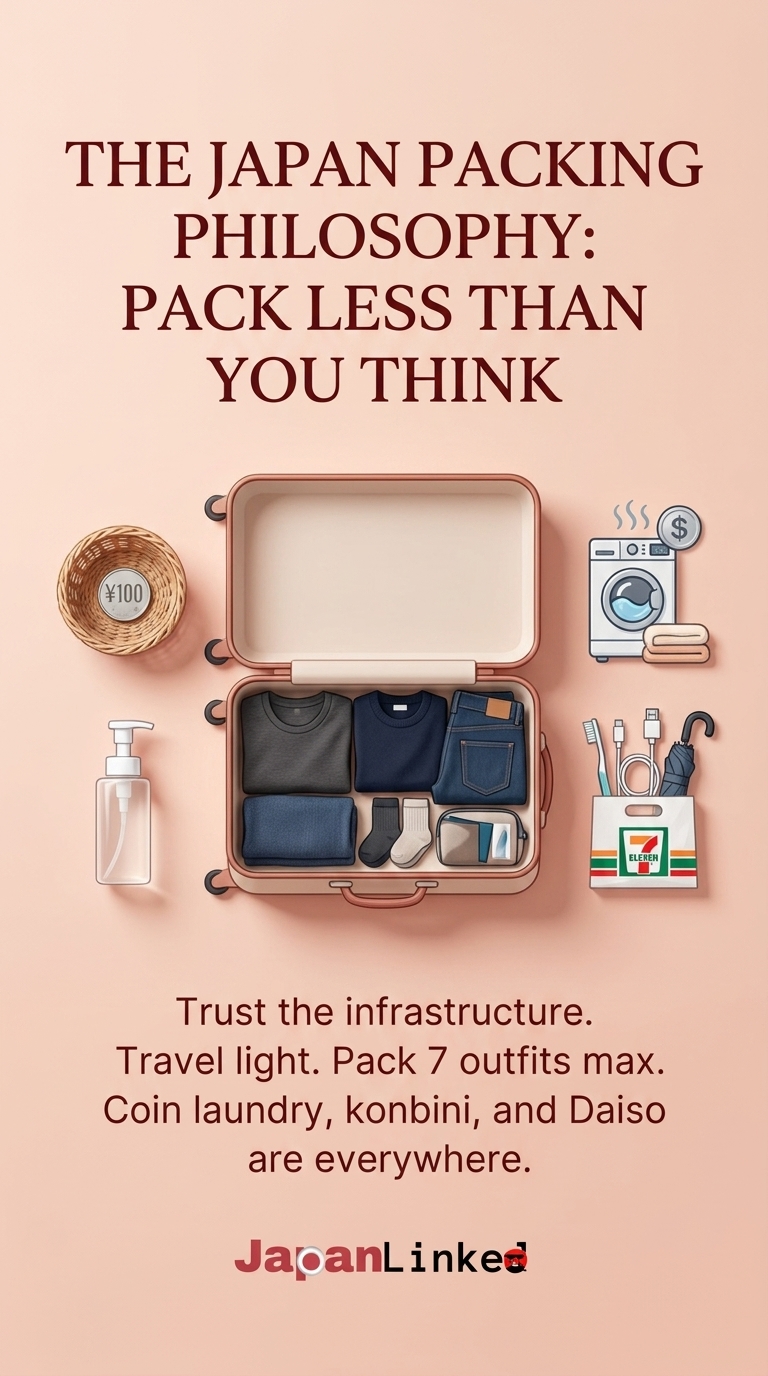
Before listing a single item, the most important thing to understand about packing for Japan is this: Japanese hotel rooms are small.
Not just “cozy” small – genuinely compact. A suitcase that opens flat will take up most of the floor space in a standard room.
The good news? Japan makes traveling light easier than almost anywhere else on earth.
- Coin laundry is everywhere – ¥300–¥500 per wash, dry included, and most hotels and hostels have machines on-site.
- Convenience stores (konbini) stock everything – forgotten toiletries, socks, phone chargers, umbrellas, even over-the-counter medicine, available 24/7 at every 7-Eleven, Lawson, and FamilyMart.
- The ¥100 shop (Daiso) is a packing safety net – toiletry bottles, travel adapters, cable organizers, and hundreds of other travel essentials for about $0.70 each.
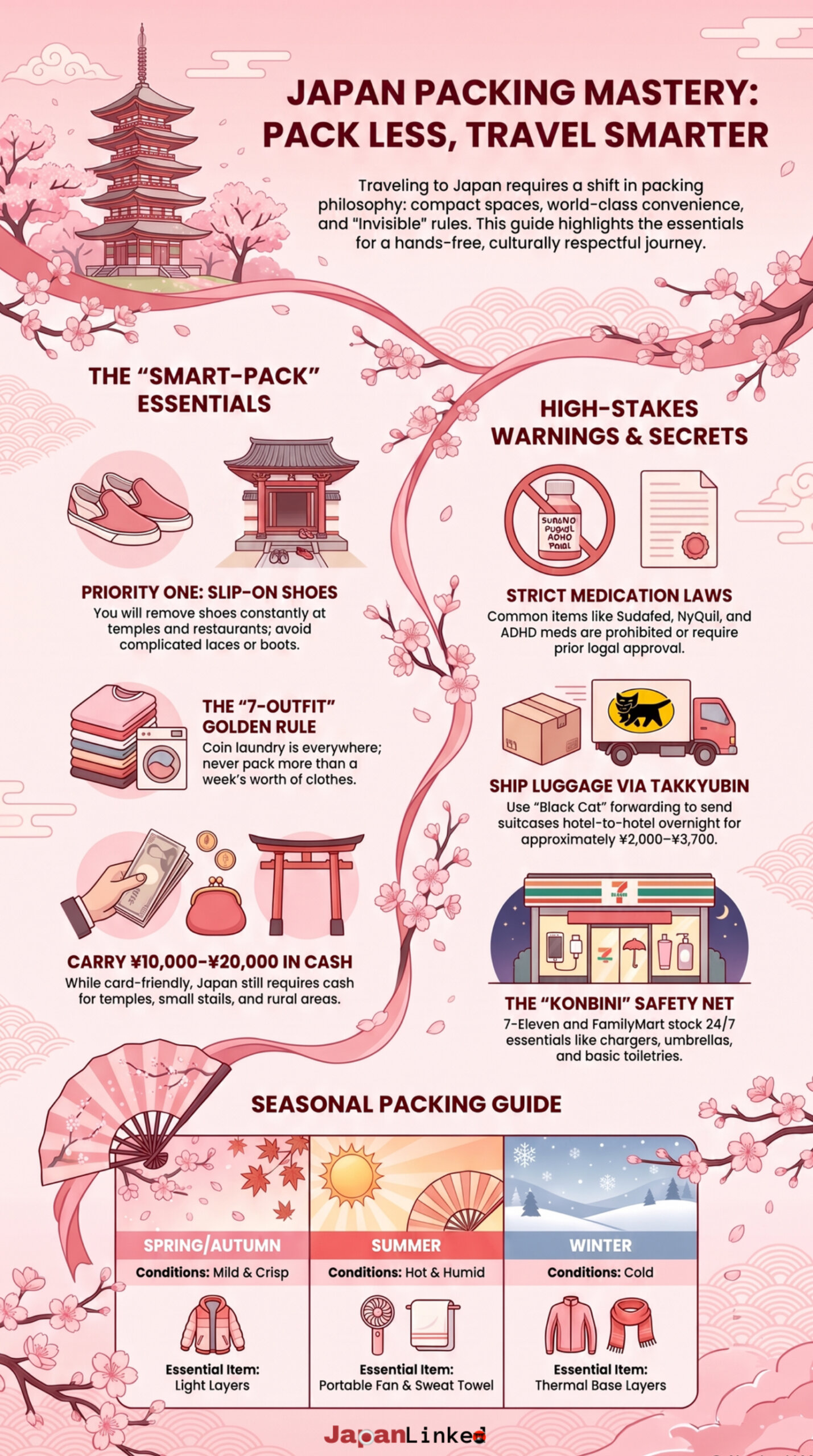
The golden rule most veteran Japan travelers follow: never pack more than seven outfits, regardless of trip length. The infrastructure exists to support you. Trust it.
Also Read: 2 Week Japan Itinerary & 3 Week Japan Itinerary
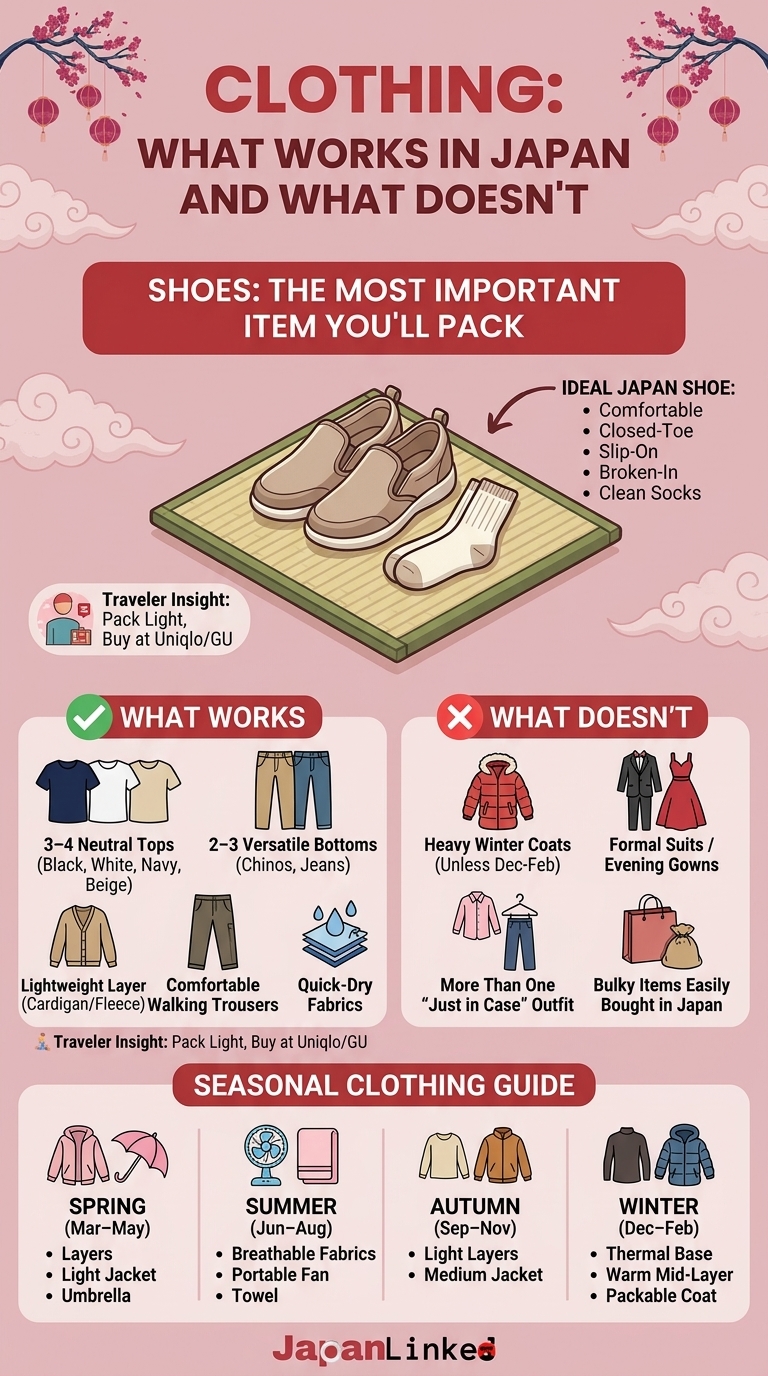
Clothing: What Works in Japan and What Doesn’t
Japan involves walking. A lot. Expect 15,000–20,000 steps per day in cities, which means your footwear choice matters more here than almost anywhere else.
Shoes: The Most Important Item You’ll Pack
Skip lace-up boots, heeled shoes, and anything with complicated fasteners. In Japan, you’ll remove your shoes constantly – at ryokan, traditional restaurants, some temples, and many private homes.
Every time. Shoes that take 45 seconds to put on will become infuriating by day three.
The ideal Japan shoe is:
- Comfortable enough for full days of walking on uneven stone paths and pavement
- Closed-toe (gravel temple paths are not sandal-friendly)
- Slip-on or easy to remove quickly
- Broken in before you arrive – never debut new shoes in Japan
A clean pair of socks matters too. In Japan, removing your shoes means your socks become visible, and arriving at a ryokan or traditional restaurant with worn-out socks is more awkward than it sounds.
Clothes That Work: The Mix-and-Match Principle
Japan’s street style is generally relaxed and fashion-forward in cities, traditional in rural areas, and always clean and neat.
You don’t need formal wear unless you’ve booked a Michelin-starred restaurant or a high-end Ginza bar – jeans and a clean shirt work everywhere else.
What to pack:
- 3–4 neutral-toned tops (black, white, navy, beige) – these photograph well against the colorful temples and neon streetscapes without competing for attention
- 2–3 versatile bottoms that work for both day sightseeing and evening dining
- 1 lightweight layer – a cardigan or fleece for heavily air-conditioned trains, department stores, and cool evenings
- Comfortable walking trousers or chinos (avoid shorts in rural or traditional areas)
- Quick-dry fabrics wherever possible – they wash overnight and dry by morning
What not to pack:
- Heavy winter coats (unless traveling December–February – even then, layering works)
- Formal suits or evening gowns
- More than one “just in case” outfit – Japan’s laundry system makes these redundant
- Anything that takes up significant space and can easily be bought at Uniqlo Japan for less than you’d pay at home
Traveler insight: Many experienced Japan visitors pack lightly and buy one or two pieces from Uniqlo or GU once they arrive. Both chains are affordable, stock Japan-exclusive designs, and sell clothes that pack well.
Seasonal Clothing Guide
| Season | Conditions | What to Bring |
|---|---|---|
| Spring (Mar–May) | Cool mornings, warm afternoons, occasional rain | Layers, light waterproof jacket, umbrella |
| Summer (Jun–Aug) | Hot and humid, 30–38°C | Breathable fabrics, portable fan (~¥300 at any konbini), sweat towel |
| Autumn (Sep–Nov) | Mild and pleasant, crisp evenings | Light layers, medium-weight jacket |
| Winter (Dec–Feb) | Cold in cities, very cold in mountains | Thermal base layers, warm mid-layer, packable coat |
Also Read: 11 Days In Japan Itinerary & 10 Days In Japan Itinerary
Tech and Connectivity: What You Actually Need
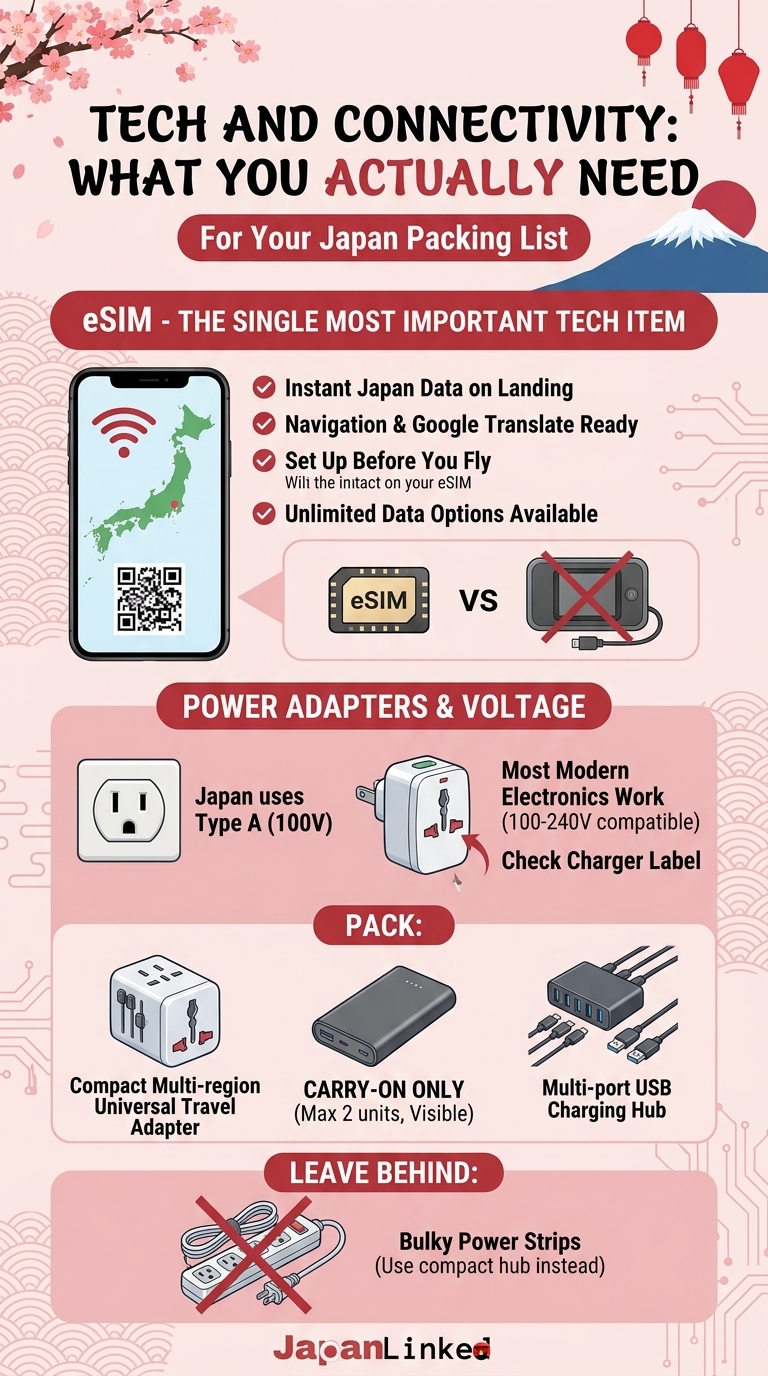
eSIM – The Single Most Important Tech Item
An eSIM gives you Japan data connectivity the moment you land, before you’ve cleared the immigration queue.
This matters enormously in a country where navigation apps, Google Translate’s camera mode, and train schedule lookups happen constantly throughout the day.
Set it up before you fly. Most modern smartphones support eSIM. Look for a Japan-specific plan – unlimited data options are widely available and worth paying a few dollars extra for.
A pocket Wi-Fi device is an older alternative that works but requires carrying an extra device and charging it separately.
Power Adapters and Voltage
Japan uses Type A outlets (two flat pins) at 100 volts – the same plug shape as North America but at a slightly lower voltage.
Most modern electronics (phones, laptops, cameras) work fine since their power bricks handle 100–240V automatically. Check your device’s charger to confirm.
You’ll likely need an adapter if you’re traveling from Europe, Australia, or the UK.
Pack:
- Universal travel adapter (compact, multi-region)
- Portable power bank (max 2 units per person; must travel in carry-on per Japanese airline rules as of 2025; must remain visible, not stored in overhead bins on Japanese carriers)
- Multi-port USB charging hub – hotel rooms often have only one or two wall outlets
Leave behind:
- Bulky power strips (a compact charging hub is lighter and more practical)
Also Read: North Japan Itinerary & South Japan Itinerary
Money: Cash, Cards, and the Suica Card Explained
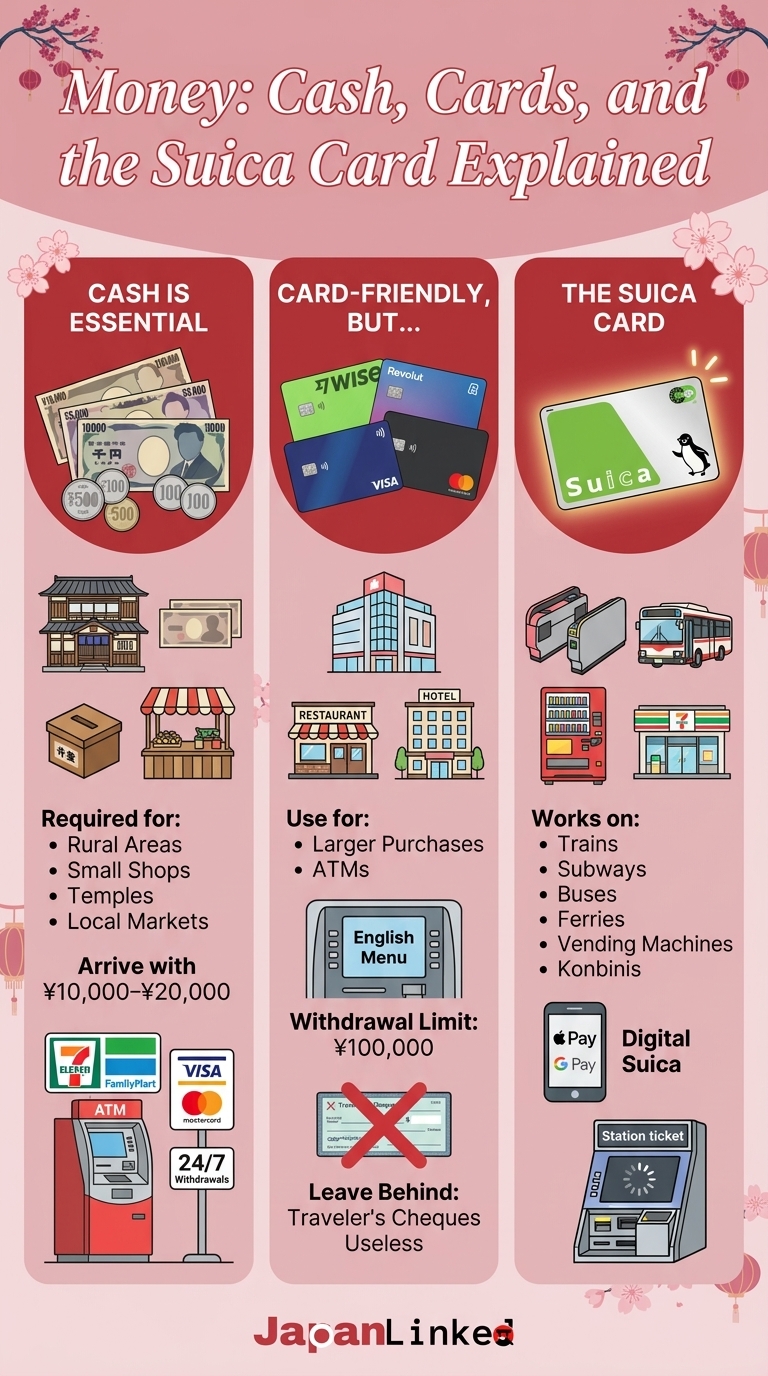
Japan is becoming more card-friendly every year – but it’s still not there yet. Cash remains essential, especially in rural areas, smaller restaurants, local market stalls, temple entry boxes, and traditional ryokan.
How much cash to carry: Arrive with ¥10,000–¥20,000 in your pocket for your first day. Once settled, withdraw from 7-Eleven or FamilyMart ATMs – these accept international Visa and Mastercard 24/7 and have English-language menus. The withdrawal limit is ¥100,000 per transaction. Do not exchange currency at the airport – services like Travelex typically charge 5–7% more than ATM rates.
The Suica Card is a prepaid IC transit card that works on virtually every train, subway, bus, and ferry in Japan. It also works at most convenience stores, vending machines, and an increasing number of shops. Load it at any station machine or via Apple Pay/Google Pay (digital Suica). It’s the single most convenient payment tool you’ll use in Japan.
Bring:
- ¥10,000–¥20,000 in yen for arrival (coin-heavy – ¥500 and ¥100 coins are used constantly)
- A Wise, Revolut, or similar low-fee debit card for ATM withdrawals and larger purchases
- Your regular Visa or Mastercard as backup
Leave behind:
- Traveler’s cheques – genuinely useless in modern Japan
- The idea that your home bank card will work everywhere – rural Japan is still cash-only in many places
Also Read: Honeymoon In Japan Itinerary & Luxury Japan Itinerary
Medications: The Section That Could Save Your Trip
This is the part most packing guides skip or gloss over – and it’s the most important section to read carefully.
Japan has some of the world’s strictest medication import laws.
Substances that are freely available over the counter in the US, UK, Australia, Canada, and Europe may be restricted, limited in quantity, or outright illegal to bring into Japan.
The consequences are not theoretical. In 2019, an American traveler was detained at Narita Airport for carrying a legally prescribed painkiller she hadn’t sought prior approval for.
Legal fees and penalties reportedly exceeded $600,000, and she spent 23 days in Japanese detention – not at the airport.
Medications You Cannot Bring Without Prior Permission
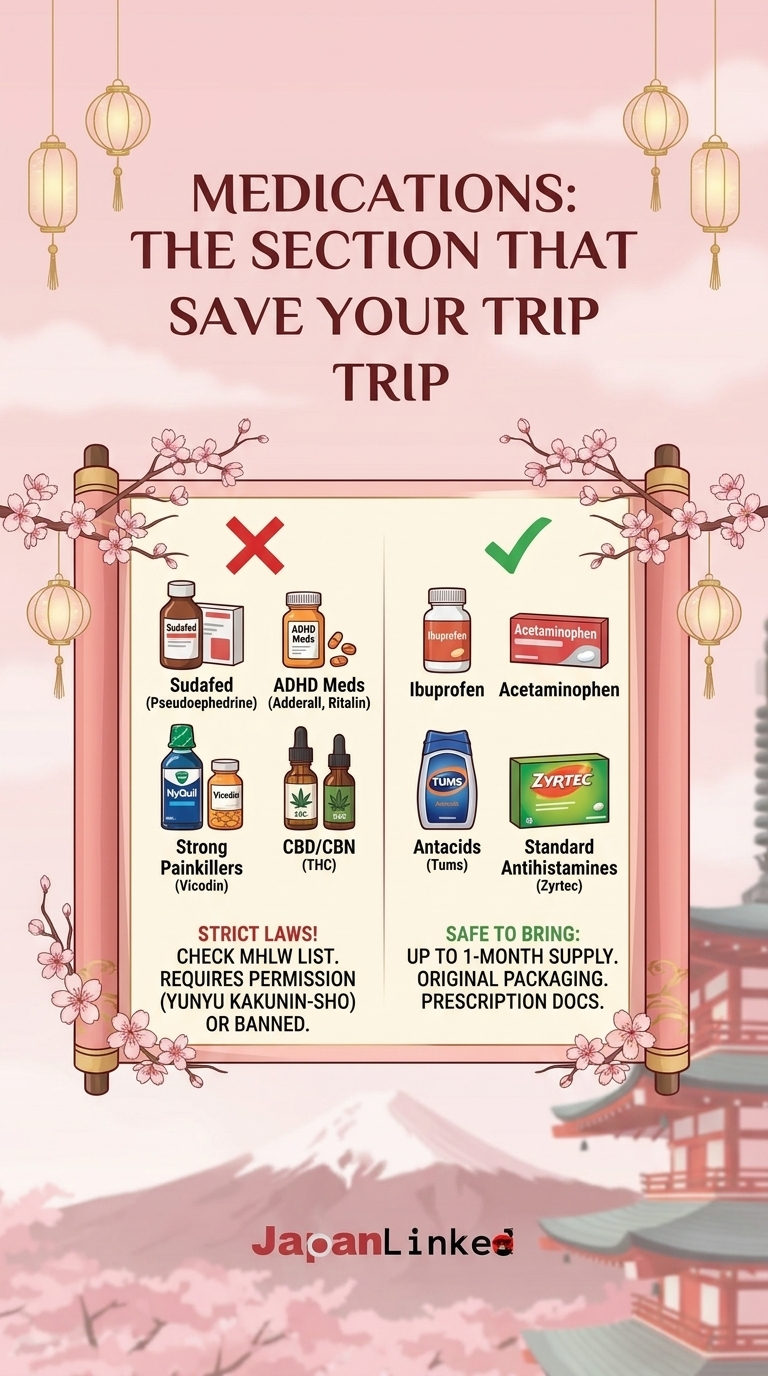
These common medications contain pseudoephedrine or stimulant-class ingredients and are controlled or prohibited in Japan:
- Sudafed and most decongestants (contain pseudoephedrine, classified as a stimulant precursor in Japan)
- Vicks NyQuil and similar multi-symptom cold medicines
- ADHD medications (Adderall, Ritalin, Vyvanse, and all amphetamine-based drugs – absolutely prohibited)
- Certain inhalers containing regulated bronchodilators
- Strong prescription painkillers including Vicodin, OxyContin, and similar opioids
- CBD products containing any THC – all marijuana derivatives are illegal
- CBN (cannabinol) – newly prohibited in Japan as of June 1, 2026, including products previously sold domestically
What to do: Check every medication’s active ingredient (not brand name) against Japan’s Ministry of Health, Labour and Welfare (MHLW) controlled substances list before you travel. If you take anything prescription-strength, apply for a Yunyu Kakunin-sho (import certificate) well in advance – approval can take several weeks.
Carry all medications in their original packaging with labels intact. Bring your prescription documentation. And when in doubt, call your doctor and ask them to check Japan’s MHLW guidelines specifically.
Safe and straightforward to bring:
- Standard antihistamines (Zyrtec, Claritin – check ingredients first)
- Antacids like Tums
- Ibuprofen and acetaminophen (paracetamol) in standard doses
- Up to a one-month supply of most non-controlled prescription medications
Also Read: Japan Family Trip Itinerary & 30 Days In Japan Itinerary
Luggage Strategy: The Takkyubin Secret
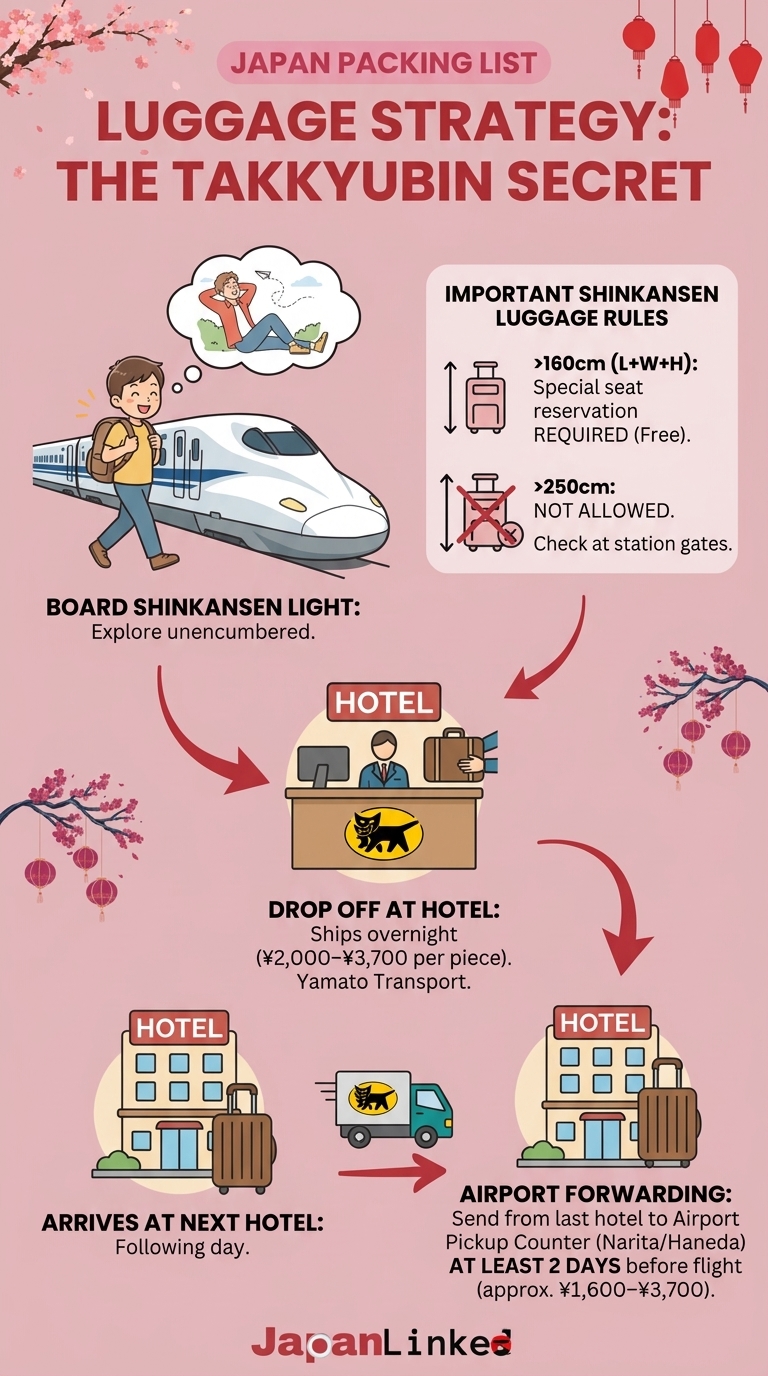
Here’s the single most underrated tip in any Japan packing guide: you don’t have to carry your luggage between cities.
Japan’s takkyubin luggage forwarding service – operated primarily by Yamato Transport (look for the black cat logo) – ships your suitcase from hotel to hotel overnight for approximately ¥2,000–¥3,700 per piece depending on size.
Drop it at the hotel front desk the night before departure. It arrives at your next hotel the following day.
This changes everything. You board the Shinkansen with a small daypack. You explore arrival cities unencumbered. You move between eight cities in 14 days without once wrestling a 23kg suitcase through a crowded station.
Important shinkansen luggage rules to know:
- Suitcases with total dimensions (length + width + height) exceeding 160cm require a special seat reservation on Tokaido, Sanyo, and Kyushu Shinkansen lines – reservation is free but must be done before boarding
- Luggage exceeding 250cm total will not be allowed onboard at all and must travel separately
- Use measuring devices installed at major station gates to check before boarding
Going home: Reverse the takkyubin process – send luggage from your last hotel to an airport pickup counter at Narita or Haneda at least two days before your flight (not the same day; it won’t arrive in time).
Airport forwarding costs around ¥1,600–¥3,700 and is available through Yamato counters in airport arrivals halls.
What to Leave Behind: The Definitive List
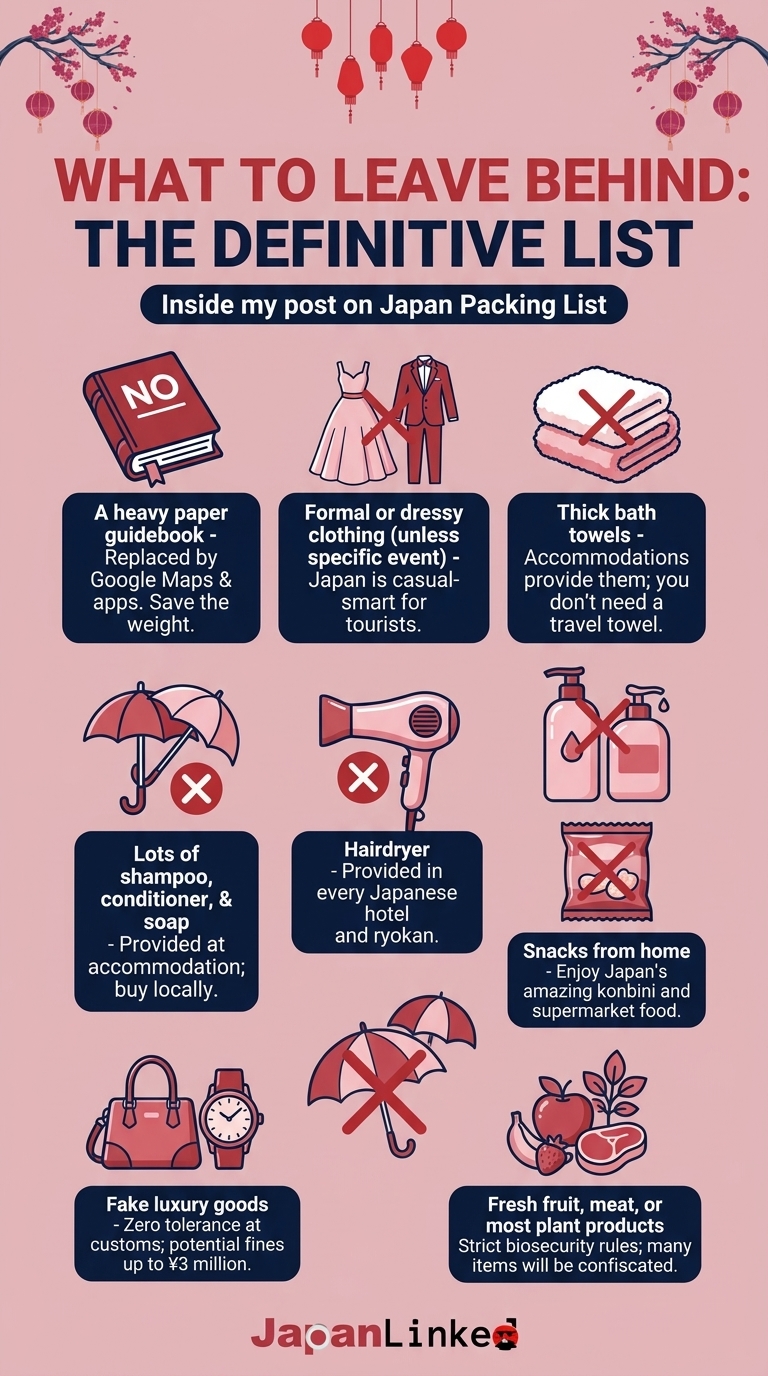
Most Japan packing guides tell you what to bring. Fewer are honest about what to leave at home.
Don’t bring:
- A heavy paper guidebook – a 600g Lonely Planet is entirely replaced by Google Maps, Hyperdia, and a translation app. Save the weight.
- Formal or dressy clothing (unless you have a specific event) – Japan is casual-smart for tourists almost everywhere
- Thick bath towels – every accommodation provides them; you don’t need a travel towel unless camping
- More than one umbrella – compact ones are sold at every konbini for under ¥1,000 if the weather turns; leave the big one home
- Hairdryer – provided in every Japanese hotel and ryokan without exception
- Lots of shampoo, conditioner, and soap – provided at virtually all accommodation; Japanese drugstores and ¥100 shops sell every toiletry you could need
- Snacks from home – Japan’s convenience stores and supermarkets have some of the best travel food in the world; pack light and eat better
- Fake luxury goods – zero tolerance at customs; confiscated, potential fines up to ¥3 million
- Fresh fruit, meat, or most plant products – Japan enforces strict biosecurity rules at customs, and many items will be confiscated
The Japan Packing List: Complete Checklist
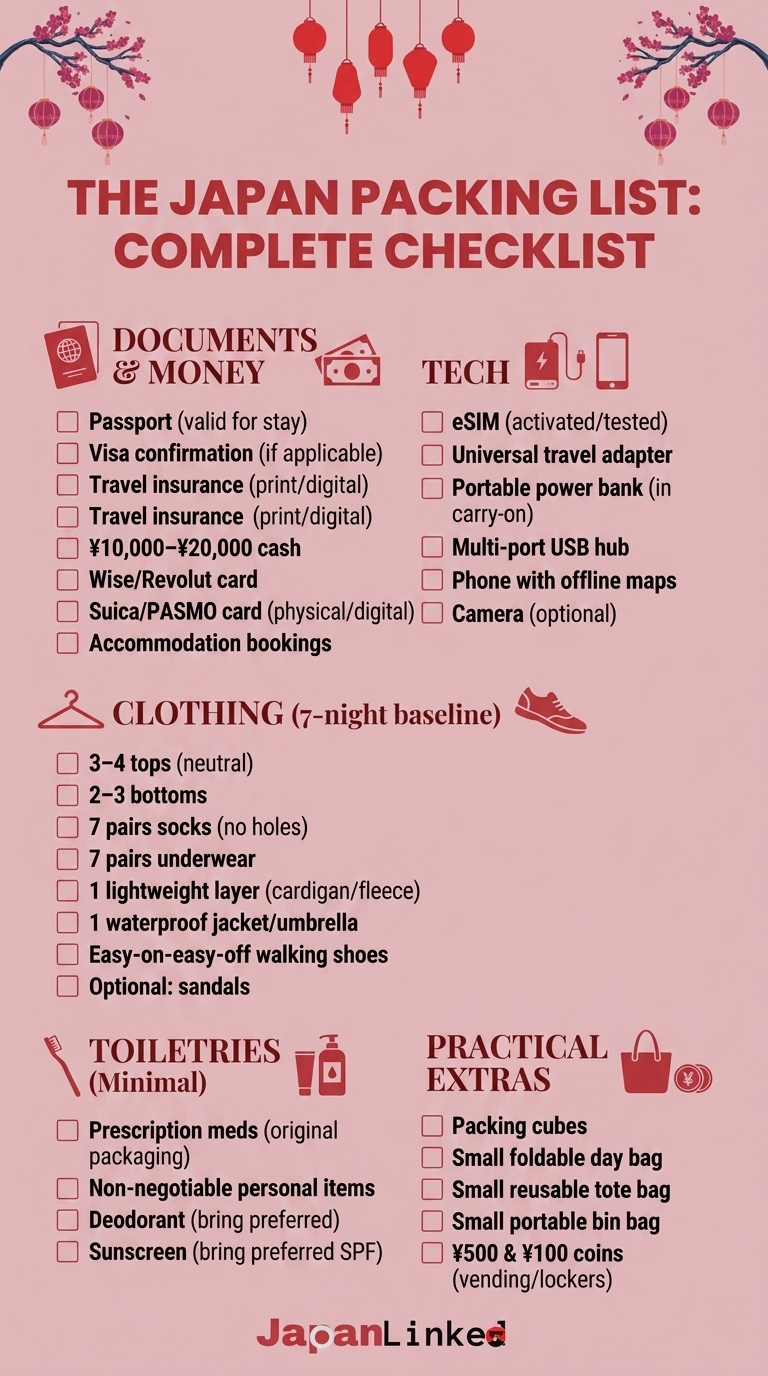
Documents & Money
- Passport (valid for the duration of your stay)
- Visa confirmation (if applicable – check MOFA website for your nationality)
- Travel insurance documents (print and digital copies)
- ¥10,000–¥20,000 in yen cash for arrival
- Wise/Revolut or low-fee debit card
- Suica or PASMO card (or set up digital version before departure)
- Copies of accommodation bookings
Tech
- eSIM (activated and tested before departure)
- Universal travel adapter
- Portable power bank (in carry-on)
- Multi-port USB charging hub
- Phone with offline maps downloaded (Google Maps works well)
- Camera if desired (phone cameras are excellent, but Japan is beautiful)
Clothing (7-night baseline, launder as needed)
- 3–4 tops (neutral colors)
- 2–3 bottoms
- 7 pairs of socks (no holes)
- 7 pairs of underwear
- 1 lightweight layer (cardigan/fleece)
- 1 waterproof jacket or compact umbrella
- Easy-on-easy-off walking shoes
- Optional: sandals for ryokan indoor use
Toiletries (minimal – konbini covers the rest)
- Prescription medications in original packaging + documentation
- Any non-negotiable personal care items not easily sourced in Japan
- Deodorant (less common in Japanese stores – bring your preferred brand)
- Sunscreen (higher SPF harder to find; Japanese SPF formulas are excellent but unfamiliar brands may not appeal)
Practical Extras
- Packing cubes (transform your suitcase management)
- Small foldable day bag or crossbody bag for daily use
- Small reusable tote bag (konbini purchases, spontaneous market shopping)
- Small plastic bag to use as a portable bin – public trash cans are genuinely rare in Japan
- ¥500 and ¥100 coins kept accessible – vending machines, temple boxes, coin lockers
Conclusion: Pack Once, Pack Right
The Japan packing list that actually works isn’t the longest one – it’s the most intentional one.
Leave space, travel light, and trust that one of the world’s most convenient countries has your back when you need an umbrella, a phone charger, or a midnight bowl of noodles.
The real reward of packing smart isn’t comfort – it’s freedom. When you’re not dragging an overstuffed suitcase through the underground passages of Shinjuku Station at rush hour, you’re actually in Japan.
Present, unencumbered, and ready for whatever’s around the next corner. Ship your big bag ahead. Fill the space with experiences, not backup outfits.
