
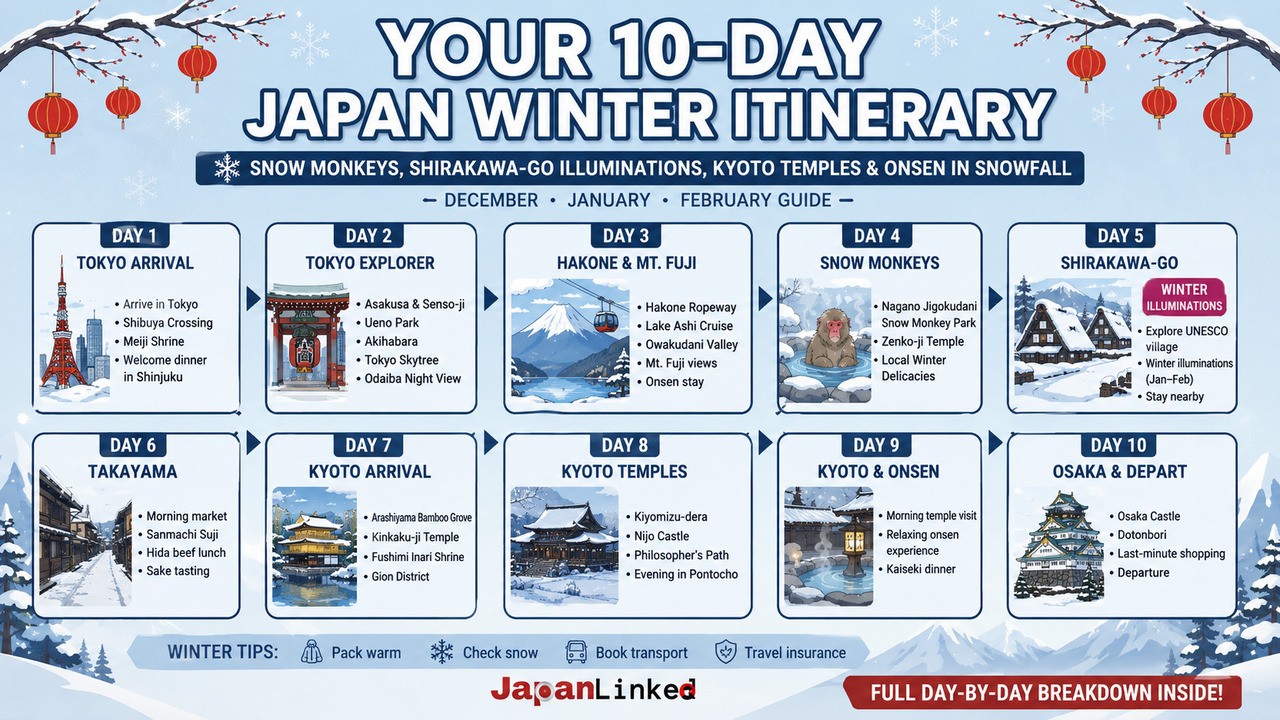
Most people think spring is the best time to visit Japan. They’re not wrong – but they’re missing something.
Japan in winter is a completely different country from the cherry blossom version. It’s quieter, cheaper, and in many ways more beautiful.
Kyoto’s temples stand empty at dawn with frost on the stone paths. Hakone’s mountain ryokan steam against snow-covered pine forests.
Shirakawa-go’s thatched farmhouses glow gold in the dark on illumination nights, snowflakes drifting through lantern light.
And in Nagano, wild Japanese macaques sit chest-deep in natural hot springs while snow falls around them – one of the most surreal and purely Japanese things you will ever see anywhere.
A 10-day Japan winter itinerary gives you enough time to experience all of this while keeping the logistics tight and the travel meaningful.
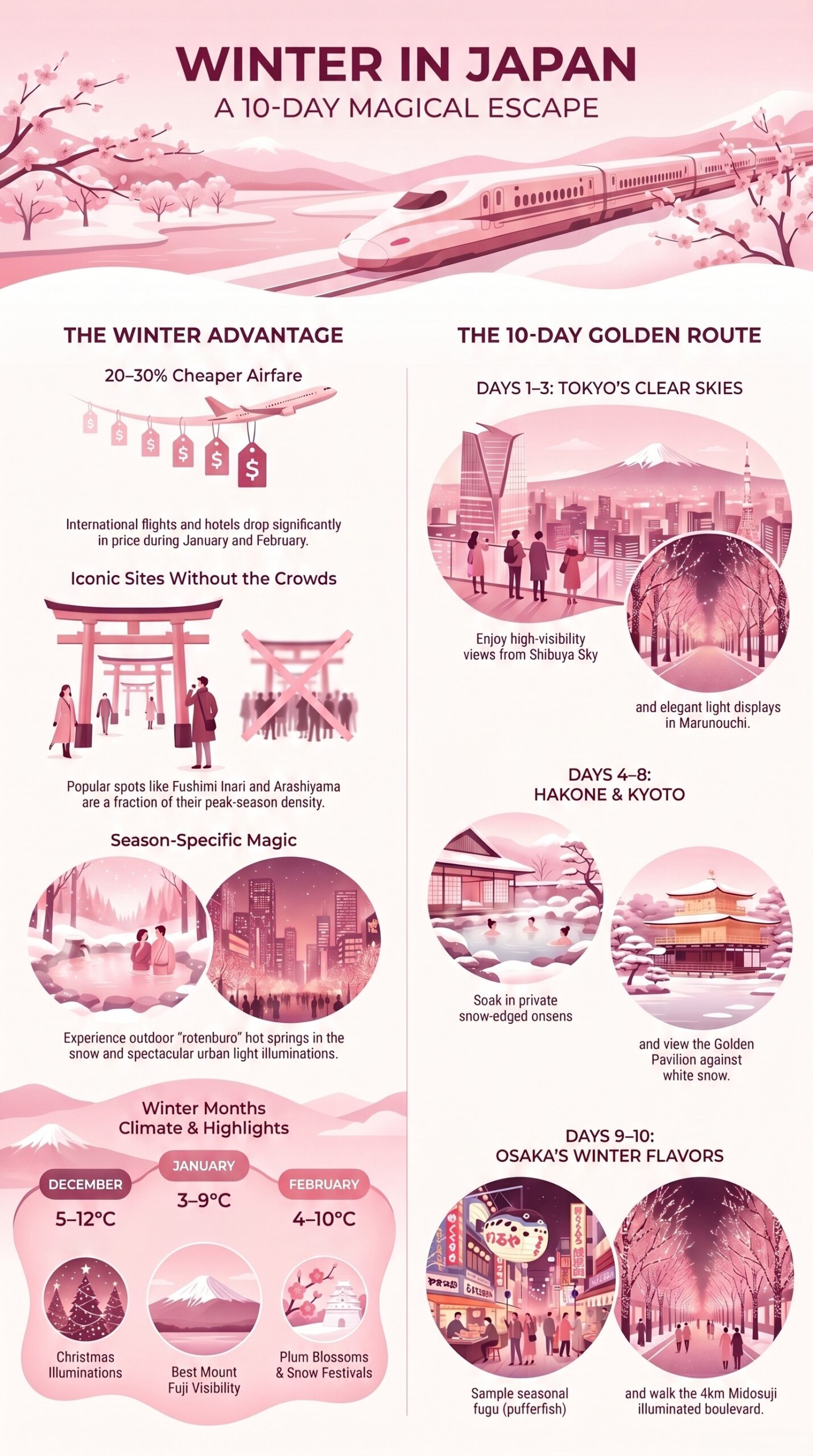
International airfares to Japan run 20–30% cheaper between mid-January and February compared to peak season. Hotels in Kyoto drop significantly.
And the crowds – at Fushimi Inari, at Arashiyama, at every temple in the country – are a fraction of what they are in April or November.
This guide gives you a complete day-by-day winter Japan itinerary, with the specific experiences that only exist in this season, honest advice on what to expect from the cold, and two route options depending on what kind of winter you’re looking for.
Why Winter in Japan Is Genuinely Underrated
Japan has four seasons and four entirely different personalities. Winter gets the least attention from international travelers – which is precisely why it rewards those who show up.
Here’s what winter Japan offers that no other season can match:
- Snow monkeys at Jigokudani – Japanese macaques bathing in natural hot springs while snow falls around them. This is a winter-only experience in its full glory; the monkeys visit year-round but only soak reliably when it’s cold
- Shirakawa-go Winter Illumination – on selected Sunday evenings in January and February, Ogimachi village’s A-frame farmhouses are lit from within, glowing against deep snow. One of Japan’s most extraordinary seasonal events. Tickets are allocated by advance reservation and sell out fast
- Kyoto without the crowds – Fushimi Inari at 6:30 AM in January is a different universe from the same place in October. Temples that require queuing in autumn are yours alone in winter
- Onsen in snow – soaking in an outdoor hot spring bath (rotenburo) while snowflakes fall around you is the definitive Japanese winter experience. Every ryokan in Hakone and Nagano offers this
- Winter illuminations – Japanese cities take December light displays seriously. Tokyo’s Roppongi, Marunouchi, and Shibuya; Osaka’s Midosuji; Nara’s Wakakusa Yamayaki – the country transforms into something cinematic after dark
- Budget advantages – hotels, flights, and even some attractions cost meaningfully less in January and February than during cherry blossom or autumn foliage season
The honest caveat: it is cold. Tokyo in January averages 3–9°C (37–48°F). Kyoto is similar. Nagano and Hokkaido drop significantly lower, sometimes to -10°C or below.
Pack properly and you’ll be comfortable; underprepare and you’ll be miserable. The packing guide at the end of this article covers exactly what to bring.
Also Read: 10 Days In Japan In Summer Itinerary
Choosing Your Winter Japan Route
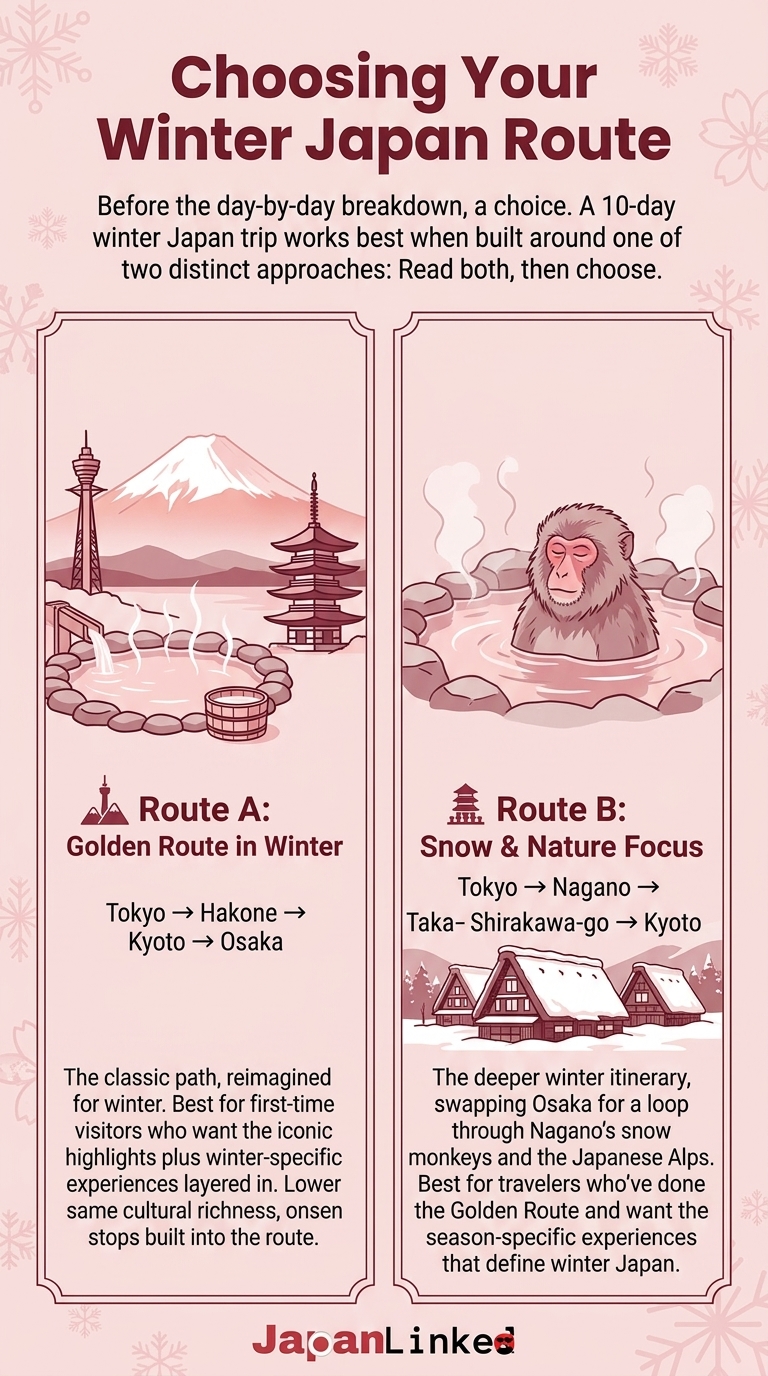
Before the day-by-day breakdown, a choice. A 10-day winter Japan trip works best when built around one of two distinct approaches:
Route A: Golden Route in Winter – Tokyo → Hakone → Kyoto → Osaka The classic path, reimagined for winter.
Best for first-time visitors who want the iconic highlights plus winter-specific experiences layered in. Lower crowds, same cultural richness, onsen stops built into the route.
Route B: Snow & Nature Focus – Tokyo → Nagano → Takayama → Shirakawa-go → Kyoto The deeper winter itinerary, swapping Osaka for a loop through Nagano’s snow monkeys and the Japanese Alps.
Best for travelers who’ve done the Golden Route and want the season-specific experiences that define winter Japan.
Both itineraries are detailed below. Read both, then choose.
Also Read: 2 Week Japan Itinerary & 3 Week Japan Itinerary
Route A: The Winter Golden Route (10 Days)
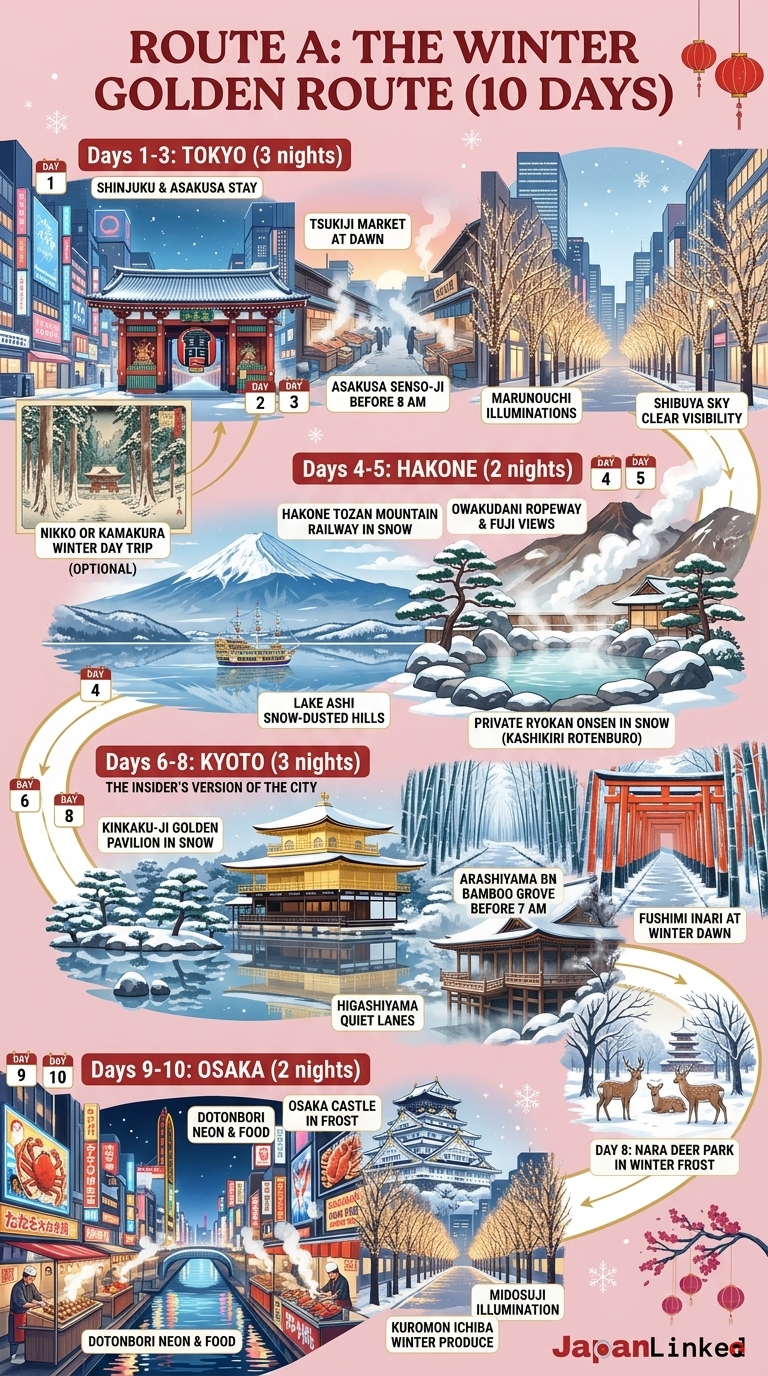
Days 1–3: Tokyo (3 nights)
Where to stay: Shinjuku or Asakusa – both put you within reach of winter illuminations and easy Shinkansen departure
Winter Tokyo runs at the same electric frequency as every other season, with two additions: spectacular light displays that transform the city’s major districts each evening, and a crisp, dry cold that makes daytime walking exceptionally pleasant.
Day 1: Land and Orient
- Tsukiji Outer Market at dawn – the market opens from 5:30 AM year-round and in winter the steam, the warmth of the stalls, and the pre-sunrise light make it even more atmospheric than usual
- Asakusa and Senso-ji before 8 AM – frost on the stone path to the main gate, lanterns lit against cold morning sky, almost no one else present
- Kaminarimon Gate at night – Asakusa’s famous gate illuminated after dark in winter is one of Tokyo’s quieter and more beautiful evening scenes
Day 2: Winter Tokyo at Its Best
- Shinjuku Gyoen in the morning – the national garden in winter is cold but beautiful: bare maples against stone paths, the greenhouse warm and tropical as a contrast
- Shibuya Sky observation deck (book 2–3 weeks ahead) – Tokyo’s skyline in winter is particularly clear. Cold air and low humidity produce the best visibility of the year
- Roppongi Hills or Marunouchi illuminations in the evening – December and early January, Tokyo’s premium business and arts districts are lit with millions of LEDs along their boulevards. Marunouchi’s “Naked Trees” illumination (zelkova trees along the main avenue wrapped in warm white light) is the most elegant. Both are free to walk through
Day 3: Day Trip to Nikko or Kamakura
Both are entirely different in winter:
- Nikko (2 hours north) – Japan’s most ornate shrine complex draped in snow is genuinely extraordinary. The cedar-lined approach to Tosho-gu Shrine with snow on the forest floor, and the lacquered gates against white mountain backgrounds, looks like ukiyo-e woodblock art come to life
- Kamakura (1 hour south) – the Great Buddha in winter frost, the seaside temple trails quiet and foggy, the bamboo grove at Hokokuji steaming slightly in cold air. A completely different atmosphere from the summer or autumn version
December note: Many businesses across Japan close December 31–January 3 for New Year. Temples and shrines are actually open – and busier than usual. Senso-ji on New Year’s Eve is one of Tokyo’s great winter experiences, with hundreds of thousands visiting for hatsumode (first shrine visit of the new year). Embrace it or avoid it, but plan around it.
Also Read: 11 Days In Japan Itinerary & 10 Days In Japan Itinerary
Days 4–5: Hakone (2 nights)
How to get there: Romancecar express from Shinjuku, 85 minutes
Winter is arguably Hakone’s best season. The combination of mountain snow, volcanic scenery, and hot spring baths reaches its most photogenic and atmospheric in January and February.
The rotenburo (outdoor onsen bath) experience – soaking in mineral water with snow falling around you and mountain forest visible through the steam – is available year-round but only feels like this in winter.
Choosing Your Ryokan for Winter
Book a ryokan with a private open-air bath in the room. Standard ryokan have communal baths; for winter, paying the premium for in-room kashikiri rotenburo means soaking in snow-edged privacy rather than sharing the experience.
Prices for a good room with private onsen in Hakone run ¥25,000–50,000 per person (dinner and breakfast included).
Key areas: Miyanoshita and Kowakidani are the most atmospheric Hakone neighborhoods for ryokan stays, with forest settings and traditional architecture.
Day 4: Hakone Round Course
- The Hakone Tozan mountain railway in winter, zigzagging up through snow-covered forest
- Owakudani ropeway – the volcanic vents billowing white steam against a white mountain landscape. Mount Fuji, if clear, appears dramatically ahead
- Cruise across Lake Ashi – in winter the lake is often mirror-calm with Fuji reflected, the surrounding pine hills snow-dusted
Activate the Hakone Freepass (¥5,000–6,000 from Shinjuku) – covers all transport on the loop plus discounts at several attractions.
Day 5: Fuji Views + Onsen Morning
- Clear winter days produce the best Mount Fuji visibility of the year – the mountain is fully capped in snow and the dry winter air gives the sharpest sightlines. A morning at Lake Kawaguchiko (45 min by bus) for the famous reflection shot is well worth it in winter specifically
- The Hakone Open-Air Museum is less crowded in winter and the sculptures against snowy mountain backgrounds make for excellent photography. The indoor Picasso pavilion is a warm respite
- Return to the ryokan by mid-afternoon. Your last private onsen soak before heading to Kyoto
Days 6–8: Kyoto (3 nights)
How to get there: Shinkansen from Odawara to Kyoto, approximately 2.5 hours
Winter Kyoto is the insider’s version of the city. The same temples, the same gardens, the same stone-paved lanes – but with a fraction of the visitors and, on snowy days, a beauty that spring and autumn genuinely cannot match.
A light snowfall over the Golden Pavilion or Fushimi Inari’s vermillion gates is one of Japan’s most quietly devastating visual experiences.
Day 6: Eastern Kyoto at Winter Dawn
- Fushimi Inari at 6:30 AM – the tunnel of 10,000 torii gates in January or February, with early morning frost underfoot and almost no one else present, is extraordinary. Carry hand warmers and take your time
- Kiyomizudera – the wooden stage extending over the valley, with mist rising from the city below in winter mornings, produces views unlike any other season
- Higashiyama District – the stone-paved lanes in winter quiet are among the most atmospheric walks in Japan. Pick up hot yudofu (tofu hot pot) from a small restaurant for lunch – Kyoto’s most famous winter comfort food
Day 7: Arashiyama + Kinkaku-ji
- Arashiyama Bamboo Grove before 7 AM – in winter, frost on the bamboo stalks and the pale winter light through the green canopy make this even more photogenic than in other seasons. The crowd differential from dawn to 9 AM is absolute
- Kinkaku-ji (Golden Pavilion) in snow – if it snows during your Kyoto days, go to Kinkaku-ji immediately. The gold-leafed pavilion reflected in its pond, surrounded by snow-dusted pines, is one of Japan’s most iconic winter images. Go early (it opens at 9 AM); snow brings extra visitors but also extraordinary beauty
- Nijo Castle in the afternoon – the shogun’s winter palace, quieter than any other season, with the famous nightingale floors echoing more sharply in the cold air
Day 8: Nara Day Trip
Nara (45 minutes by Kintetsu Express) in winter has one underrated advantage over other seasons: the deer. In spring and autumn, Nara Park is gridlocked with tourists chasing the animals.
In January or February, you’ll walk through a largely empty park with deer huddled under trees in morning frost, the Great Buddha Hall of Todai-ji (¥600) approached through a near-empty stone path.
- Kasuga Taisha Shrine – the hundreds of stone lanterns lining the forested path to this shrine are lit on two specific nights each year for the Mantoro Lantern Festival: February 3 and August 14–15. If visiting in early February, this is unmissable
- Return to Kyoto for a winter evening in Gion – the wood-and-lantern district is quietest and most atmospheric in winter, when the crowds of autumn have long departed
Days 9–10: Osaka (2 nights)
How to get there: Shinkansen from Kyoto, 15 minutes
Winter Osaka is the full, unfiltered city without peak-season pricing. Dotonbori in January is still brilliantly lit and energetic; it just belongs more to locals than tourists.
The food – fugu (pufferfish, at its seasonal peak in winter), oysters from Hiroshima, sake warm in small ceramic cups – is at its best.
- Kuromon Ichiba Market in the morning – winter produce includes extraordinary seasonal seafood. This is the best time of year to eat at the market
- Dotonbori for street food and neon – takoyaki, kushikatsu, and fresh crab from the canal-side stalls
- Osaka Castle grounds in winter frost – the stone walls and moat in a light snowfall are genuinely beautiful
- Midosuji Illumination (runs late November through mid-February) – the 4 km boulevard lined with illuminated trees is one of Japan’s finest winter light displays. Walk it after dark on your final evening
Fly home from Kansai International Airport (KIX) – 30 minutes by Haruka Express from central Osaka.
Also Read: Northern Japan Itinerary & Japan Honeymoon Itinerary
Route B: Snow & Nature Winter Focus (10 Days)
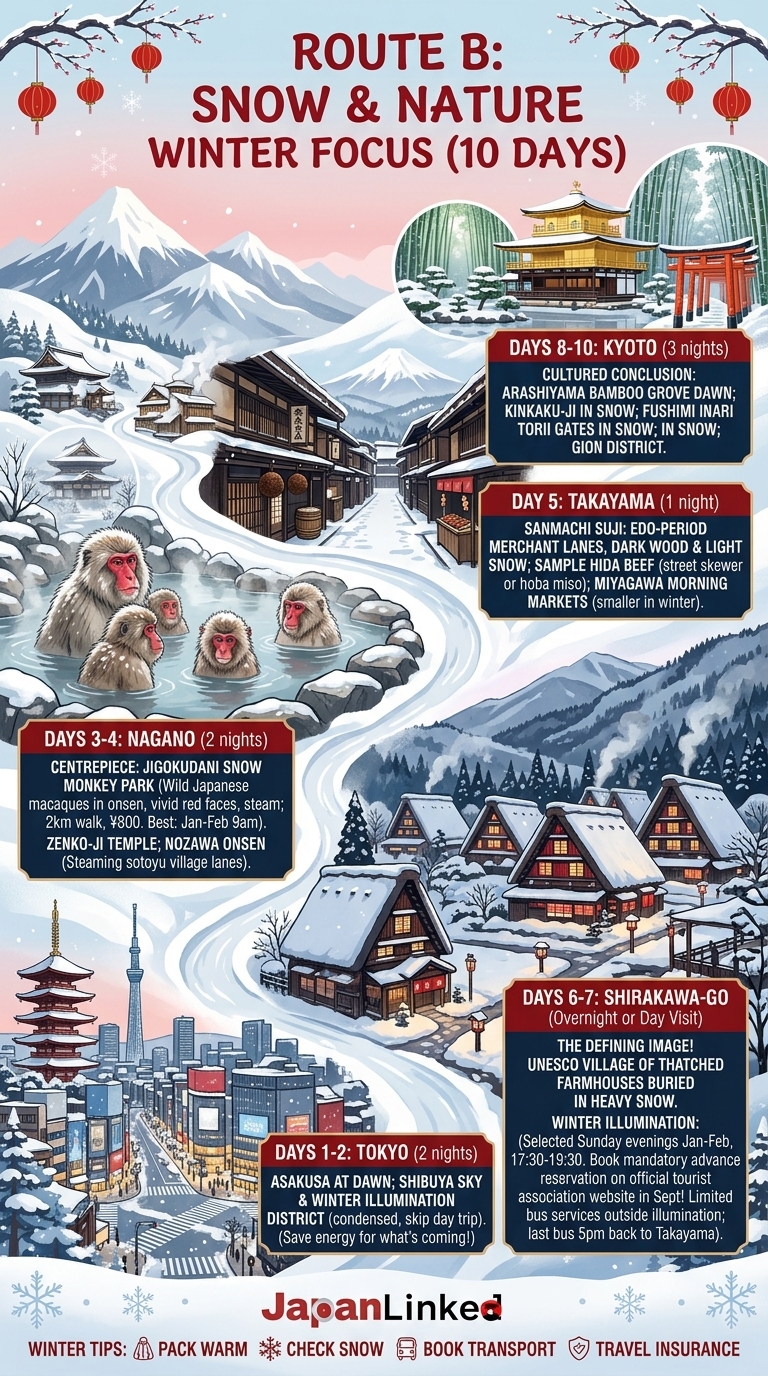
For travelers who want the full winter Japan experience: snow monkeys, alpine villages, thatched farmhouses in illuminated snowfall, and mountain onsen.
Days 1–2: Tokyo (2 nights)
Same as Route A, condensed. Focus on:
- Asakusa at dawn
- Shibuya Sky and one winter illumination district in the evening
- Skip the day trip – save energy for what’s coming
Days 3–4: Nagano (2 nights)
How to get there: Hokuriku or Nagano Shinkansen from Tokyo, approximately 1.5 hours
Jigokudani Snow Monkey Park
This is the centrepiece of Route B and one of the most memorable wildlife encounters in Asia. Jigokudani Yaen Koen is home to a troop of wild Japanese macaques who descend from the surrounding mountains to soak in natural thermal springs – a behaviour they developed in the 1960s and have passed down through generations.
In winter (December–March), the monkeys are in the onsen most reliably. Cold temperatures encourage them to stay in the water for extended periods, sitting chest-deep in mineral-rich steam with thick snow-dusted fur and vivid red faces – one of the most visually arresting wildlife spectacles in Japan.
- Getting there: Train from Nagano Station to Yudanaka, then bus to Kanbayashi Onsen, then a 2 km forested walk to the park (about 30 minutes, often snowy – wear proper footwear)
- Opening hours: 9 AM–4 PM daily; admission ¥800
- Best time to visit: January and February, arriving when the park opens at 9 AM before tour groups arrive mid-morning
- The monkeys are wild and their appearance isn’t guaranteed, but no-shows are rare in winter. Don’t approach or touch them; observe from the path
Nagano City
- Zenko-ji Temple – one of Japan’s most important and oldest Buddhist temples, founded in the 7th century. The enormous main hall, approached through a long stone-lanterned avenue, is particularly atmospheric in winter frost and early morning mist. The inner sanctuary contains Japan’s oldest Buddhist statue, which remains hidden from public view – the surrounding ritual of worshipping what you cannot see is deeply Japanese
- Nozawa Onsen (90 minutes from Nagano by limited express and bus) – a traditional ski and onsen village with free communal outdoor baths (sotoyu) maintained by the locals for centuries. The village’s narrow lanes, wooden bathhouses steaming in cold air, and genuine agricultural community give it a completely different atmosphere from Hakone’s resort polish
Day 5: Takayama (1 night)
How to get there: JR Hida limited express from Nagano via Matsumoto, about 2.5 hours
Takayama’s Sanmachi Suji historic district – Edo-period merchant lanes of dark wooden buildings with sake breweries, craft shops, and tea rooms – is transformed in winter.
The crowds thin to almost nothing, a light snow on the rooftops and the smell of cedar fires from within the breweries. Walk it in the early morning before the day-trippers arrive from nearby cities.
- Sample Hida beef – the regional wagyu, served as a street skewer or hoba miso (grilled on a magnolia leaf over charcoal). Winter is peak season for rich, warming food in the mountains
- The morning Jinya-mae and Miyagawa markets still operate in winter, smaller and more local than in peak season
Days 6–7: Shirakawa-go (overnight or day visit)
How to get there: Bus from Takayama, approximately 50 minutes (¥2,800, reserve ahead)
Shirakawa-go in winter is the defining image of this entire itinerary – and one of the most photographed scenes in Japan.
The UNESCO World Heritage village of thatched gassho-zukuri farmhouses, buried under heavy mountain snow, is extraordinary in daylight. After dark, on illumination evenings, it becomes something else entirely.
The Shirakawa-go Winter Illumination runs on selected Sunday evenings in January and February (17:30–19:30). The village’s farmhouses are lit from within; lanterns glow along the snow-covered paths; smoke rises from the thatched roofs.
Tickets are mandatory and allocated by advance reservation – they open in September and sell out quickly. Book through the Shirakawa-go tourist association website the moment registration opens.
- Day visitor strategy (non-illumination days): Take the morning bus from Takayama, visit the Ogimachi observation deck for the aerial view, enter the Wada and Nagase farmhouses, walk the village paths, return to Takayama or continue to Kanazawa in the afternoon
- Illumination night strategy: Stay overnight in the village (the most atmospheric option; farmhouse guesthouses from ¥15,000/person including dinner and breakfast), or book a bus tour from Takayama or Kanazawa that includes guaranteed entry
Critical: Winter bus services between Takayama and Shirakawa-go operate on reduced schedules. Check Nohi Bus timetables and book seats before travel. The last bus back to Takayama from Shirakawa-go typically runs around 5 PM outside illumination event days.
Days 8–10: Kyoto (3 nights)
Same as Route A Days 6–8, above. After the mountains, Kyoto’s winter temples and dawn experiences feel like the perfect cultural conclusion.
Also Read: 12 Days In Japan Itinerary & 1 Week In Japan Itinerary
What to Pack for Winter Japan: The Essential List
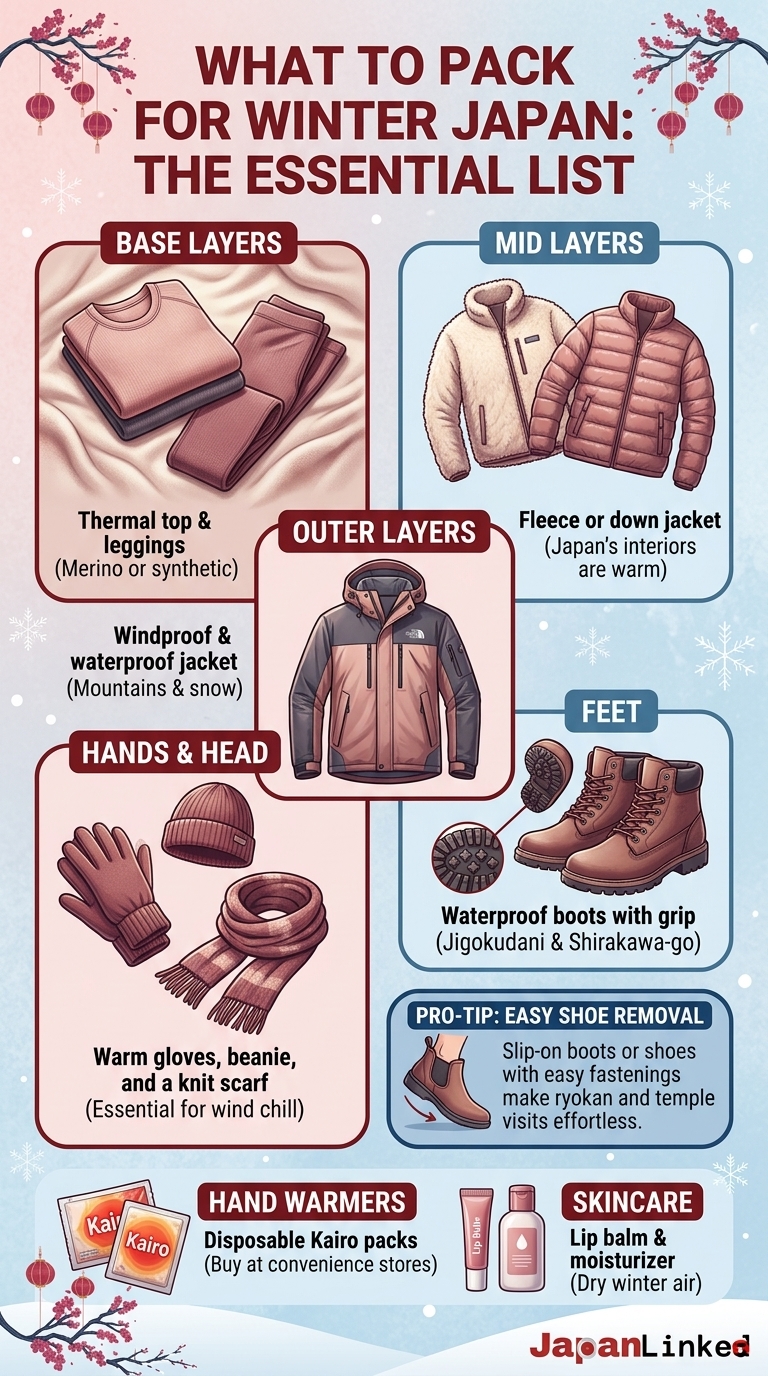
Japan’s winter cold is dry rather than wet, which makes it more manageable than northern European winters of the same temperature.
But wind chill in mountain areas and the gap between heated interiors and freezing outside air requires proper layering.
| Category | What to Bring |
|---|---|
| Base layer | Thermal long-sleeve top and leggings (merino wool or synthetic) |
| Mid layer | Fleece or down jacket — Japan’s convenience stores and indoor spaces are warm; you’ll take this on and off constantly |
| Outer layer | Windproof, waterproof jacket – critical for mountain areas and snowy days |
| Feet | Waterproof ankle boots with grip for icy paths (non-negotiable for Jigokudani and Shirakawa-go) |
| Hands and head | Gloves, beanie, scarf — wind chill at Hakone and Nagano makes these essential |
| Hand warmers | Disposable kairo heat packs are available everywhere in Japan and a winter staple. Buy a bag of them at any convenience store on Day 1 |
| Lip balm and moisturiser | Winter Japan air is very dry; your skin will thank you |
One more thing: Remove and replace shoes multiple times daily in Japan (ryokan, temples, traditional restaurants). Slip-on boots or shoes with easy fastenings make this significantly less annoying.
Winter Japan: Month-by-Month at a Glance
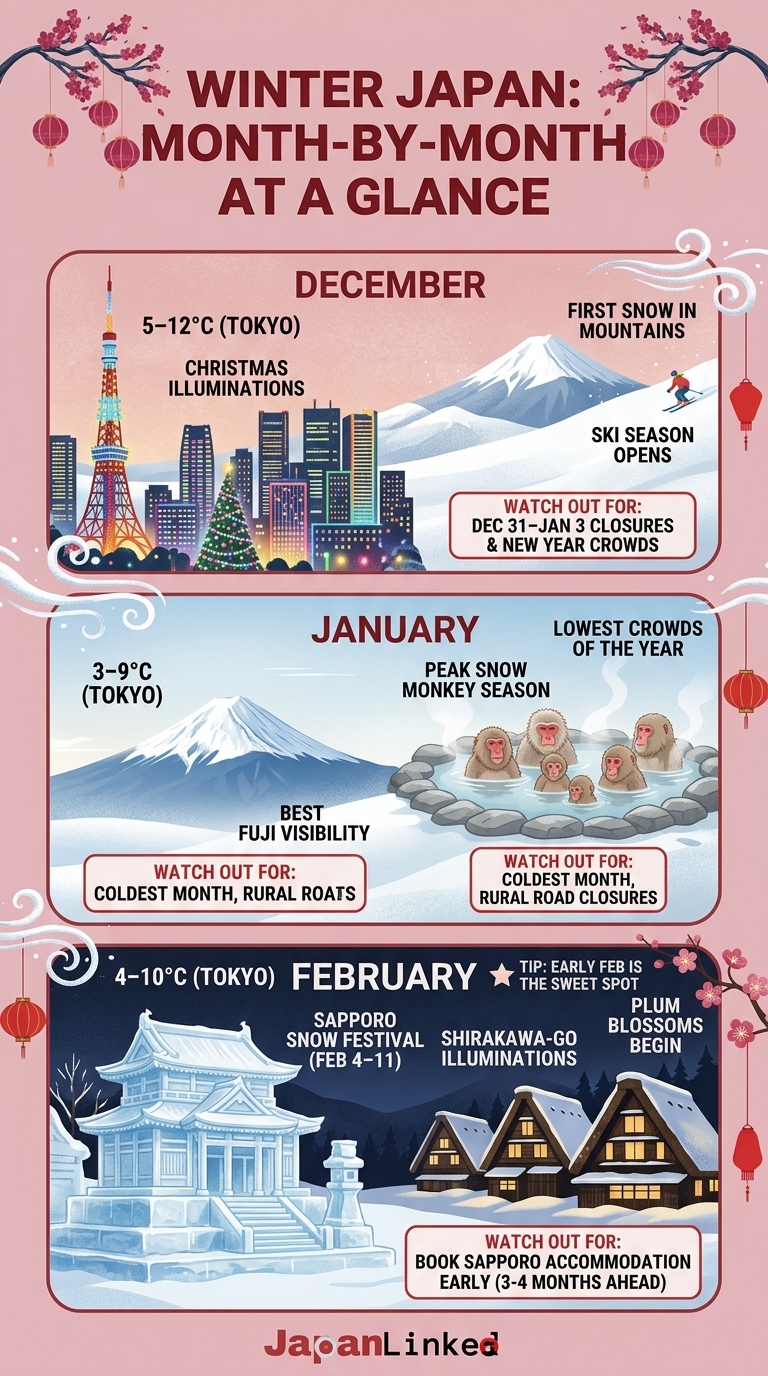
| Month | Temperature (Tokyo) | Highlights | Watch Out For |
|---|---|---|---|
| December | 5–12°C | Christmas illuminations; first snow in mountains; ski season opens | Dec 31–Jan 3 closures; New Year crowds at temples |
| January | 3–9°C | Lowest crowds of the year; snow monkeys at peak; best Fuji visibility | Coldest month; some rural roads close in heavy snow |
| February | 4–10°C | Sapporo Snow Festival (Feb 4–11, 2026); Shirakawa-go illuminations; plum blossoms begin | Book Sapporo accommodation 3–4 months ahead for Snow Festival |
Early February is the sweet spot for Route B specifically – snow is deep, the Sapporo Snow Festival runs February 4–11 (making it an excellent addition if you fly in/out of Hokkaido), and Shirakawa-go illuminations are active.
JR Pass and Transport for Winter Japan
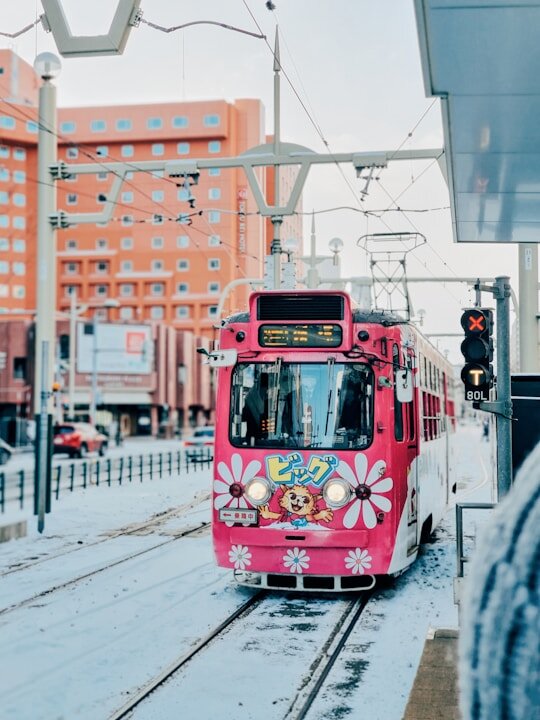
For Route A (Golden Route), individual Shinkansen tickets are often cheaper than the 7-day JR Pass (¥50,000). Run the numbers on your specific legs before buying.
For Route B (Snow Focus), the JR Pass starts to earn its keep with the Tokyo → Nagano → Matsumoto → Takayama → Kyoto sequence plus the Kyoto day trips.
The JR Central Takayama-Hokuriku Area Tourist Pass (¥14,260 for 5 days) is a strong alternative if your trip is focused on the Alps and Kyoto – it covers Nagano, Takayama, Shirakawa-go buses, and Kanazawa.
Get a Suica IC card at the airport regardless of which pass you choose – it handles all city transit, buses, and convenience stores.
Budget Guide: 10-Day Winter Japan Trip
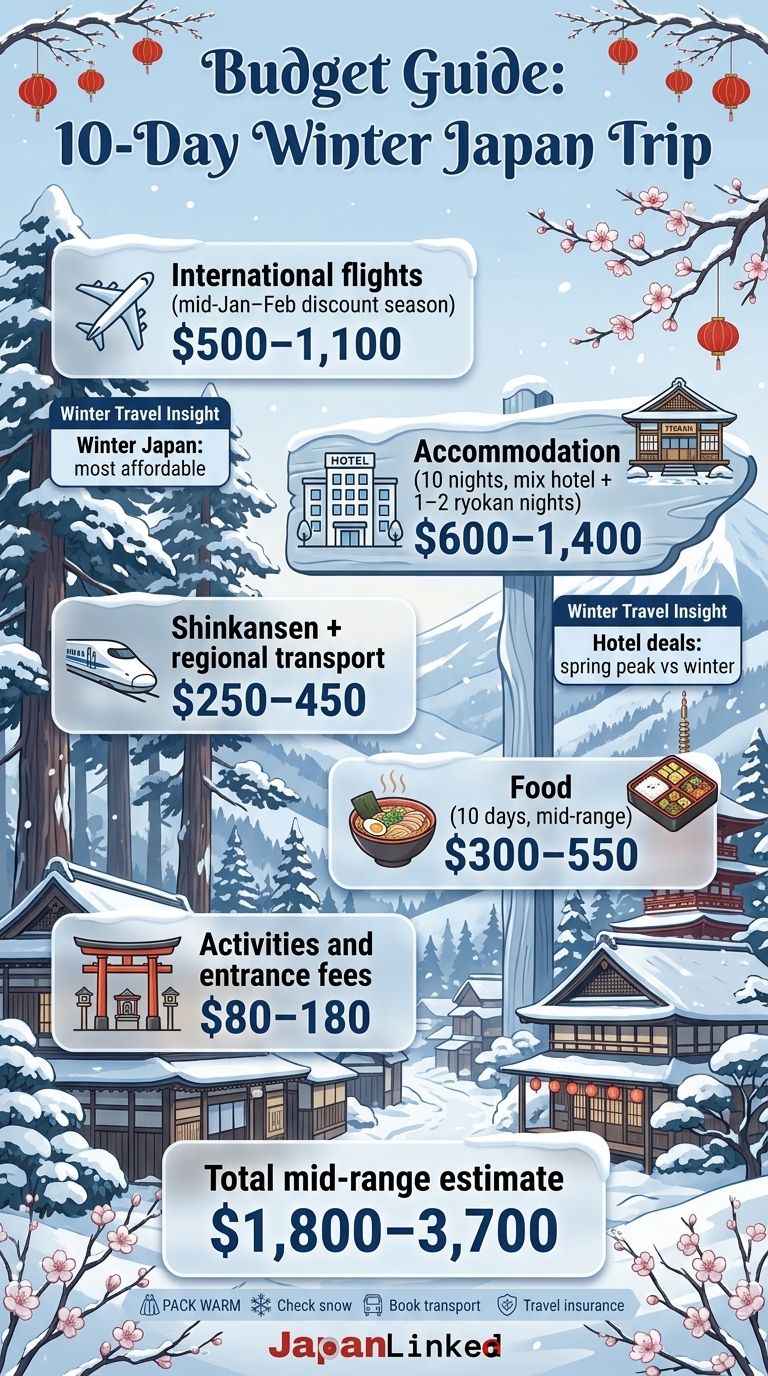
| Category | Budget (USD) |
|---|---|
| International flights (mid-Jan–Feb discount season) | $500–1,100 |
| Accommodation (10 nights, mix hotel + 1–2 ryokan nights) | $600–1,400 |
| Shinkansen + regional transport | $250–450 |
| Food (10 days, mid-range) | $300–550 |
| Activities and entrance fees | $80–180 |
| Total mid-range estimate | $1,800–3,700 |
Winter Japan is the most affordable version of the country for international travelers. January and February flights from major hubs run 20–30% cheaper than spring peak.
Kyoto hotels that cost ¥25,000/night in October often run ¥14,000–17,000 in January. The ryokan night you couldn’t afford in autumn is suddenly within reach.
Conclusion
Winter Japan doesn’t ask for your attention the way cherry blossom season does. There are no crowds pressing you toward the experience, no Instagram algorithm amplifying every pink petal.
It just waits – quietly spectacular, half-empty, and significantly cheaper than the version most people think they need to visit.
The snow monkey sitting in its thermal pool while snowflakes fall around it doesn’t know it’s iconic. The Fushimi Inari torii gates at 6:30 on a January morning don’t care whether you’re there.
Shirakawa-go in illumination-night snow will be exactly as beautiful whether you booked tickets or not. But you should be there. That’s the point.
Pack the hand warmers, book the ryokan with the private outdoor bath, set the alarm for dawn, and let winter Japan show you what everyone else is missing.
