
Most travel articles about Japan in summer spend the first three paragraphs warning you about the heat.
This one won’t. You already know it’s hot. What those articles bury – usually in paragraph eight – is the real reason to go.
Japan in summer is the most culturally alive the country gets all year.
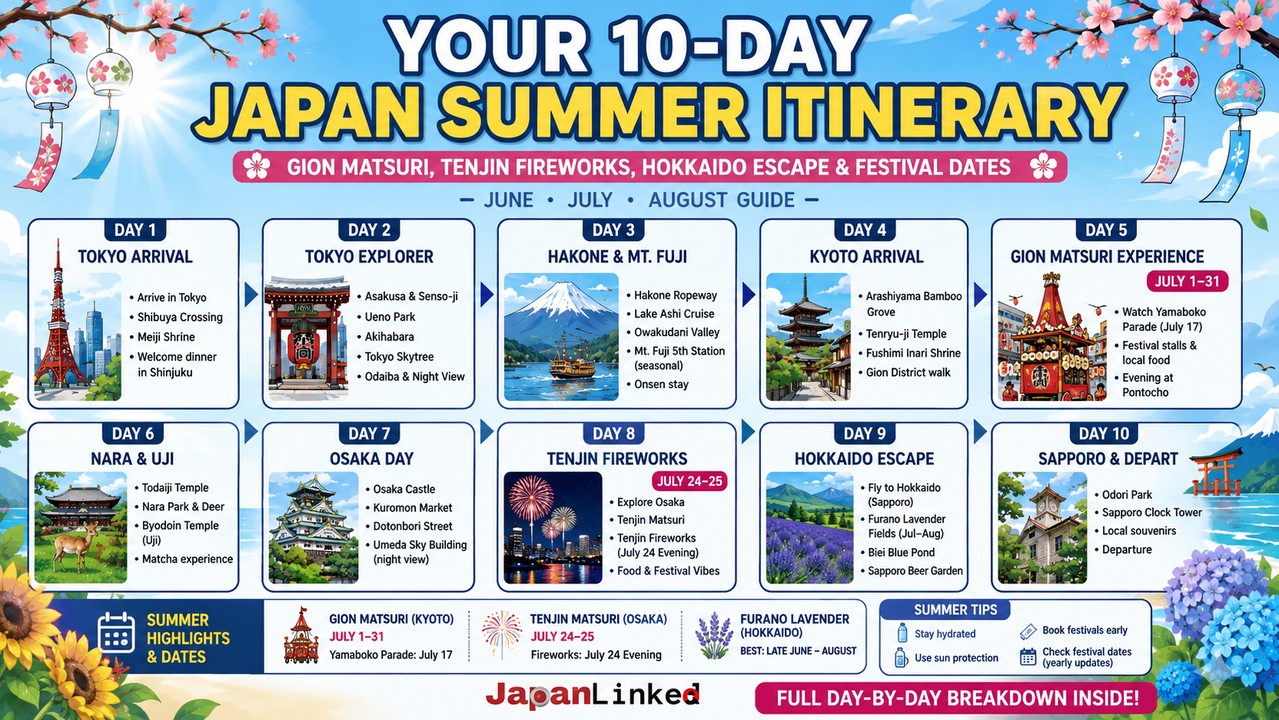
July and August alone contain Kyoto’s Gion Matsuri (the entire month of July, with parade days on the 17th and 24th), Osaka’s Tenjin Matsuri on July 25th – one of Japan’s three great festivals with over 100 boats on the Okawa River and fireworks above them – and Tokyo’s Sumida River Fireworks the same evening.
In early August, Aomori’s Nebuta Matsuri launches its parade of enormous illuminated warrior floats through the city streets for five consecutive nights.
The Tanabata star festival decorates cities across the country in colored paper streamers.
Obon brings Bon Odori street dances to every neighborhood. No other season in Japan comes close to this density of celebration.
A well-planned 10-day Japan summer itinerary doesn’t fight the heat – it works around it. Mornings outdoors while it’s bearable, air-conditioned afternoons in museums and markets, evenings at festivals and fireworks.
That rhythm, applied to the right cities in the right order, produces one of the most memorable Japan trips possible.
This guide gives you the complete day-by-day plan, real festival dates, and the honest heat strategy that makes summer Japan genuinely enjoyable rather than an endurance test.
The Honest Truth About Japan in Summer
Before the itinerary, the facts – because knowing what you’re walking into means you can prepare rather than be blindsided.
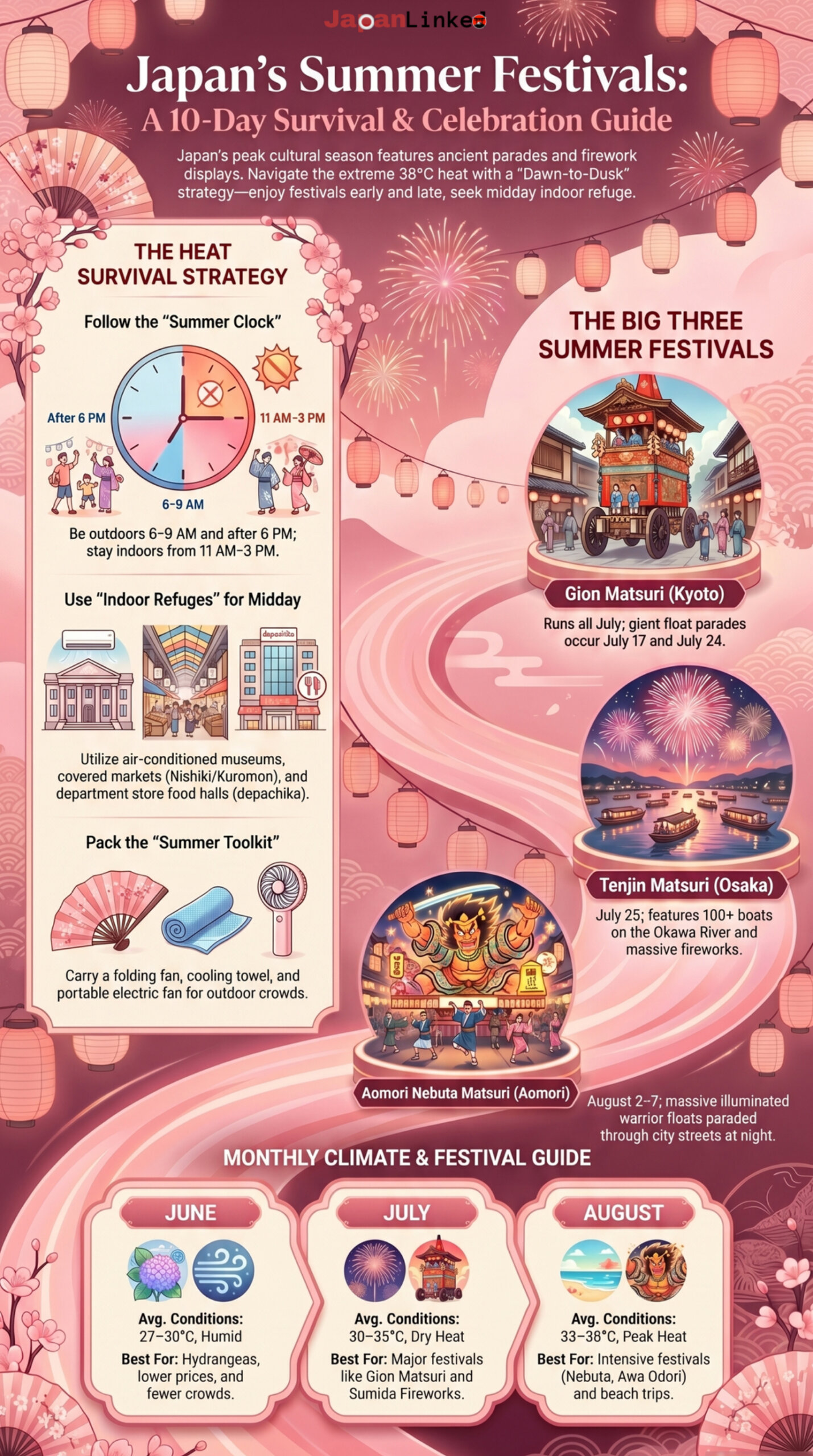
The heat is real. Tokyo and Osaka regularly hit 33–38°C (91–100°F) in July and August, with humidity between 75–85%. That combination makes midday outdoor activity genuinely uncomfortable and potentially dangerous. Heatstroke warnings are issued frequently in major cities in August. This is not exaggerated.
But it’s completely manageable with the right approach:
- Be outdoors in the early morning (6–9 AM) and evening (after 6 PM). Both windows are cooler and often coincide with the best experiences – dawn temples and evening festivals
- Spend midday (11 AM–3 PM) indoors – Japan’s museums, covered markets, department store basement food halls (depachika), and air-conditioned shopping arcades are world-class and make for an excellent few hours
- Hydrate constantly. Japan’s convenience stores and vending machines on every street corner make this easy. Cold barley tea (mugicha), sports drinks, and cold coffee are everywhere
- Carry a folding fan and a small cooling towel. Every Japanese person does. Convenience stores sell both for under ¥500
June vs. July vs. August:
| Month | Conditions | Best For |
|---|---|---|
| June | Rainy season (tsuyu): warm and humid, frequent showers, 27–30°C. Hokkaido stays dry | Hydrangea gardens, fewer crowds, lower prices; Hokkaido as a heat escape |
| July | Rainy season ends ~July 20; dry heat takes over; 30–35°C+ | Gion Matsuri (all month), Tenjin Matsuri and Sumida fireworks July 25, Mount Fuji opens July 1 |
| August | Peak heat 33–38°C; festival season at maximum intensity | Nebuta Matsuri (Aug 2–7), Tanabata, Obon Bon Odori; beach and Okinawa trips |
June is the sweet spot for first-time summer visitors – warm but not brutal, hydrangeas in bloom across temple gardens, and none of the August crowds.
Late July is the festival peak. August is for those who plan around specific festivals or want beach and island time.
Also Read: 10 Days Winter Japan Itinerary & Northern Japan Itinerary
The Summer Japan Strategy: Two Routes
Like the winter itinerary, summer Japan works best when built around a primary intention.
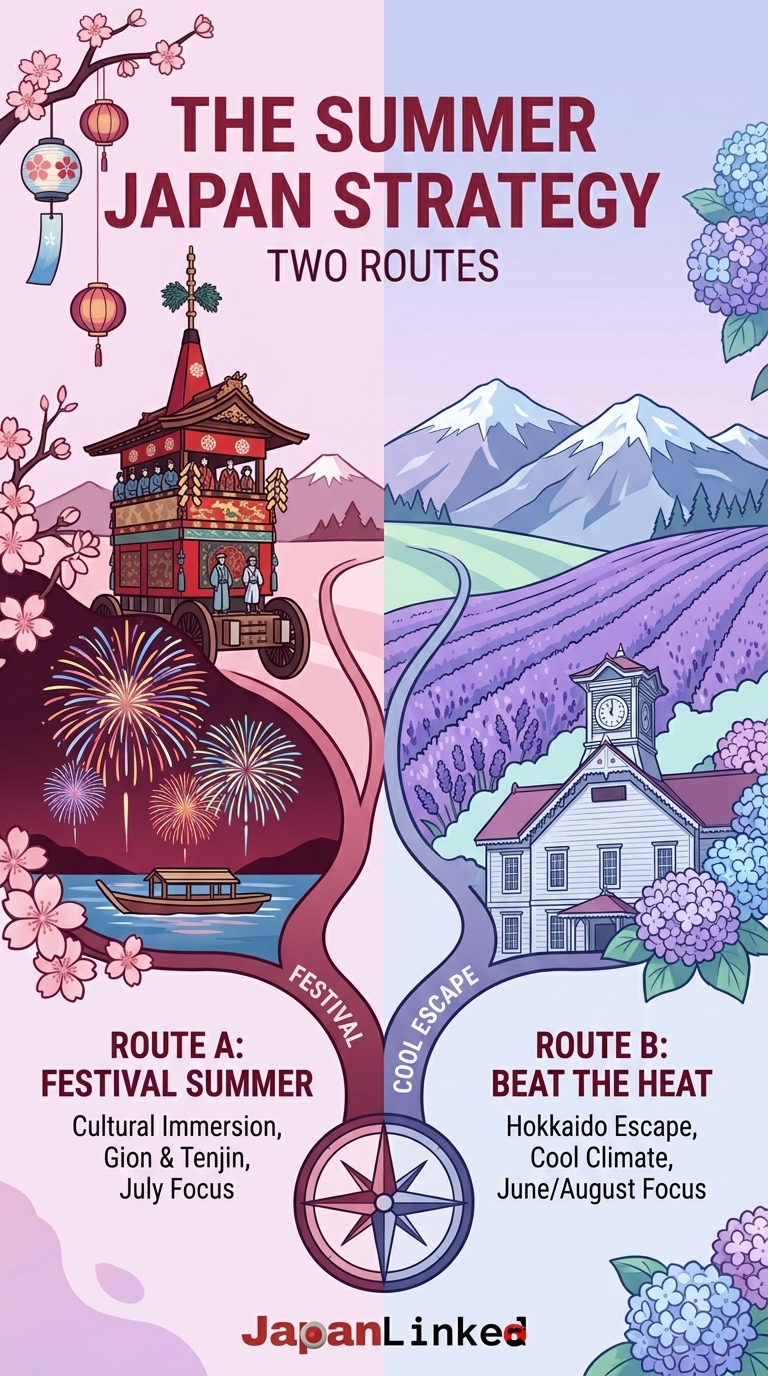
Route A: Festival Summer – Tokyo → Nikko (escape) → Kyoto (Gion Matsuri) → Osaka (Tenjin Matsuri) The essential summer cultural experience. Timed to catch at least one major festival parade and fireworks event. Best for July travelers.
Route B: Beat the Heat – Tokyo → Hokkaido (Sapporo/Furano) → Kyoto → Osaka Escapes the mainland heat with 3–4 days in Hokkaido, Japan’s northern island, where summer temperatures are a revelation: cool, dry, and blissfully unlike the rest of Japan. Best for those visiting June or August who want summer scenery without the full heat.
Both routes are detailed below.
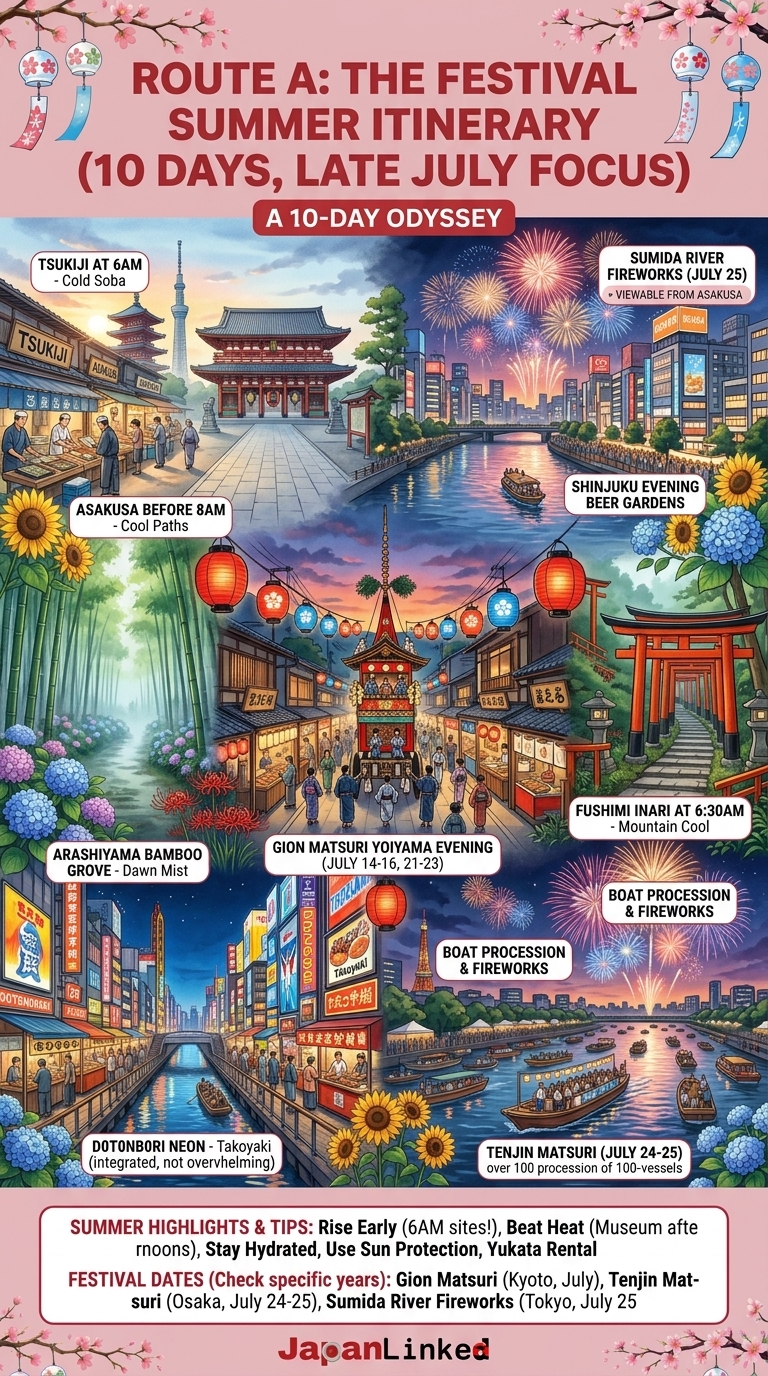
Route A: The Festival Summer Itinerary (10 Days, Late July Focus)
Days 1–3: Tokyo (3 nights)
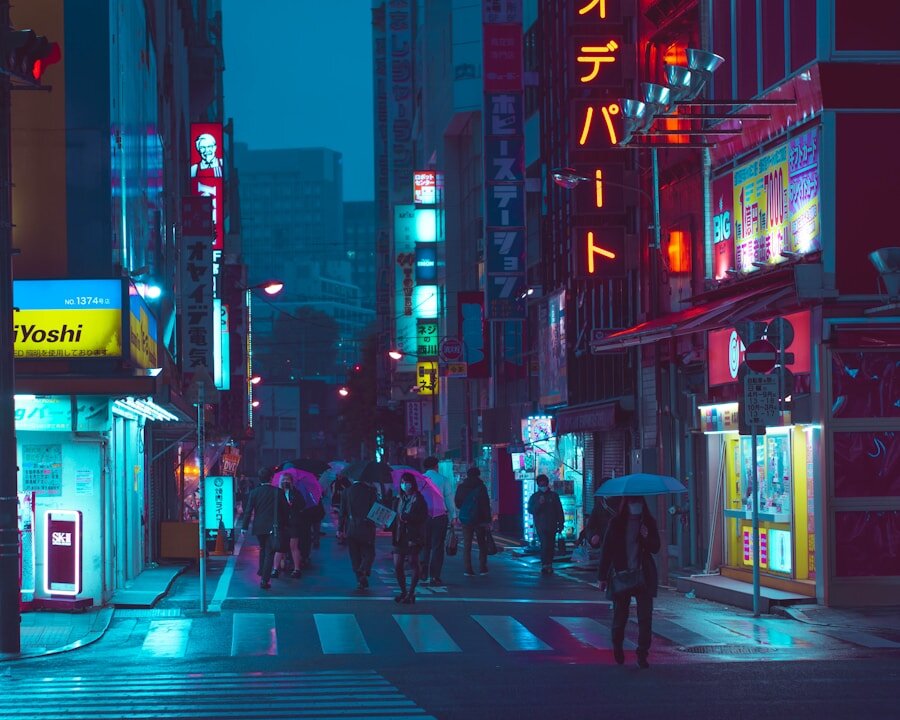
Where to stay: Shinjuku or Asakusa – both have immediate access to the city’s best summer evening energy
Summer Tokyo runs on a different clock than the rest of the year. The city’s rhythm becomes: rise early, hit the outdoor sites before 10 AM, disappear indoors during the peak heat, resurface for evening festivals and street life. Once you internalize that pattern, Tokyo in July is exhilarating.
Day 1: Dawn Tokyo + Indoor Afternoon
- Tsukiji Outer Market at 6 AM – the market starts before the heat builds. Cold soba for breakfast, fresh sushi at a standing counter, the pre-sunrise energy of vendors and early-rising chefs
- Asakusa and Senso-ji before 8 AM – the stone paths to the temple are cool in early morning, the Nakamise Dori shopping street empty. By 10 AM both are sweltering and crowded
- Afternoon: Tokyo National Museum in Ueno – one of Asia’s finest museum collections in air-conditioned comfort. Budget 2–3 hours for the Japanese Gallery alone
- Evening: Sumida River walk – the riverside path between Asakusa and Ryogoku cools significantly after 7 PM. Summer beer gardens operate along the route
Day 2: Neighborhoods + Summer Night
- Shimokitazawa in the morning – Tokyo’s most charming local neighborhood is best explored before noon. Independent coffee shops, vinyl record stores, second-hand clothing
- Shibuya afternoon – the underground shopping complex connecting Shibuya Station is vast, air-conditioned, and genuinely interesting. Shibuya Hikarie’s upper floors have good restaurants and city views
- Summer evening in Shinjuku – outdoor beer gardens on department store rooftops operate June through August (several major department stores; Takashimaya Times Square has one of the best). Cool air, cold beer, Tokyo spread below
Day 3: Sumida River Fireworks (July 25) or Day Trip
If visiting around July 25: The Sumida River Fireworks Festival launches over 20,000 fireworks from two locations along the river, viewable from Asakusa and along the Sumida riverside.
It draws enormous crowds – arrive by 4 PM to claim a riverside spot for a 7 PM display, or pay for reserved seating (tickets go on sale about one month before, worth it for comfort). The festival ends around 8:30 PM; expect very full trains for the next 90 minutes.
If not visiting July 25: Day trip to Nikko (2 hours north by JR) – Japan’s most ornate shrine complex, in mountain forest, where temperatures run 5–8°C cooler than Tokyo. The cedar-lined approach to Tosho-gu Shrine in summer deep green is extraordinary.
Gion Matsuri note: If you’re planning to catch the Gion Matsuri parade in Kyoto on July 17 or 24, time your Tokyo departure accordingly. The July 17 Yamaboko Junko parade starts mid-morning; traveling from Tokyo the evening of July 16 puts you there in time.
Also Read: 2 Week Japan Itinerary & 3 Week Japan Itinerary
Days 4–6: Kyoto – Gion Matsuri Season (3 nights)
How to get there: Shinkansen from Tokyo, approximately 2 hours 15 minutes
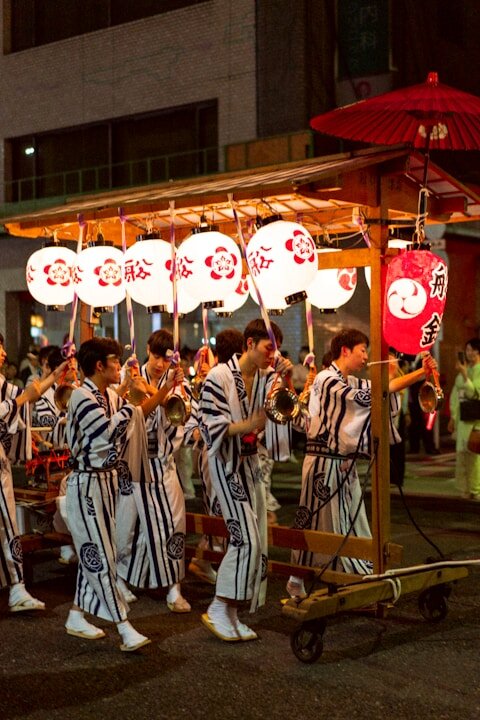
Kyoto in July is simultaneously the busiest and most culturally electric the city gets. The entire month belongs to Gion Matsuri – Japan’s most famous festival, running since 869 AD.
For most of July, the city’s central streets fill with elaborate wooden floats (yamaboko) being assembled by neighbourhood associations, paper lanterns strung between buildings, and stalls selling festival food that appears nowhere else in the calendar.
The heat in Kyoto in July is genuinely fierce – the city sits in a basin that traps heat and humidity. The dawn-and-evening strategy is not optional here; it is the difference between misery and magic.
Day 4: Arrive + Evening Yoiyama
- Check in by early afternoon; rest or find air conditioning
- Yoiyama evenings (July 14–16 for the first parade, July 21–23 for the second): The evenings before each major parade are when Gion Matsuri is at its most atmospheric. The yamaboko floats are assembled and lit with paper lanterns along Shijo-dori and the surrounding streets. Chestnut and sweet potato vendors, food stalls, and crowds in yukata (summer cotton kimono). The streets close to traffic and become a pedestrian festival from around 6 PM. This evening experience arguably surpasses the parade itself
- Rent a yukata from one of the many shops in central Kyoto for the Yoiyama evening – ¥2,000–5,000 for the day. Wearing one isn’t just for photographs; it’s genuinely cooler than Western summer clothing in Japan’s humid heat
Day 5: Dawn Temples + Parade Day
- Fushimi Inari at 6:30 AM – even in summer, the mountain is cooler than the city floor. The torii gate tunnel in early morning mist is extraordinary; by 9:30 AM the heat is building and the crowds have arrived
- Kiyomizudera before 8:30 AM – the wooden veranda extending over the valley, with summer mist rising from the hills below
- Avoid outdoor sightseeing 11 AM–3 PM. Instead: Nishiki Market (covered, shaded, excellent for sampling pickles, tofu, and grilled skewers), Kyoto National Museum, or a traditional craft workshop (pottery, tea ceremony, indigo dyeing – many studios in the Higashiyama area run 1–2 hour sessions and are completely air-conditioned)
- Gion Matsuri Yamaboko Junko parade (July 17 or 24): The main float parade. Arrive by 9 AM and find a spot along Shijo-dori or Oike-dori. The procession begins mid-morning and lasts several hours. Paid viewing stands (book through the festival’s official site or Klook) offer seating and shade – worth considering in July heat
Day 6: Arashiyama Morning + Nara Afternoon
- Arashiyama Bamboo Grove before 7 AM – summer dawn, the grove steaming gently in humidity, spider lilies and hydrangeas blooming along the riverbanks
- Tenryu-ji Temple Garden – the Zen pond garden in summer green is at its lushest
- Nara (45 min from Kyoto by Kintetsu Express) in the late afternoon – deer park in summer with the park’s ancient trees providing real shade, the Great Buddha at Todai-ji in relative afternoon quiet
Days 7–8: Osaka (2 nights)
How to get there: Shinkansen from Kyoto, 15 minutes
Osaka in late July is the city at its fullest. The heat is real, the energy is higher, and the food – oysters, cold ramen, summer festival street food – is excellent.
Tenjin Matsuri (July 24–25)
One of Japan’s three great festivals, Tenjin Matsuri honours the deity of learning at Osaka Tenmangu Shrine.
The main day is July 25, when a land procession of 3,000 participants in Heian-period costumes (15:30–18:00) leads into a boat procession of over 100 vessels on the Okawa River (18:00–21:00), capped by fireworks above the river starting around 19:30.
- Free viewing: Riverbanks near Temmabashi Station and Sakuranomiya Park fill with crowds from late afternoon. Arrive by 2 PM for a good spot
- Paid boat cruise: Several operators run river boats during the procession for ¥5,000–15,000 per person – the best view of both the boats and fireworks, booked weeks in advance
- Note: Both the Sumida River Fireworks (Tokyo) and Tenjin Matsuri fall on July 25. You can only do one; Tenjin Matsuri wins on depth of experience
Day 7: Osaka Without the Festival
- Kuromon Ichiba Market at 9 AM – Osaka’s covered market, 200 years old, at its best in morning cool. Summer produce includes cold-pressed watermelon juice, fresh octopus for takoyaki, and seasonal seafood
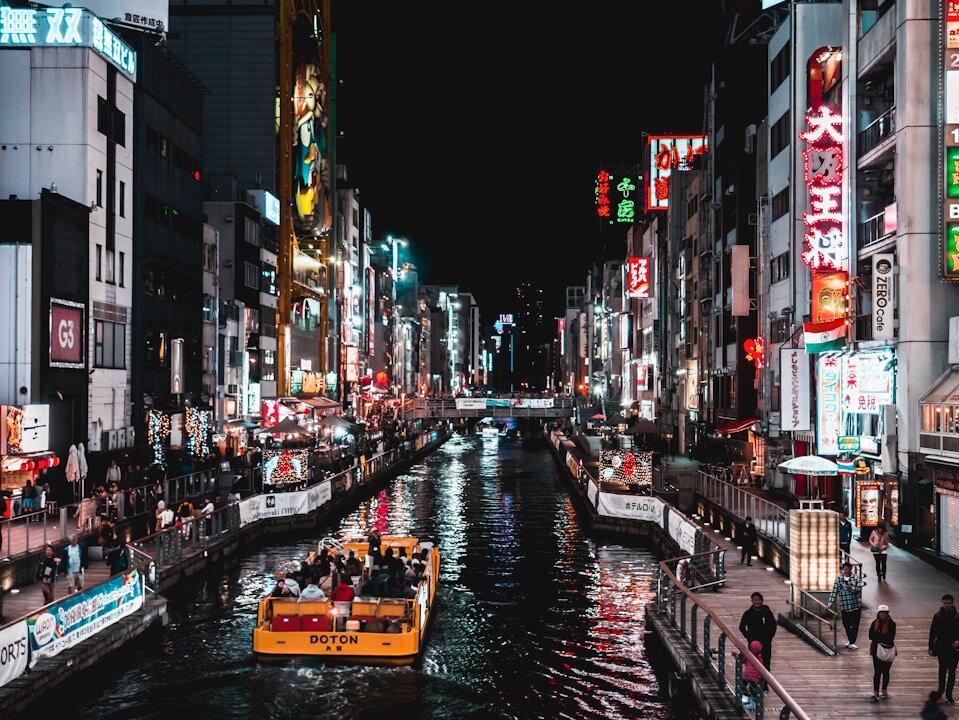
- Dotonbori in the evening – Japan’s neon-soaked canal district is best after dark when the heat eases. Cold beer on the canal, takoyaki from a street stall, kushikatsu at a standing bar
- Shinsekai – old Osaka with its retro restaurants and sento bathhouses. A cold bottle of Osaka craft beer at one of the neighborhood’s standing bars is the perfect summer evening
Day 8: Tenjin Matsuri Day
- Morning: Osaka Castle gardens in early morning before the heat – the summer greenery around the castle moat is genuinely beautiful
- Afternoon: indoors – Osaka Museum of History overlooks the castle and has excellent air conditioning and a deep collection on the city’s merchant history
- Evening: Tenjin Matsuri (see above). Budget the full evening; the procession, fireworks, and post-festival train crowds take until around 10:30 PM
Also Read: 11 Days In Japan Itinerary & 10 Days In Japan Itinerary
Days 9–10: Hiroshima & Miyajima (2 nights)
How to get there: Shinkansen from Osaka, approximately 1.5 hours
Summer Hiroshima carries a particular weight. August 6th is the anniversary of the atomic bombing – a date the city marks with a ceremony at the Peace Memorial Park and a lantern-floating memorial on the Motoyasu River.
If your trip includes this date, attending is among the most profound experiences in Japan.
Day 9: Hiroshima
- Peace Memorial Museum in the morning – go before 10 AM to avoid the busiest period. Budget 2 hours minimum. The rebuilt city visible through the windows as you exit, and the A-Bomb Dome standing preserved beside it, create a contrast that stays with you
- Afternoon: shaded walking in Naka Ward – Hiroshima’s covered shotengai shopping arcades are vast and air-conditioned. The Hondori and Mikawa-cho arcades connect several blocks of restaurants, shops, and cafés
- Hiroshima-style okonomiyaki – the city’s layered savory pancake is particularly satisfying in summer. Okonomimura, the five-floor dedicated okonomiyaki building in central Hiroshima, is reliable and atmospheric
Day 10: Miyajima Island
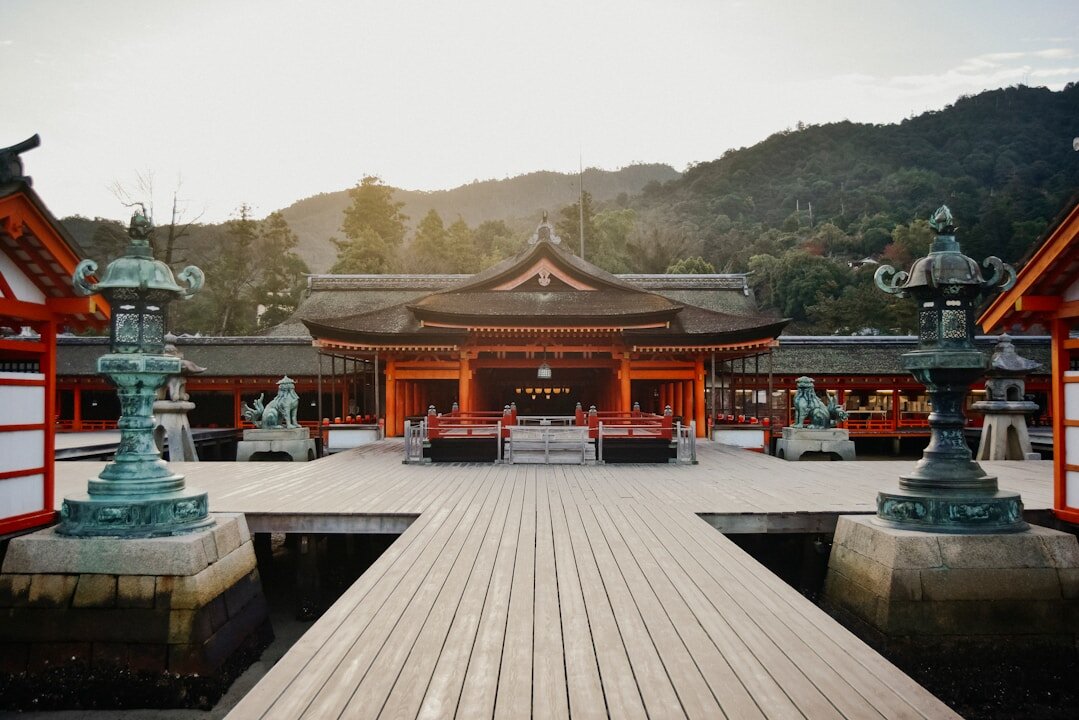
- The floating torii gate of Itsukushima Shrine – summer brings the torii surrounded by deep green hillside rather than the bare winter mountain, giving it a lush tropical quality quite different from other seasons
- Mount Misen ropeway in the morning before heat peaks – the summit at 535m is noticeably cooler than the coast. Views over the Seto Inland Sea in summer haze are beautiful
- The island’s deer wander the shrine grounds and streets as always, noticeably more relaxed in summer heat than in winter
Fly home from Hiroshima Airport (flights to Tokyo and international connections) or return to Osaka for Kansai International Airport (KIX).
Also Read: 1 Week Japan Itinerary & Honeymoon In Japan Itinerary
Route B: Beat the Heat – Hokkaido Summer (10 Days)
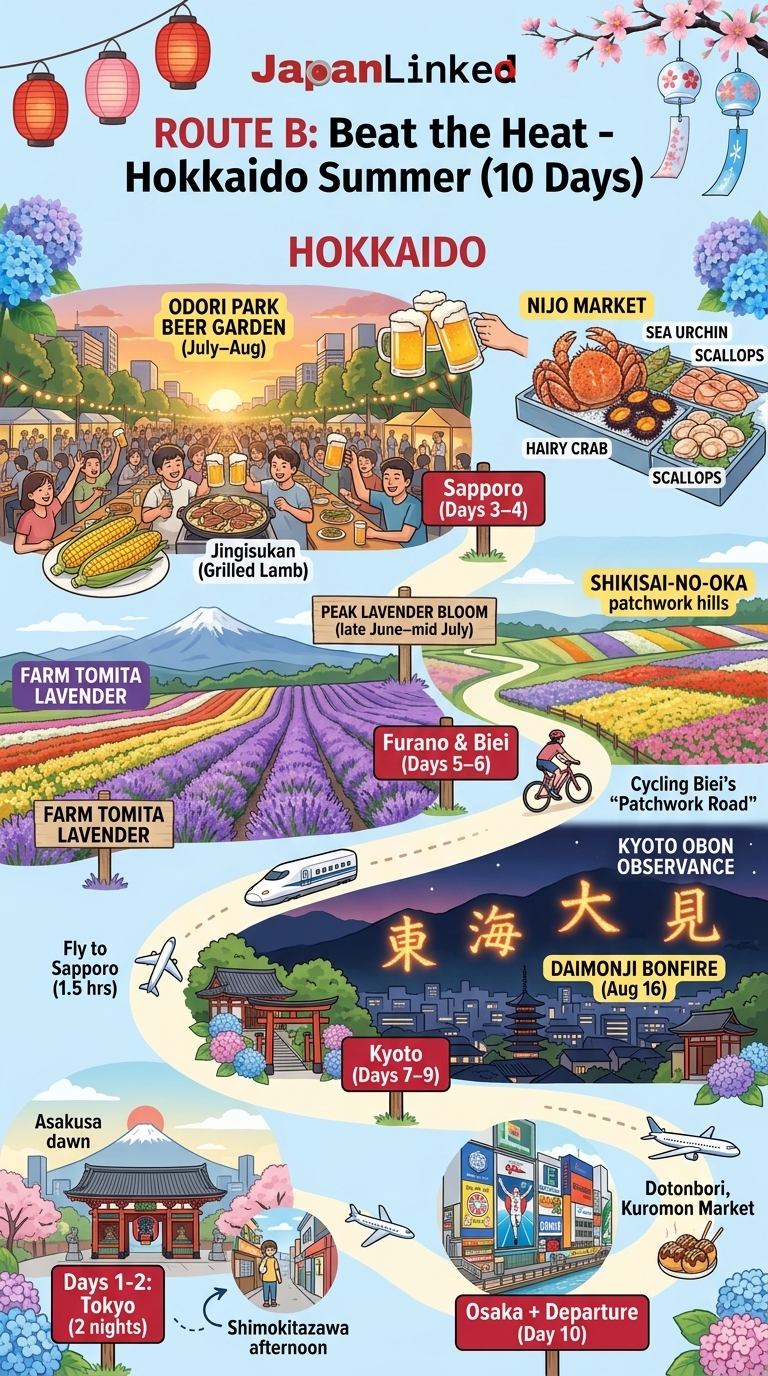
For June or August travelers, or anyone for whom mainland summer heat is genuinely a dealbreaker.
Days 1–2: Tokyo (2 nights)
Same condensed Tokyo opening as the winter itinerary: Asakusa dawn, Shimokitazawa afternoon, one evening out. Don’t linger – Hokkaido is waiting.
Days 3–6: Hokkaido (4 nights)
How to get there: Fly from Tokyo (Haneda or Narita) to Sapporo’s New Chitose Airport – about 1.5 hours, multiple daily flights from ¥8,000–15,000 one way
Summer in Hokkaido is Japan’s best-kept seasonal secret. While Tokyo and Osaka bake at 35°C+ with brutal humidity, Hokkaido in July averages 20–25°C with low humidity – essentially perfect outdoor weather.
The island stays green long into summer, with lavender fields, flower gardens, and national park hiking that would be impossible in the heat of Honshu.
Sapporo (2 nights)
- Odori Park beer garden – Sapporo’s famous Sapporo Beer Museum is the obvious start, but the real experience is the massive outdoor beer garden that runs in Odori Park July–August, where thousands of people drink Hokkaido beer, eat jingisukan (grilled lamb) and corn, and enjoy the warm (but not hot) Sapporo evenings
- Nijo Market – Sapporo’s covered seafood market at dawn. The Hokkaido specialties here – hairy crab, sea urchin, scallops, king salmon – are among the finest seafood experiences in Japan
- Susukino – Sapporo’s entertainment district is livelier in summer than any other season. Rooftop bars, summer izakayas with open walls, and the kind of city-cool that Hokkaido has in abundance
Furano and Biei (2 nights)
2 hours from Sapporo by JR, the Furano-Biei area is famous for its lavender fields – the most photographed landscape in Hokkaido, and one of the most beautiful in Japan in late June to mid-August.
- Farm Tomita – the most iconic lavender farm in Japan, operating since 1903. Fields of purple, pink, and white lavender in long rows against a mountain backdrop. Peak bloom is late June to mid-July. Free to enter the lavender fields
- Shikisai-no-Oka (Biei) – a hillside farm with rows of different colored flowers arranged in stripes across the slope – salvia, marigold, zinnia, lavender – that creates a patchwork quilt effect visible from a distance. One of Japan’s most photogenic summer landscapes
- Cycling through Biei’s “patchwork road” – gently rolling farmland with Hokkaido’s distinctive large-scale agriculture. Bicycle rental available in town for ¥1,500–2,500/day
Days 7–9: Kyoto (3 nights)
Same Kyoto section as Route A, adjusted for June (fewer crowds, hydrangeas in bloom at Mimurotoji Temple and Fujinomori Shrine) or early August (post-Gion Matsuri quiet, Daimonji bonfire on August 16 – five enormous kanji characters lit on the mountains surrounding Kyoto as part of the Obon observance, visible from much of the city).
Day 10: Osaka + Departure
Same Osaka coda: Dotonbori, Kuromon Market, fly from Kansai International.
Also Read: 12 Days In Japan Itinerary & 5 Days In Japan Itinerary
Summer Japan Packing: What Actually Matters
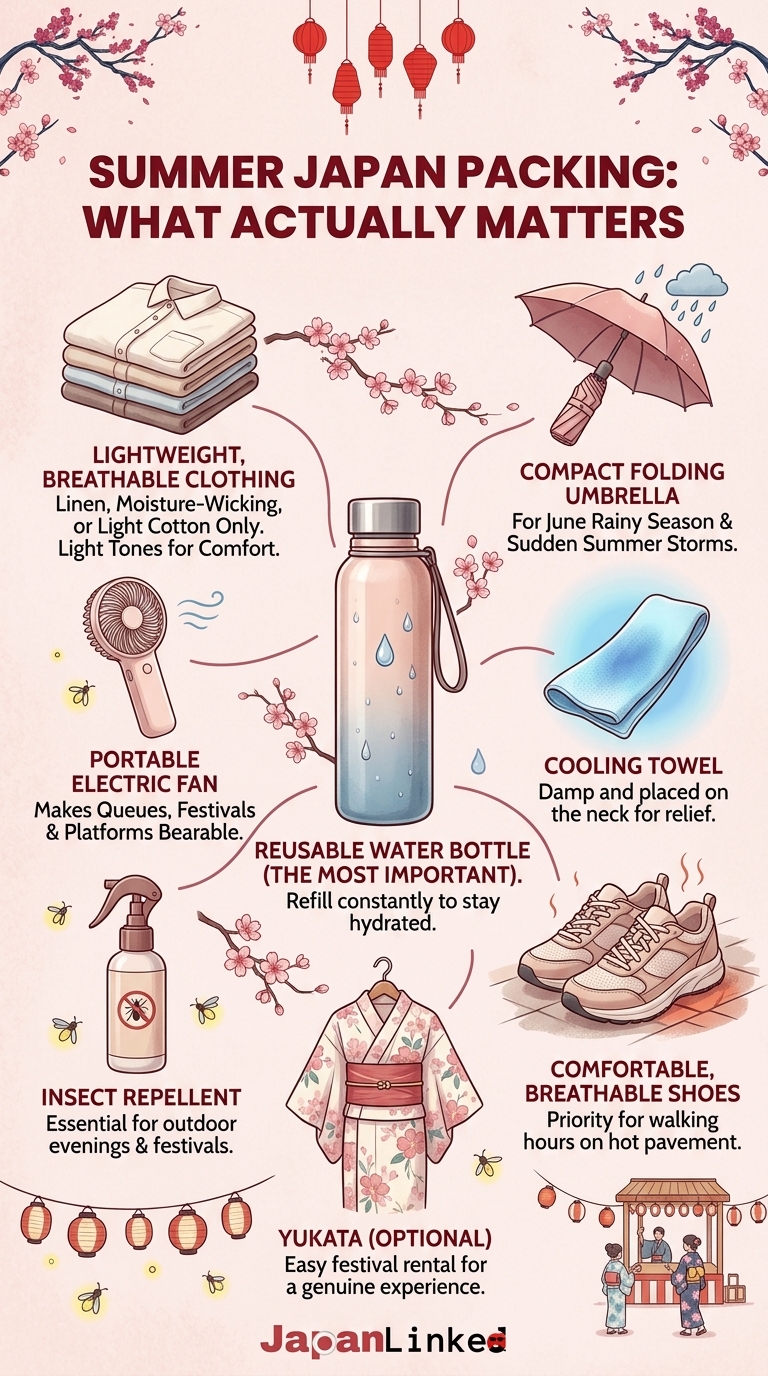
The wrong packing list will ruin a Japan summer trip. The right one makes it comfortable.
| Item | Why It Matters |
|---|---|
| Lightweight, breathable clothing | Linen, moisture-wicking, or light cotton only. Dark colors absorb heat; lighter tones are more comfortable outdoors |
| Compact folding umbrella | For rainy season in June and sudden summer storms in July-August. Japanese convenience stores sell good ones for ¥800 if you forget |
| Portable electric fan | A small handheld rechargeable fan (available everywhere in Japan from ¥800–1,500) makes outdoor waiting — queues, festival crowds, train platforms — bearable |
| Cooling towel | Damp and placed on the neck, these provide genuine temperature relief. Available at all convenience stores and 100-yen shops |
| Insect repellent | Essential for any outdoor evening activity, especially festivals near rivers and parks |
| Comfortable, breathable shoes | Summer festivals involve hours of standing and walking on hot pavement. Don’t sacrifice comfort for style |
| Yukata (optional) | Renting a yukata for festival evenings is easy and genuinely adds to the experience. Skip the expensive ones; ¥2,000–4,000 rental is fine |
The most important item: A reusable water bottle you refill constantly. Convenience stores and vending machines are everywhere, but carrying your own means you drink more, which matters in this heat.
Key Japan Summer Festival Dates
| Festival | Location | Dates | Highlight |
|---|---|---|---|
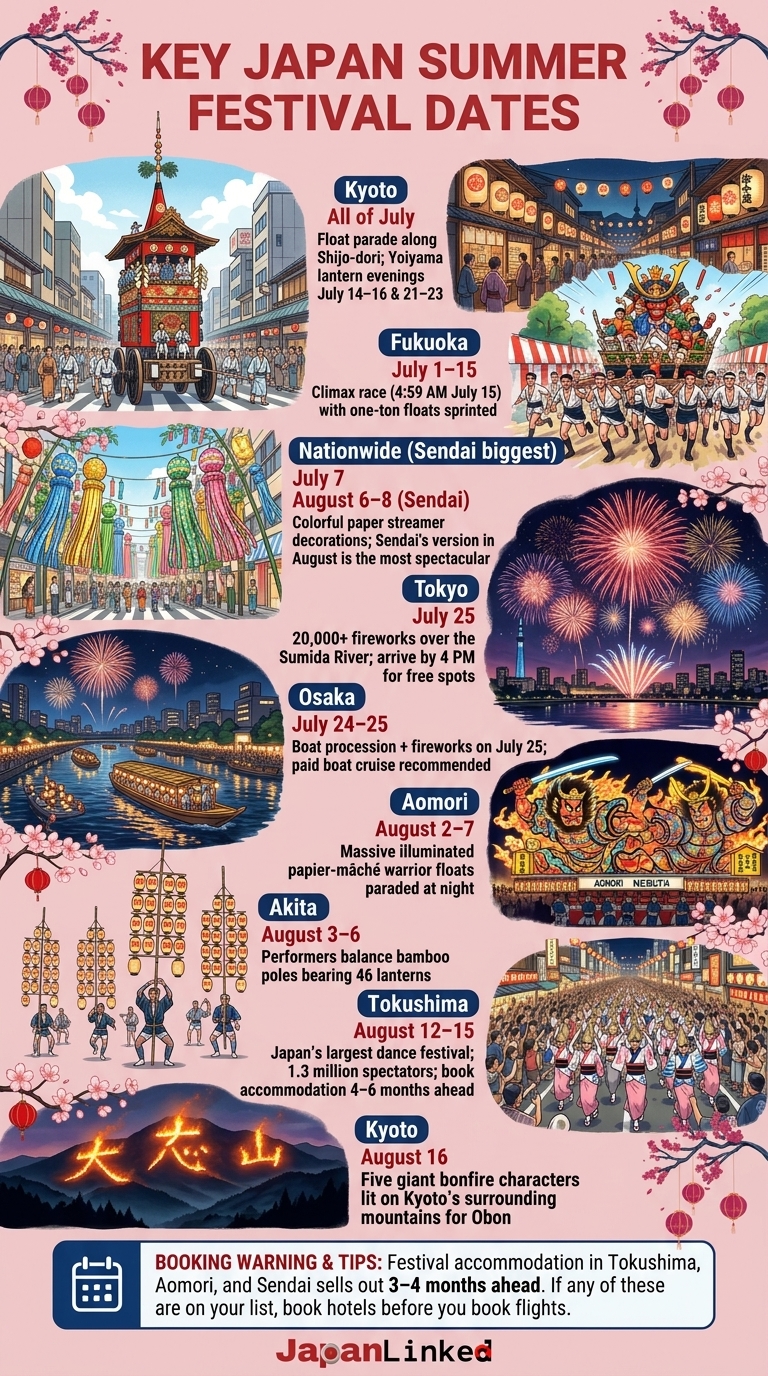
| Gion Matsuri | Kyoto | All of July; parades July 17 & 24 | Float parade along Shijo-dori; Yoiyama lantern evenings July 14–16 & 21–23 |
| Sumida River Fireworks | Tokyo | July 25 | 20,000+ fireworks over the Sumida River; arrive by 4 PM for free spots |
| Tenjin Matsuri | Osaka | July 24–25 | Boat procession + fireworks on July 25; paid boat cruise recommended |
| Hakata Yamakasa | Fukuoka | July 1–15 | Climax race (4:59 AM July 15) with one-ton floats sprinted through narrow streets |
| Tanabata | Nationwide (Sendai biggest) | July 7 / August 6–8 (Sendai) | Colorful paper streamer decorations; Sendai’s version in August is the most spectacular |
| Aomori Nebuta | Aomori | August 2–7 | Massive illuminated papier-mâché warrior floats paraded at night |
| Akita Kanto | Akita | August 3–6 | Performers balance bamboo poles bearing 46 lanterns on their foreheads, chins, and hips |
| Awa Odori | Tokushima | August 12–15 | Japan’s largest dance festival; 1.3 million spectators; book accommodation 4–6 months ahead |
| Daimonji | Kyoto | August 16 | Five giant bonfire characters lit on Kyoto’s surrounding mountains for Obon |
Booking warning: Festival accommodation in Tokushima, Aomori, and Sendai sells out 3–4 months ahead. If any of these are on your list, book hotels before you book flights.
Budget Guide: 10-Day Summer Japan Trip
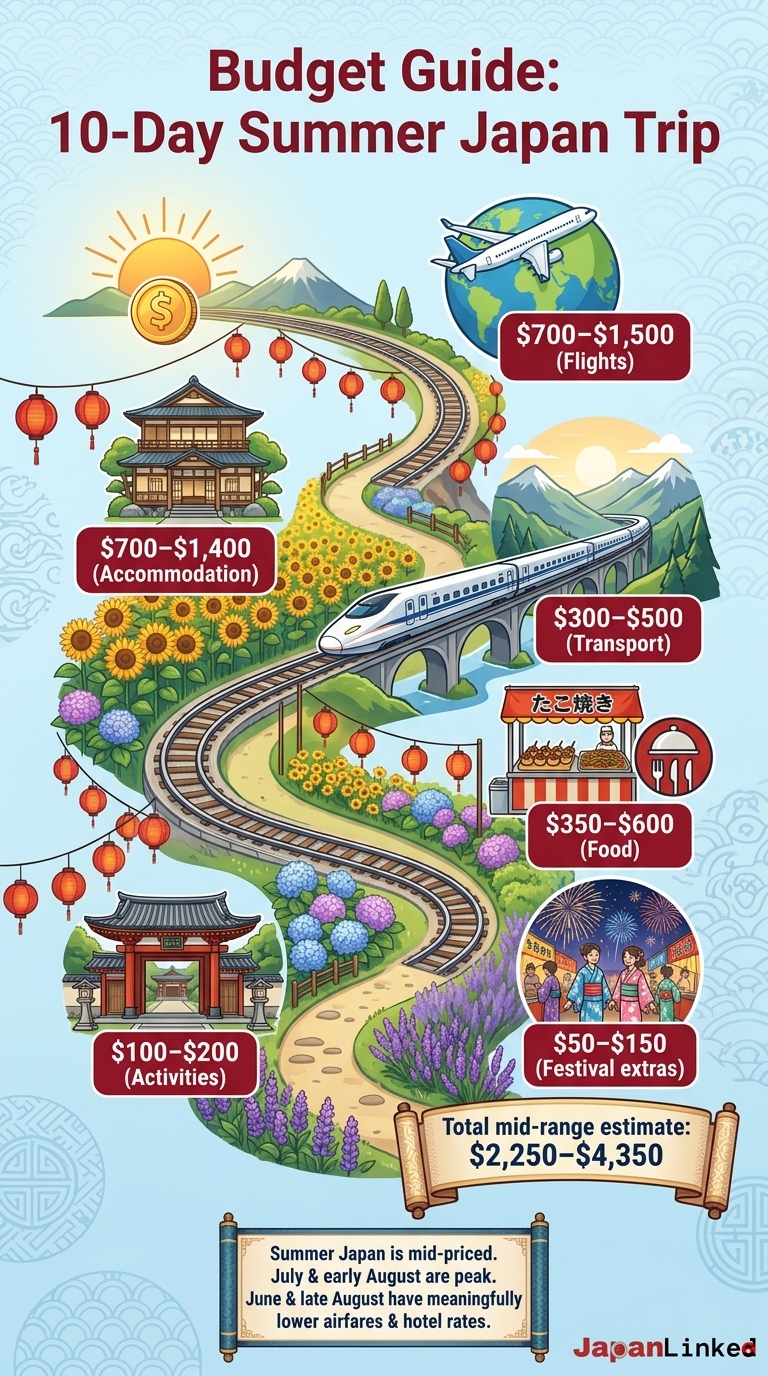
| Category | Budget (USD) |
|---|---|
| International flights (summer, peak July–Aug) | $700–1,500 |
| Accommodation (10 nights, mid-range) | $700–1,400 |
| Shinkansen + regional transport | $300–500 |
| Food (10 days, mid-range) | $350–600 |
| Activities and entrance fees | $100–200 |
| Festival extras (yukata rental, paid seats) | $50–150 |
| Total mid-range estimate | $2,250–4,350 |
Summer Japan sits in the middle of the price range – higher than winter (no discount season), lower than cherry blossom (no surge pricing).
The major cost variable is flights: July and early August are peak summer travel globally. June and late August offer meaningfully lower airfares and hotel rates with only slightly fewer festival options.
Conclusion
Summer Japan doesn’t want your sympathy. It doesn’t need you to brave it – it needs you to understand it. The heat is the admission price for the greatest festival season in Asia.
The discomfort of a midday Tokyo street in August is the trade for standing on a Kyoto riverbank as 100 boats process past you carrying flaming torches, fireworks bursting above.
For five nights in August, Aomori puts 3 million people on its streets to watch illuminated floats the size of houses move through the city.
Kyoto spends an entire month celebrating a festival it has run continuously for over 1,100 years.
No other season in Japan comes close to this cultural density. No other season asks this much of you physically. And no other season rewards the preparation this completely.
Come in the morning, disappear at midday, return for the festivals. Let the evenings belong to you and Japan’s oldest traditions.
