
Most first-time visitors to Japan never make it south of Kyoto. And honestly? That’s great news for everyone who does.
Southern Japan spanning the island of Kyushu, the historic city of Hiroshima, and the scenic routes of western Honshu – is where the country gets wilder, quieter, and more authentically itself.
There are fewer tour buses here, more locals in the ryokans, and a sense that you’ve stumbled into a Japan that hasn’t been polished for Instagram.
You’ll find an active volcano you can peer into, hot-spring baths carved into cliffside hotels, a harbour city shaped by centuries of East-meets-West trade, and one of the most moving peace memorials in the world.
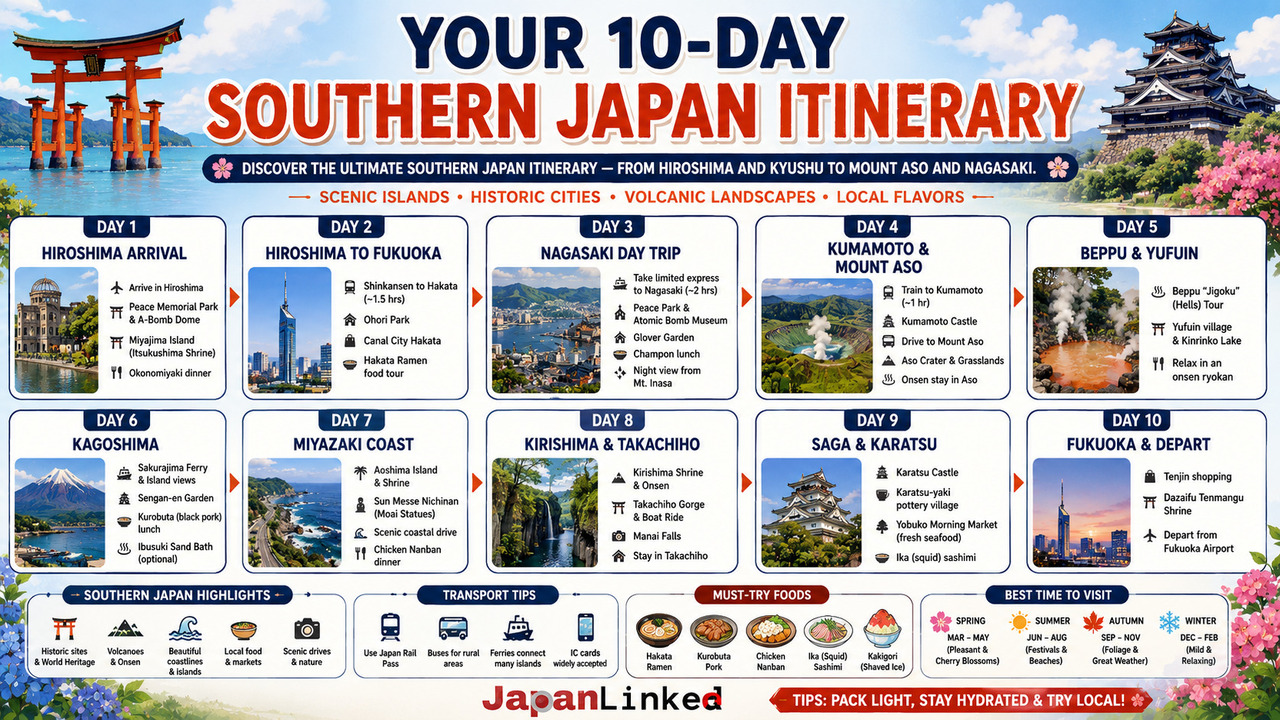
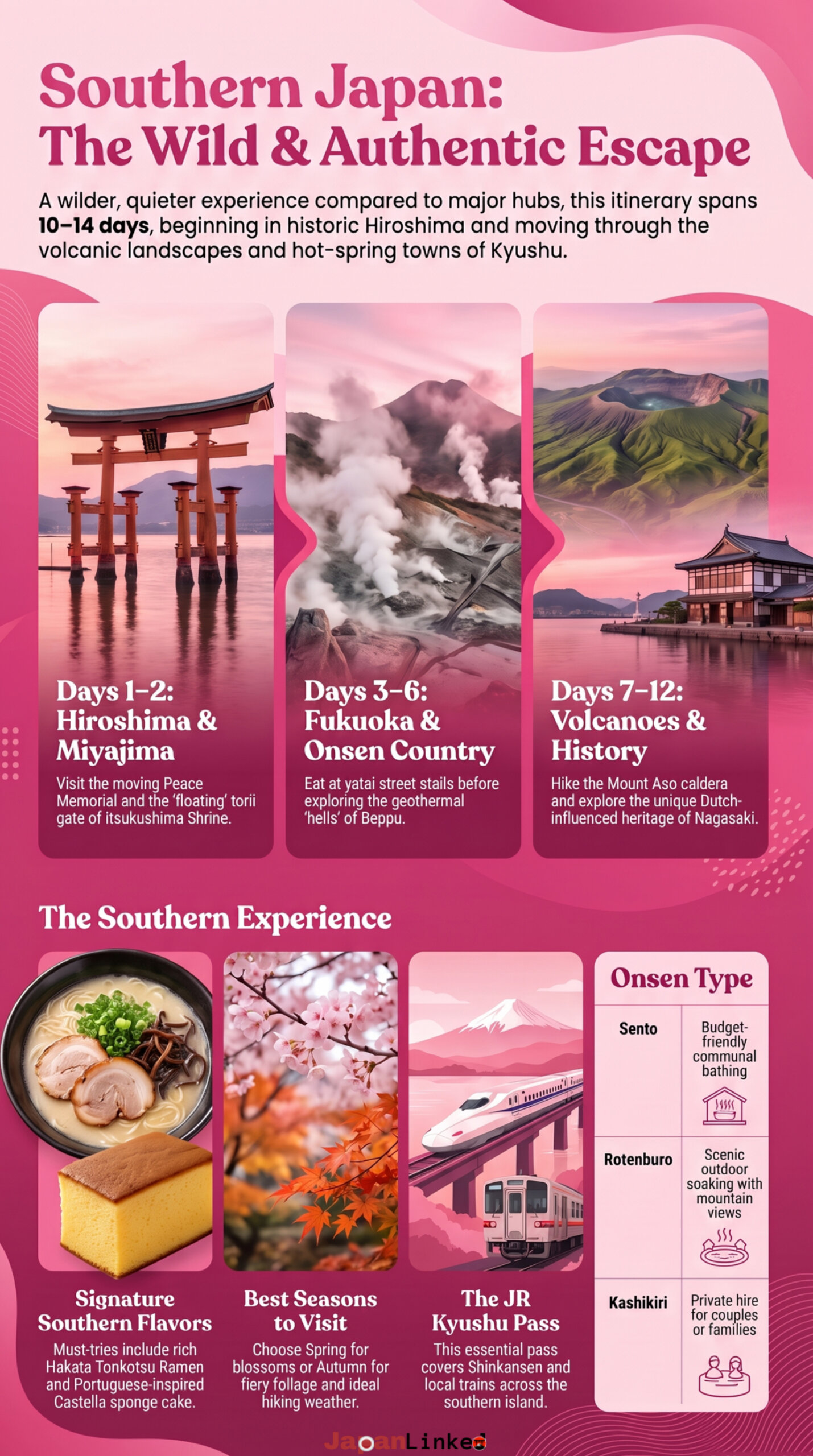
This southern Japan itinerary is built for travelers with 10–14 days who want something beyond the Golden Route.
Whether you start in Osaka and work your way southwest, or fly directly into Fukuoka, here’s everything you need to plan the trip.
Why Southern Japan Deserves a Spot on Your Bucket List
Let’s address the obvious: Tokyo, Kyoto, and Osaka are incredible. Nobody’s denying that. But they’re also extremely well-trodden. Southern Japan offers the same cultural depth with far less competition for space.
Kyushu, Japan’s southernmost main island, is a region where volcanic peaks, hot-spring villages, and historic port cities meet a relaxed, welcoming culture. The island alone packs in:
- Mount Aso, one of the world’s largest active volcanic calderas
- Beppu, a town so saturated with geothermal steam that plumes rise from the streets like something out of a Studio Ghibli film
- Nagasaki, a harbour city shaped by centuries of Dutch, Portuguese, and Chinese influence – and one of the most emotionally significant WWII sites in the world
- Fukuoka, Kyushu’s buzzy capital and one of Asia’s most liveable cities, famous for its yatai street-food stalls and Hakata ramen
Add Hiroshima and the Seto Inland Sea to the mix, and you have the ingredients for one of the most varied itineraries in all of Japan.
Also Read: Japan Countryside Itinerary & Northern Japan Itinerary
When to Go: The Best Season for a Southern Japan Itinerary
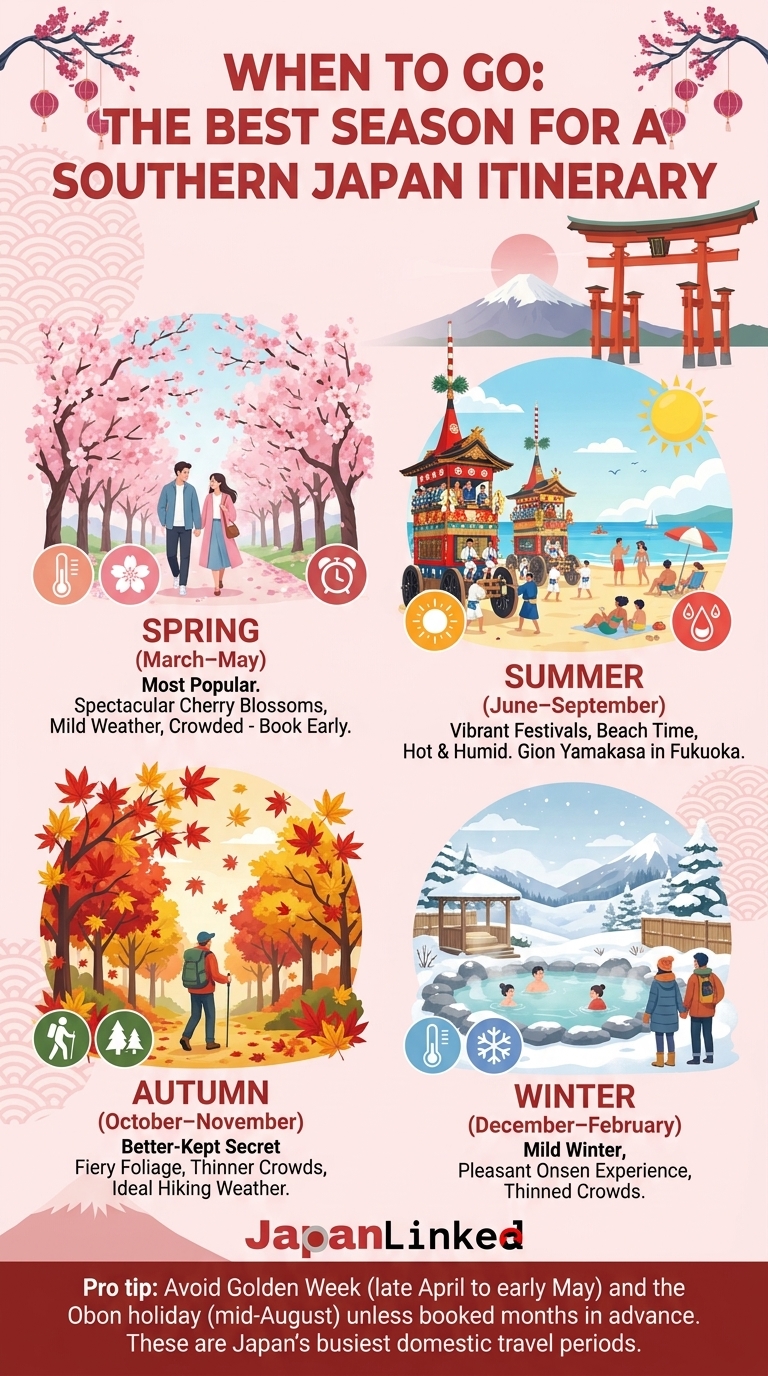
Southern Japan is a year-round destination, but the season you choose dramatically shapes the experience.
Spring (March–May) is the most popular window. Cherry blossoms are spectacular across the region, temperatures are mild, and the entire landscape feels impossibly pretty. The downside: it’s peak season, so book accommodation early.
Autumn (October–November) is arguably the better-kept secret. Autumn foliage transforms parks and temple grounds into a canvas of fiery reds and golds, crowds are thinner than in spring, and the weather is ideal for hiking. Ritsurin Garden in Takamatsu and the hills around Nagasaki are particularly stunning.
Summer (June–September) brings heat and humidity, but also the region’s most vibrant festivals. The Gion Yamakasa festival in Fukuoka – held annually in July – is a centuries-old spectacle involving teams carrying enormous floats through the city streets at dawn. If beach time is on your agenda, the waters around Kyushu and Okinawa are warmest and clearest between May and October.
Winter is mild by Japanese standards (think London autumn, not Hokkaido), making it a genuinely pleasant time to visit onsen towns when the crowds have thinned.
Pro tip: Avoid Golden Week (late April to early May) and the Obon holiday (mid-August) unless you’ve booked everything months in advance. These are Japan’s busiest domestic travel periods.
Also Read: 10 Days Winter Japan Itinerary & 10 Days In Summer Japan In Itinerary
The Southern Japan Itinerary: Day by Day
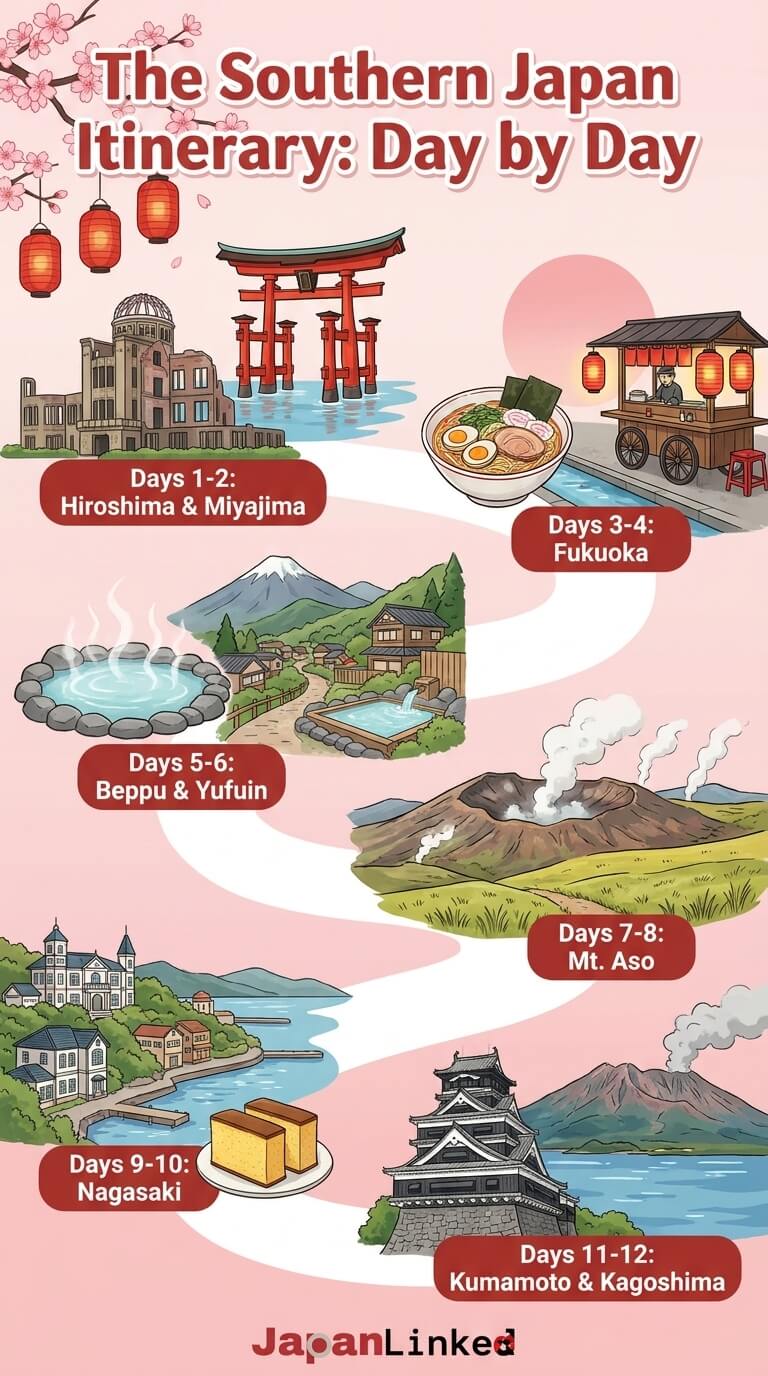
Days 1–2: Hiroshima and Miyajima Island
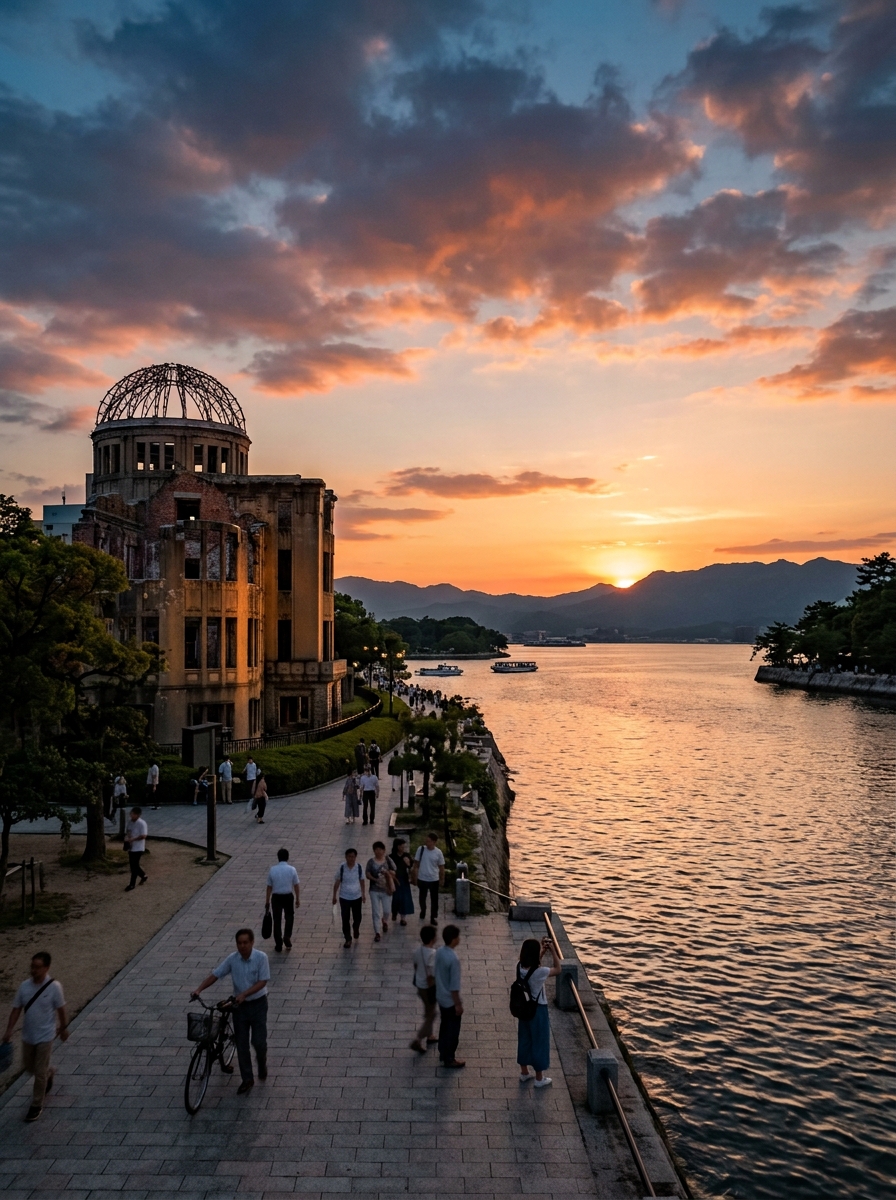
Start your southern Japan journey in Hiroshima – a city that earns its nickname, “The City of Peace,” a thousand times over. There is powerful history here, but the city is also vibrant, warm, and deeply alive.
Begin at the Hiroshima Peace Memorial Park, which commemorates the atomic bombing of August 6, 1945.
The A-Bomb Dome – the skeletal remains of a building at the bomb’s hypocenter – is a UNESCO World Heritage Site and one of the most quietly devastating sights in Japan.
The adjacent Peace Memorial Museum provides context without sensationalism. Budget at least two hours here; most visitors find they need longer.
Afterwards, take a breath in the Shukkei-en Garden, a classical Japanese garden built in 1620 that offers complete tranquility just minutes from the city centre.
On day two, take the 25-minute ferry to Miyajima Island to see the famous floating torii gate of Itsukushima Shrine.
Time your visit around high tide if you can – when the water rises to meet the base of the gate, the effect is otherworldly. Friendly deer wander freely across the island, completely unbothered by tourists.
Don’t miss: Hiroshima-style okonomiyaki. Unlike Osaka’s mixed version, Hiroshima’s layers its ingredients – cabbage, noodles, egg, and meat – into a tall savory stack. There are entire multi-storey buildings dedicated to it (Okonomimura is the most famous).
Also Read: Japan Honeymoon Itinerary & 1 Week Japan Itinerary
Days 3–4: Fukuoka – The Gateway to Kyushu
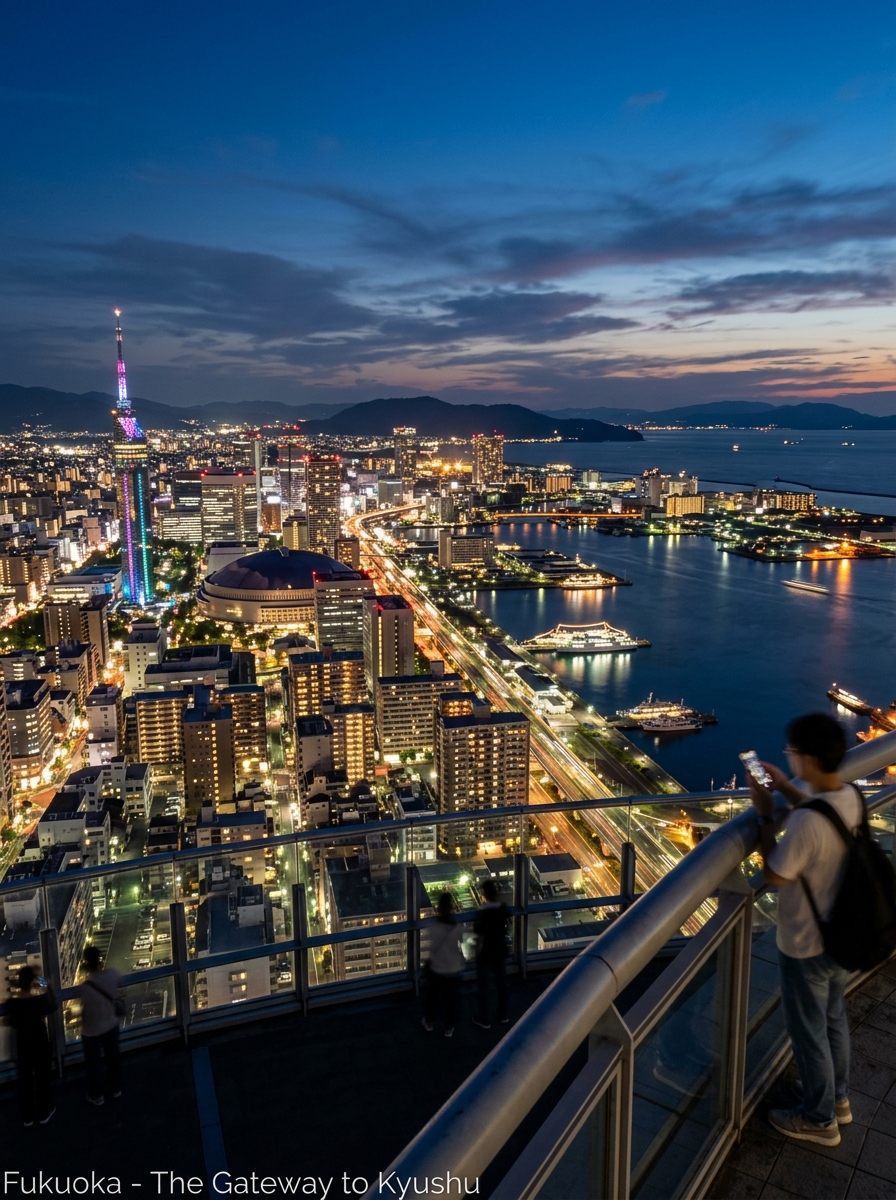
Cross into Kyushu via a one-hour Shinkansen ride from Hiroshima to Fukuoka (around ¥5,000 with a JR Pass). Fukuoka is the largest city in Kyushu and one of the best entry points for the island.
The city has an ease and confidence to it that sets it apart. Explore the Hakata canal district and the Kushida Shrine, then lose an afternoon in the Tenjin shopping area.
But the real reason to be here surfaces after dark: Fukuoka’s legendary yatai – small canvas-covered food stalls that line the riverbanks and park edges from dusk.
Pull up a stool, order a bowl of Hakata tonkotsu ramen (a rich, cloudy pork-bone broth that’s thicker and more intense than what you’ll find in Tokyo), and watch the city decompress around you.
These stalls are a quintessentially local experience, intimate and communal in a way that bigger restaurant chains never are.
From Fukuoka, you can also make a half-day trip to Dazaifu, a deeply atmospheric town just 30 minutes away.
The Dazaifu Tenmangu shrine – dedicated to the god of learning and surrounded by plum trees – is one of the most visited in all of Japan, with good reason.
Also Read: 2 Week Japan Itinerary & 3 Week Japan Itinerary
Days 5–6: Beppu and Yufuin – Onsen Country
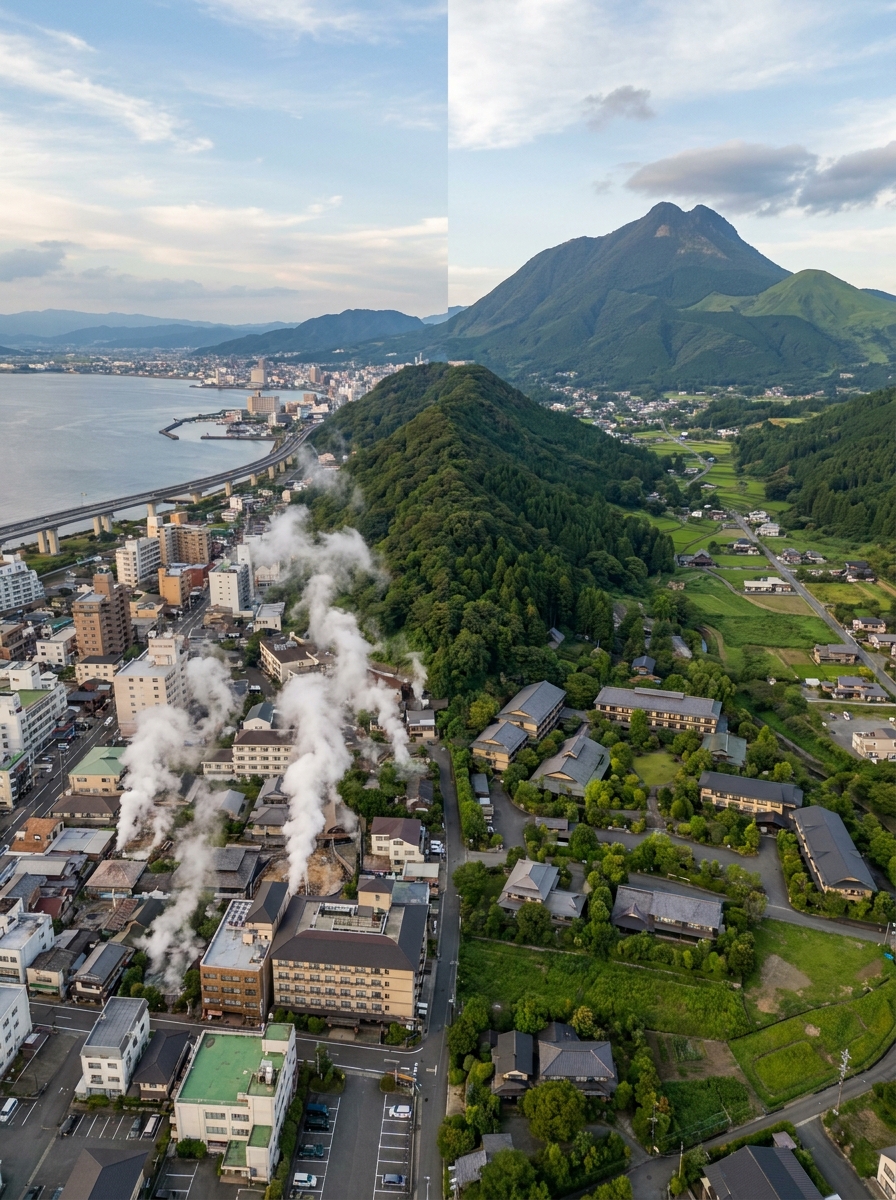
Head east across Kyushu by train to Beppu, Japan’s most famous hot-spring city, where geothermal steam rises from the ground around every corner.
The city is famous for its “Jigoku Meguri” – a tour of eight spectacular hot-spring pools known as the “hells.”
These aren’t for bathing; they’re geological spectacles with names like Blood Pond Hell (a vivid crimson pool) and Sea Hell (a cobalt-blue thermal lake fringed with tropical plants).
Admission to the hells is separate from bathing facilities, but the surrounding public onsen baths are among the best in Japan.
After Beppu, take a short 45-minute bus ride into the mountains to Yufuin, one of Japan’s most beloved hot-spring resort towns.
Where Beppu is loud and touristy, Yufuin is hushed and refined. The town sits in a bowl-shaped valley beneath twin volcanic peaks, and on autumn mornings, mist rolls across the rice fields in a way that makes you want to stay indefinitely.
The main street, Yufuin Floral Village, is lined with artisan shops, local bakeries, and galleries.
But the real treasure is booking a ryokan – a traditional Japanese inn – with a private rotenburo (outdoor hot-spring bath).
Soaking in 40°C mineral water while looking out at forested hills is one of those experiences that sounds like a cliché until it happens to you.
| Onsen Type | What to Know |
|---|---|
| Public sento | Cheapest; communal bathing, gender-separated |
| Ryokan onsen | Included in your stay; often shared or semi-private |
| Kashikiri onsen | Private hire by the hour; best for couples or families |
| Rotenburo | Outdoor bath; most scenic option |
Note: Many onsen have strict no-tattoo policies. If you have visible tattoos, look for “tattoo-friendly” options when booking, or opt for a private kashikiri bath.
Days 7–8: Mount Aso – Into the Volcano
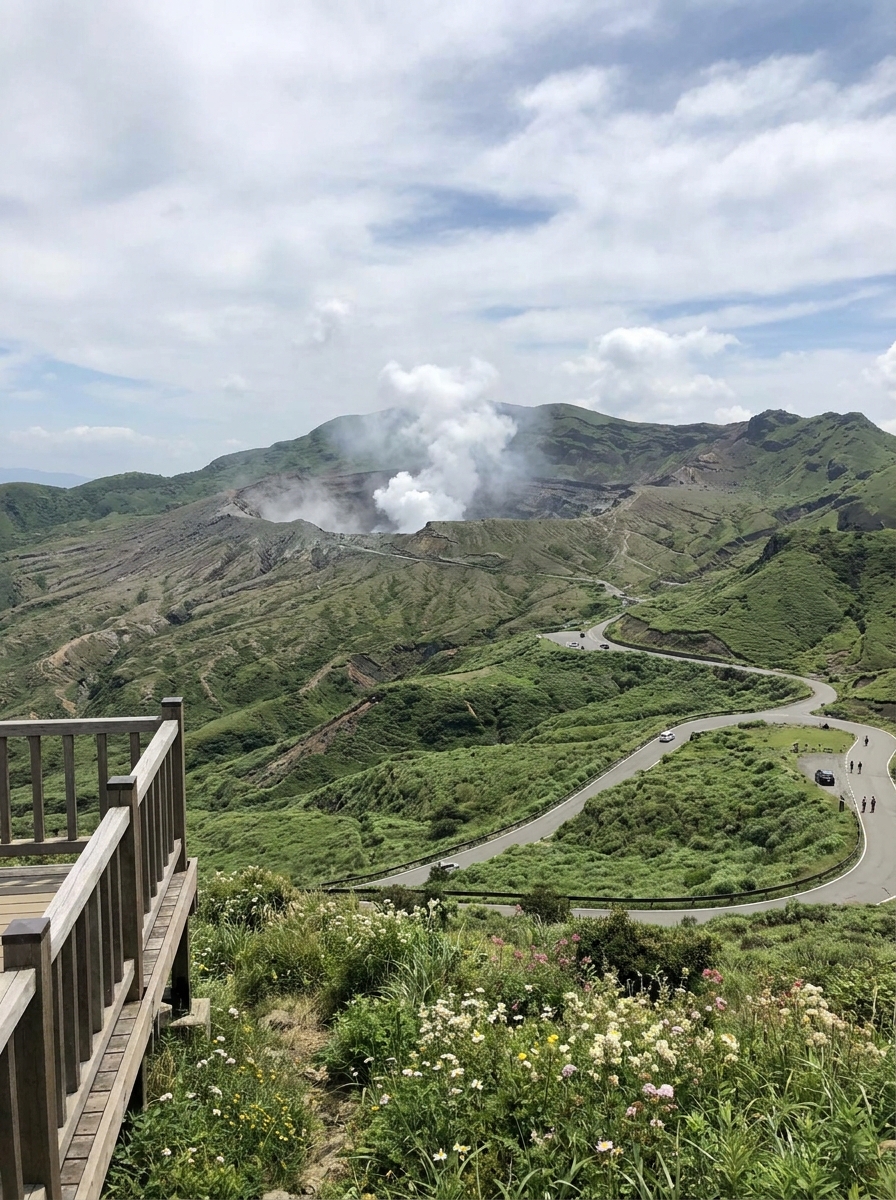
Few experiences in southern Japan match the sheer drama of Mount Aso. Located in the heart of Kyushu within Aso-Kujū National Park, Aso sits inside one of the world’s largest volcanic calderas – a landscape so vast and otherworldly it feels cinematic.
The outer rim encompasses entire towns, farmland, and forests; the inner cone, Nakadake, is an active crater you can sometimes walk right up to.
Access to the Aso crater depends on volcanic activity and safety conditions (as of summer 2025, access had reopened), so check current alerts before visiting.
Even if the crater rim is off-limits, the Kusasenri Plateau offers sweeping views across the caldera – a vast carpet of green grasslands ringed by volcanic peaks – that will stop you dead in your tracks.
The area is also dotted with local cattle farms, traditional thatched-roof farmhouses, and small-batch shochu distilleries.
Rent a car for this section of your itinerary if you can – the freedom to pull over whenever the landscape demands it is worth every yen.
Also worth stopping for: Shirakawa Suigen, a crystal-clear natural spring that produces 60 tonnes of water per minute and is considered one of Japan’s 100 finest waters. You’ll fill bottles here alongside locals.
Days 9–10: Nagasaki – Where History and Culture Converge
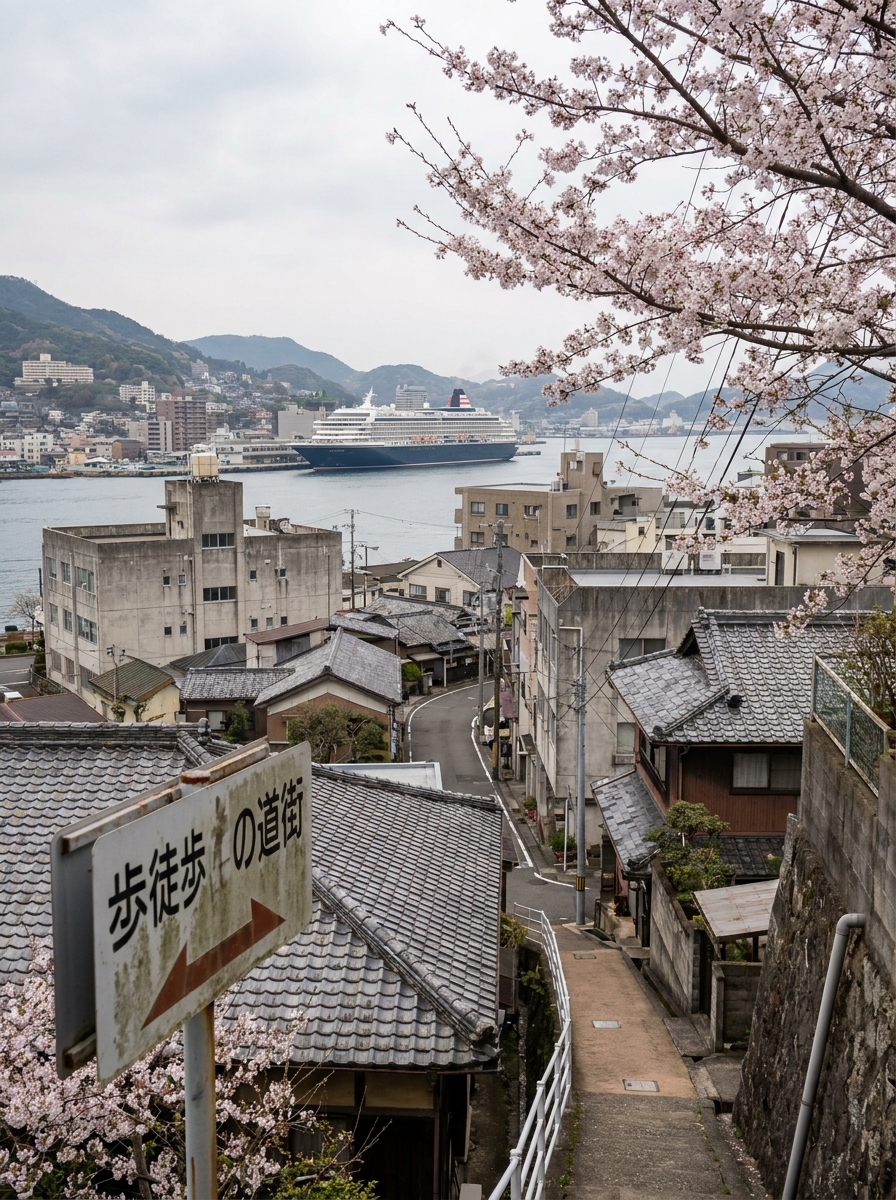
Nagasaki is one of the great cities of the world. There, that needed to be said plainly.
Yes, it carries the weight of August 9, 1945, when the second atomic bomb was dropped on the city.
The Nagasaki Peace Memorial Park and the Nagasaki Atomic Bomb Museum – located on a hill above the Hypocenter Park, where a black monolith marks the exact point of detonation – are among the most important and sobering sites in Japan. Visit with time and attention; they deserve both.
But Nagasaki is also joyful, strange, and singular in the best possible way.
As Japan’s principal trading port for much of the Edo period – when virtually all other ports were closed to foreigners – Nagasaki absorbed centuries of Dutch, Portuguese, and Chinese influence. The result is an architectural and culinary fingerprint unlike anywhere else in Japan.
Wander through Glover Garden, a hillside open-air museum of 19th-century Western-style buildings with sweeping views over the harbor.
Try champon, Nagasaki’s signature noodle dish – thick wheat noodles in a rich pork-and-seafood broth with Chinese roots.
Hunt down castella, the Portuguese-origin sponge cake that’s been a Nagasaki specialty for 500 years.
Days 11–12: Kumamoto and Kagoshima – Castles and Active Volcanoes
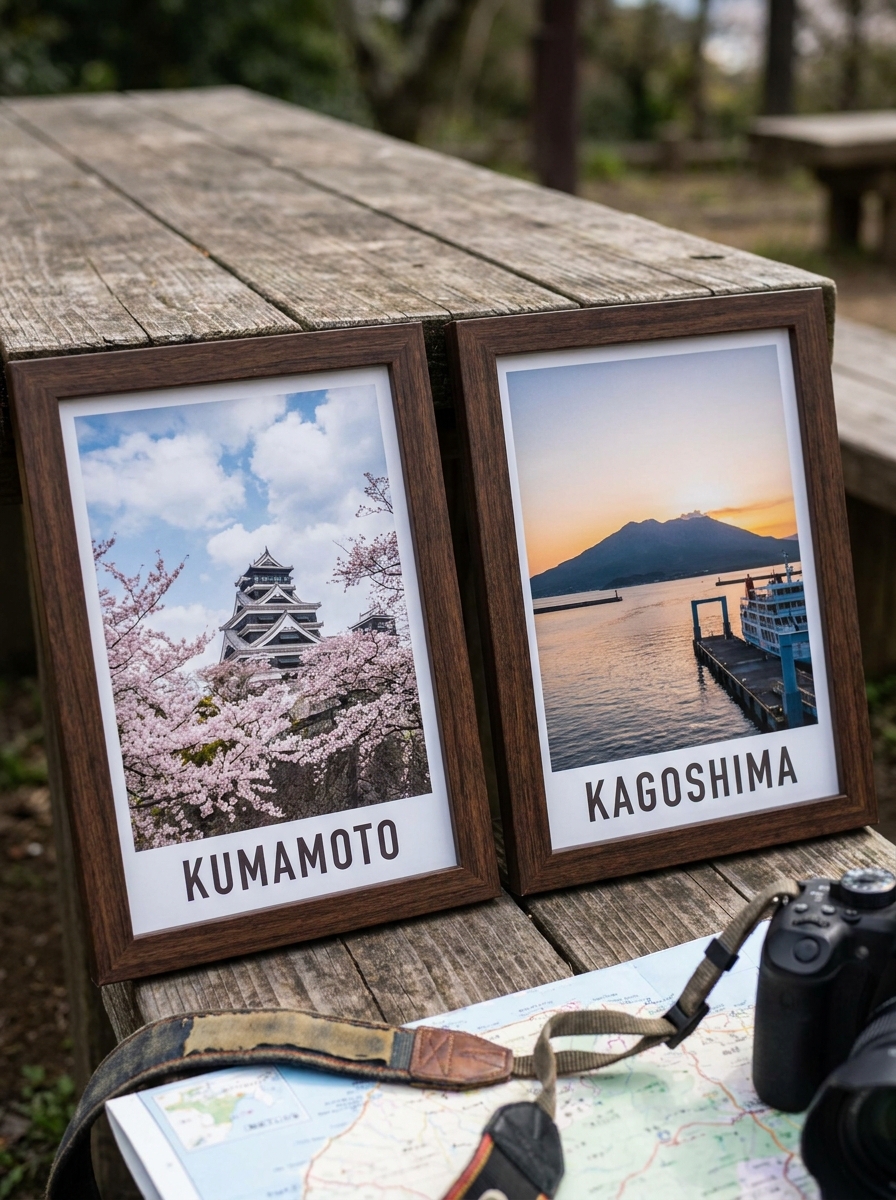
Kumamoto Castle, known as one of Japan’s three greatest castles, is worth the detour.
Severely damaged in the 2016 earthquake, the castle has been gradually undergoing restoration – visiting now is an unusually intimate way to watch a national treasure being pieced back together.
The castle’s dramatic black-and-white exterior and multi-tiered towers are spectacular against clear skies.
If you have the days, push further south to Kagoshima, Kyushu’s most southern major city. From the waterfront, you can watch Sakurajima – one of Japan’s most active volcanoes – puffing ash into the sky directly across the bay.
Taking a short ferry to the volcano itself, then cycling or hiking around its flanks, is a genuinely thrilling way to spend an afternoon.
Also Read: 11 Days In Japan Itinerary & 10 Days In Japan Itinerary
Getting Around: Transport Tips for Your Southern Japan Itinerary
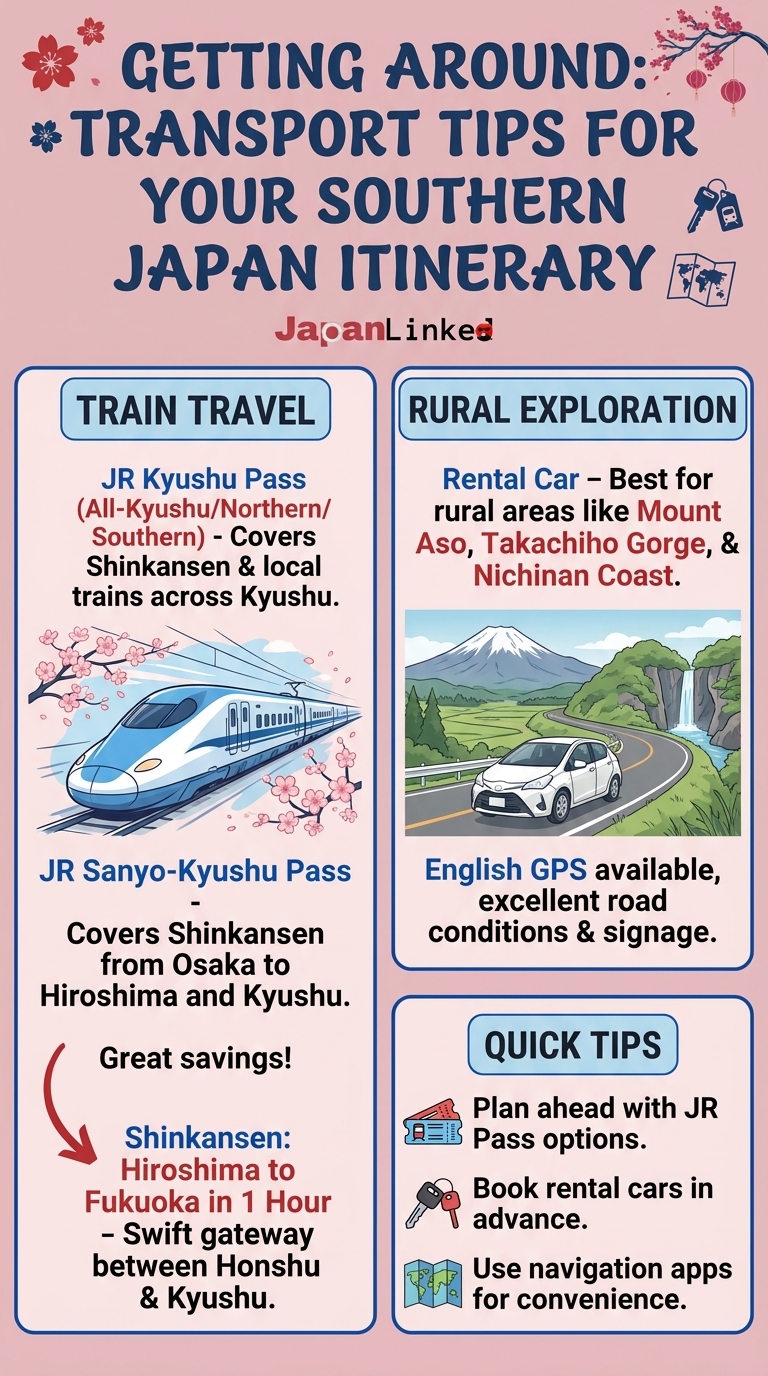
The JR Kyushu Pass (available in all-Kyushu or northern/southern variants) is invaluable for train travel across the island, covering Shinkansen and local trains.
If you’re also visiting Hiroshima, the JR Sanyo-Kyushu Pass covers the Shinkansen all the way from Osaka through Hiroshima and into Kyushu, offering significant savings over point-to-point tickets.
The Shinkansen offers a swift one-hour journey from Hiroshima to Fukuoka – a practical gateway between western Honshu and Kyushu.
For rural areas like Mount Aso, Takachiho Gorge, and the Nichinan Coast, a rental car is the best option. English GPS is available in most rental cars, and road conditions and signage are generally excellent.
What to Eat: A Southern Japan Food Guide
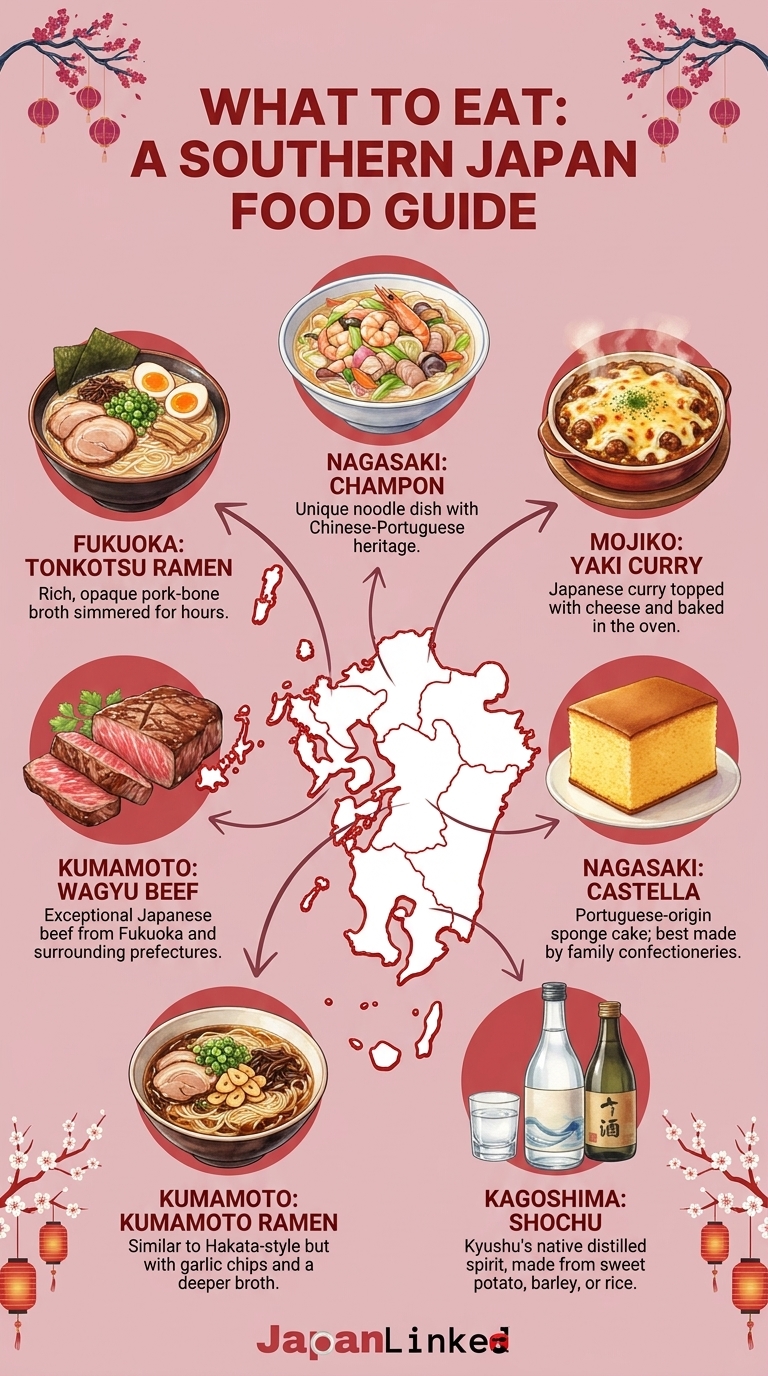
Southern Japan has one of the most distinct regional food cultures in the country:
- Tonkotsu ramen – Fukuoka’s claim to fame; a rich, opaque pork-bone broth that’s been simmered for hours
- Champon – Nagasaki’s unique noodle dish with Chinese-Portuguese heritage
- Yaki curry – a Mojiko speciality; Japanese curry topped with cheese and baked in the oven
- Wagyu beef – Fukuoka and the surrounding prefectures produce exceptional Japanese beef
- Castella – Nagasaki’s Portuguese-origin sponge cake; the best versions are still made by small family confectioneries
- Kumamoto ramen – similar to Hakata-style but with garlic chips and a deeper broth
- Shochu – Kyushu’s native distilled spirit, made from sweet potato, barley, or rice; sample the local varieties in Kagoshima
Conclusion
The Golden Route gets all the glory, but the roads south are where Japan reveals its full depth.
A well-planned southern Japan itinerary delivers volcanic landscapes, meditative onsen towns, world-altering history, and food that you’ll spend years trying to recreate at home.
The crowds thin out, the pace slows, and you start to understand why seasoned Japan travelers always circle back to the south. Start planning. The bullet train south is waiting.
