
You’ve already ridden the shinkansen, bowed at Fushimi Inari, and eaten your weight in ramen.
Your first trip to Japan was magical – now you want more. Not more of the same, but the Japan that lives underneath the surface. The one most tourists never find.
Your second time in Japan itinerary is where things get genuinely exciting. You know how to tap a Suica card and you’re not afraid of a menu without English.
You’ve earned the right to skip the crowds and go somewhere that doesn’t have a selfie queue.
This guide is built for exactly that – a 14-day route that moves beyond the Golden Route into mountain towns, art islands, samurai districts, and onsen villages that will make your first trip feel like a warm-up act.
Why Your Second Japan Trip Should Look Nothing Like Your First
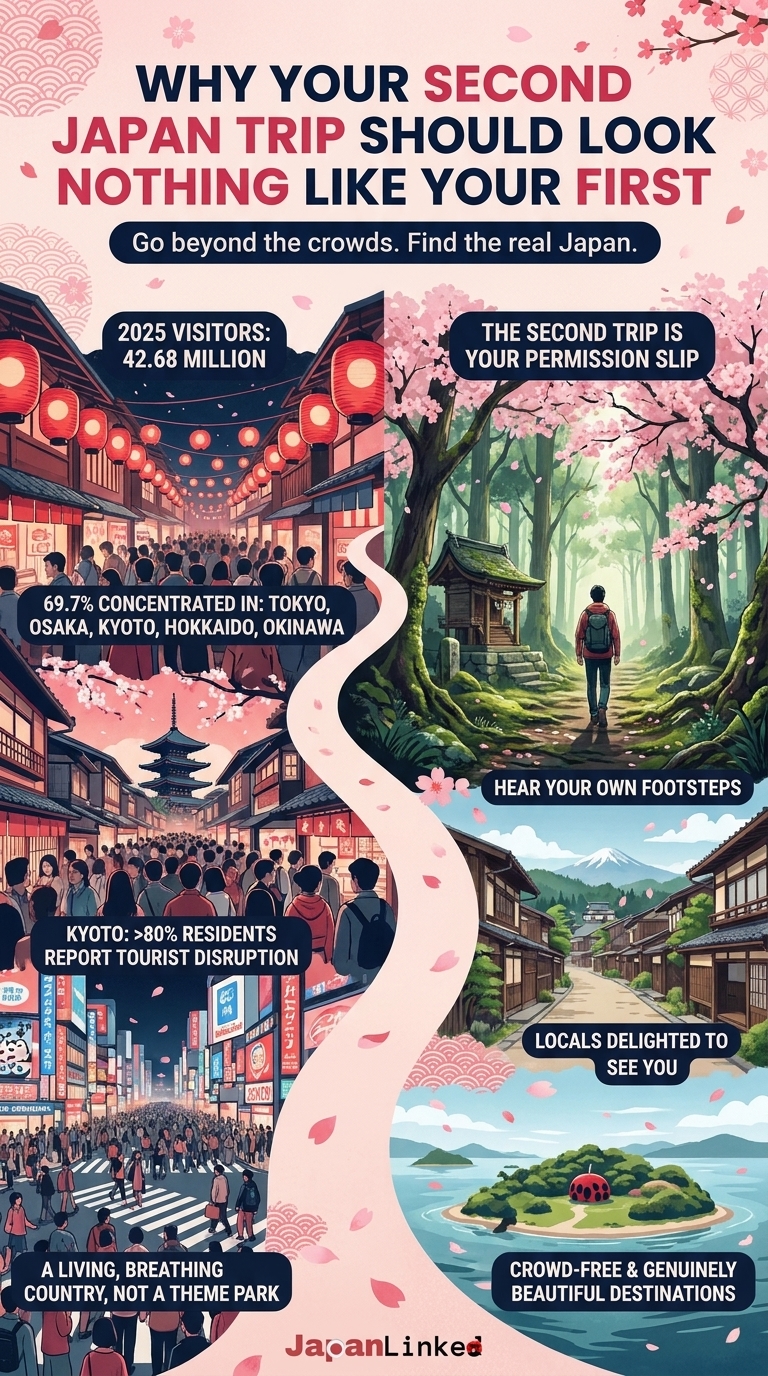
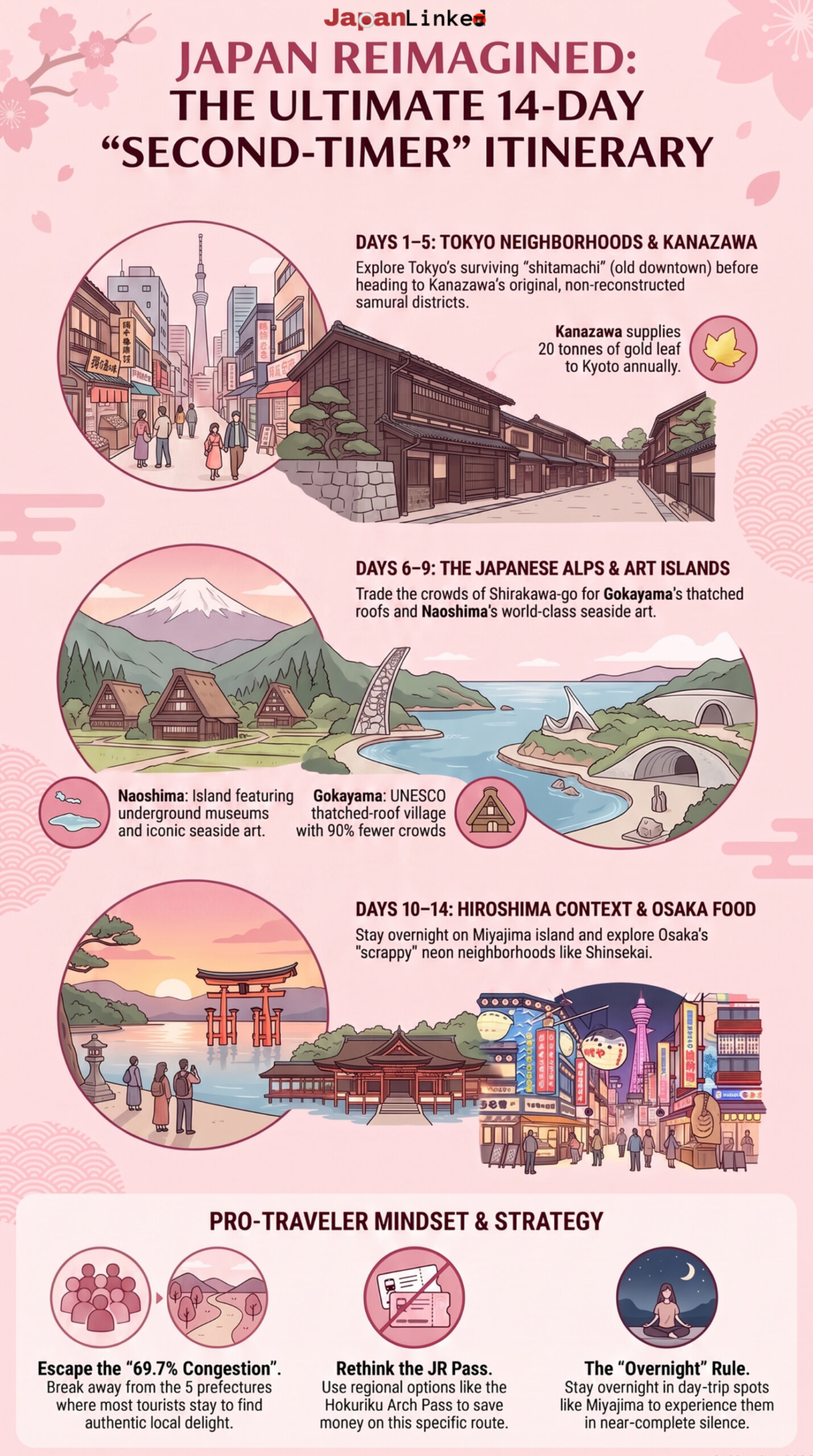
Here’s a number worth knowing: Japan welcomed a record 42.68 million foreign visitors in 2025, and a staggering 69.7% of them stayed in just five prefectures – Tokyo, Osaka, Kyoto, Hokkaido, and Okinawa.
A Kyoto University survey found that over 80% of Kyoto residents now report disruptions to their daily lives because of tourist congestion on public transport.
That’s not meant to make you feel guilty. It’s meant to set you free.
The second trip is your permission slip to go to the places where you can actually hear your own footsteps.
Where locals look surprised (and delighted) to see a foreigner – not exhausted by them. Where Japan feels less like a theme park and more like a living, breathing country that’s been there for centuries.
The destinations in this itinerary are all well-connected by train and bus, genuinely beautiful, and – for now – crowd-free.
Also Read: One Month In Japan Itinerary & 1 Week Japan Itinerary
The Mindset Shift: From Checklist Tourist to Slow Traveler
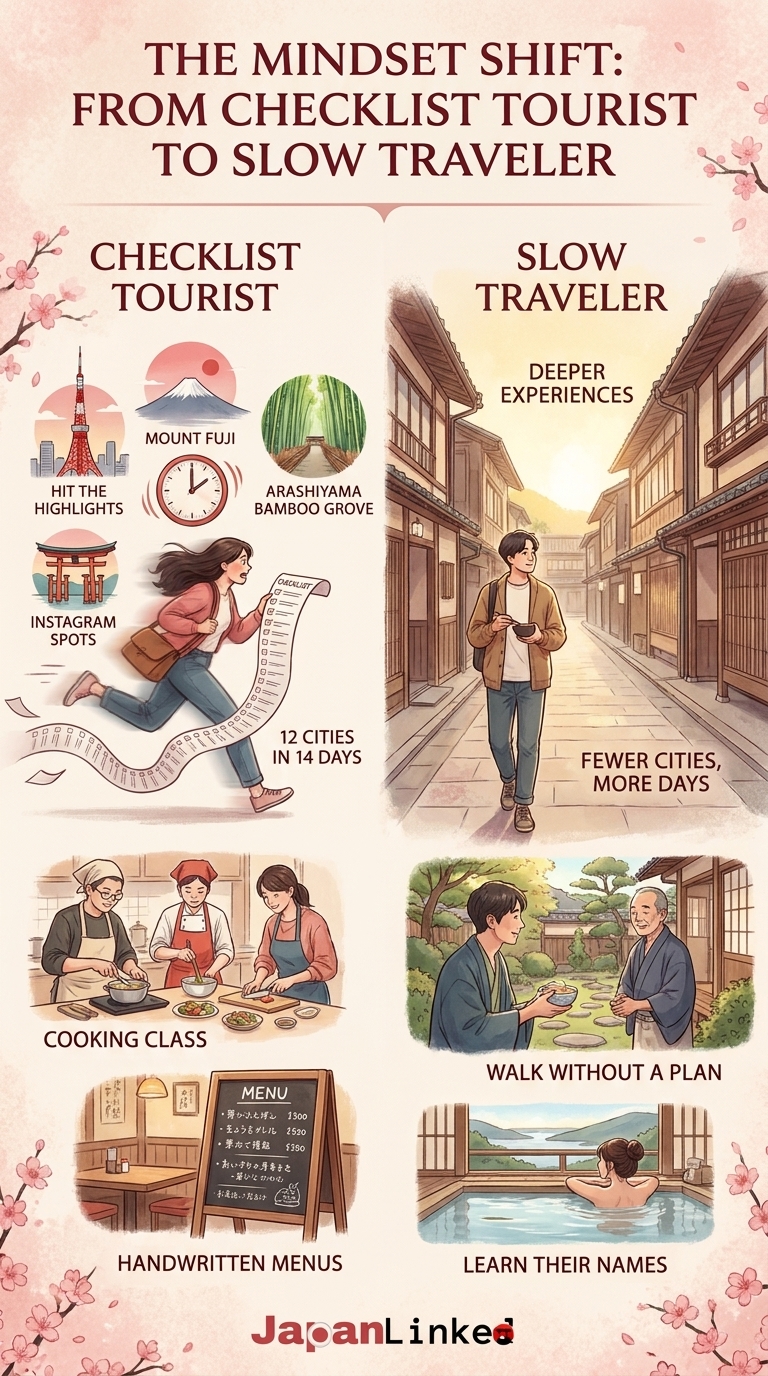
Your first Japan trip was probably driven by FOMO. Hit the highlights, fit in the famous spots, Instagram the bamboo grove.
Your second trip should be the opposite.
Fewer cities. More days. Deeper experiences.
Instead of moving every two nights and running between sights, consider locking into a town for three or four days.
Take a cooking class. Walk a neighborhood without a plan. Eat where there’s a handwritten menu board and not a single photo of the dish.
The travelers who come back from Japan raving the loudest are almost never the ones who hit 12 cities in 14 days. They’re the ones who spent three days in Kanazawa and learned the name of their ryokan owner.
Also Read: Luxury Japan Itinerary & Honeymoon In Japan Itinerary
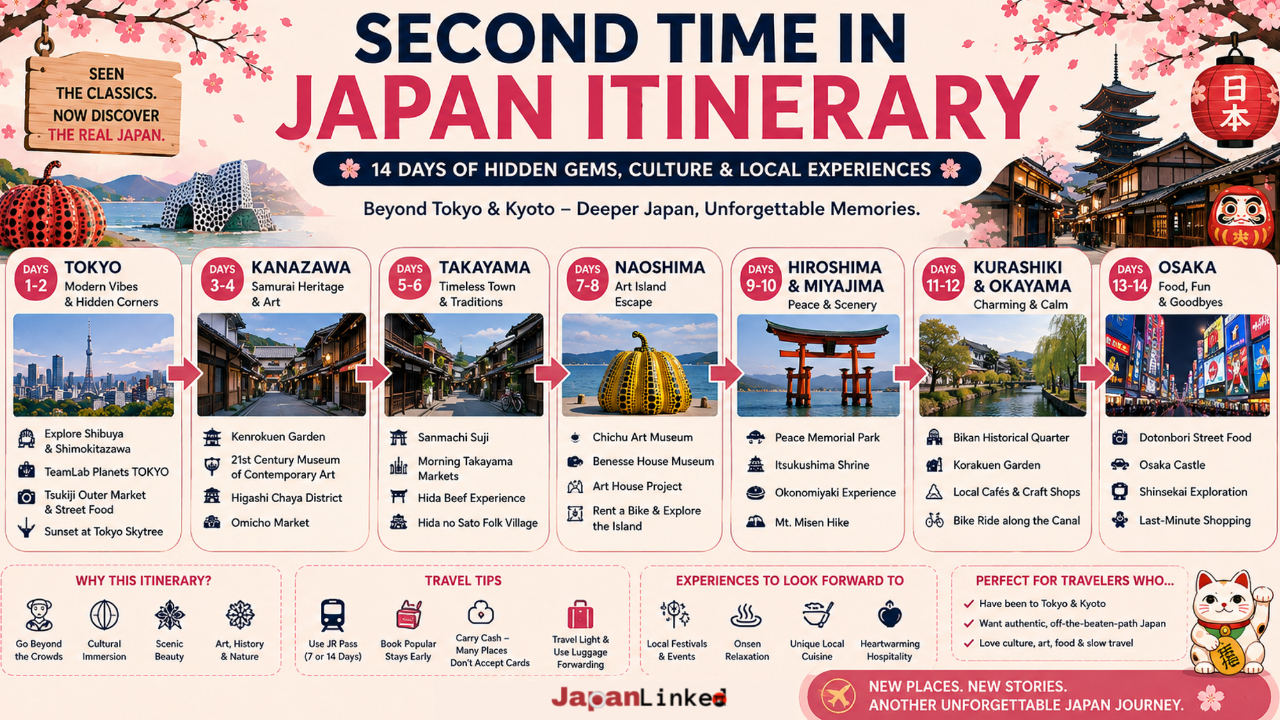
Your 14-Day Second Time in Japan Itinerary
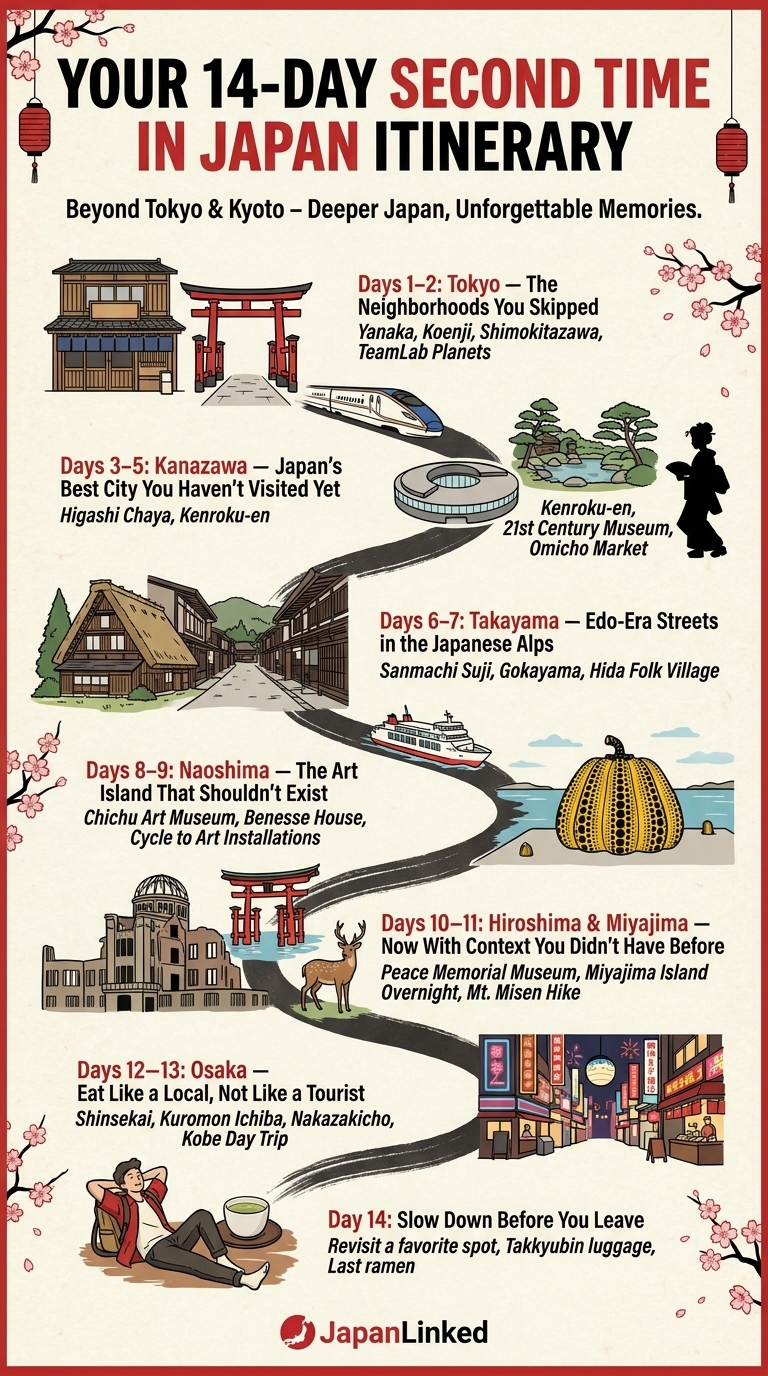
Here’s a suggested route that balances the highlights you might have missed the first time with genuinely off-the-beaten-path discoveries.
It’s designed as a loop from Tokyo, so you can fly in and out of the same airport without backtracking.
Days 1–2: Tokyo – The Neighborhoods You Skipped
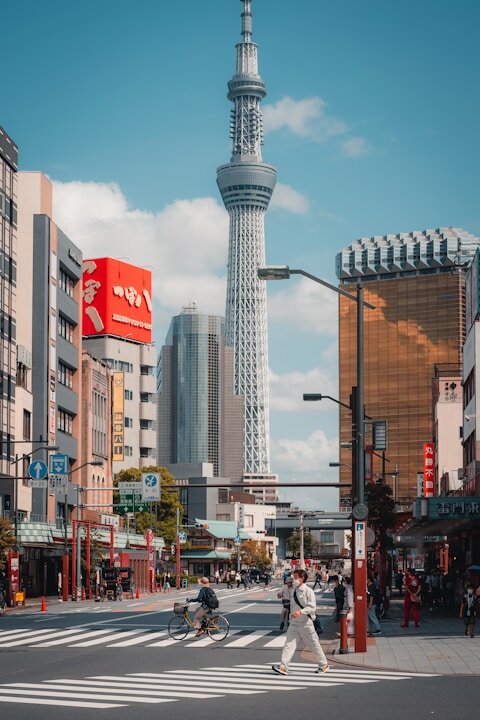
You’ve done Shibuya crossing and Senso-ji. This time, go where Tokyo actually lives.
Yanaka is one of Tokyo’s last surviving shitamachi (old downtown) neighborhoods. It survived the 1923 earthquake and the WWII bombing raids, which means its wooden shopfronts and winding alleys are the real thing – not a reconstruction.
Spend a morning wandering Yanaka Ginza, picking up handmade ceramics and grilled skewers, and you’ll feel like you’ve slipped 60 years back in time.
Koenji is Tokyo’s bohemian soul – vintage clothing shops, jazz cafés, live music venues, and a market scene that feels nothing like the tourist belt.
Shimokitazawa is its spiritual sibling: record stores, indie theatre, and the best second-hand bookshop browsing in the city.
For food this time around, skip the department store food halls and find a standing sushi bar in Tsukiji Outer Market or a standing yakitori joint under the train tracks in Yurakucho. These are where Tokyo actually eats.
Insider tip: TeamLab Planets in Toyosu is far more intimate than the larger TeamLab Borderless – if you haven’t done either, book Planets; it’s genuinely one of the most disorienting and beautiful experiences in the city.
Days 3–5: Kanazawa – Japan’s Best City You Haven’t Visited Yet
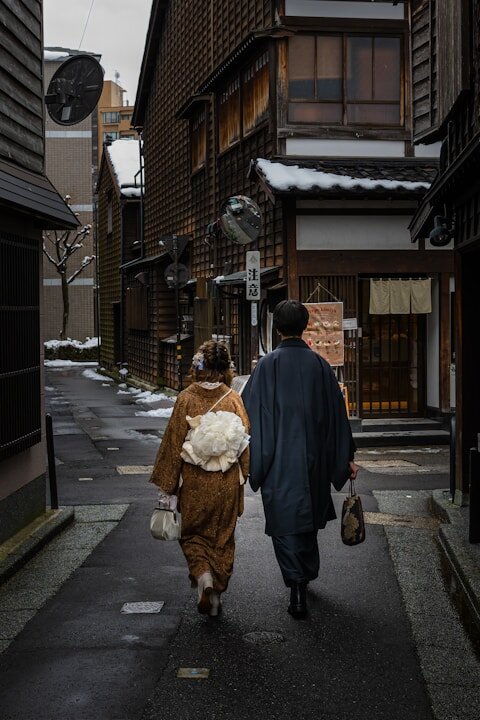
Three hours from Tokyo by Shinkansen, Kanazawa is the city that should be on every second-time visitor’s list.
It’s often called a “mini-Kyoto,” but that undersells it – Kanazawa survived World War II largely intact, which means its samurai and geisha districts are original structures, not postwar reconstructions.
Kenroku-en Garden is one of Japan’s officially designated “top three gardens,” and unlike Kyoto’s famous spots, you can often walk through it without a crowd pressing from behind.
The Higashi Chaya geisha district rivals Gion in atmosphere but with a fraction of the visitors – on a weekday morning you may have entire cobblestone streets to yourself.
The 21st Century Museum of Contemporary Art is a circular building with free outdoor sections and paid galleries – it’s world-class modern art in a building that’s itself a work of art.
Then head to the Omicho Market to eat fresh snow crab, white shrimp, and firefly squid – Kanazawa’s position on the Sea of Japan gives it some of the best seafood in the country.
A fascinating detail: Kanazawa supplies 20 tonnes of gold leaf annually to Kyoto’s famous Kinkaku-ji temple.
Order a gold leaf soft-serve ice cream just to say you ate something from the city that gilds Japan’s most famous building.
| What to Do | Why It’s Worth It |
|---|---|
| Higashi Chaya District | Geisha atmosphere, almost no crowds |
| Kenroku-en Garden | One of Japan’s top 3 gardens |
| 21st Century Museum | World-class art, striking circular building |
| Omicho Market | Best fresh seafood in central Japan |
| Nomura Samurai House | Genuine Edo-era interiors (~$5 entry) |
Where to stay: A ryokan in Kanazawa transforms the experience. Many offer dinner and breakfast, which is where you’ll try your first kaiseki meal if you haven’t already.
Days 6–7: Takayama – Edo-Era Streets in the Japanese Alps
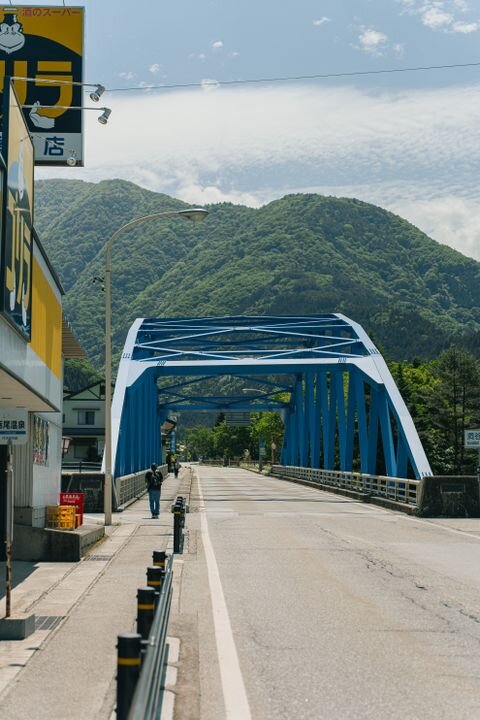
From Kanazawa, a scenic bus ride (about an hour) through mountain passes brings you to Takayama – a perfectly preserved Edo-period merchant town tucked into the Japanese Alps.
The Sanmachi Suji district is lined with sake breweries, craft shops, and machiya townhouses that have stood for 300 years.
Arrive early on a market morning (Jinya-mae Morningmarket or Miyagawa Morning Market) and you’ll be shopping alongside locals buying seasonal vegetables and pickles, not just tourists hunting for souvenirs.
Don’t just go to Shirakawa-go. Yes, the UNESCO thatched-roof village is stunning – but it’s no longer a secret.
The nearby hamlet of Gokayama offers the exact same architectural beauty (also UNESCO-listed) with perhaps a tenth of the visitors.
If you’re willing to arrange a local bus, you’ll have thatched farmhouses and rice paddies almost entirely to yourself.
In Takayama itself, the Hida Folk Village is an open-air museum of relocated traditional farmhouses from across the region – best visited on a misty morning when the atmosphere turns atmospheric and slightly eerie in the best possible way.
Practical note: Takayama is cash-heavy. Smaller ryokan, market stalls, and rural buses may not take cards. Hit an ATM (7-Eleven and Japan Post are the most reliable for foreign cards) before you arrive.
Days 8–9: Naoshima – The Art Island That Shouldn’t Exist
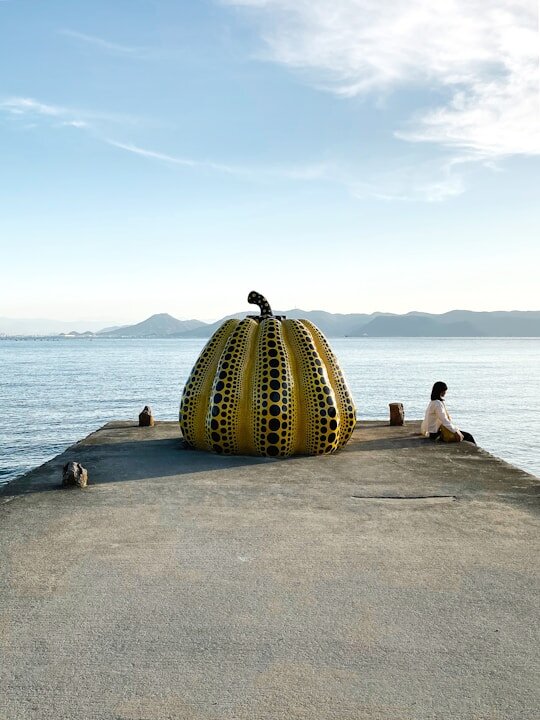
Naoshima is one of those places that makes you wonder how a 14km² island in the Seto Inland Sea became one of the world’s most significant contemporary art destinations.
The BBC named it the only Japanese location on its “25 Places to Travel” list – and yet, compared to Kyoto, it still feels like a secret.
The island is home to the Chichu Art Museum, built entirely underground by architect Tadao Ando to house a permanent collection that includes enormous Claude Monet water lily paintings, James Turrell light installations, and Walter De Maria sculptures.
The architecture alone is worth the trip. Benesse House is a museum-hotel hybrid where guests sleep surrounded by artworks.
Even if you don’t stay overnight, rent a bicycle (~$5/day) and spend a day cycling between art installations, including Yayoi Kusama’s iconic polka-dot pumpkins on the seafront. The island is small enough to cover by bike in a single day.
Getting here: Take the Shinkansen to Okayama or Takamatsu, then a 20–50 minute ferry. Budget a full day here minimum, or preferably an overnight at one of the island’s guesthouses.
Days 10–11: Hiroshima & Miyajima – Now With Context You Didn’t Have Before
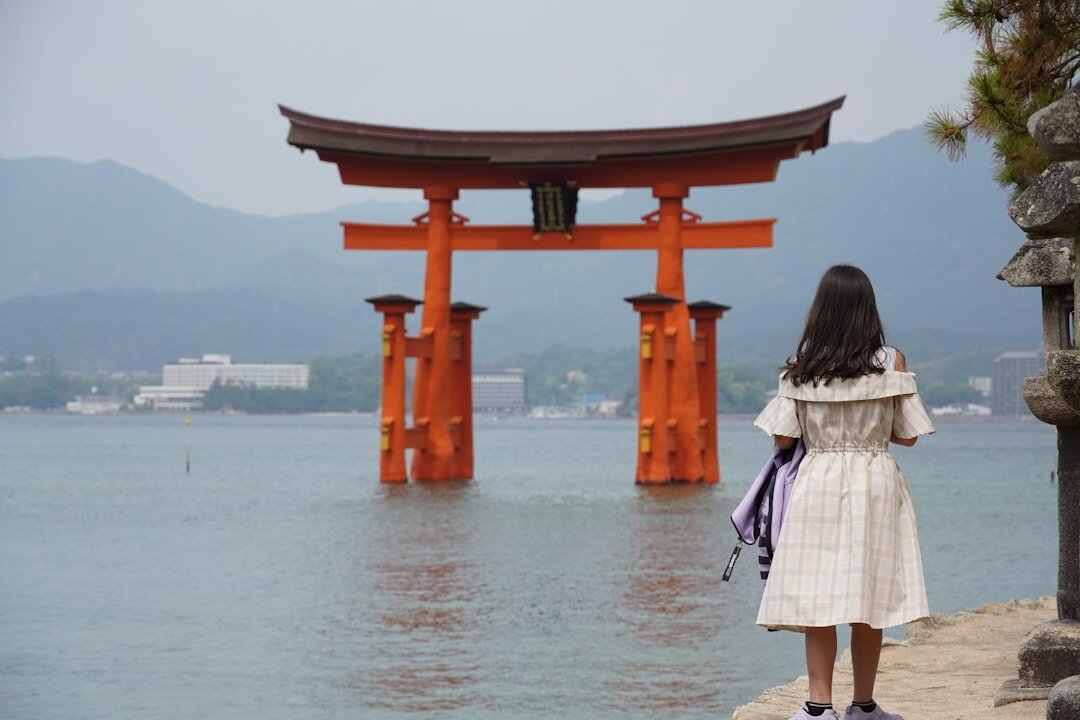
You may have visited Hiroshima on day trips before. Coming back with more Japan experience makes it land differently.
The Peace Memorial Museum is one of the most important museums in the world. Many first-time visitors rush it because they have somewhere to be.
Your second trip, allow four hours. Walk the park slowly. Read the plaques. Have lunch in the city center with locals who live here now.
Then head to Miyajima Island – but this time, stay overnight. The day-trip crowds thin dramatically after the last ferry, and spending the night means waking up to the famous floating torii gate of Itsukushima Shrine in near-complete silence. The deer that wander the island in daylight are even more surreal at dawn.
While on Miyajima, hike up Mount Misen rather than taking the ropeway. It’s a 90-minute climb through old-growth forest to a summit with views across the entire Inland Sea.
The route passes a flame that, according to legend, has burned continuously for over 1,200 years.
Days 12–13: Osaka – Eat Like a Local, Not Like a Tourist
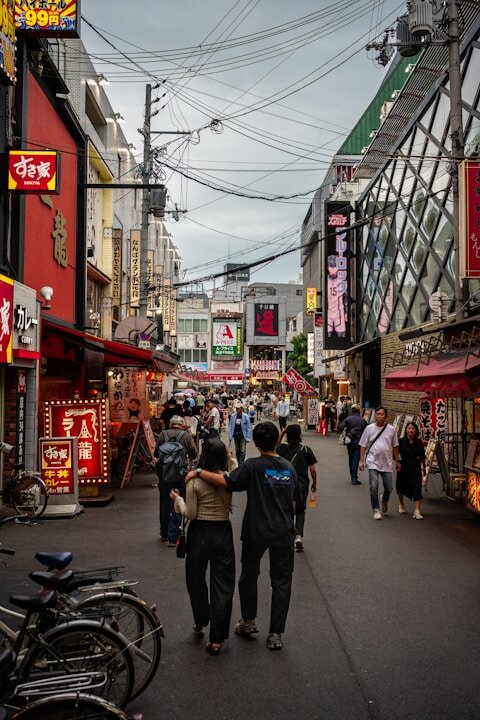
Osaka on your second visit can drop the big-ticket pressure entirely. You’ve done Dotonbori. Now go deeper.
Shinsekai is a pre-war entertainment district that somehow avoided gentrification – Osaka’s scrappy, neon-lit, slightly rough-around-the-edges neighborhood where kushikatsu (deep-fried skewers) was invented.
Nakazakicho is the city’s café-and-vintage neighborhood: narrow streets, independent coffee shops, record stores, and the sense that time moves slower here than anywhere else in the city.
For food, the Kuromon Ichiba Market is brilliant for grazing – grilled oysters, fresh tamagoyaki, and A5 wagyu skewers eaten standing at market stalls.
For a sit-down experience that’s worth the splurge, try a kaiseki dinner in Osaka’s Namba or Shinsaibashi neighborhoods. You won’t need to book months in advance the way you might in Kyoto.
Day trip option from Osaka: Take the train to Kobe and drink sake in Nada district, where you can tour working breweries and taste regional varieties you won’t find packaged at an airport. It’s 30 minutes from Osaka and almost entirely skipped by tourists.
Day 14: Slow Down Before You Leave
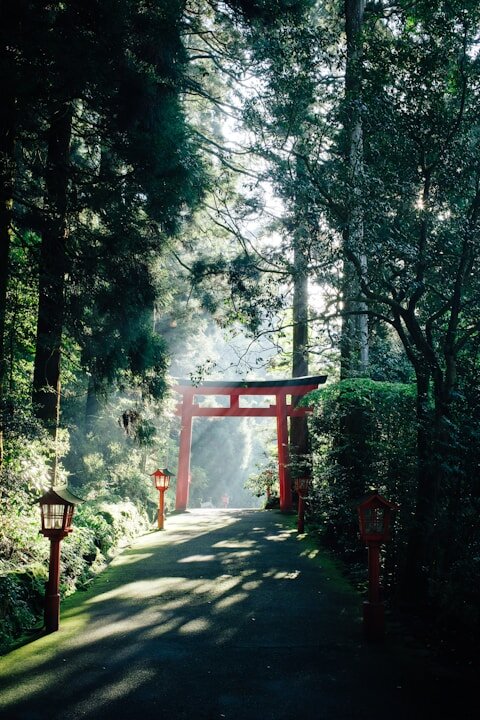
Don’t schedule a museum on your last day. Every experienced Japan traveler will tell you the same thing: build buffer into your final 24 hours.
Use the morning to revisit one street or neighborhood that stayed with you. Buy the gift you kept putting off. Eat one more bowl of ramen at the tiny counter where only three people fit.
Ship your heaviest luggage ahead to the airport using takkyubin (Japan’s door-to-door luggage delivery service, available from most convenience stores) so you can wander the city hands-free until departure.
Also Read: 2 Week Japan Itinerary & 3 Week Japan Itinerary
Essential Tips for Your Second Trip to Japan
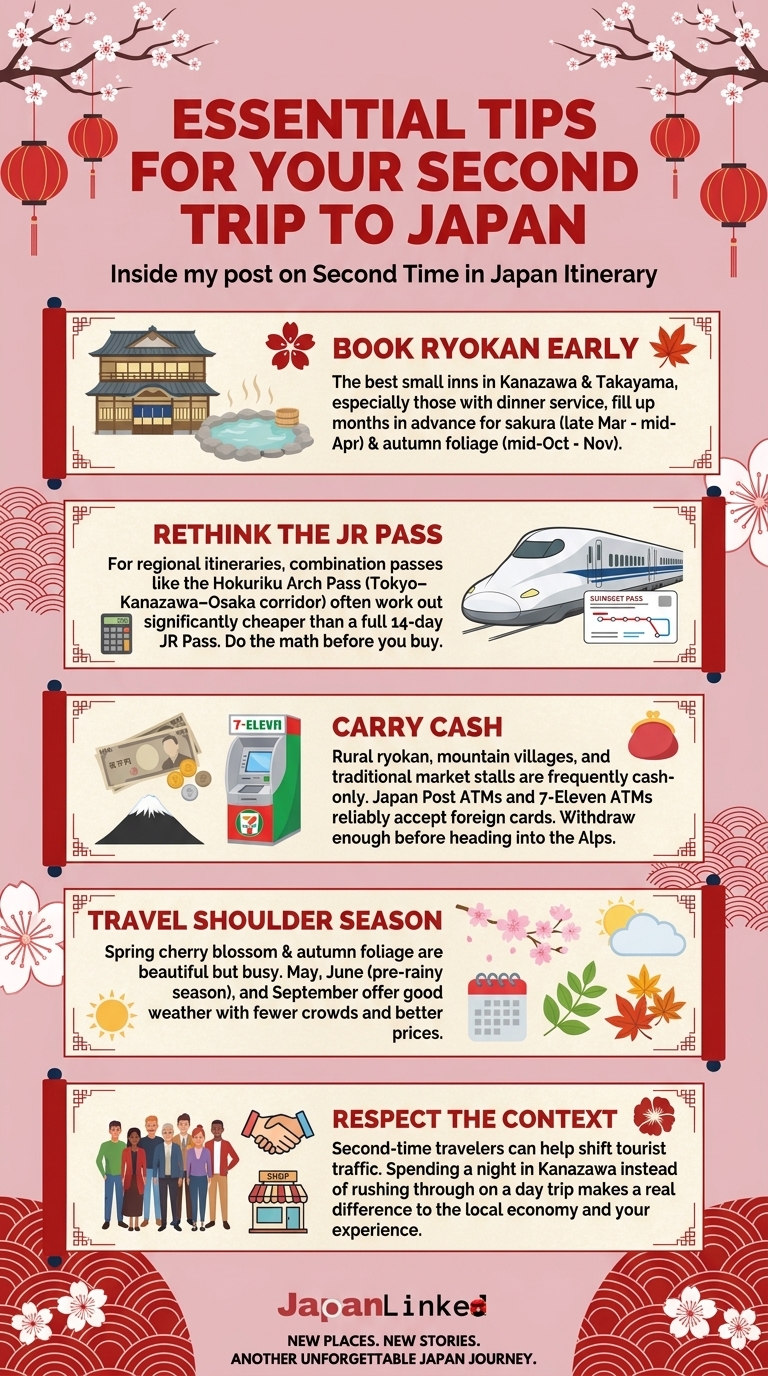
Book ryokan early. The best small inns in Kanazawa and Takayama – especially those with dinner service – fill up months in advance, particularly during sakura season (late March to mid-April) and autumn foliage (mid-October to November).
Rethink the JR Pass. For this kind of regional itinerary, combination passes like the Hokuriku Arch Pass (covering the Tokyo–Kanazawa–Osaka corridor) often work out significantly cheaper than a full 14-day JR Pass. Do the math before you buy.
Carry cash. Rural ryokan, mountain villages, and traditional market stalls are frequently cash-only. Japan Post ATMs and 7-Eleven ATMs reliably accept foreign cards. Withdraw enough before heading into the Alps.
Travel shoulder season. Spring cherry blossom and autumn foliage seasons are Japan’s most beautiful – but also its busiest. May, June (pre-rainy season), and September are when you get good weather with far fewer crowds and better accommodation prices.
Respect the context. With overtourism now affecting over 30% of visitors’ experiences in crowded areas, second-time travelers have a genuine opportunity to help shift tourist traffic to regions that welcome it. Spending a night in Kanazawa instead of rushing through on a day trip makes a real difference – to the local economy and to your experience.
The Second Trip Rule Nobody Tells You
First-time Japan visitors collect sights. Second-time visitors collect feelings.
The moment that sticks from a second trip is never the famous temple – it’s the five-minute conversation with the sake brewer who poured you a cup before the shop officially opened.
It’s finding a ramen shop down a Kanazawa alley with no English menu and pointing at what the salary worker beside you ordered.
It’s standing in front of a Monet in an underground museum on a tiny art island and genuinely forgetting where you are.
None of that is on a must-see list. All of it is available to anyone willing to slow down, step off the Golden Route, and trust that the best Japan is the one that surprises you.
Book the ryokan. Take the mountain bus. Go to Kanazawa.
